



Questions to Ask Before Starting a Residential Roof Claim
A Step-by-Step Guide for North Texas Homeowners
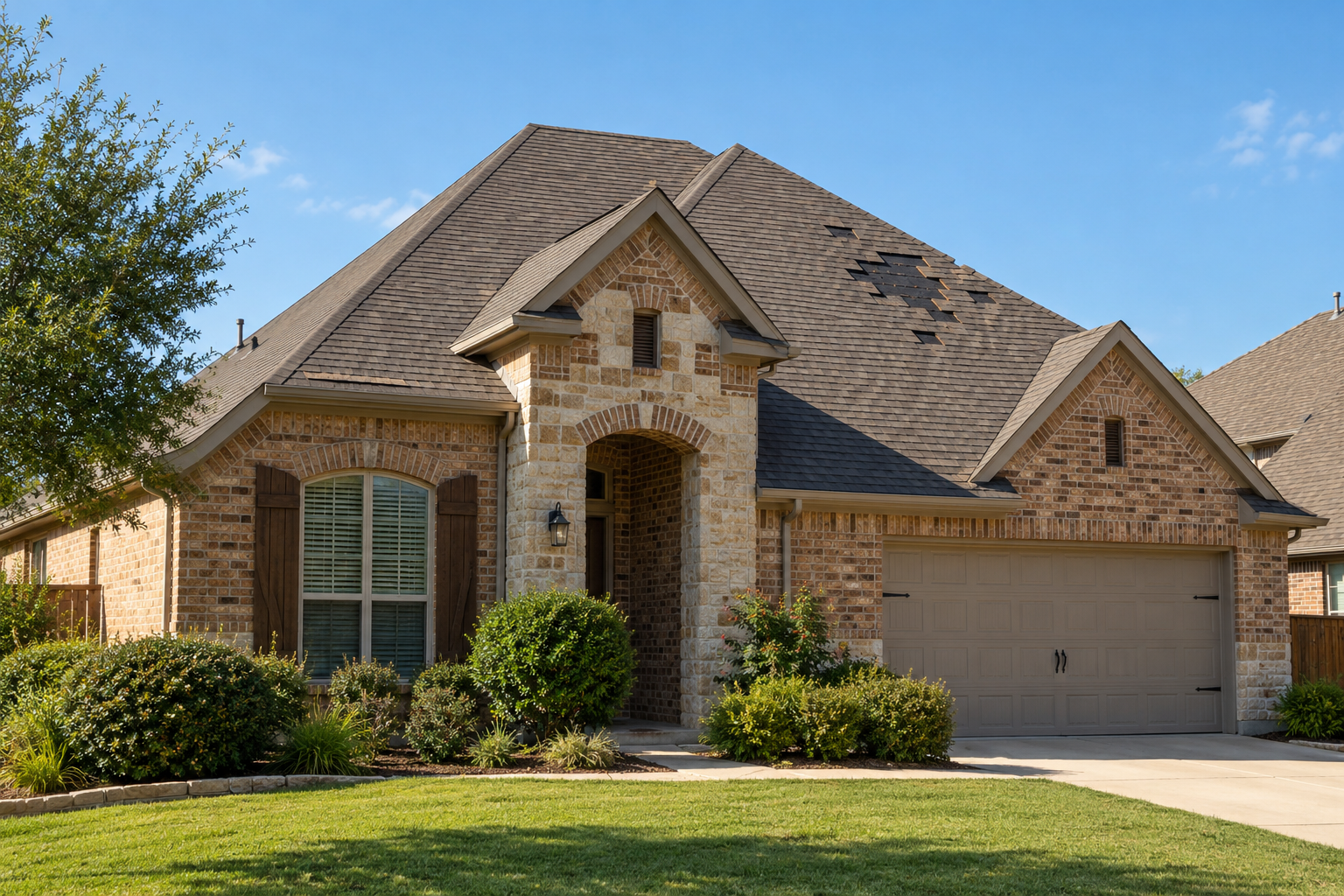
A severe Texas storm can leave a homeowner facing two urgent questions: Is the roof damaged, and should I start an insurance claim? The answers are not always obvious. Missing shingles, a fallen limb, punctured flashing, or water entering the house require immediate attention. Other conditions—hail marks, creased shingles, loosened seals, bruised materials, displaced vents, or damage beneath the surface—may be difficult to see from the ground.
Starting a residential roof claim without first understanding the policy, deductible, physical condition, and documentation can create confusion. Waiting too long to protect the home or report a potential covered loss can also create problems. The goal is not to assume that every storm requires a claim or that every damaged roof must be replaced. The goal is to make a safe, informed decision using the issued policy and reliable evidence.
Before filing, homeowners should ask their insurance company or licensed agent about coverage and claim requirements, and ask a qualified roofer about the roof's physical condition and appropriate repair options. Those are separate roles. A contractor can inspect the roof, document visible conditions, perform emergency protection, and prepare a repair or replacement scope. The insurance company determines whether a loss is covered and what it will pay under the policy.
This guide provides the questions Texas homeowners should ask before opening a residential roof claim, the records they should collect, and the practical steps that can protect the house without damaging evidence.
Important disclaimer: This article provides general educational information, not insurance, legal, engineering, or adjusting advice. Every policy and loss is different. Policy language controls, and the insurance carrier determines coverage, valuation, depreciation, deductibles, and payment. Showtime Exteriors documents physical roof conditions and proposes or performs roofing work; it does not act as a public adjuster, interpret coverage for the carrier, waive deductibles, or promise claim approval, payment, renewal, or premium results.
Quick Answer: What Should You Ask Before Filing?
Before starting a residential roof claim, ask:
What happened, and when did it happen?
Is the home safe, and does it need immediate temporary protection?
What does my policy say about the reported cause of loss?
What deductible applies to wind, hail, or another event?
Is my roof settled at replacement cost value or actual cash value?
Are there roof schedules, cosmetic-damage exclusions, or age limitations?
What notice deadlines and documentation duties apply?
What does a professional roof inspection show?
Is the observed condition localized, widespread, storm-related, or pre-existing?
What evidence should be preserved before cleanup or repair?
Can the roof be repaired, or does its condition support replacement evaluation?
Who is authorized to discuss coverage or negotiate the claim?
What will I owe out of pocket?
How will emergency work, permits, code items, and supplements be handled?
What records should I keep after the work is complete?
These questions do not guarantee a favorable decision. They help the homeowner understand the facts before taking a consequential step.
Question 1: What Exactly Happened?
Start with a factual event timeline. Record the date and approximate time of the hailstorm, windstorm, tornado, fallen tree, fire, or other event. Note when damage was first observed, who saw it, which rooms were affected, and whether utilities, trees, windows, siding, fences, vehicles, or neighboring properties also showed damage.
Avoid guessing. If the exact storm time is unknown, say that water was first observed at a specific time and preserve local alerts, photographs, messages, or security-camera records. Weather reports can support context, but weather near the property does not by itself prove that every mark on the roof resulted from that event.
Ask whether there was a sudden occurrence or a gradual problem. Home policies often treat sudden accidental damage differently from wear, deterioration, defective maintenance, or long-term seepage. A roofer should objectively describe the condition rather than labeling it covered or excluded.
Question 2: Is Anyone in Danger?
Protect people before property. Leave rooms with sagging ceilings, active electrical hazards, suspected structural movement, broken glass, fire damage, unstable trees, or significant water near electrical equipment. Call emergency services, the utility, or an appropriate specialist when necessary.
Do not climb onto a wet, steep, storm-damaged, or structurally questionable roof. Residential roofs can be slippery even when they appear dry, and wind-damaged shingles or decking may not support normal movement. Ground-level photographs, attic observations from safe access, and a qualified inspection are better than an unsafe attempt to gather evidence.
If water is entering, ask what immediate action can safely reduce further damage. Temporary protection may include tarping, securing an opening, extracting water, moving contents, or creating an interior catch system. Temporary work should be documented and followed by a permanent correction.
Question 3: Should I Call the Insurer Before a Roofer—or a Roofer Before the Insurer?
There is no universal order for every situation. If the home has major damage, an active emergency, or an obvious covered event, prompt notice to the insurer may be important. If the condition is uncertain and there is no emergency, a professional roof inspection can help establish whether physical damage exists before the homeowner decides how to proceed.
The homeowner should review policy duties and avoid missing a reporting deadline merely to wait for an inspection. At the same time, a roofing contractor should not pressure someone to file a claim when the facts are unclear. Ask the insurer about reporting requirements and ask the roofer for a written condition assessment.
The most reliable approach is coordinated but role-specific: the insurer explains its claim process and applies the policy; the roofer evaluates and documents the roof.
Question 4: What Does My Policy Actually Cover?
Request the complete policy effective on the event date, including declarations, forms, schedules, and endorsements. A declarations page alone may not reveal roof limitations or exclusions.
Ask a licensed insurance professional:
Is wind covered at this location?
Is hail covered?
Does a separate wind or hail deductible apply?
Is the roof covered at replacement cost value or actual cash value?
Is there a roof payment schedule based on age or material?
Is cosmetic damage excluded or limited?
Are metal surfaces, gutters, vents, or soft metals treated differently?
Is interior rain damage covered only when the storm first creates an opening?
Are code upgrades or ordinance-and-law costs covered?
Does matching coverage apply when identical materials are unavailable?
Are fences, detached structures, solar equipment, or personal property subject to different terms?
What exclusions apply to wear, deterioration, faulty installation, maintenance, or repeated seepage?
Do not accept a general statement such as “you have full coverage” without identifying the applicable terms. Coverage depends on the issued contract and facts of the loss.
Question 5: What Deductible Will I Pay?
A deductible is the policyholder's responsibility. Texas policies may use a stated dollar deductible or a percentage deductible, and wind or hail may have a different deductible from other causes of loss.
If the deductible is a percentage, ask what amount the percentage applies to. For illustration only, a two-percent deductible applied to a $400,000 dwelling limit would be $8,000. The actual calculation depends on the policy. A homeowner should understand that number before authorizing work or assuming a claim will fund the project.
It is illegal in Texas for a contractor to waive, absorb, rebate, or help a homeowner avoid paying a required property insurance deductible. Ask for a written contract, pay the deductible as required, and retain proof of payment. An offer to “cover” the deductible is a warning sign, not a discount.
Question 6: Is My Roof ACV or RCV?
Replacement cost value, commonly called RCV, generally refers to the cost of repairing or replacing covered property at current prices, subject to policy terms. Actual cash value, or ACV, generally reflects replacement cost minus depreciation. Some policies treat the dwelling one way and the roof another way.
Under an RCV claim, the carrier may issue an initial payment reflecting depreciation and later release eligible recoverable depreciation after required work and documentation are completed. Under an ACV roof provision, depreciation may not be recoverable unless the policy says otherwise.
Ask:
Which form or endorsement establishes the valuation?
How is the roof's age determined?
How is depreciation calculated?
Is depreciation recoverable?
What completion deadline applies?
What invoices, photographs, contracts, or inspections are required to request any remaining amount?
Illustrative example: If accepted covered replacement work is $25,000, depreciation is $7,000, and the deductible is $4,000, an initial figure could be $14,000. The actual payment may change because of limits, exclusions, taxes, line items, prior payments, or policy language. A roofing contractor cannot predict or guarantee the insurer's calculation.
Question 7: Is There a Roof-Age Schedule or Special Endorsement?
Older roofs may be subject to ACV treatment, scheduled percentages, reduced wind or hail payment, or other limitations. Ask the agent or carrier to identify every roof-specific endorsement and explain where it appears in the policy.
Confirm that the insurer's roof-age record is accurate. Preserve installation invoices, permits, warranties, dated photographs, closing documents, and prior inspection reports. If part of the roof was replaced at a different time, document each section.
Age alone does not prove storm damage or lack of damage. It may, however, affect valuation, repairability, and underwriting. A brittle or deteriorated shingle can be difficult to manipulate for a localized repair without affecting neighboring material. The inspector should document that condition rather than assume an insurance outcome.
Question 8: What Is the Condition of the Roof Before the Claim?
Pre-loss evidence helps distinguish recent conditions from prior wear, maintenance, or repairs. Look for:
home inspection reports from purchase;
prior roofing inspections;
installation contract and warranty;
dated photographs or real-estate listing images;
maintenance and repair invoices;
records of earlier leaks or claims;
permits and completion certificates;
solar, satellite, chimney, HVAC, or tree-work records; and
photographs taken before the reported storm.
Be accurate about prior issues. A previous repair does not automatically defeat a later claim, but concealing known damage can undermine the record. Provide factual dates, locations, and documents.
Question 9: What Does the Roof Inspection Need to Show?
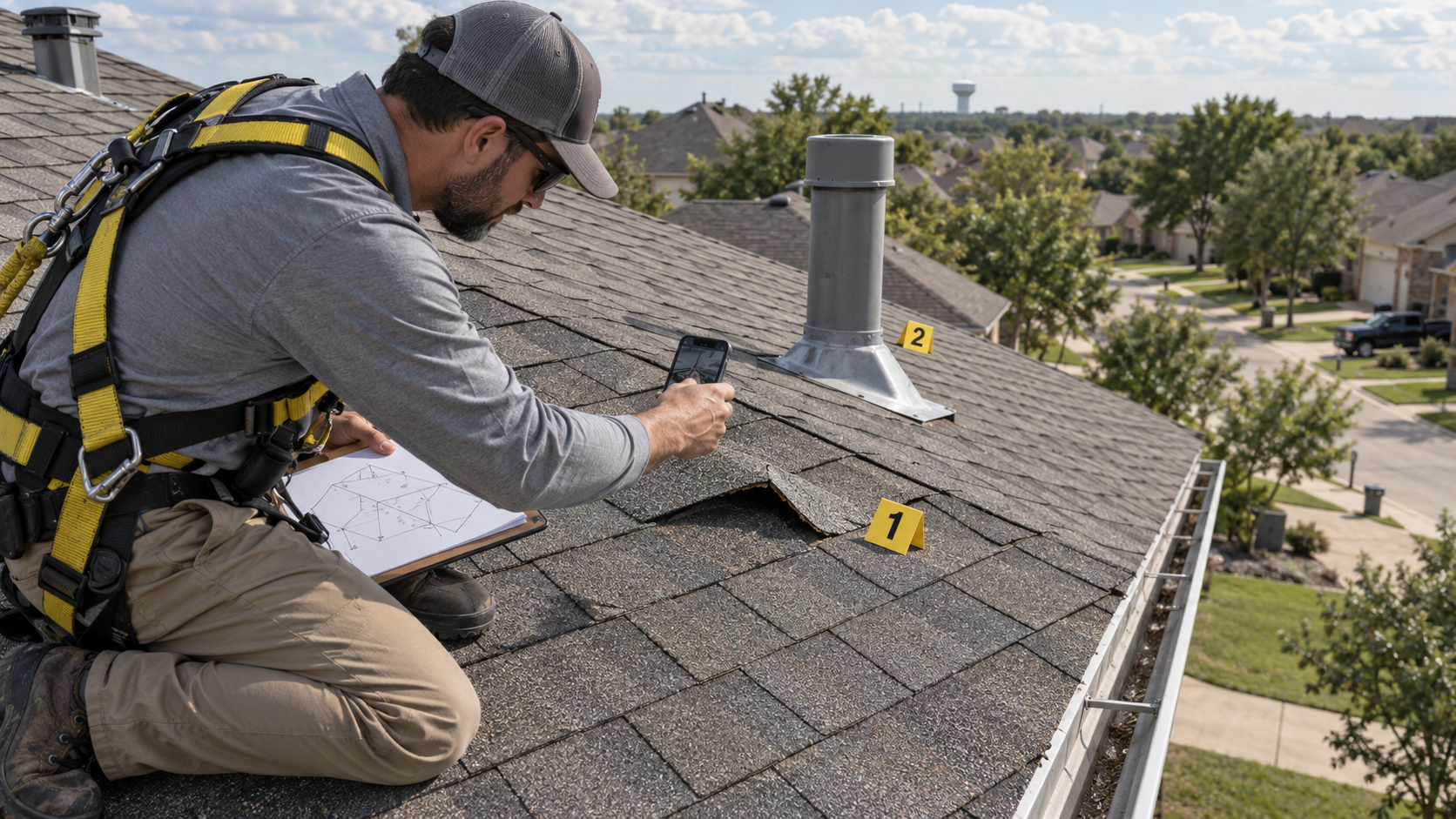
A useful residential roof report should identify the property, inspection date, weather, roof covering, approximate age when known, slope, elevations, penetrations, flashing, valleys, ridges, gutters, ventilation, visible decking concerns, and access limitations.
Photographs should include overview, middle-distance, and close views. Each condition should be tied to a slope or location. The report should distinguish observed facts from opinions and clearly state when testing or concealed-component review was not performed.
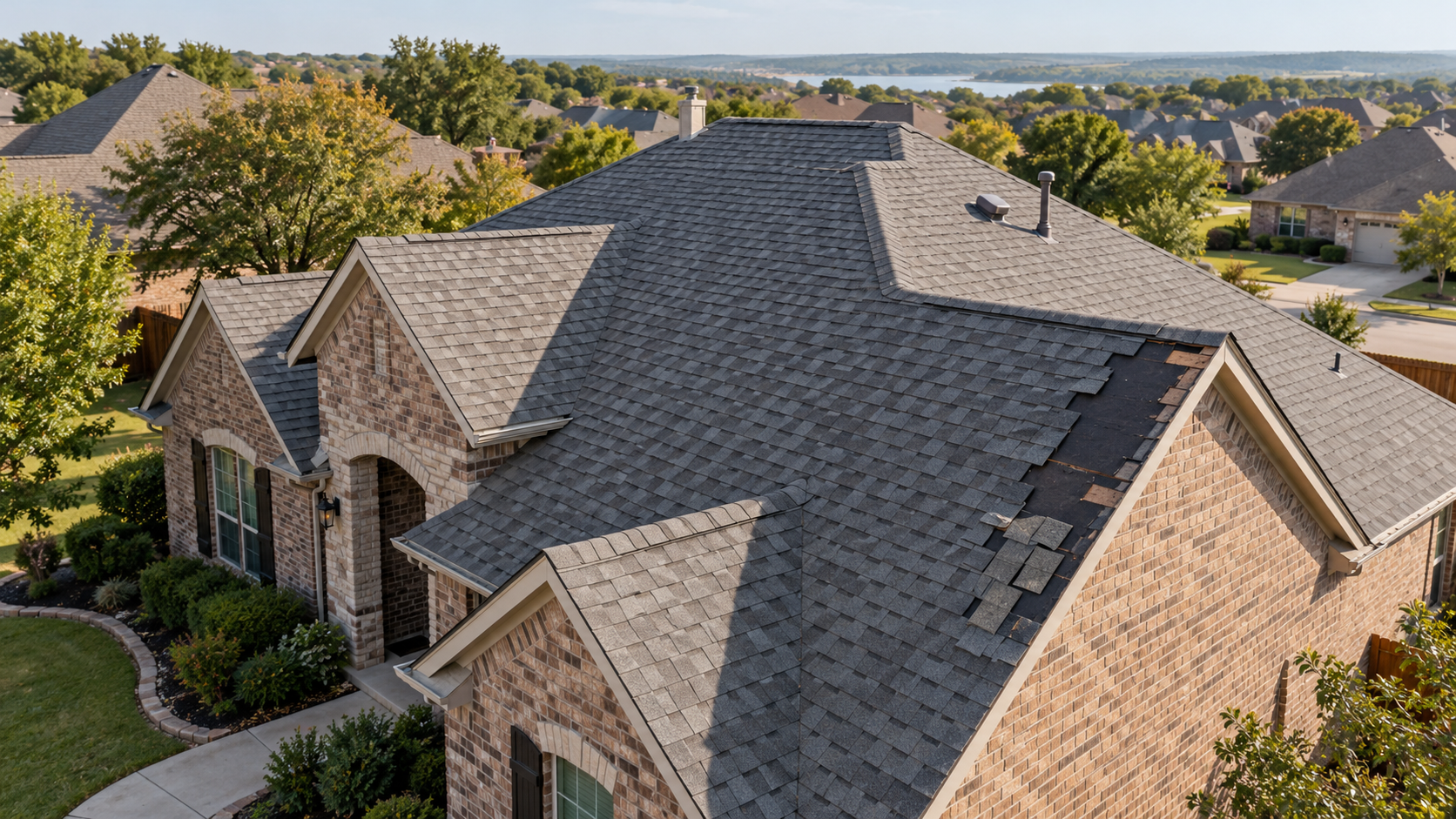
For asphalt shingles, the inspector may document missing or displaced shingles, creases, tears, exposed fasteners, seal condition, impact-related observations, granule distribution, prior repairs, flashing movement, and soft-metal conditions. For metal, tile, synthetic, or wood systems, the relevant distress indicators differ.
The report should not declare that the insurance company “owes a roof.” It should explain the physical condition and recommend repair, further evaluation, or replacement based on construction factors.
Question 10: How Should Damage Be Photographed?
Start outside at ground level when safe. Photograph every elevation, roof plane, gutters, downspouts, vents, fences, windows, siding, air-conditioning equipment, debris, and fallen limbs. Collateral conditions can help establish context.
Inside, photograph stains, dripping water, wet insulation, damaged ceilings, flooring, walls, furniture, and personal property. Use wide views to identify the room, medium views to show the affected area, and close views to show detail. Do not discard damaged material before asking the insurer when practical.
Preserve original image files rather than only screenshots or compressed social-media copies. Record the date, photographer, location, and what each photograph shows. A folder of unlabeled close-ups is much less useful than a mapped, chronological record.
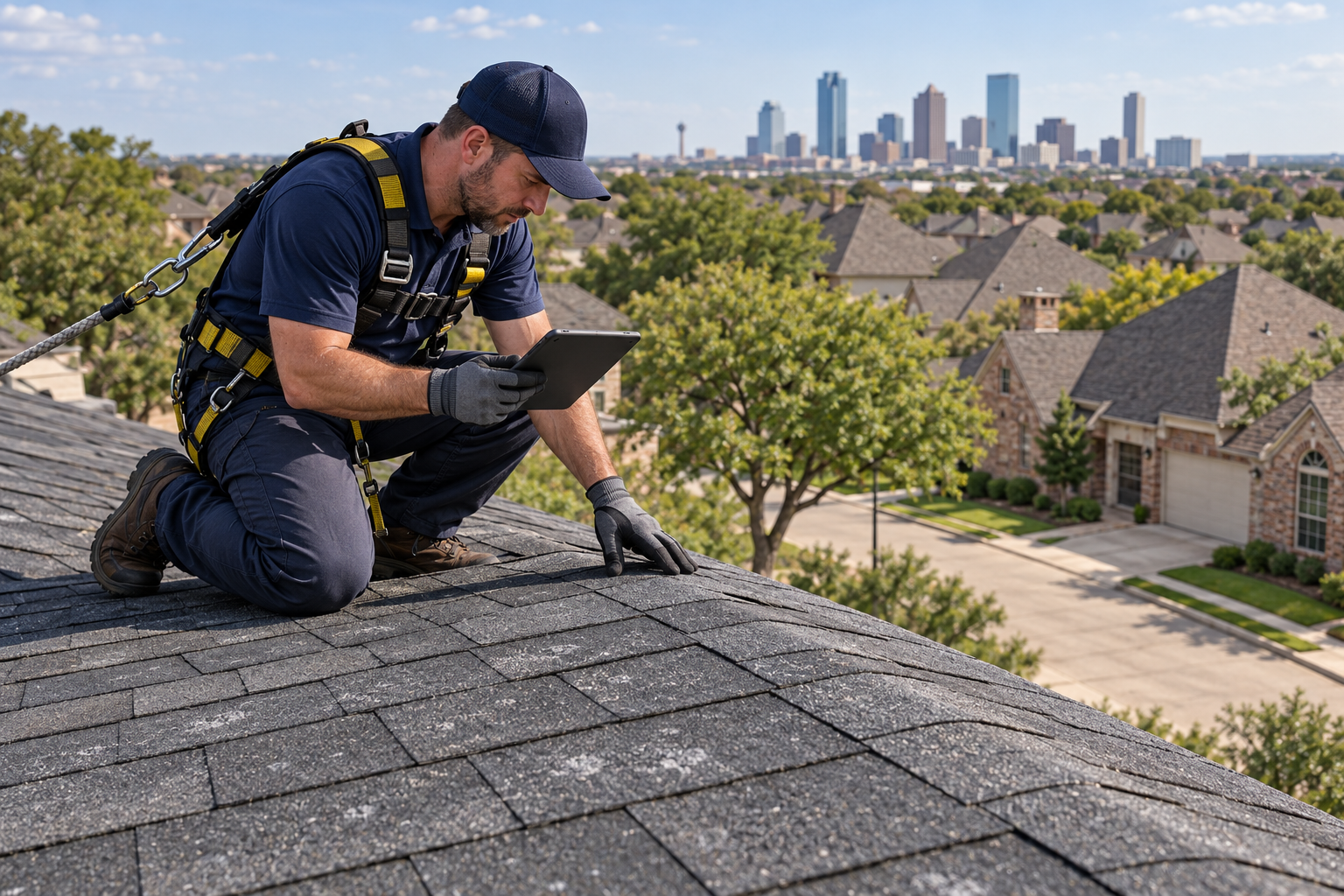
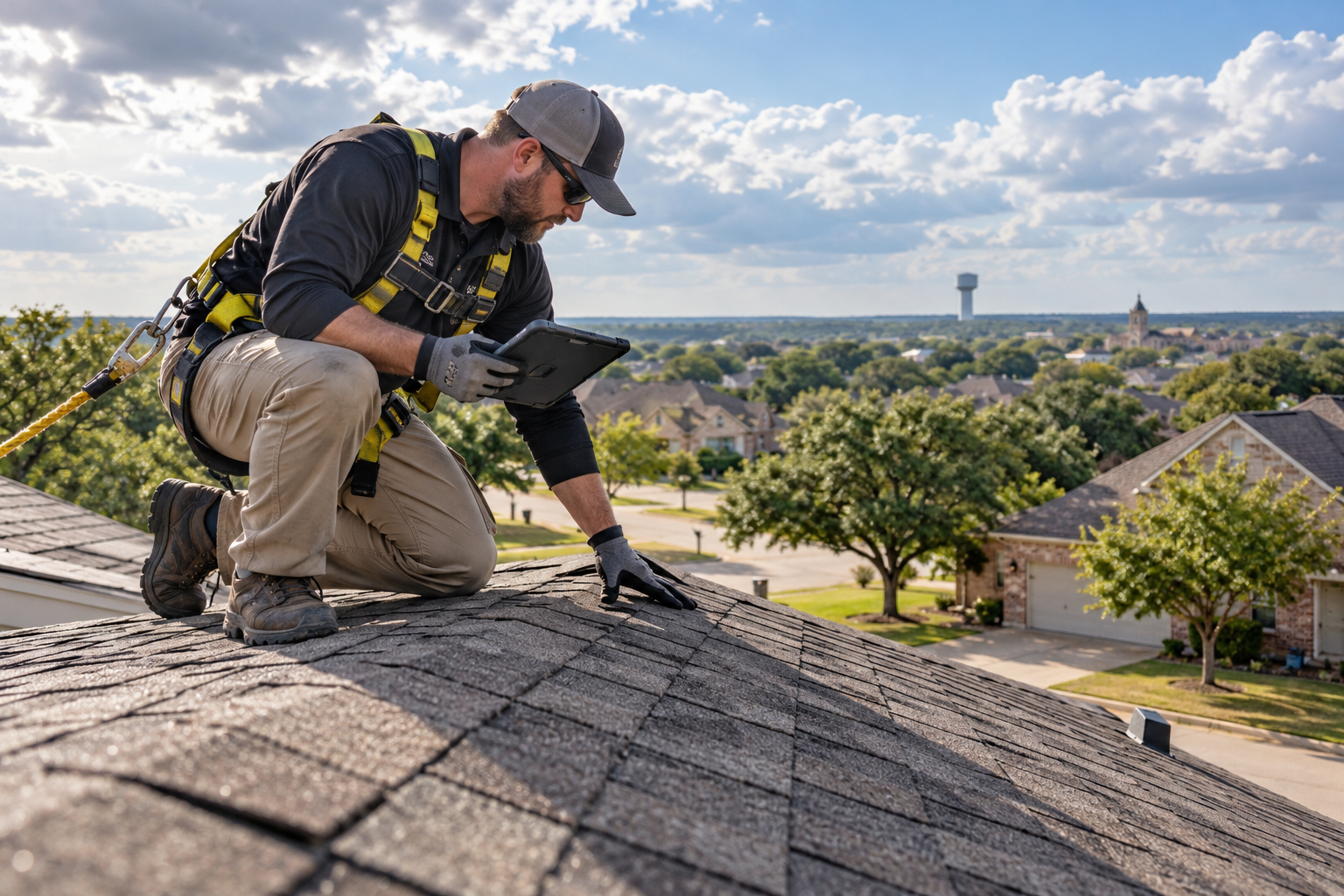
{width=6.6in}Image alt text: Residential roofing inspector using fall protection to document storm-related shingle conditions in North Texas.
Question 11: What Temporary Repairs Are Necessary?
Most policies require reasonable steps to protect property from additional damage, but exact duties vary. Ask the carrier what it expects and how emergency expenses should be submitted.
When safe, document the condition before temporary work. Then record the materials, labor, location, installer, date, and after-condition. Save receipts for tarps, water extraction, temporary boarding, dehumidification, and emergency service.
Temporary patches should remain temporary. A tarp can loosen, trap moisture, direct water elsewhere, or conceal a developing problem. Schedule follow-up and a permanent plan. Do not delay urgently needed mitigation simply to wait for ideal photographs.
Question 12: Repair or Replacement?
A storm-damaged residential roof does not automatically require replacement. A durable repair may be appropriate when damage is isolated, surrounding materials are serviceable, compatible products are available, the roof can be manipulated without causing additional damage, and the repair can meet code and manufacturer requirements.
Replacement evaluation becomes more reasonable when damage is widespread, many slopes are affected, decking is compromised, materials are brittle or unavailable, prior repairs are extensive, water has spread through the assembly, or a compliant and warrantable repair cannot be integrated.
Ask the contractor to explain:
the exact damaged areas;
whether damage is functional or cosmetic;
the condition of surrounding materials;
whether matching material is available;
what must be removed to perform the work;
whether decking or flashing is concealed;
code and ventilation considerations;
repair and replacement alternatives;
limitations of each alternative; and
warranty implications.
The carrier determines what covered scope it accepts. The contractor determines what work it is willing and qualified to perform under a construction agreement.
Question 13: Does the Estimate Describe the Complete Roofing Scope?
A roofing estimate should be more than one total price. Depending on the project, it may address tear-off, disposal, underlayment, ice-and-water or self-adhered membrane where appropriate, starter, field shingles, ridge material, valleys, flashing, vents, pipe boots, edge metal, decking allowances, ventilation, permits, protection, cleanup, magnet sweep, and warranties.
Ask which items are included, excluded, or priced as allowances. Ask how unknown decking will be handled after tear-off. Confirm product line, color-selection process, installation method, start conditions, payment schedule, change-order procedure, and responsibility for moving or protecting property.
The insurer's estimate and contractor's estimate may differ because they serve different purposes. Compare quantities, measurements, materials, and scope line by line instead of assuming that one total should automatically match the other.
Question 14: What Happens During the Insurance Inspection?
Ask when the adjuster or inspector will visit, who should attend, what areas require access, and whether the carrier wants temporary materials or damaged samples preserved. Make pets secure, provide safe attic or interior access, and have records ready.
Keep a list of attendees and take notes about inspected locations and requested documents. The roofer may attend to identify construction details and observed roof conditions, but should not present itself as the homeowner's public adjuster or negotiate coverage if not licensed for that role.
Afterward, request the carrier's written estimate, coverage explanation, depreciation, deductible, and any additional information request. Read the correspondence and calendar deadlines.
Question 15: Who Can Negotiate the Claim?
In Texas, roofing and insurance-adjusting roles are distinct. A roofing contractor can estimate and perform construction work. It should not advertise or act as a public adjuster on a claim for which it may provide roofing services.
The insurer's adjuster represents the carrier in evaluating the claim. A licensed public adjuster may represent a policyholder for a fee, subject to Texas law. An attorney can advise on legal rights and disputes. Before hiring anyone, verify licensing, read the agreement, understand fees, and check for conflicts.
Showtime Exteriors' proper role is to inspect the roof, document physical conditions, explain roofing options, provide a construction scope, and complete authorized work. It cannot promise that a claim will be approved or paid.
Question 16: Are There Deadlines?
Policies and communications may impose deadlines for notice, proof of loss, document submission, repairs, recoverable depreciation, appraisal, suit, or other action. Ask the insurer or a qualified legal professional which dates apply to the specific claim.
Do not assume that a general internet timeline controls. Preserve the policy, every letter and email, claim-portal messages, and proof of submission. Maintain a calendar with the claim number, responsible person, required action, and confirmation.
Prompt action also protects the building. A small opening can allow repeated water intrusion, wet insulation, decking deterioration, stains, microbial growth, and damage to finishes. Reporting quickly does not replace emergency mitigation, and mitigation does not replace timely reporting.
Question 17: What About Interior Water and Personal Property?
Roof damage, interior water damage, and damaged contents may be evaluated under different provisions. Ask the carrier how to inventory affected items, whether cleaning or storage must be approved, and what photographs or receipts are required.
Create a room-by-room list with item description, approximate age, purchase record when available, condition, and photographs. Do not discard items before the insurer gives direction unless health or safety requires removal. When disposal is necessary, document the reason and retain images and receipts.
Ask whether temporary housing, loss of use, food spoilage, mold remediation, or water extraction is included. Do not assume. Home policies generally do not cover flood water entering from the ground; flood insurance is separate. The source and policy language matter.
Question 18: Will Code Requirements Affect the Work?
A reroof may trigger current code requirements involving underlayment, ventilation, decking, flashing, fasteners, drip edge, or other components. Municipal rules and adopted codes vary. Ask the roofer which requirements apply and whether a permit is needed.
Then ask the insurer whether ordinance-or-law coverage applies to covered work and what documentation it needs. Code-required work is not automatically paid unless the policy provides applicable coverage. Obtain permit records, inspection results, and invoices.
Question 19: What If Hidden Damage Appears During Tear-Off?
Decking deterioration, prior concealed repairs, multiple layers, wet materials, or flashing problems may not be visible during the initial inspection. The contract should explain allowances and change orders.
Before proceeding beyond the agreed scope, photograph the exposed condition, measure the affected area, notify the homeowner, and preserve relevant material when appropriate. Ask the insurer how it wants newly discovered damage documented and whether it will reinspect. Do not assume every concealed condition is storm-created or covered.
Question 20: How Are Supplements Handled?
A supplement is a request for the carrier to consider additional scope, quantities, or pricing after its initial estimate. Contractors may provide construction documentation for omitted or changed work, but the carrier decides whether the item is covered and payable.
Ask who will submit photographs, measurements, invoices, code references, and explanations; what the homeowner must sign; and whether work should proceed before a decision. Keep copies of everything. A supplement is not a guarantee of additional payment.
Question 21: What Should Be in the Roofing Contract?
Read the complete agreement before signing. It should clearly identify the company, homeowner, property, scope, products, price or pricing method, payment schedule, deductible responsibility, permits, start conditions, change orders, cleanup, warranties, cancellation rights when applicable, and handling of insurance proceeds.
Never sign a blank contract or one you do not understand. Be cautious with broad assignments, open-ended authorizations, pressure to sign immediately, or promises that the work will cost “only your deductible” regardless of the final scope.
Confirm insurance, business identity, references, and local presence. A storm can attract temporary operators who are difficult to reach later.
Question 22: What Will I Pay Beyond the Deductible?
The deductible may not be the only homeowner expense. Possible costs can include uncovered deterioration, elective upgrades, excluded cosmetic work, code items without applicable coverage, decking allowances, changes requested by the owner, and differences caused by limits or depreciation.
Ask the contractor to separate covered-scope assumptions from owner-selected upgrades. Ask the carrier to explain noncovered or limited items in writing. Do not authorize upgrades based on an assumption that insurance will reimburse them.
Question 23: How Should Payments Be Managed?
Insurance claim checks may include a mortgage company or lender. Ask the lender about endorsement, inspections, draws, and documentation before the project starts. Processing can take time.
Match contractor payments to the written agreement and verified progress. Obtain receipts, change orders, and a final invoice. Preserve proof that the deductible was paid. Ask for lien releases where appropriate and do not pay the entire project in cash without documentation.
If replacement cost benefits may be available, ask the insurer exactly what completion proof and final documentation are required. Submit accurate invoices that reflect the actual work and price.
Question 24: What Records Should I Keep After Completion?
Create a permanent roof file containing:
issued policy and claim correspondence;
before, during, and after photographs;
inspection reports and measurements;
carrier and contractor estimates;
signed contract and change orders;
deductible proof and payment records;
permits and inspection approvals;
material names, colors, and product information;
warranty registration and workmanship warranty;
invoices and completion certificate;
mortgage-company documents;
retained samples or disposal records when relevant; and
future maintenance instructions.
These records help with warranties, resale, future underwriting, maintenance, and any later storm. Record the exact completion date and roof system rather than leaving the next owner to estimate the age.
A Step-by-Step Decision Process Before Filing
Step 1: Protect people
Restrict unsafe areas and address emergency hazards. Do not climb the roof yourself.
Step 2: Prevent reasonable additional damage
Use qualified emergency help when needed. Photograph before and after temporary work when safely possible and save receipts.
Step 3: Write the event timeline
Record the reported cause, date, time, first observation, affected rooms, and collateral conditions.
Step 4: Read the complete policy
Identify wind and hail coverage, deductible, ACV or RCV treatment, roof endorsements, exclusions, duties, and deadlines. Direct policy questions to a licensed insurance professional.
Step 5: Obtain a professional roof assessment
Ask for objective, mapped photographs and a written explanation of repairability, limitations, and recommended next steps.
Step 6: Compare likely repair cost with financial responsibility
Understand the deductible and possible uncovered work. Do not file solely because a salesperson says insurance will buy a roof.
Step 7: Decide promptly
If a potential covered loss exists, follow policy notice requirements. If the condition is maintenance rather than a covered event, make the needed repair without allowing the problem to worsen.
Step 8: Preserve the evidence
Keep original photographs, damaged material when instructed, emergency receipts, inspection records, and communications.
Step 9: Coordinate the carrier inspection
Provide safe access and factual records. Keep roles clear.
Step 10: Review written decisions
Compare the carrier's scope and valuation with the contractor's construction scope. Ask appropriate professionals about discrepancies.
Warning Signs of a Problem Contractor
Be cautious if a contractor:
promises claim approval or a “free roof”;
offers to waive or rebate the deductible;
tells you not to read the contract;
asks you to sign blank documents;
cannot explain its business identity or insurance;
pressures you to file before inspecting;
claims every mark is storm damage;
refuses to provide a written scope;
demands full cash payment before work;
represents itself as your adjuster while seeking the roofing contract; or
guarantees a carrier, premium, or renewal result.
A responsible contractor explains what it observed, what it recommends, what remains unknown, and what the work will cost.
Frequently Asked Questions
Should I file a roof claim if there is no leak?
Lack of a leak does not prove there is no roof damage, and a storm nearby does not prove there is damage. Arrange a qualified inspection and review policy notice duties promptly.
Can hail damage be invisible from the ground?
Yes. Some conditions require close professional review. Homeowners should not climb the roof to check.
Does an old roof prevent a claim?
Not automatically. Age may affect condition, valuation, repairability, and policy terms. The carrier applies the policy to the facts.
Can Showtime Exteriors file or negotiate my claim?
Showtime Exteriors can inspect, document roofing conditions, prepare a construction scope, and perform authorized work. It does not act as a public adjuster or promise a claim outcome.
Can my deductible be waived?
No. Texas law prohibits contractors from waiving, absorbing, rebating, or helping a homeowner avoid a required property insurance deductible.
Do I need three estimates before filing?
There is no universal rule that every homeowner must obtain three estimates before reporting a loss. Follow the policy and carrier's instructions. Choose a contractor based on qualifications and scope, not only the lowest total.
Should permanent repairs begin before the adjuster visits?
Emergency mitigation may be necessary. When practical, allow the insurer to inspect before permanent alteration, document thoroughly, and ask for instructions. Do not leave the home exposed merely to preserve evidence.
What if the carrier and contractor disagree?
Request written explanations and compare measurements, materials, damage locations, and scope. Direct coverage disputes to the insurer, a licensed public adjuster, or an attorney as appropriate; direct construction questions to the roofer.
Does a claim guarantee roof replacement?
No. The carrier may accept, limit, or deny coverage, and a repair may be technically appropriate. The evidence and policy control the process.
Will filing affect my premium or renewal?
Only the insurer or licensed insurance professional can explain potential underwriting implications. No contractor can promise that a claim, inspection, repair, or replacement will preserve coverage or pricing.
The Right First Step for a North Texas Homeowner
Before starting a residential roof claim, slow the decision down just enough to ask the right questions—but not so much that safety, mitigation, or policy deadlines are ignored. Understand the reported event, inspect the physical condition, read the complete policy, calculate the deductible, preserve evidence, and keep each professional within the proper role.
Showtime Exteriors is a Texas-based, full-service roofing company serving Mansfield and the Dallas-Fort Worth Metroplex with residential roof inspections, repairs, and replacements. For a roof assessment after hail, wind, fallen-tree, fire, or age-related concerns, call 817-400-ROOF (7663).
Related Showtime Exteriors Resources
Texas Missing Shingles After a Storm
Authoritative External Resources
Texas Department of Insurance: Insurance and Your Roof
Texas Department of Insurance: Help After a Storm
Texas Department of Insurance: Roofing and Insurance—Know the Law
Texas Department of Insurance: Homeowners Insurance and Disaster Claims
Texas Department of Insurance: What to Know About Deductibles
Editorial and insurance disclaimer: This content is general educational information. It is not an insurance-policy interpretation, legal opinion, engineering report, claim-adjusting service, or promise of claim approval, payment, renewal, premium reduction, or underwriting eligibility. Coverage and valuation depend on the issued policy and the insurer's determination. Consult a licensed insurance professional or attorney about a specific policy or claim. Showtime Exteriors evaluates physical roof conditions and prepares or performs roofing work within its lawful role.
817-400-ROOF (7663) showtimeexteriors.com