



What Evidence Do You Need for a Commercial Roof Inspection Report?
A Texas property owner’s guide to photographs, roof plans, moisture findings, storm records, repair history, insurance requests, and practical recommendations
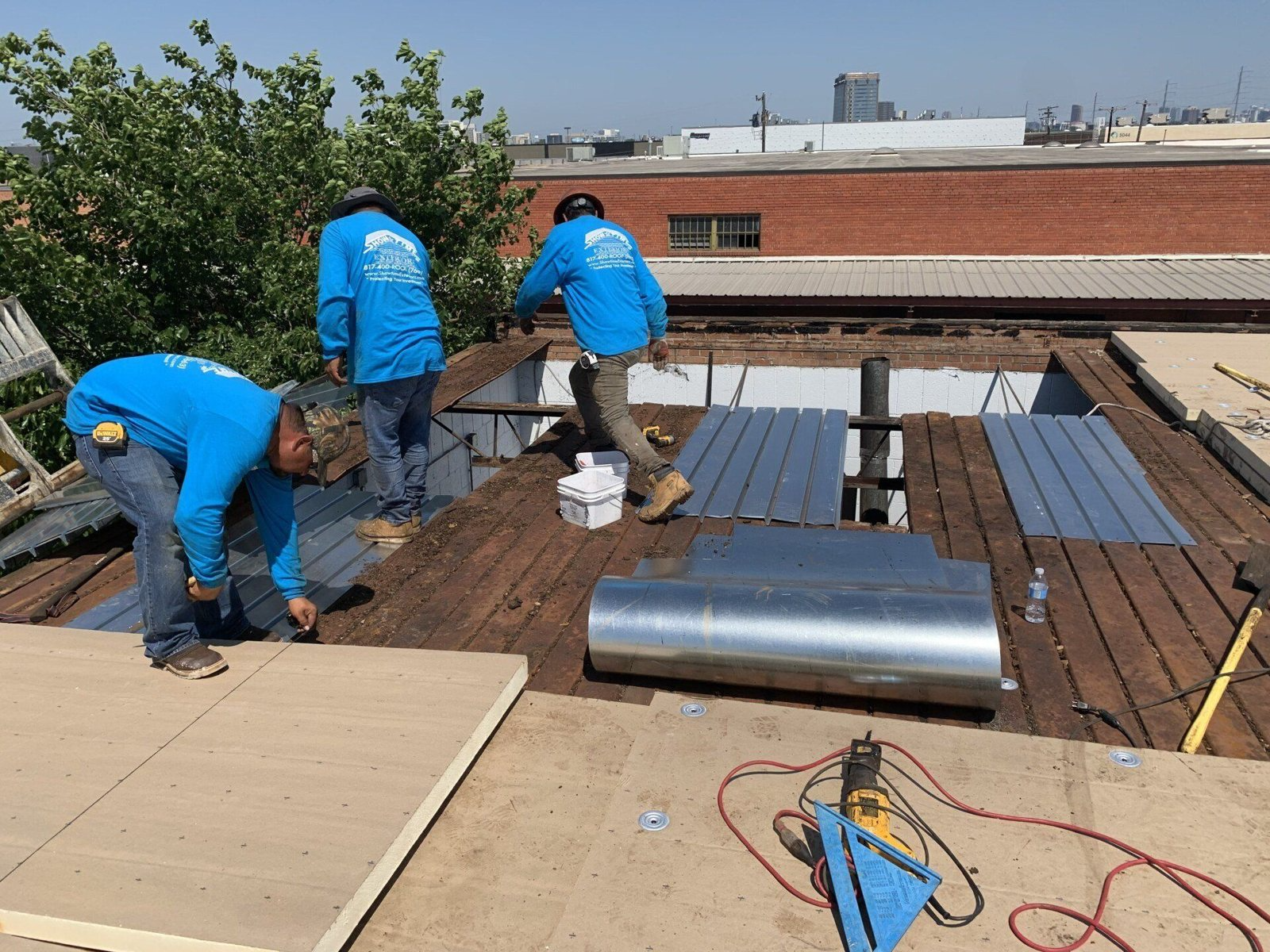
Quick answer: A useful commercial roof inspection report should identify the property, date, inspector, weather, access, roof areas, system and apparent age; define the inspection scope and limitations; include a labeled roof plan; provide overview, context, and close-up photographs; record observable conditions at the membrane, seams, flashings, penetrations, perimeters, drainage, and equipment; document interior evidence, maintenance history, and temporary repairs; explain any moisture testing and verification; rank priorities; and recommend the next step. It should distinguish observed facts from professional interpretation and should never promise an insurance outcome.
The best report is not necessarily the longest. It is the one that lets a property owner, facility manager, contractor, broker, insurer, buyer, lender, or consultant understand what was inspected, where each condition is located, how the conclusion was reached, what remains unknown, and what should happen next. A folder of unlabeled photographs is not a report. A one-page estimate without condition evidence is not a report. Good documentation connects every important statement to a location, observation, photograph, measurement, record, or disclosed limitation.
What a commercial roof inspection report is—and is not
A commercial roof inspection report is a dated record of conditions observed during a defined inspection. It organizes the building information, roof-system description, visible findings, testing, photographs, maintenance evidence, reported leaks, limitations, priorities, and recommendations into one usable file. It may support maintenance planning, repair design, budgeting, a transaction, warranty communication, storm response, or an insurance conversation. The purpose should be stated because the depth and methods appropriate for a routine maintenance visit may differ from those required for a suspected moisture problem or renewal deadline.
The report is not an insurance policy, engineering certification, guarantee of remaining life, warranty decision, or promise that a carrier will renew coverage or pay a claim. A roofing contractor can document physical conditions and recommend roofing work. Insurers, adjusters, engineers, manufacturers, code officials, and other parties make decisions within their own authority. Keeping those roles separate protects the owner from relying on a conclusion the inspector was not engaged or qualified to provide.
A responsible report also states what was not inspected. Unsafe areas, locked rooms, active operations, concealed deck, inaccessible wall interfaces, snow or standing water, heavy rooftop equipment, multiple concealed layers, and gravel surfacing may restrict observation. If destructive testing, infrared scanning, electrical capacitance, core cuts, deck probes, laboratory analysis, or engineering review was not performed, the report should not imply that concealed conditions were ruled out.
Start with the inspection purpose and audience
Before anyone steps onto the roof, the owner should explain why the report is needed and who will read it. A maintenance assessment may focus on defects that can be corrected during the coming budget cycle. A leak investigation needs interior mapping and tracing of possible water pathways. A pre-purchase review may require records, remaining-serviceability discussion, capital planning, and identification of major unknowns. An insurance-related report may need roof age, system, maintenance history, storm evidence, repairs, and photographs formatted for the carrier or broker.
The audience determines how much context belongs in the report. A facility manager may recognize roof-area names and equipment tags that an underwriter will not. A buyer may not know which addition was reroofed in 2018. A useful report translates site knowledge into a record that remains understandable after staff changes. It should use consistent roof-area labels, equipment identifiers, compass directions, and photo numbers instead of relying on phrases such as “near the unit” or “back corner.”
When an insurer, lender, manufacturer, or buyer supplied a questionnaire or evidence request, attach it to the inspection scope before work begins. The inspector can then confirm which items are within a roofing assessment and identify items that require an engineer, electrician, HVAC contractor, licensed adjuster, or another professional. This prevents an urgent deadline from producing an incomplete package.
Property identification and inspection conditions
Every report should include the property name, street address, owner or client, primary contact, inspection date, inspector, company, and report date. Record the general building use, approximate roof area when known, number of roof sections, access method, occupancy conditions, and whether construction or equipment work was underway. If the property contains several buildings, each building and roof area needs a unique label.
Weather affects what can be seen and tested. Record recent rainfall, temperature, wind, cloud cover, surface dryness, and any weather that limited safe access or the reliability of a method. Infrared observations, for example, depend on suitable environmental conditions and verification. Wet surfaces may conceal cracks or create fall hazards. Strong wind can prevent perimeter access. A report should disclose those constraints instead of presenting partial access as a complete inspection.
Include the names or roles of people who provided background information. Statements such as “the tenant reports leaking after wind-driven rain” are useful, but they should be attributed as reported information rather than presented as the inspector’s direct observation. The distinction between records, client statements, and site observations should remain clear throughout the document.
Define the inspection scope and limitations
The scope should say whether the work was visual and non-destructive, whether the interior was reviewed, which roof areas were accessed, which components were included, and whether moisture testing or cuts were authorized. It should list excluded areas and known limitations. If only one leak area was investigated, do not title the result a comprehensive roof assessment. If the roof was viewed from a ladder or drone, explain which details could not be touched, probed, measured, or seen from that position.
Inspection methods should be named. Examples include visual observation, sounding, seam probing where appropriate, moisture meter readings, electrical capacitance, infrared thermography, test cuts, core samples, pull tests, adhesion tests, fastener withdrawal tests, drainage observation, and interior moisture readings. Each method has capabilities and limits. A scan may identify anomalies for verification; it does not automatically identify the moisture source, exact boundaries, deck condition, or insurance cause.
Safety restrictions belong in the report. Inspectors should not walk unstable decks, exposed electrical hazards, damaged skylights, unsecured edges, or unsafe access routes merely to complete a photo list. When safety blocks observation, document the location and recommend a safe follow-up method. A disclosed limitation is more credible than an unsupported conclusion.
Identify the roof system and assembly
Record the visible roof type for each area: TPO, PVC, EPDM, modified bitumen, metal, coating, spray polyurethane foam, built-up roofing, or another assembly. Identify membrane color, surfacing, apparent attachment, seam type, flashing materials, insulation or cover board where known, deck type where confirmed, and the number of roof layers when records or test cuts establish it. Avoid guessing at concealed materials from surface appearance alone.
Roof age should be supported by evidence such as invoices, warranties, permits, manufacturer records, prior reports, dated photographs, owner files, or test cuts interpreted with other information. If the age is unknown, say unknown and list the records searched. “Appears old” may be a condition observation, but it is not a defensible installation date. Separating verified dates, client-reported dates, and estimated ranges helps prevent later confusion.
Changes in membrane, seam layout, edge metal, repairs, elevations, or equipment may show that one roof contains several construction phases. Map them separately. A 2019 addition should not inherit the age assigned to a 1998 original building. Likewise, a coating date is not necessarily the installation date of the membrane below it.
Use a roof plan that makes every finding locatable
A roof plan is the organizing backbone of the report. It can be an architectural drawing, aerial image, measured sketch, or simplified diagram, but it should show north, roof-area names, approximate dimensions or scale when available, access points, walls, edges, drains, scuppers, gutters, downspouts, overflows, curbs, major equipment, penetrations, expansion joints, changes in elevation, and important interior areas below.
Number or code each finding and photograph, then place the corresponding marker on the plan. If moisture testing was performed, show the survey boundaries, anomaly areas, verification points, cuts, and repaired openings. If leak locations were reported indoors, map them to the roof plan while acknowledging that water can travel through the assembly, deck, structure, or interior before it becomes visible.
A reader should be able to move from a recommendation—such as repairing an open flashing at RTU-4—to the finding number, photographs, roof-plan location, and scope item without guessing. This traceability makes estimates easier to compare and gives crews a stronger starting point for repair.
Photographic evidence: overview, context, detail, and scale
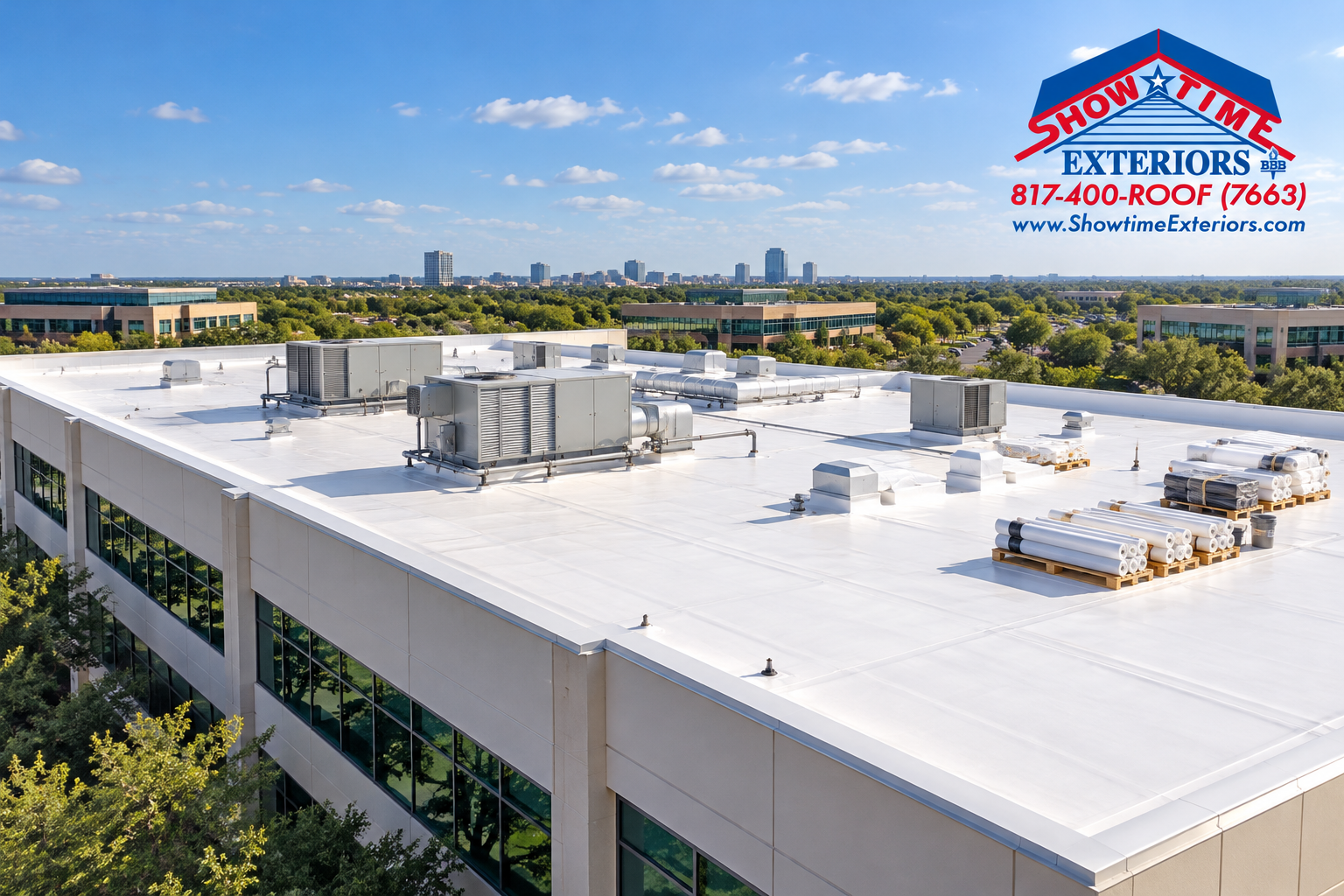
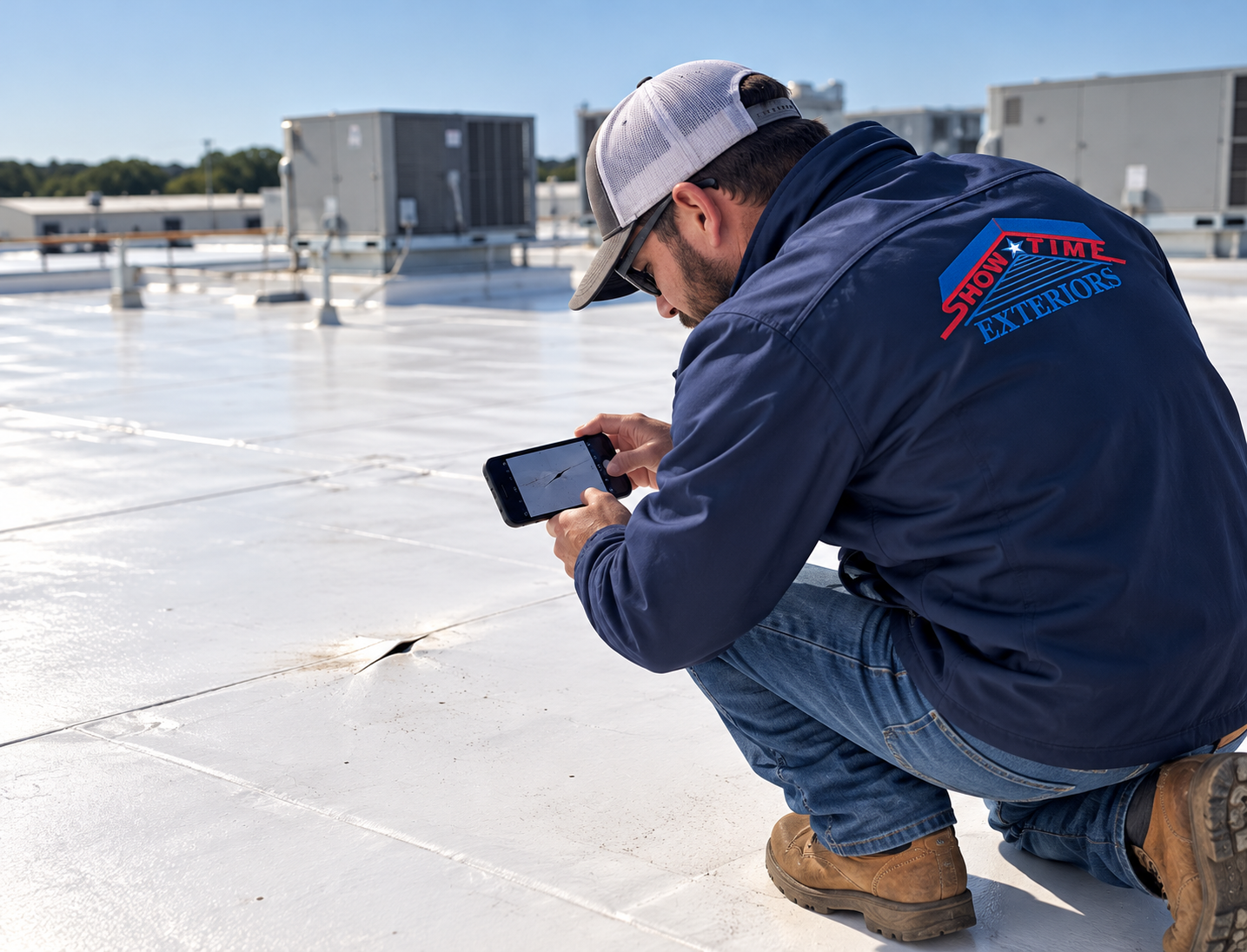
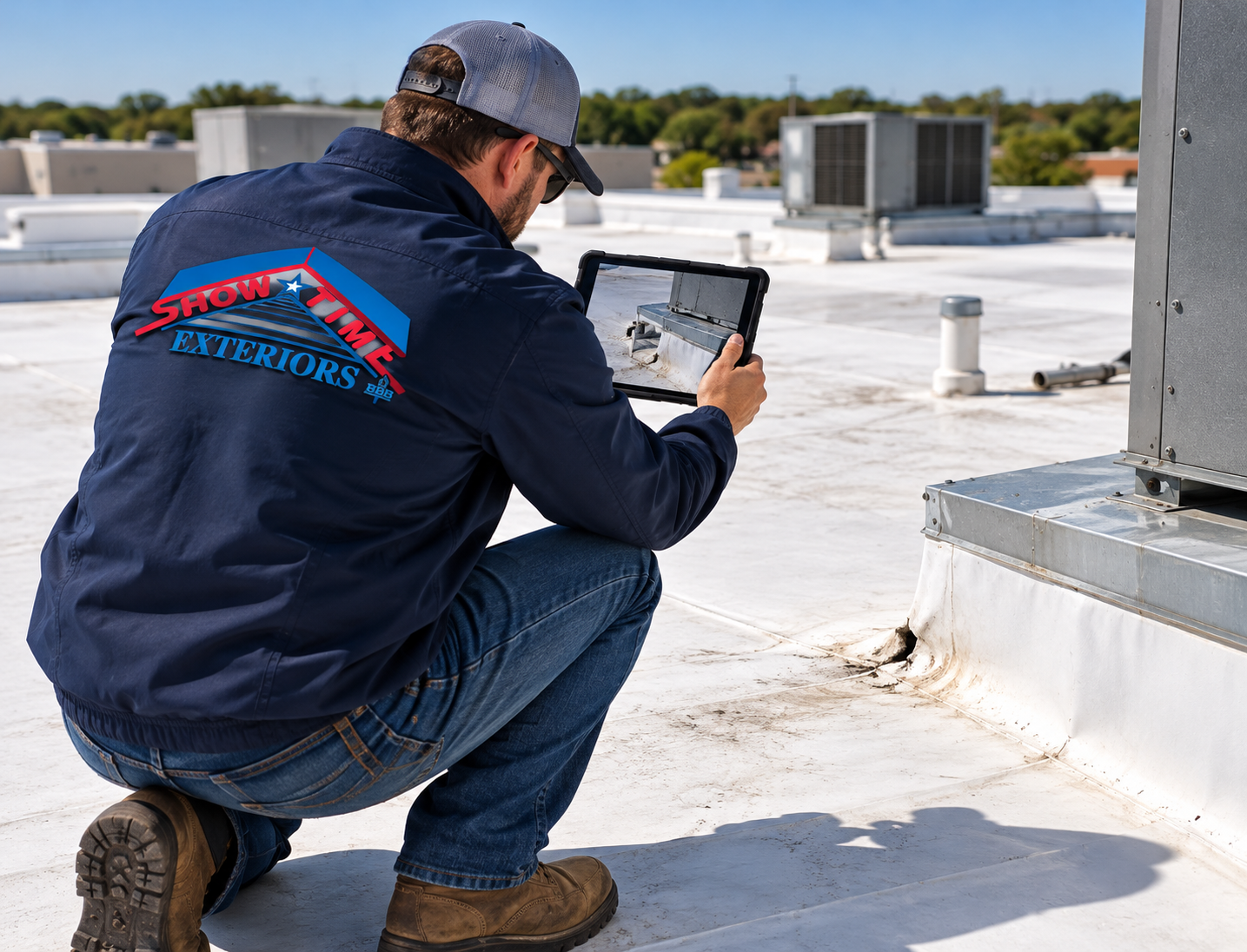
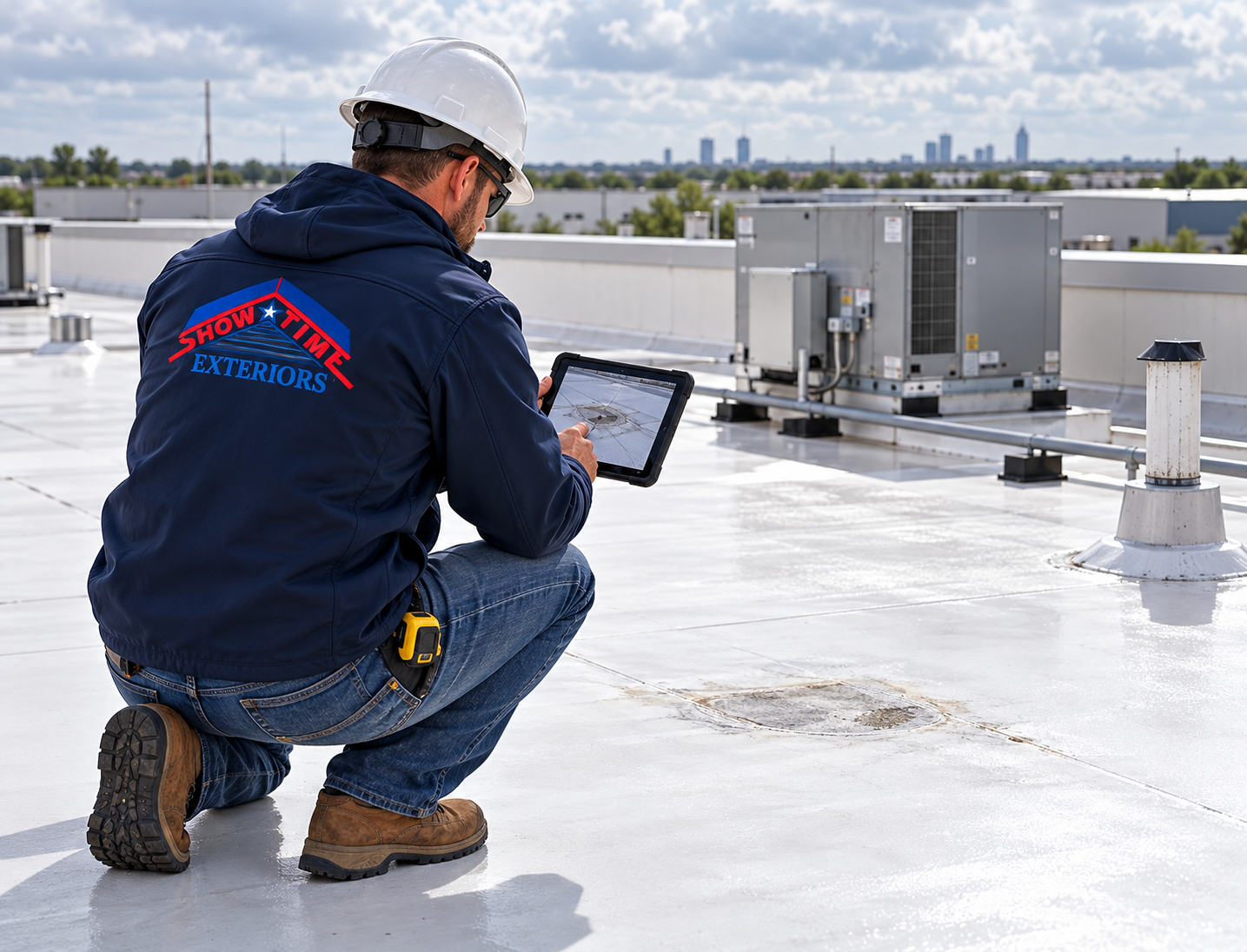
Begin with building elevations and wide roof overviews. These establish the building, roof geometry, general system, equipment density, drainage pattern, and the relationship among roof areas. Add context photographs that show where a condition sits relative to a recognizable feature. Finish with close-ups that show the defect itself. A close-up without context is difficult to locate; an overview without detail may not prove the condition.
Use a ruler, probe, chalk mark, seam edge, fastener head, or another safe reference to show size where dimensions matter. Photograph both sides of a penetration, the full length of a split, the drainage path around ponding, and the transition around a repair when one image cannot communicate the condition. Do not alter a surface merely to make a photograph more dramatic. If material was lifted, cut, cleared, or probed, record the method and authorization.
File names or captions should include roof area, finding number, direction, component, and date. Preserve original image files and metadata when possible. Avoid filters, heavy compression, unexplained crops, or screenshots as the only record. Annotated copies can help readers, but the unedited originals should remain available. Where privacy or security matters, establish rules for tenants, people, access systems, proprietary equipment, and interior operations before photographing.
Write condition notes that separate fact from interpretation
Each finding should identify the location, component, observed condition, extent, apparent severity, supporting photograph or measurement, and recommended response. “Open seam approximately 18 inches long at the north side of RTU-4” is more useful than “roof is failing.” “Interior staining reported below Roof Area B; surface moisture reading elevated at the ceiling tile” is different from claiming the roof caused the stain without tracing the pathway.
Use language such as observed, measured, reported, consistent with, possible, or requires verification deliberately. An interpretation can be valuable, but it should not be disguised as a directly observed fact. When several causes are plausible, list them and recommend the next diagnostic step. Water entry around a curb could involve roof flashing, counterflashing, equipment panels, condensate, ductwork, or wind-driven rain. The report should not select one without evidence.
Quantify extent where practical: number of punctures, linear feet of open seam, square feet of displaced coating, percentage of perimeter affected, dimensions of a ponded area, moisture-test boundaries, or count of previous patches. If a quantity is approximate, label it. Quantification helps owners move from concern to scope and budget.
Interior evidence and leak history
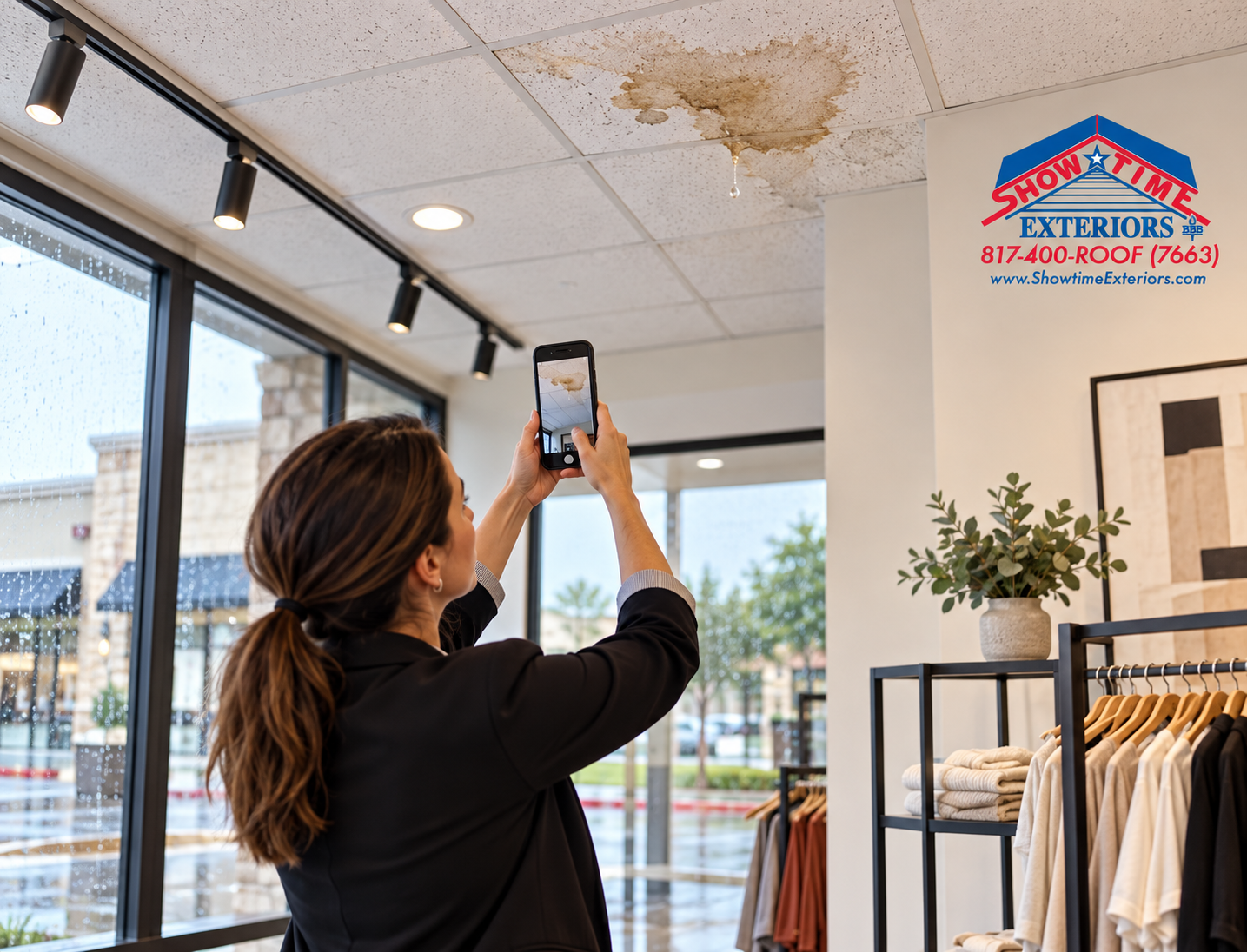
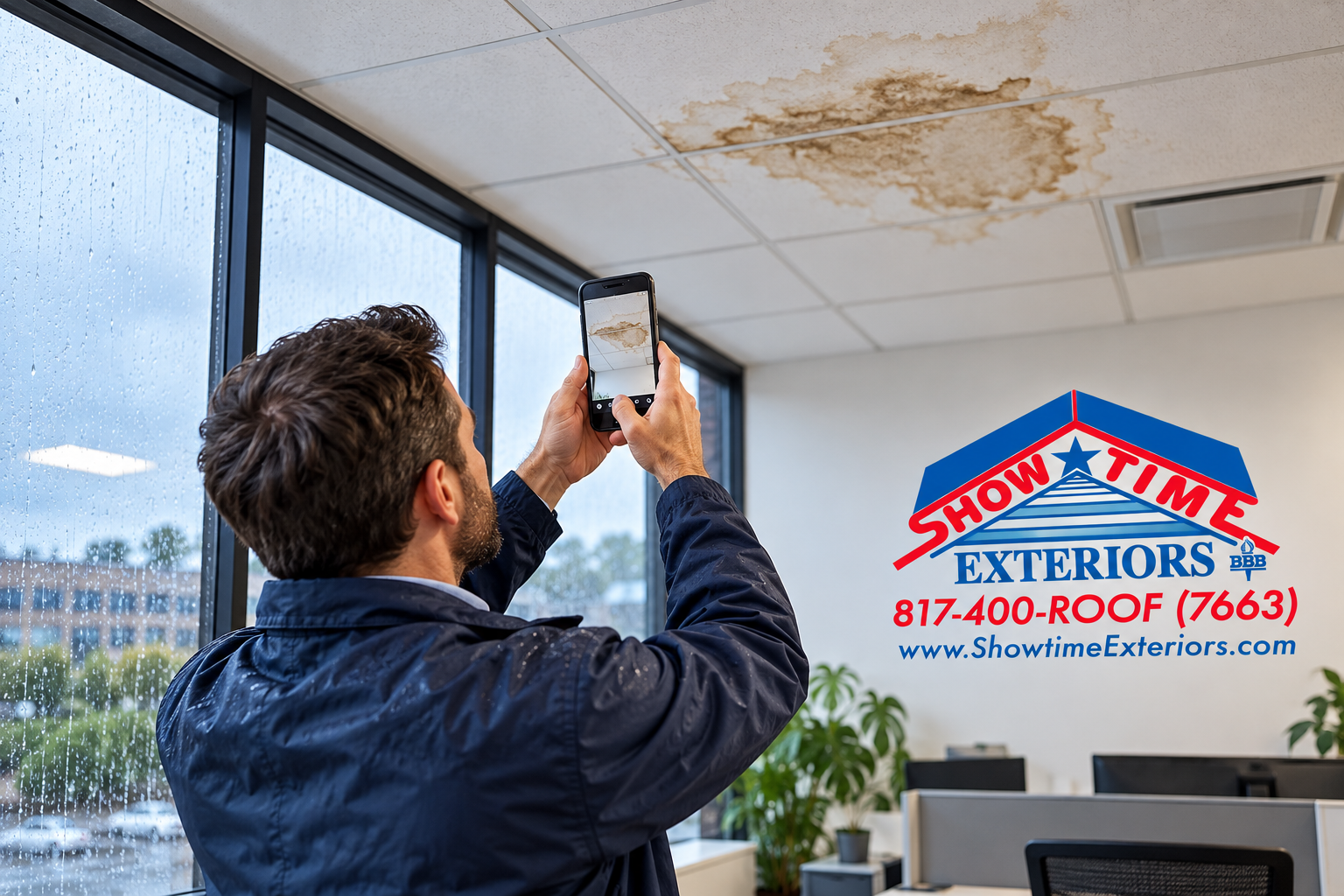
A roof inspection report is stronger when the interior is reviewed with the roof. Record active drips, stains, damaged finishes, wet insulation, odors, corrosion, microbial concerns, inventory exposure, electrical proximity, and the time and weather associated with the event. Take overview and detail photographs and mark interior locations on floor and roof plans. Do not disturb suspect hazardous material without proper procedures.
Create a leak log with date, time, rainfall or wind conditions, location, duration, response, temporary work, and whether the area recurred. Tenant and maintenance statements should be attributed. Repeated leaks at different interior points may indicate multiple entry paths or water travel, not necessarily widespread membrane failure. Conversely, no visible interior stain does not prove that roof insulation is dry.
If operations are sensitive—medical, food service, manufacturing, data, electrical rooms, archives, or high-value inventory—note the consequence of water entry and access restrictions. Repair priorities should consider business impact as well as the apparent size of the roof defect.
Moisture evidence and verification
Concealed moisture can affect repair boundaries, recover eligibility, attachment, insulation value, deck condition, odor, corrosion, and project cost. Visual inspection may find clues such as stains, blisters, soft areas, open details, or repeated patches, but surface appearance alone does not map all wet materials. When moisture information will change a major decision, use an appropriate survey and verification plan.
Infrared thermography, electrical capacitance, nuclear methods, handheld meters, cores, and test cuts have different requirements and limitations. The report should identify the equipment, date, survey conditions, roof areas covered, operator, interpretation criteria, anomaly map, verification points, and repairs to openings. An anomaly is not automatically wet insulation; verification helps distinguish moisture from material thickness, ballast, repairs, heat sources, shading, or construction differences.
Test cuts can confirm layer count, material type, thickness, adhesion, moisture, and deck at selected points, but they do not reveal the entire roof. Record location, dimensions, observations, photographs of each layer, sample handling, and permanent repair. If laboratory testing or engineering review is required, preserve chain of custody and state who will interpret the results.
Drainage, ponding, and water-flow evidence
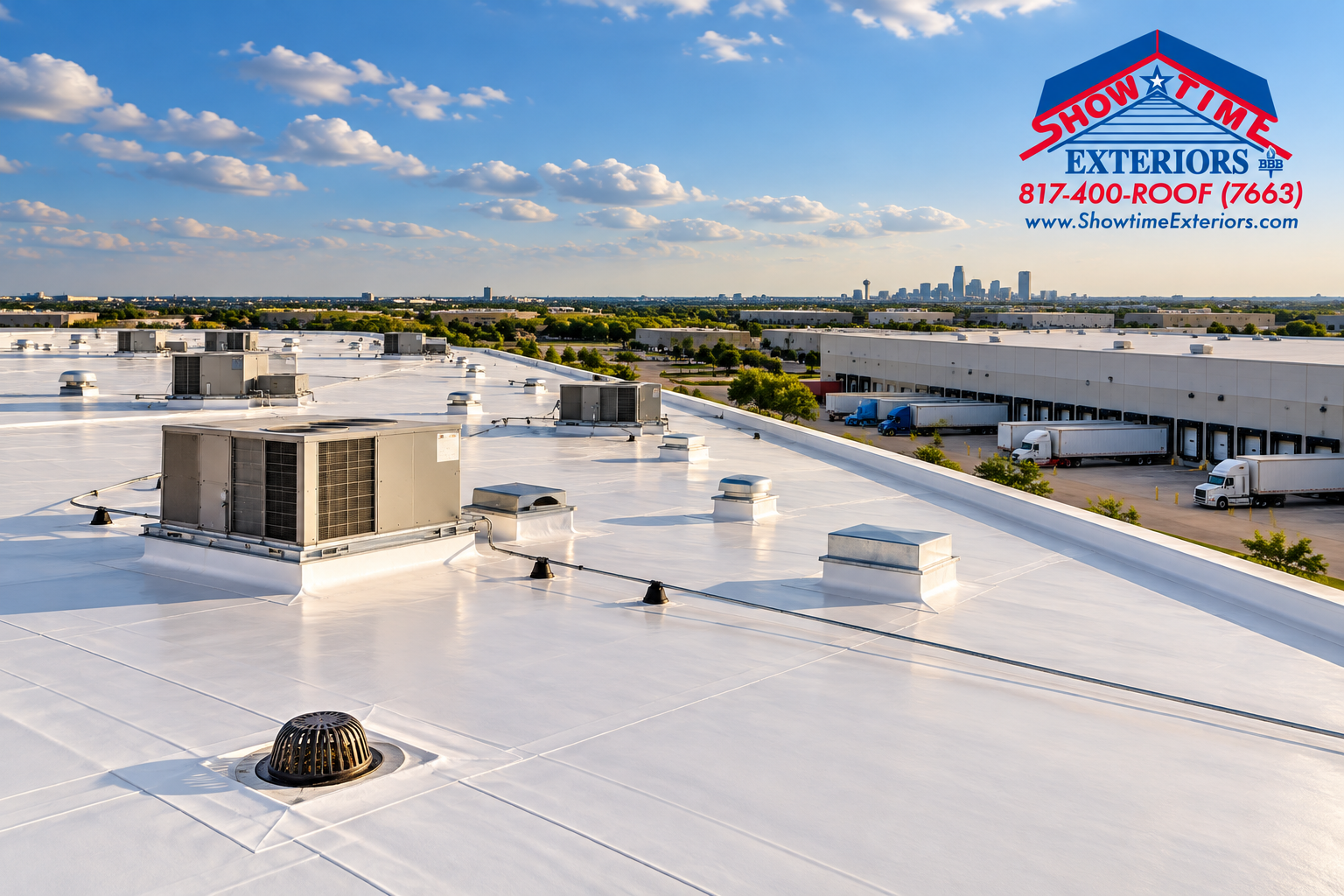
Document drains, scuppers, gutters, downspouts, overflows, crickets, sumps, slopes, debris, vegetation, staining, sediment lines, and ponding indicators. Show the water path with wide photographs and a roof plan. Measure standing-water depth and area only when it is safe and useful. Record whether the observation followed recent rain and how long water was reportedly present.
Distinguish a blocked drain from settled insulation, deck deflection, inadequate taper, poor equipment placement, an undersized opening, or missing overflow. Cleaning a drain may resolve a maintenance issue; it will not correct structural deflection or reverse slope. If structural movement is suspected, recommend an appropriate engineer rather than presenting a roofing observation as a structural conclusion.
Drainage evidence should extend beyond the membrane. Photograph loose strainers, damaged bowls, open clamping rings, failed seals, deteriorated scupper liners, overflowing gutters, disconnected downspouts, erosion, and discharge near foundations. Water-management components work as a system.
Perimeters, flashings, penetrations, and rooftop equipment
Many commercial roof problems develop at transitions rather than in the open field. Inspect walls, curbs, pipes, vents, drains, scuppers, expansion joints, hatches, skylights, pitch pans, conduits, equipment supports, walk pads, terminations, counterflashings, copings, edge metal, gutters, and changes between roof systems. Photograph the overall detail and the specific defect.
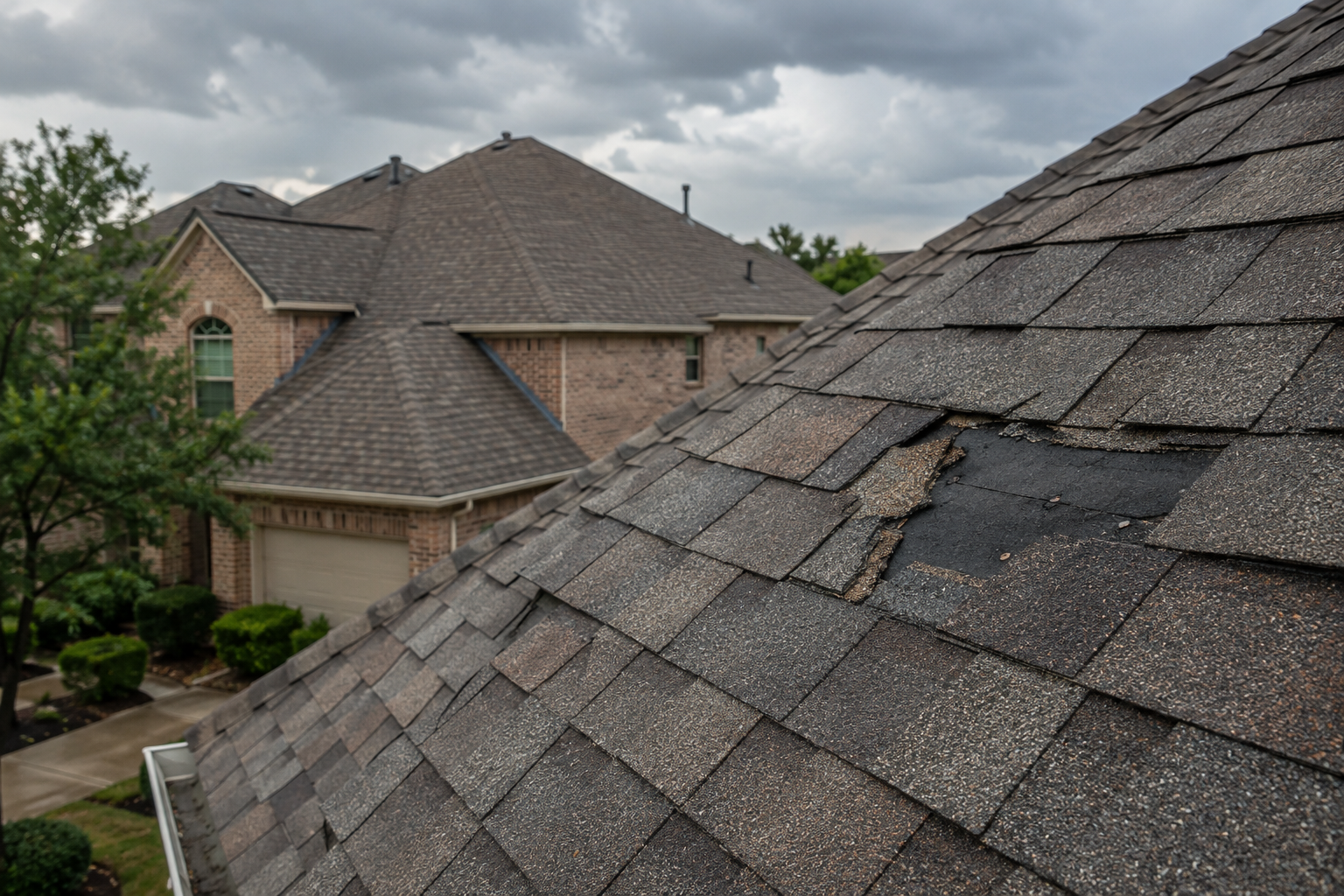
Record loose or missing fasteners, open laps, membrane pullback, fishmouths, cracks, split corners, deteriorated sealant, exposed reinforcement, corrosion, displaced metal, unsupported membrane, incompatible patching, and abandoned penetrations. Note equipment discharge, grease, chemicals, hot air, vibration, condensate, and frequent service traffic that may affect the roof.
The report should distinguish roofing work from equipment, masonry, glazing, plumbing, or structural work. A roof contractor may coordinate the solution, but the correct trade should address the component. This prevents repeated roof patches around an unresolved equipment or wall problem.
Storm evidence without overstating causation
After hail or wind, preserve the inspection date, reported storm date, owner and tenant statements, weather records, before-and-after photographs when available, maintenance history, emergency actions, and observed changes. Photograph the field membrane, seams, flashings, perimeters, edge metal, coping, rooftop equipment, soft metals, drains, skylights, and debris. Map each significant condition.
Weather data can establish that a storm was reported in the area; it does not by itself prove damage at a specific component. Likewise, marks on metal may help describe exposure but do not automatically establish identical damage to the membrane below. The report should describe physical evidence, possible mechanisms, pre-existing conditions, and limitations, then identify whether further testing or specialist review is appropriate.
Do not discard removed materials or complete broad permanent work before parties who need to inspect have had a reasonable opportunity, unless emergency conditions require immediate action. Stabilize active water entry, protect occupants and contents, photograph before and after, retain invoices and material records, and communicate with the owner’s insurer or representative. Coverage decisions belong to the insurer.
Maintenance, repair, warranty, and construction records
Collect warranties, original proposals, permits, invoices, product data, roof plans, inspection reports, moisture surveys, repair tickets, photographs, coating records, equipment-change documentation, and storm logs. These records help establish age, assembly, maintenance, recurring locations, prior conditions, and work completed. They can also reveal gaps—for example, a warranty that covers only one roof area or a coating installed over an older assembly.
Repairs should be mapped and described by date, contractor, materials, reason, and result. Temporary patches should be clearly labeled as temporary and scheduled for permanent correction. A roof covered with undocumented mastics, tapes, coatings, or patches may require additional testing because those materials can conceal the original defect and complicate compatibility.
Warranty status should be verified with the issuing party. The presence of a warranty document does not prove current coverage or that a proposed repair is approved. If warranty procedures apply, follow notification, inspection, material, contractor, and documentation requirements before work.
Special evidence for aging gravel-surfaced BUR
Aging built-up roofs with gravel surfacing require particular caution because loose aggregate can conceal the membrane, flood coats, cracks, blisters, splits, previous repairs, fasteners, and moisture-related distress. The visible gravel layer does not provide a clear view of the waterproofing below. This uncertainty can complicate maintenance planning, proposal comparison, property transactions, and insurance review.
The report should map gravel depth and distribution, displaced or bare areas, vegetation, drainage restrictions, debris, surfacing movement, visible blisters or splits, perimeter and flashing conditions, previous patches, interior leak history, and any moisture survey or test cuts. Representative clearing or cuts should occur only where safe, authorized, and repairable. The report must state that sampled locations do not prove the condition of every concealed area.
Showtime Exteriors’ campaign direction is clear: do not frame aging gravel as a positive feature or use the report to minimize its inspection limitations. The practical goal is to replace uncertainty with evidence and a plan. Depending on condition, moisture, deck, drainage, layers, cost, and owner priorities, that plan may involve targeted repair, preparation for replacement, or evaluation of a more inspectable and maintainable system such as TPO, PVC, EPDM, modified bitumen, metal retrofit, or a compatible restoration assembly.
System-specific evidence
For TPO and PVC, document welded seams, patches, flashings, membrane shrinkage or movement, punctures, contamination, surface condition, attachment indicators, and compatibility of repairs. For EPDM, document field seams, uncured flashing, splice tape, shrinkage, punctures, ballast if present, adhesives, and perimeter securement. For modified bitumen, record plies where known, granules or coating, splits, blisters, laps, exposed asphalt, reinforcement, and heat- or adhesive-related details.
For metal, document panel profile, seam type, clips or exposed fasteners, end laps, penetrations, closures, sealants, corrosion, coating, movement, oxidation, gutters, and evidence of leakage beneath panels. For coatings and spray foam, record substrate, coating type where known, thickness testing if included, adhesion, cracks, pinholes, blisters, exposed foam, repairs, drainage, and application records.
For recover or overlay systems, identify retained layers, attachment path, moisture assumptions, added load, transitions, perimeter heights, drainage, code or manufacturer requirements, and concealed conditions. A surface-only description is insufficient when the owner is deciding whether to retain an older assembly.
Priorities, condition grades, and remaining serviceability
A report should translate findings into action. A practical priority system may identify emergency stabilization, near-term repair, planned capital work, routine maintenance, and monitoring. Define the categories instead of relying on colors alone. Priority should reflect water-entry risk, safety, business consequence, extent, rate of change, weather exposure, access, and the effect of delay.
Condition grades can help compare roof areas, but the basis must be clear. One “poor” rating should not combine a dry but aged membrane, an actively leaking roof with wet insulation, and a roof that cannot be assessed because gravel hides the membrane. Separate observable condition, moisture evidence, documentation quality, maintenance status, and confidence level where that distinction matters.
Avoid unsupported promises that a roof has a precise number of years remaining. Serviceability depends on concealed conditions, drainage, weather, maintenance, traffic, materials, details, and repairs. It is more defensible to state the current conditions, evidence, uncertainty, expected consequences, and recommended timing.
Recommendations and repair scopes
Recommendations should connect directly to findings. Identify the component, location, action, approximate extent, compatible materials, preparation, wet-material removal, flashing tie-in, drainage correction, temporary protection, access, testing, and documentation required. When alternatives exist, explain what condition would make repair, restoration, recover, retrofit, or replacement appropriate.
A repair scope should not merely say “seal leaks.” It should describe how unsound material will be removed, how the substrate will be evaluated, how wet insulation will be handled, how the repair will extend into sound material, and how completed work will be photographed. Allowances and unit prices can address concealed deck or insulation discovered during construction.
If design pressures, structure, fire classification, code, hazardous materials, or equipment support exceeds the roofing inspector’s engagement, recommend the appropriate professional. A strong report identifies the boundary and the next responsible step.
Insurance renewal, underwriting, and claim packages
When insurance is the reason for inspection, ask the broker or carrier for the exact request in writing. Some parties want age, roof type, condition, leak status, maintenance, photographs, and planned work; others use their own form or require a particular professional. The report should answer the stated questions accurately without changing physical observations to fit a desired outcome.
An organized package may include the inspection report, roof plan, original photographs, invoices, maintenance log, warranties, permits, product or assembly information, moisture findings, completed-repair photographs, paid invoices, and a letter or closeout statement describing work actually performed. Submit only accurate records and retain a copy of what was sent.
A professional inspection and completed repairs may reduce uncertainty, but they do not guarantee renewal, coverage, premium, valuation, or claim payment. Underwriting varies by carrier, property, roof age, condition, location, claims history, system, attachment, and market. Showtime Exteriors documents roofing conditions and work; the insurer makes the insurance decision.
Common report mistakes to avoid
Common weaknesses include unlabeled photographs, no roof plan, missing inspection date, vague findings, no weather record, an unknown roof age presented as fact, conclusions beyond the inspection scope, no interior review, moisture claims without method or verification, repair recommendations disconnected from locations, and estimates that omit assumptions. Another mistake is failing to preserve the original image files and records behind a polished summary.
Reports can also become less useful by using alarmist language or oversimplifying a system. One puncture does not prove the entire roof requires replacement. One dry test cut does not prove the entire roof is dry. One storm report does not prove every observed condition is storm-caused. Conversely, a lack of active leaking on the inspection day does not prove there is no concealed moisture or open pathway.
For aging gravel BUR, the specific mistake to avoid is presenting the gravel layer as proof of good membrane condition. Gravel can hide the surface. The report should state that limitation, use appropriate evidence, and recommend a plan based on verified conditions rather than reassurance.
How property owners can prepare before the inspection
Gather roof plans, warranties, proposals, invoices, permits, maintenance records, leak logs, storm dates, insurance letters, tenant reports, equipment-change records, and previous photographs. Identify all roof areas and access points. Arrange keys, escorts, interior access, ladder or hatch requirements, fall-protection coordination, and permission for testing. Notify tenants and operations teams when interior photographs, odor, noise, or test cuts may occur.
Mark known leak locations inside before the inspector arrives. Explain when each leak appears—during heavy rain, wind-driven rain, after long rainfall, during HVAC operation, or under plumbing use. Do not direct the inspector only to known leaks; ask for the agreed scope across the roof. A narrow focus can miss drainage, perimeter, or equipment conditions that will become the next problem.
After the report arrives, check that every roof area is addressed, the limitations are clear, photographs are locatable, findings support recommendations, and priorities match the property’s operational risk. Ask for clarification before using the document to obtain bids or submit it to another party.
Frequently asked questions
How many photographs should a report contain? There is no universal number. The report needs enough overview, context, and detail images to establish the inspected areas and support material findings without burying the reader in duplicates. A large, complex roof may require many more photographs than a small building.
Do drone photographs replace a rooftop inspection? Not usually. Drones can document inaccessible areas, elevations, geometry, and broad conditions, but they may not establish adhesion, seam condition, softness, moisture, layer count, deck, or small defects. The report should state what the drone could and could not verify.
Do I need a moisture scan? Not for every purpose. Moisture testing is most useful when concealed wet areas could change repair boundaries, recover eligibility, attachment, cost, or replacement decisions. The method and conditions must suit the roof, and anomalies should be verified appropriately.
Can a report prove the roof will pass insurance inspection? No. It can document condition, repairs, and maintenance for review, but only the carrier decides underwriting and coverage. Ask for requirements in writing and allow time to address findings before the deadline.
Should the report include an estimate? It can, but keep findings and scope clear. A report may recommend work before quantities are finalized. If pricing is included, state assumptions, allowances, exclusions, unit prices, and whether design, permits, testing, deck repairs, drainage, equipment work, or warranty fees are included.
What evidence matters most for a gravel roof? Labeled photos, roof plan, interior history, drainage, visible defects, representative authorized investigation, moisture testing and verification where appropriate, layer and deck information, repair records, and a direct statement that gravel conceals much of the membrane. Do not treat the surfacing as proof that the waterproofing is sound.
How often should the roof be inspected? Frequency depends on system, age, condition, warranty, manufacturer guidance, climate, occupancy, traffic, equipment work, and risk. Inspections are also useful after major hail, wind, debris, water entry, or rooftop construction. A site-specific maintenance plan is better than a generic interval.
Commercial roof inspection evidence checklist
Property name, address, building use, owner or client, contacts, and report purpose.
Inspection date, report date, inspector, weather, recent rainfall, access method, and safety limitations.
Roof-area labels, approximate size, roof plan, north arrow, equipment, drainage, access, and finding markers.
Roof-system type, apparent attachment, surfacing, flashings, age evidence, layers, insulation, and deck where verified.
Building and roof overviews, location context, detailed findings, scale, captions, and preserved original photographs.
Condition notes that separate observed facts, client-reported information, professional interpretation, and unknowns.
Membrane, seams, flashings, perimeters, penetrations, drainage, rooftop equipment, repairs, and traffic areas.
Interior leak map, stains, active water, operations at risk, tenant or staff reports, and leak history.
Moisture-test method, coverage, conditions, anomaly map, verification, core or cut details, and repaired openings.
Storm date and records, emergency actions, before-and-after evidence, observed damage, and causation limitations.
Maintenance records, warranties, invoices, permits, product data, prior reports, repairs, and equipment changes.
Condition priorities, timing, repair/restoration/recover/replacement options, scope assumptions, and follow-up testing.
Insurance disclaimer: physical conditions are documented; carriers decide underwriting, renewal, coverage, and claims.
For gravel BUR: concealment limitation, mapped surface conditions, authorized representative investigation, moisture evidence, and replacement planning.
Closeout package after work: completed-repair photographs, invoices, material records, warranties, permits, and updated roof plan.
817-400-ROOF (7663) • showtimeexteriors.com
SHOWTIME EXTERIORS | TEXAS COMMERCIAL ROOFING
Evidence matrix: what each item helps establish
Evidence
Helps establish
Does not prove alone
Good practice
Labeled photos
Visible condition and location
Concealed moisture or cause
Keep overview, context, detail, date, originals
Roof plan
Relationship among findings
Exact construction if unverified
Use area names, north, drains, equipment, markers
Moisture survey
Possible concealed anomalies
Source, deck condition, or exact extent
State method and verify representative areas
Test cuts
Assembly at selected points
Condition of every roof area
Map, photograph layers, repair openings
Leak history
Timing, recurrence, operational impact
Roof source without investigation
Attribute reports and map interior points
Weather records
Reported exposure in the area
Damage to a specific roof component
Pair with physical evidence and dates
Repair records
What work was performed
Current condition without inspection
Retain scope, materials, invoice, photos
Insurance letter
Carrier’s stated request
Renewal or coverage outcome
Obtain in writing and answer accurately
Why work with Showtime Exteriors?
Showtime Exteriors helps commercial property owners across Texas evaluate BUR, TPO, PVC, EPDM, modified bitumen, metal, coatings, overlays, retrofits, and replacement options. The team can document visible conditions, organize roof areas and findings, investigate leaks, evaluate storm-related concerns, identify maintenance and repair priorities, and develop a practical scope around the building’s operations and deadlines.
The approach is evidence first. That means acknowledging uncertainty, especially when gravel, multiple layers, coatings, equipment, or inaccessible construction conceals conditions. It also means avoiding insurance guarantees. The owner receives a clearer record of what was observed, what remains unknown, what additional testing may be justified, and what repair, restoration, recover, retrofit, or replacement path should be considered.
Need a commercial roof inspection report in Texas? Call Showtime Exteriors at 817-400-ROOF (7663), or schedule a commercial roof assessment.
Helpful Showtime Exteriors resources
Commercial roof inspection for insurance renewal
Commercial roof maintenance records insurers may request
Why gravel can hide commercial roof damage
What to do when a commercial roof causes non-renewal
How roof age affects commercial property insurance
North Texas post-storm roof inspection
817-400-ROOF (7663) • showtimeexteriors.com
SHOWTIME EXTERIORS | TEXAS COMMERCIAL ROOFING
Independent technical and insurance resources
National Roofing Contractors Association technical resources
Texas Department of Insurance commercial resources
FEMA Building Science resources
Insurance Institute for Business & Home Safety commercial resources
U.S. Department of Energy cool-roof guidance