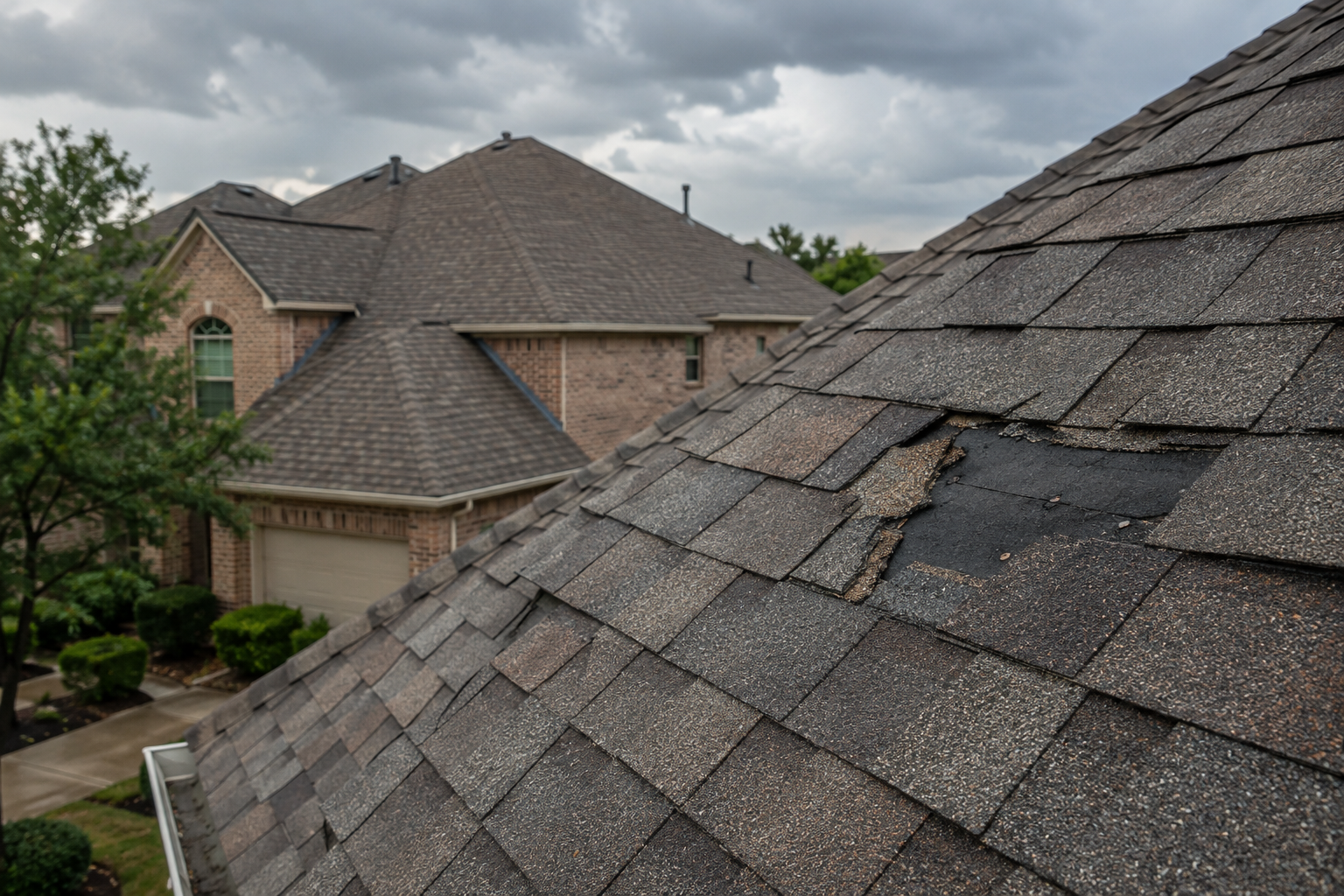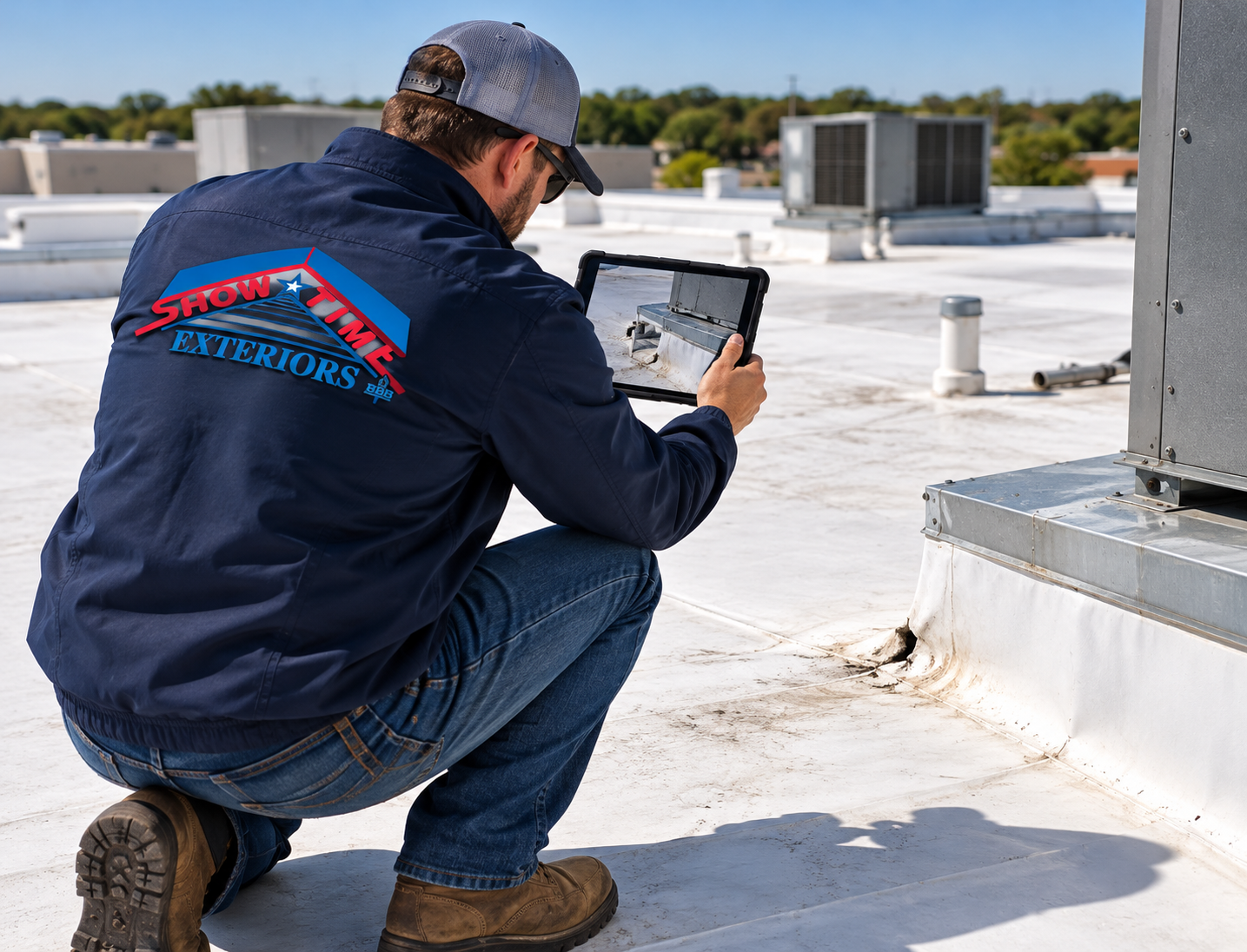




How Quickly Should You Address a Punctured Commercial Membrane?
A response guide for Texas commercial property owners from Showtime Exteriors.

Contact a qualified roofing contractor promptly after discovering a puncture. If water is entering, the roof opening is exposed to approaching rain, or occupied areas are at risk, request urgent assessment and appropriate temporary protection.
There is no universal 24-hour or 48-hour period during which every punctured roof can safely remain unattended. The response depends on the opening, roof assembly, weather, and conditions inside the building.
A small puncture does not automatically require replacement. It does require evaluation to establish whether a localized repair is sufficient and whether underlying materials have been affected.
Why a Small Puncture Deserves Attention
A roof membrane provides a continuous barrier. An opening interrupts that barrier, even when it appears minor.
Do not judge urgency solely by the visible size or the absence of a ceiling stain. The extent of any underlying concern may not be apparent from the surface.
GAF’s commercial inspection guidance treats membrane condition and associated roof details as part of evaluating repair or replacement needs. gaf.com
The practical next step is to establish the condition and arrange suitable protection—not wait for more obvious interior symptoms.
When Is It Urgent?
Describe the following conditions clearly when requesting service:
- Active water entry.
- Visible opening with rain approaching.
- Water near electrical equipment.
- Sagging ceilings or falling materials.
- Sensitive inventory or equipment beneath the affected area.
- Additional loose or damaged components.
Keep people away from unsafe areas and seek appropriate professional assistance. Do not enter a hazardous room solely to photograph damage.
If there is no visible interior water, still arrange prompt evaluation. A dry interior does not establish that the roof is intact or that concealed materials remain dry.
A Practical Response Guide
Observed conditionRecommended next stepActive leakRequest urgent assessment and protectionPuncture discovered before rainContact the roofer promptly and discuss exposureNo interior symptomsArrange inspection and a supported repair planSagging ceiling or electrical concernRestrict access and seek appropriate assistanceTemporary protection installedConfirm monitoring and permanent repair arrangementsWater returns after workReport the new observation and request reevaluation
This table helps communicate conditions. It does not guarantee a contractor’s arrival time or replace an on-site assessment.
What Should You Do Immediately?
Notify the property manager or designated facilities contact. Record when the puncture was discovered and who observed it.
Contact a roofing professional with a clear description:
“A puncture was reported near the rooftop equipment on our commercial building. We need an assessment of the opening, any underlying effects, and appropriate protection.”
Mention active water entry, upcoming weather, occupancy, and access restrictions.
Owners and employees should leave roof access and repairs to qualified professionals. Collect safe interior and ground-level observations while the contractor handles roof-level documentation.
Identify the Roof System Before Repairing It
A repair must fit the installed membrane and assembly.
TPO, PVC, EPDM, modified bitumen, and coated systems require different product-specific approaches. White appearance alone does not identify the material.
Provide available:
- Installation records.
- Manufacturer information.
- Warranty documents.
- Prior repair invoices.
- Inspection reports.
- Rooftop service history.
Ask the contractor to identify the existing system and explain the supported repair method.
Do not assume generic caulk, tape, or leftover roofing material provides a permanent compatible repair.
What Should the Inspection Establish?
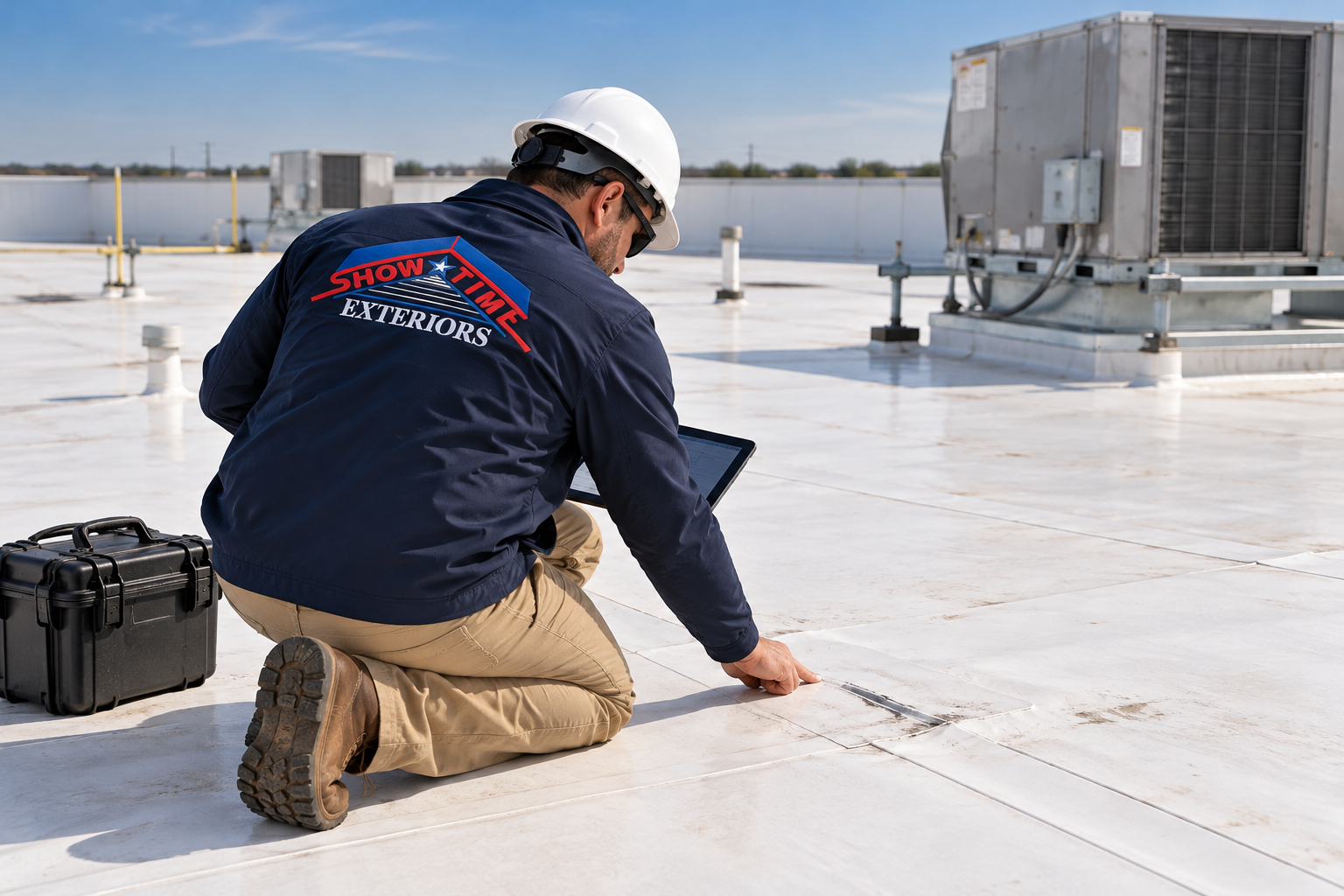
Request findings that answer:
- Where is the opening?
- What is its extent?
- What is the surrounding membrane’s condition?
- Are adjacent details affected?
- Is underlying investigation needed?
- What protection or repair is appropriate?
- What limitations remain?
Ask for overview and detail photographs linked to a roof location.
The report should distinguish observations from conclusions about cause. A puncture found after a storm or equipment visit does not independently prove how it occurred.
Accurate records help the owner coordinate repairs, warranty reporting, and any insurance review.
Can a Puncture Usually Be Repaired?
A localized repair may be appropriate when the affected area is defined and the remaining materials can support suitable work.
The contractor should explain:
- Compatible repair products.
- Preparation.
- Repair boundaries.
- Associated work.
- Verification of completion.
- Further investigation or monitoring.
GAF’s field guidance specifies system-matched materials for certain TPO and PVC repairs, illustrating why repair selection should follow the installed system’s instructions. gaf.com
Avoid selecting the repair method from a photograph alone.
When Might the Scope Be Larger?
Broader work may require consideration when inspection establishes additional damage or affected underlying components.
Ask what evidence supports the proposed extent.
A contractor should explain why the scope is limited to a patch, includes a roof section, or requires more extensive work.
Replacement should not be recommended simply because a puncture exists. Equally, a patch should not be presented as complete restoration when important conditions remain unresolved.
If further investigation is needed, establish the question it will answer before authorizing it.
Does the Roof Need Moisture Testing?
It depends on the findings and history.
Ask the professional whether investigation beneath the membrane is appropriate and why.
Clarify:
- Areas evaluated.
- Method.
- Limitations.
- Documentation.
- Any destructive work.
- Restoration of disturbed locations.
A moisture result does not independently establish its source or age. It should be interpreted alongside the inspection and roof history.
Do not assume that sealing the visible opening automatically addresses all affected materials underneath.
Temporary Protection and Permanent Repair Are Different
If permanent work cannot be completed immediately, ask which temporary method is appropriate.
Document the original condition when safe and practical, then obtain records of the completed protection.
Keep:
- Authorization.
- Work description.
- Photographs.
- Invoice.
- Limitations.
- Follow-up instructions.
Ask who to contact if water appears or the protection changes.
Temporary work needs monitoring and a permanent plan. Do not treat the initial emergency visit as the end of the response.
Check the Warranty Requirements
Locate the actual warranty and reporting instructions.
Do not assume accidental punctures are covered by every manufacturer warranty.
GAF offers a specific puncture-resistance warranty for eligible membranes with its own notification requirements. Carlisle also offers warranty options with limited puncture coverage. Review the documents issued for your roof rather than general advertising. gaf.com
Notify the relevant party promptly when required. Coordinate necessary protection while asking how repairs should be handled.
Warranty coverage and property insurance are separate questions.
Preserve Evidence if Insurance May Be Involved
Keep the discovery timeline, photographs, inspection findings, roof history, emergency invoices, and permanent estimate.
Report observations accurately. Do not invent a cause or date.
Ask the insurer about policy requirements and submission procedures. Do not delay urgent protection solely while awaiting a claim decision.
A contractor’s estimate supports the construction scope; it does not guarantee coverage.
Coordinate With Rooftop Service Providers
If a puncture is discovered near equipment, review available access and service records without assuming responsibility.
Document recent work, locations, and observations. Preserve relevant communication.
For future work, establish roof-access procedures and coordinate protection with service providers.
GAF’s maintenance guidance recommends additional inspection after activities such as rooftop equipment repair or replacement that may expose the roof to damage. gaf.com
A service log helps the owner understand the roof’s history and plan inspections.
What Should a Repair Estimate Include?
Request:
- Property and affected location.
- Findings supporting the scope.
- Proposed materials.
- Preparation and associated work.
- Underlying-work assumptions.
- Access requirements.
- Documentation.
- Exclusions.
- Price and payment terms.
- Additional-work authorization.
- Warranty information.
Ask what the repair resolves and what remains outside it.
If the price changes after investigation, request the supporting findings and revised scope.
What Should Happen After Repair?
Obtain completion photographs and a description of the work performed.
Keep the final invoice, product information, and applicable warranty documents.
Ask what follow-up is appropriate. Report renewed water entry with its location and time.
A later drip requires investigation; it should not automatically be attributed to the repaired puncture without evaluation.
Add the repair location to the property’s roof records so future inspectors and equipment providers understand the work.
Common Mistakes to Avoid
Avoid waiting for a ceiling stain, sending employees onto the roof, using an unidentified repair product, or treating temporary protection as permanent restoration.
Also avoid assuming one opening requires full replacement or that every puncture is covered by warranty or insurance.
The useful response is prompt, documented, and specific to the installed system.
Frequently Asked Questions
Can I wait until the next scheduled inspection?
Contact the roofer when the opening is discovered. Let the assessment guide timing rather than assuming a delay is safe.
Does a dry ceiling mean there is no problem?
No. It does not establish the roof or underlying materials’ condition.
Will one patch resolve everything?
Possibly, if the findings support a localized scope. Underlying concerns may require additional work.
Can a coating fix a puncture?
Only use a supported repair approach for the actual system and condition. A general coating application is not automatically an appropriate repair.
Does puncture damage mean replacement?
No. Establish extent and repair feasibility first.
Should I repair it myself?
Leave roof access and technical work to qualified professionals.
What records should I keep?
Retain photographs, findings, authorization, invoices, completion records, and warranty communication.
Address the Opening Before Deferring the Decision
A punctured commercial membrane deserves prompt evaluation. Active water entry or safety concerns require urgent attention; other openings still need a clear inspection and repair plan.
Found a puncture or unexplained roof leak at your Texas commercial property? Contact Showtime Exteriors to discuss the condition and appropriate next steps.
Call [817-400-ROOF (7663) (line 8174007663)](tel:8174007663) or visit ShowtimeExteriors.com.