



How Quickly Should You Address a Wind-Damaged Roof?
A Practical Guide for Texas Commercial Property Owners

Address suspected wind damage promptly. If your roof has an opening, active leaking, or loose materials that could fall, arrange professional emergency assistance as soon as conditions allow safe access. If the damage appears minor, schedule an inspection before deciding that repairs can wait.
There is no universal waiting period that makes a wind-damaged roof safe. The right response depends on what moved, what remains exposed, whether people or property are at risk, and what weather is approaching.
For Texas commercial property owners, this decision involves more than roofing materials. A damaged roof can affect inventory, equipment, tenants, customer access, and everyday operations. A warehouse owner might need to protect stored products. A restaurant manager might need to keep water away from food preparation areas. An office building manager might need to coordinate access with several tenants.
A useful response separates three decisions:
- What needs immediate protection?
- What needs professional inspection?
- What permanent work does the evidence support?
You can begin protecting the building before every question about the final repair has been answered. Likewise, scheduling an inspection does not commit you to replacing the entire roof.
This guide explains how to prioritize the response, document conditions, coordinate repairs, and keep your business informed throughout the process.
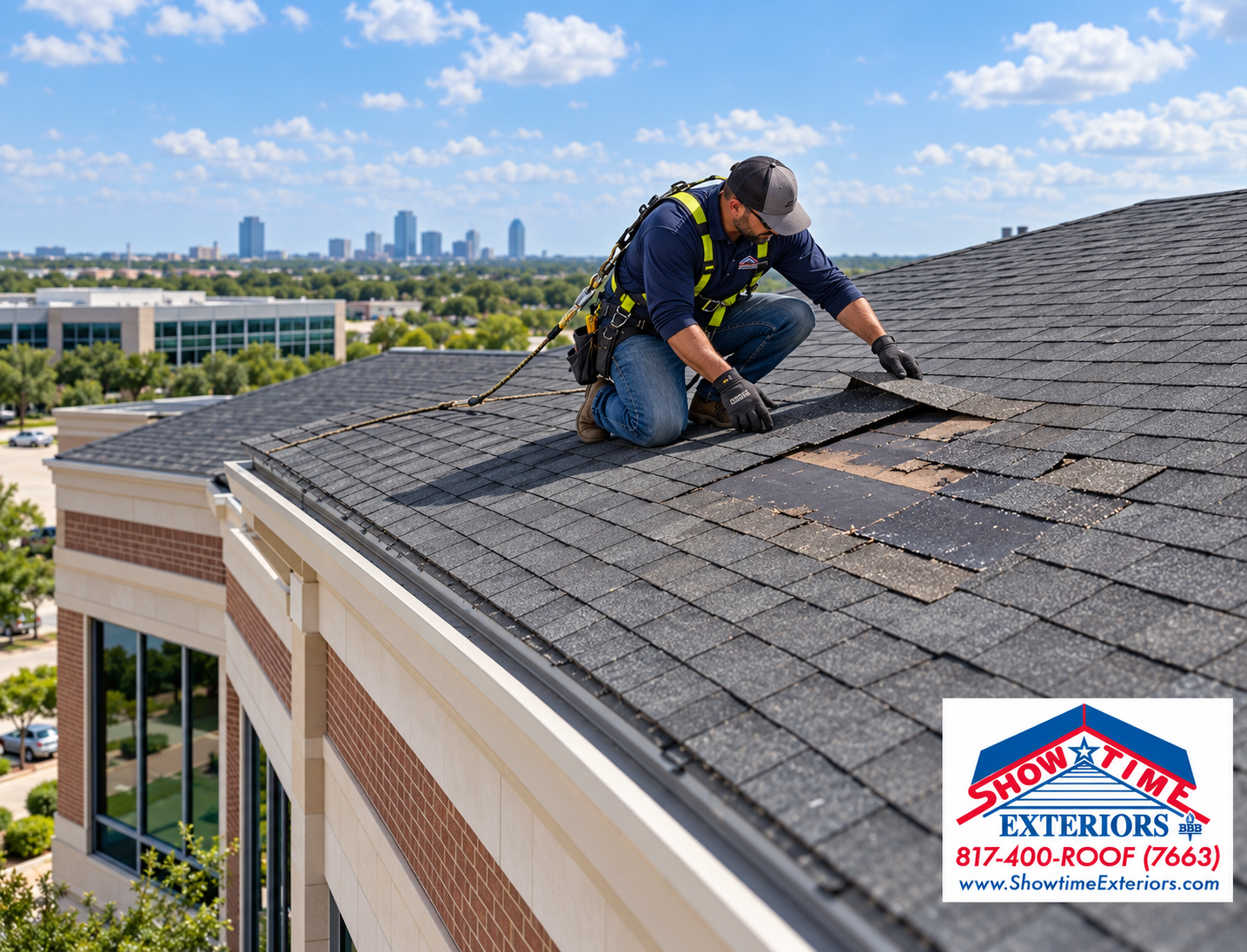
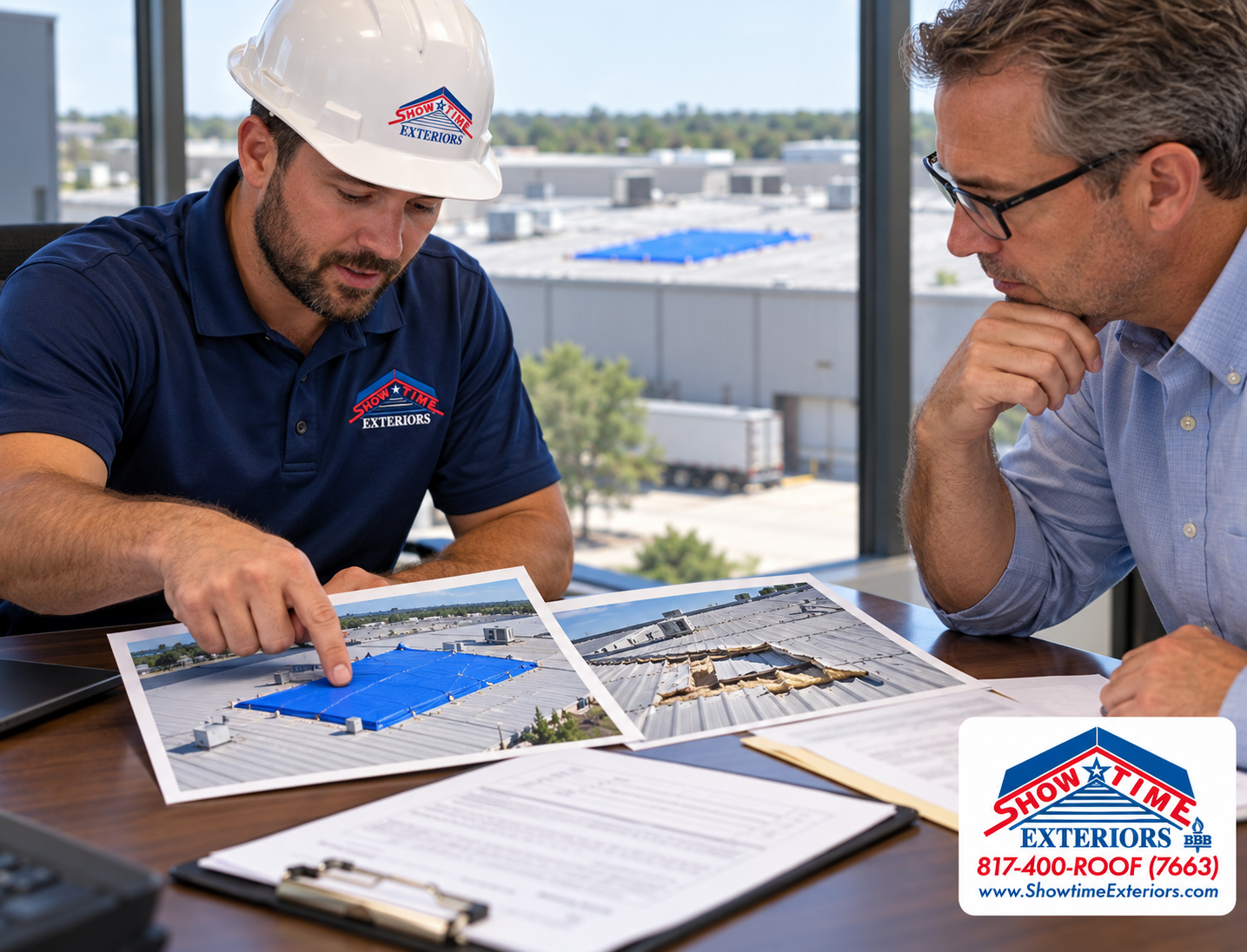
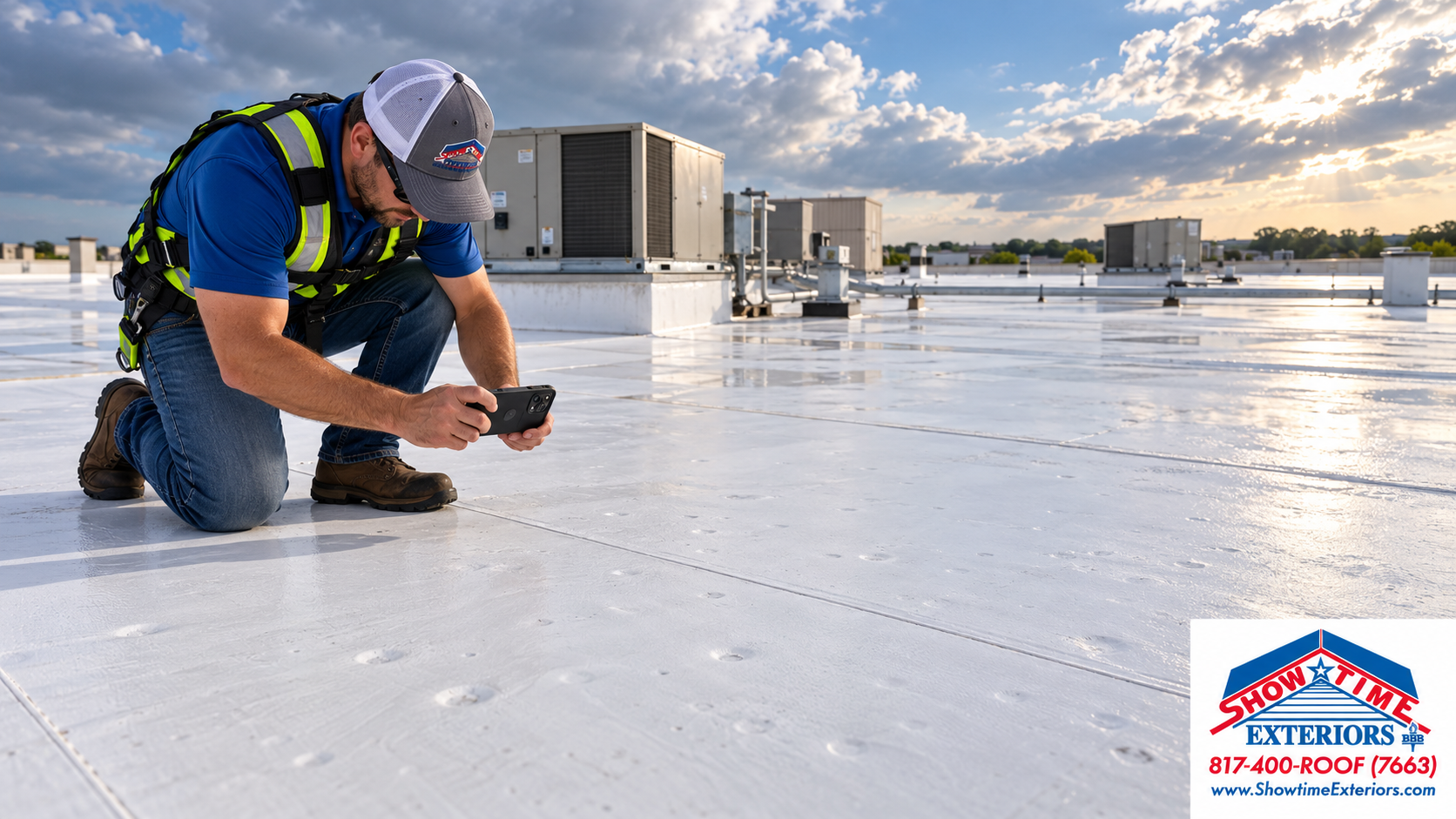
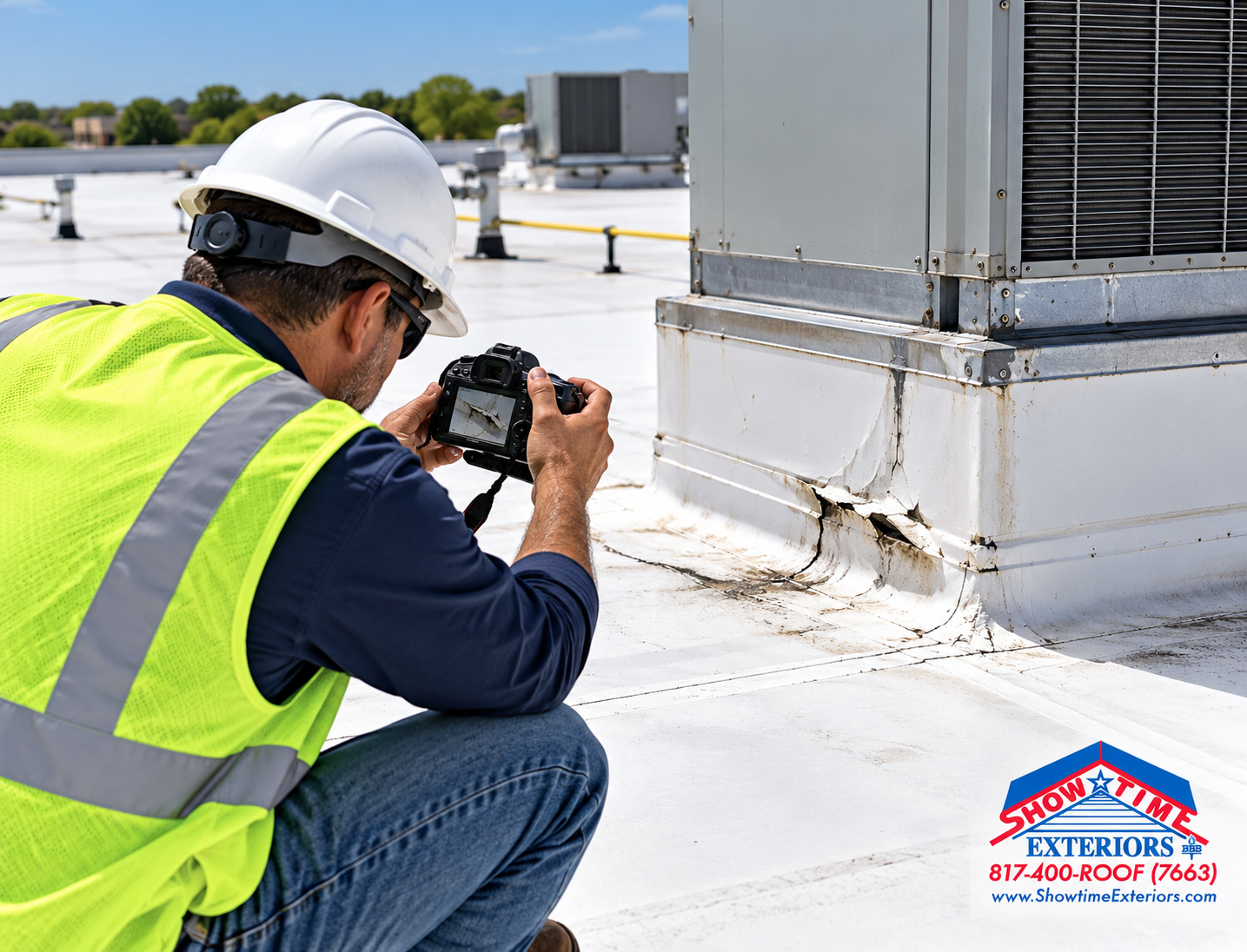
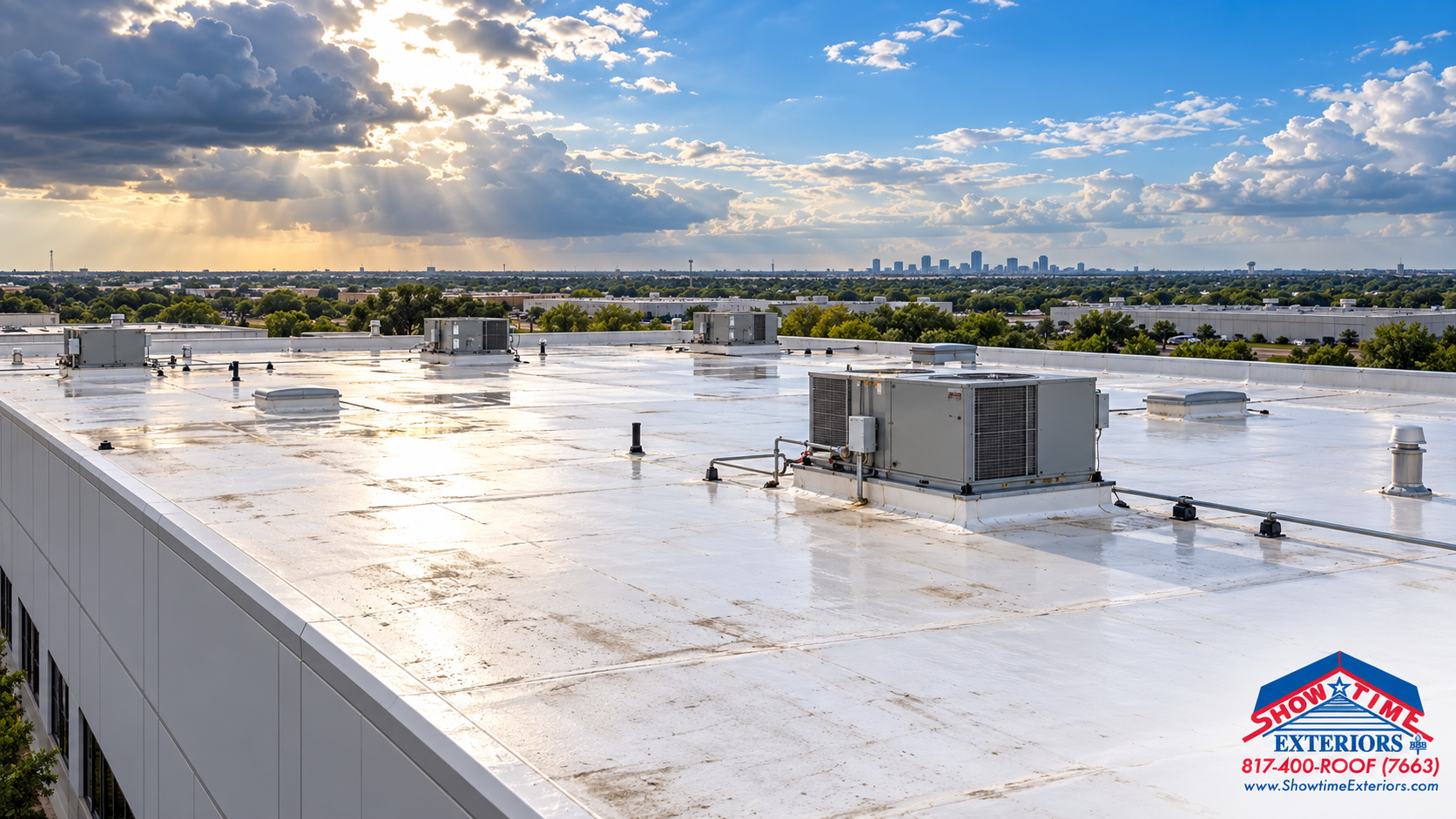
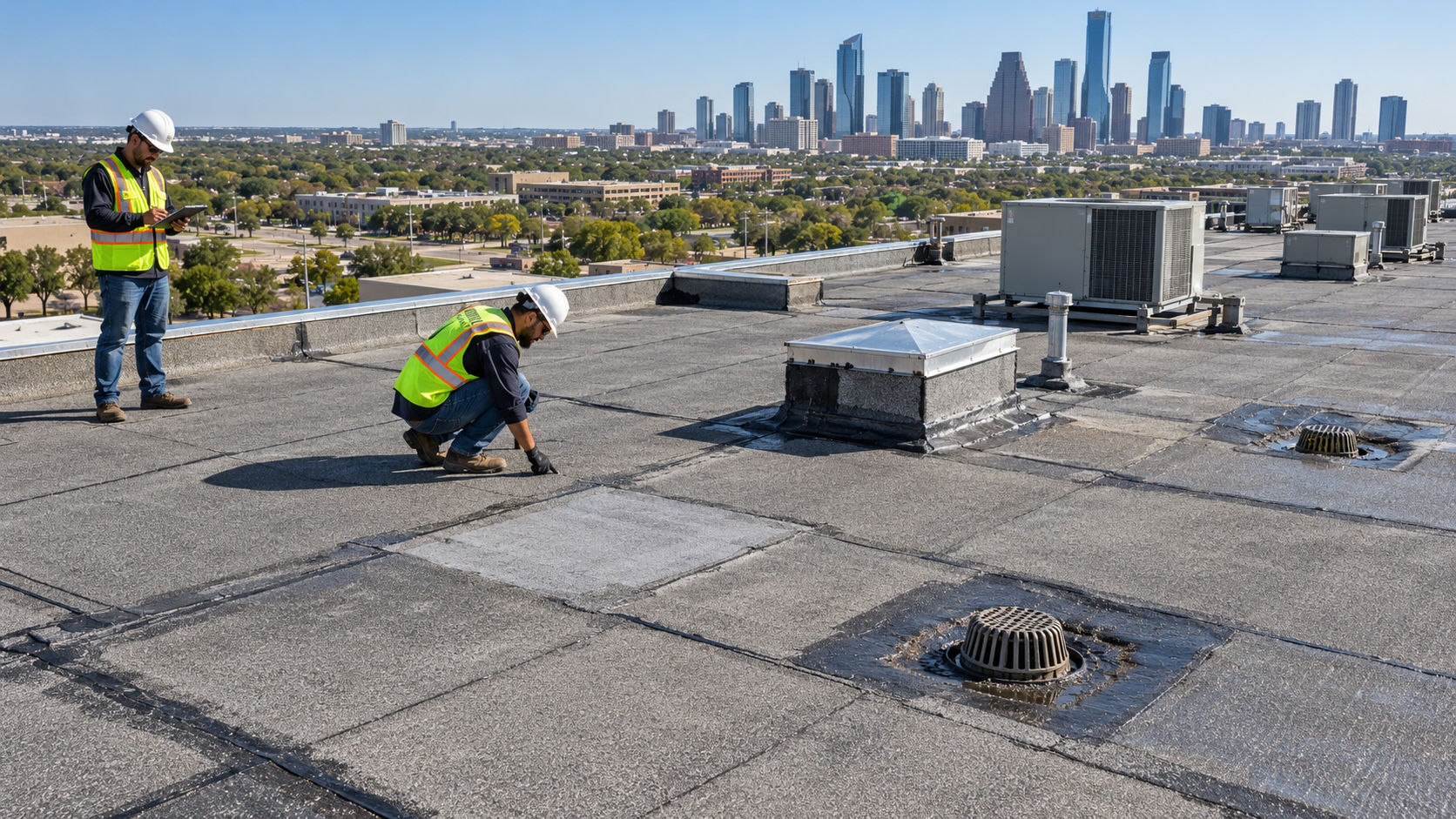
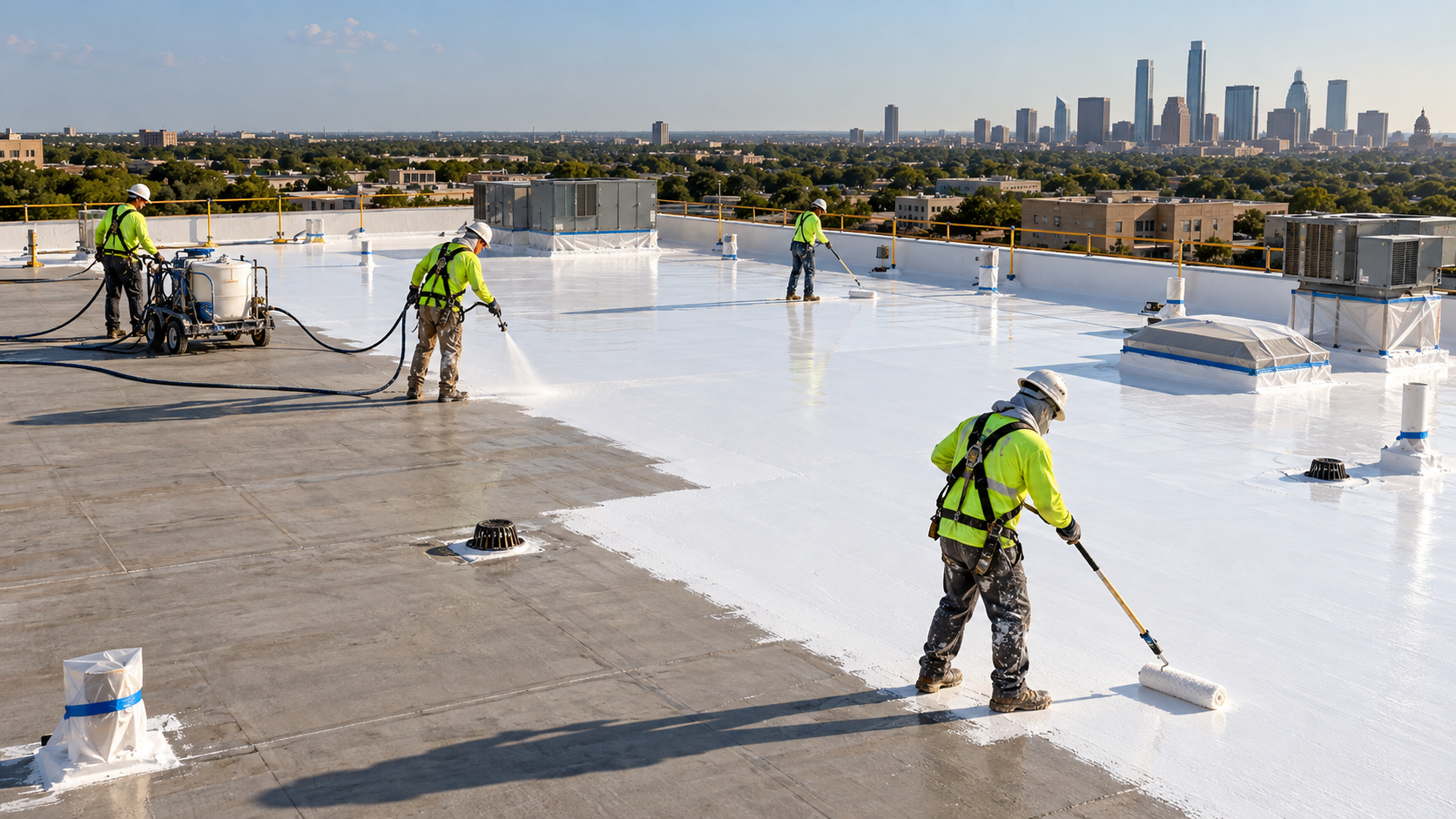
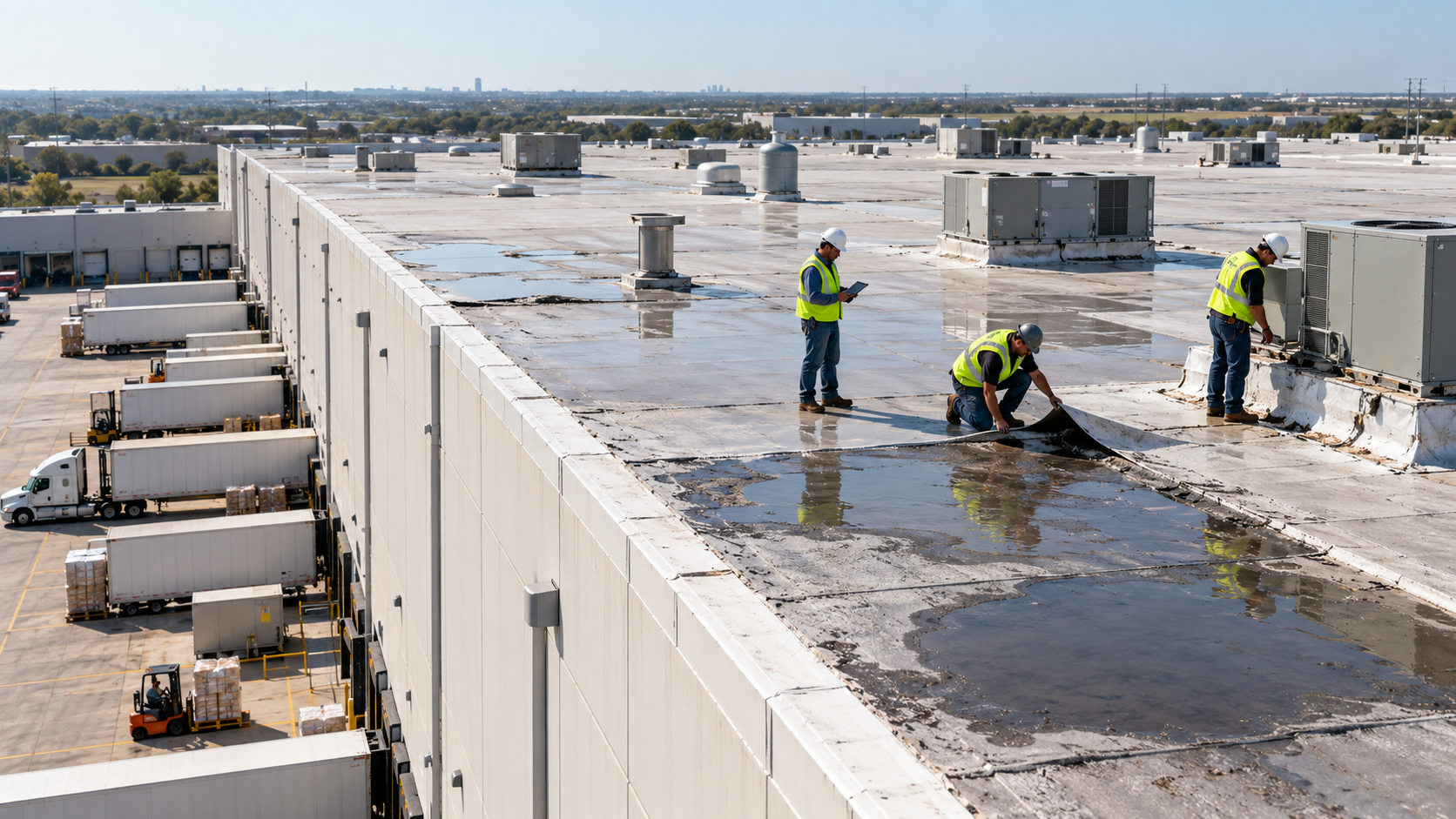
The two Showtime Exteriors images above are illustrative artwork created for this article, rather than photographs of an actual project.
1. Use the Roof’s Condition to Set the Timeline
The most useful question after a windstorm is: What is happening at the building right now?
A roof with loose edge metal above a busy entrance requires a different response from a roof with a questionable surface mark and no visible opening. An active leak above electrical equipment deserves a different priority from an old, unchanged ceiling stain.
Use the following table as a planning guide. These are practical response priorities, not insurance deadlines or guaranteed contractor arrival times.
Observed conditionSuggested responseFalling materials, suspected structural instability, or water near electrical equipmentKeep people away and seek appropriate emergency assistance immediately.Exposed roof opening, displaced roofing, or active interior leakageContact a roofing professional promptly for assessment and temporary protection when access is safe.Lifted flashing, missing shingles, displaced panels, or suspected membrane damage without a leakArrange the earliest practical professional inspection.Significant storm exposure without obvious damageSchedule a condition check, especially if the roof has known vulnerabilities.A temporary repair is already installedConfirm its limitations, monitoring needs, and the schedule for permanent work.
Do not treat a dry afternoon as evidence that the problem has resolved. The response should account for the roof’s current condition and the next period of exposure.
2. Understand What “Address the Damage” Actually Means
Addressing wind damage does not always mean completing a permanent repair immediately.
It may begin with restricting access below loose materials, relocating vulnerable inventory, calling a contractor, or arranging temporary protection. Those actions can happen while the permanent repair scope is still being developed.
For a property manager, the first milestone should be a clear assessment of immediate risk. The next milestone should be a documented plan for controlling exposure. The final milestone should be a completed repair with records that explain what was done.
Keeping these milestones separate helps prevent confusion.
For example, an owner may hear that a contractor has “taken care of the roof” when the crew has only installed an emergency patch. That patch may be useful, but the owner still needs to know whether additional work is required.
Ask for precise language:
- Is this an inspection, temporary repair, or permanent repair?
- Which conditions have been addressed?
- Which conditions remain unresolved?
- When should the next visit occur?
A clear answer makes scheduling and budgeting much easier.
3. Why Wind Damage Deserves Attention Before a Leak Appears
A leak is an important warning sign, but it is not the only measure of roof condition.
IIBEC’s guidance on roof functionality explains that a roof can have diminished functional attributes without an obvious immediate effect on performance. A building remaining dry does not, by itself, establish that the roof is undamaged. IIBEC
This matters because owners often wait for interior evidence before taking roof concerns seriously. That approach can leave an unresolved exterior condition in place until another weather event reveals it.
Suppose a contractor identifies a displaced component during an inspection. The absence of a ceiling stain does not answer whether that component is adequately secured or whether the surrounding assembly needs evaluation.
Your decision should therefore consider the inspection findings, rather than relying exclusively on the interior.
Ask the inspector to explain the practical significance of each observation. Is it cosmetic? Does it affect water protection? Does it raise a concern about attachment? Does it require additional investigation?
Those distinctions help you act promptly without assuming that every visible change requires extensive replacement.
4. Recognize the Warning Signs You Can Observe Safely
Start with observations from safe, accessible locations.
From the ground, you may notice missing shingles, displaced metal, debris that appears to have come from the roof, or a component that looks different from its previous position. Inside the building, you may notice a new stain, dripping water, or a change reported by employees.
GAF identifies lifted or missing shingles and damage around roof penetrations, flashing, soffits, and fascia as conditions worth investigating after high winds. It recommends professional evaluation when wind damage is suspected. gaf.com
Describe what you see without assigning a cause prematurely.
“Metal hanging below the west roof edge” is more useful than “the whole roof failed.” “New water stain above aisle seven” is more useful than “storm damage everywhere.”
Specific observations help the contractor prepare for the visit and prioritize the appropriate areas.
Avoid climbing onto the roof to obtain a better photograph. Do not lift roofing materials, pull on panels, or move loose components to test them. Leave close inspection and roof access to qualified professionals with appropriate safety procedures.
5. Make Safety the First Decision
Before discussing repair costs, determine whether people can safely occupy the affected area.
Loose materials above a doorway, a visibly distressed ceiling, or water around powered equipment can require immediate restrictions. Keep employees and customers away from the affected location while appropriate professionals assess it.
Do not send staff onto the roof because they know the building well. Familiarity with the property does not establish safe roof access.
Inside the building, communicate clearly. A handwritten note that says “roof issue” may not tell employees which aisle to avoid or which entrance to use. Give specific instructions and identify the person responsible for updates.
If a ceiling appears unstable, keep people out from underneath it. If water is near electrical equipment, avoid touching the equipment or surrounding wet surfaces and seek qualified assistance.
A roofing contractor can assess roofing conditions. Other hazards may require an electrician, structural professional, restoration specialist, or emergency responder.
The response works best when each concern reaches the professional equipped to evaluate it.
6. Gather Useful Information Before Calling
You do not need a complete technical report before contacting a roofer. A few accurate details can make the first conversation more productive.
Have the property address, building type, approximate roof type if known, and a short description of the concern available. Explain whether water is currently entering, whether materials appear loose, and whether occupied areas are affected.
Mention any access limitations. These might include locked roof access, tenant restrictions, delivery schedules, or equipment that requires coordination.
A useful initial message could be:
“We manage a commercial building in Mansfield. After yesterday’s windstorm, we noticed loose material at the rear roof edge and a new stain in the storage area. We have restricted access below the exterior concern. We need an assessment of immediate protection and repair needs.”
That description gives the contractor actionable information without overstating the diagnosis.
Provide a reliable on-site contact and an alternate contact. If the inspection requires approval from someone off-site, identify that person early so access and authorization do not become avoidable delays.
7. Prepare the Property for the Inspection
Before the inspector arrives, assemble the information that already exists.
Useful records may include previous roof inspection reports, installation documents, repair invoices, warranty paperwork, photographs, and a simple building plan. These records can help the inspector understand the roof’s history.
Prepare a list of current concerns by location. For a large building, “the northwest corner” may be insufficient if several roof sections or tenant spaces share that description. Use room names, suite numbers, aisle numbers, or marked photographs.
Ask staff to report what they observed and when they first noticed it. Preserve their descriptions accurately rather than rewriting them into technical conclusions.
Arrange access to relevant interior areas as well as the roof access point. A contractor who can inspect the roof but cannot enter the room with the reported leak may have an incomplete picture.
Finally, confirm who will receive the findings. One designated contact helps prevent conflicting instructions and ensures that the inspection results reach the person responsible for the next decision.
8. Expect an Inspection That Considers the Whole Building
A useful investigation should connect exterior observations with interior symptoms.
GAF describes a commercial inspection approach that begins inside the building, continues around the perimeter, and then examines the roof membrane and vulnerable details. Its guidance also notes that some apparent roof leaks can originate from problems elsewhere in the building exterior. gaf.com
For the owner, the practical lesson is to avoid assuming that the spot directly above a ceiling stain is automatically the source.
Ask the inspector to explain which areas were examined and which remained inaccessible. If the inspection covered only one roof section, the report should make that limitation clear.
A useful report should identify observations, locations, recommended actions, and unanswered questions. It should distinguish confirmed findings from conditions that require further evaluation.
Photographs should support the explanation. A collection of close-ups without location references can be difficult to use later.
The goal is a report that helps you make decisions, rather than simply confirming that someone visited the property.
9. Ask Questions That Clarify Urgency
Before approving a scope, ask the contractor to explain the order of work.
Start with immediate concerns:
- Is anything loose or exposed?
- Is temporary protection needed?
- Which areas should remain restricted?
- What could change the urgency?
- What should we monitor before the next visit?
Then ask about the inspection itself. Which roof sections were evaluated? Were the reported interior conditions examined? Is additional testing needed? Are there limitations that affect the recommendation?
Finally, ask about permanent work. What would a localized repair accomplish? What conditions would support a larger scope? What remains uncertain?
These questions encourage a concrete explanation.
“Your roof needs attention” does not tell an owner enough. “This opening needs temporary protection, this adjacent area needs further evaluation, and these unrelated maintenance items can be scheduled separately” provides a basis for action.
Request the recommendations in writing. Written priorities help an owner, manager, tenant, and contractor work from the same understanding.
10. Document Conditions Without Delaying Necessary Protection
Photographs and records are useful, but documentation should not create additional exposure or place someone in danger.
The Texas Department of Insurance recommends photographing damage, making temporary repairs to prevent additional damage, and keeping repair records and receipts. It also advises reporting damage promptly and coordinating permanent repairs with the insurance inspection process. tdi.texas.gov
For a commercial property, a practical record should include the building address, observation date, location of the concern, and a brief description.
Where it is safe, take both context photographs and closer views. A wide image helps identify the location; a closer image helps show the condition.
Keep original files. Avoid replacing the originals with edited images that remove surrounding context.
Record the storm date separately from the discovery date. If you first noticed a stain several days after a storm, say so. Do not imply that you observed damage during the storm if you did not.
Accurate chronology is more useful than a confident but unsupported story.
11. Build a Simple, Usable Damage File
Create a folder that another person could understand without a lengthy explanation.
A practical structure is:
- Property information and contacts.
- Storm and discovery chronology.
- Exterior and interior photographs.
- Inspection findings.
- Temporary protection records.
- Estimates and permanent repair documents.
- Relevant correspondence.
Name files consistently. A filename such as “2026-10-07_Warehouse_Aisle-7_Ceiling.jpg” is easier to locate than “IMG_4821.jpg.”
Keep a short index describing what each group of photographs shows. For a large property, use a marked building plan to connect images with roof sections and interior spaces.
Include communications that explain changes in the plan. If the contractor recommends additional investigation after opening an area, preserve that recommendation and the reason for it.
This organization serves more than a potential claim. It also helps future maintenance, ownership transfers, budget planning, and follow-up inspections.
The objective is a reliable property record that remains useful after the immediate storm response ends.
12. Notify the Insurer Without Assuming Coverage
If you intend to seek insurance coverage, contact your insurer or agent promptly and ask for instructions specific to your commercial policy.
Do not wait for a polished report if that would delay the initial notice. You can describe the known facts and explain that professional evaluation is pending.
Ask what documentation is needed, how inspection will be arranged, and how urgent protective work should be handled. Request written clarification of applicable notice requirements and deadlines.
Avoid assuming that every commercial policy uses the same reporting period, valuation method, deductible, or exclusion. Likewise, a contractor’s repair recommendation does not establish what the insurer will pay.
Keep roofing decisions and coverage decisions clear. The contractor evaluates roof conditions and proposes work. The insurer evaluates the claim under the policy.
If you are uncertain about a policy requirement, obtain clarification from the insurer, agent, or an appropriately qualified adviser. Document the response so the person managing the property can follow it consistently.
13. Understand the Purpose of Temporary Protection
Temporary protection should address a defined exposure while the permanent plan is being developed.
Ask the contractor to identify the area being protected, the method used, and any remaining limitations. A temporary measure should not leave the owner guessing about whether the roof is ready for normal service.
For commercial roofing, avoid assuming that a generic tarp is appropriate for every assembly or every location. The professional should select a method suited to the actual condition.
Obtain a written description of the work and retain before-and-after photographs where available.
Also ask about follow-up. Who should inspect the temporary work after additional weather? What changes should prompt another call? Does the temporary work need to be removed or incorporated when permanent repairs begin?
If the repair schedule is uncertain, request a specific next communication date.
A temporary repair is most useful when it comes with a plan. Without that plan, an owner may mistake an interim measure for a completed project and lose track of unresolved work.
14. Decide Whether a Localized Repair Is Appropriate
Wind exposure does not automatically mean full roof replacement is necessary.
A localized repair may be worth evaluating when the identified problem is limited and the surrounding roof can support a suitable repair. The contractor should explain how the proposed work addresses the observed condition.
Ask what will be removed, what will remain, and how the repaired area will connect with the existing system. If the scope addresses only the visible symptom, ask whether the cause has also been evaluated.
For example, replacing a displaced component may be appropriate, but the owner still needs to understand why it moved and whether nearby components require attention.
Request a clear boundary for the repair. “Repair storm damage” is too vague for comparing proposals or verifying completion.
Also ask what would trigger a change in scope. If concealed conditions cannot be evaluated until work begins, the estimate should explain how discoveries will be documented and how additional work will be authorized.
15. Evaluate Restoration or Replacement With Evidence
A broader scope should come with a broader explanation.
If restoration is proposed, ask why the existing roof is a suitable candidate and what preparation is required. If replacement is proposed, ask which findings support that recommendation and whether alternative scopes were considered.
Do not make the decision solely from the roof’s age, the severity of a weather report, or the appearance of one photograph.
A commercial roof evaluation should help determine whether repair or replacement is appropriate for the actual roof condition. GAF’s guidance treats inspection as part of that decision-making process. gaf.com
For owners, the useful comparison is between defined scopes.
Compare the work each option includes, unresolved conditions, expected disruption, warranty terms, and exclusions. Ask how each option addresses the identified damage.
An expensive proposal may still omit important work. A lower-priced proposal may be sufficient for a limited problem. The written scope and supporting findings are what allow a meaningful comparison.
16. Know When Additional Testing May Help
Some inspection questions cannot be resolved by photographs alone.
When a professional recommends testing, ask what question the test is intended to answer. A test should have a defined purpose, an appropriate method, and a plan for interpreting the result.
IIBEC identifies several evaluation methods used by professionals, including water testing, wind uplift testing, infrared thermography, and moisture surveys. These methods examine different aspects of roof condition and should be considered in context with other findings. IIBEC
For the owner, the important distinction is between locating a condition and establishing its cause. A finding that suggests moisture does not automatically establish when that moisture entered or which event caused it.
Ask whether additional confirmation is needed and whether testing will disturb the roof. If openings are required, clarify how they will be repaired and documented.
Do not attempt improvised testing by pulling on materials or flooding an area. Leave method selection and execution to qualified professionals.
17. Keep the Building Operating Around the Response
Commercial roof work needs an operational plan.
Identify the activities most sensitive to disruption. A restaurant may need coordination around food preparation and deliveries. A warehouse may need access to loading areas. An office property may need advance notice for tenants.
Provide the contractor with these constraints early, while recognizing that urgent protection may require changes to the preferred schedule.
Agree on work areas, access routes, staging locations, and communication procedures. Make sure temporary restrictions remain visible and understandable.
Assign one person to communicate operational changes to employees or tenants. That person should receive contractor updates and translate them into practical instructions.
For example, “Use the east entrance until the exterior restriction is removed” is clearer than “Roof work is happening today.”
If affected inventory or equipment must be moved, record the location and responsible person. Avoid creating a second operational problem by relocating items without tracking them.
The aim is to protect the building while keeping necessary activities organized.
18. Compare Estimates by Scope, Not Just Price
An estimate is useful only if you understand what it includes.
Ask for the affected roof area, materials, preparation, attachment or flashing work, cleanup, and any related work to be described clearly. Confirm whether temporary protection is included in the price or billed separately.
Review exclusions carefully. Access equipment, concealed damage, interior restoration, testing, permits, or work by other trades may require separate coordination.
Ask how additional work will be handled. A defined authorization process helps prevent confusion when an unexpected condition is discovered.
When comparing bids, place the scopes side by side. If one proposal covers only a small repair and another includes substantial replacement, the price difference alone tells you very little.
Also clarify scheduling assumptions. When could work begin? What approvals or materials are needed? What weather conditions could affect progress?
A responsible estimate should help you plan the project. It should not rely on a promise of guaranteed insurance payment or an unexplained assertion that the most expensive option is the only acceptable one.
19. Review Warranty Documents Before Permanent Work
If the roof has an existing warranty or guarantee, locate the actual documents.
Do not rely on a remembered warranty length or a sticker on a maintenance folder. Read the provisions that apply to reporting concerns, maintenance, authorized repairs, and exclusions.
GAF notes that documented inspections and maintenance can be important to preserving coverage under certain roof guarantees. The requirements should be checked against the specific documents for the building. gaf.com
Ask whether the manufacturer or warranty provider needs notice and whether proposed work requires approval. Keep the answer with the project records.
An existing warranty does not eliminate the need for immediate protective action. It does, however, create another coordination step that should be addressed promptly.
Also ask about the warranty for the new work. What is covered? Who provides the coverage? What documentation will you receive?
Separating the existing roof warranty from the repair warranty prevents assumptions that one automatically replaces, extends, or duplicates the other.
20. Manage the Period Between Inspection and Repair
Once an inspection has occurred, do not let the project disappear into an undefined waiting period.
Agree on the next action, the responsible person, and the expected communication date. If materials or approvals are pending, identify those dependencies explicitly.
Ask the contractor what should be monitored while the permanent work is outstanding. Give staff a simple reporting process for new leaks, changed stains, or other concerns.
Maintain a log with dates, locations, photographs, and actions taken. Avoid requiring employees to diagnose the roof. Their role is to report observable changes.
Review approaching weather with the contractor if a known exposure remains. Ask whether the interim plan needs adjustment.
If the original appointment is delayed, obtain an updated plan rather than assuming the temporary work remains adequate indefinitely.
This period requires active management. The inspection provides information, but unresolved conditions still need a schedule and someone accountable for moving the work forward.
21. Close the Project With Records You Can Use
Permanent work should end with a clear handoff.
Request a description of the completed work, final photographs, warranty information, and any recommended maintenance or follow-up. Confirm whether all items in the approved scope were completed.
If the scope changed, retain the supporting observations and written authorization. The final invoice should be understandable in relation to the work performed.
Ask whether any conditions remain outside the completed scope. An owner should not discover later that a known concern was deferred without a clear record.
Confirm that access restrictions can be removed and that staging areas have been cleared. Update staff and tenants so temporary instructions do not remain in circulation after they are no longer needed.
Place the closeout documents in the property’s permanent roof file.
A well-documented closeout makes the next inspection easier. It also helps a future manager understand which areas were repaired, what materials were used, and what responsibilities continue after the contractor leaves.
22. Avoid Common Decisions That Create Confusion
Several mistakes can complicate an otherwise manageable response.
One is waiting for a leak before requesting an inspection. Another is approving a major project before understanding the findings. Both bypass useful information.
Owners also create difficulties by using unclear authorization. “Do whatever is needed” can mean different things to different people. Define emergency authority, permanent scope, and the process for additional work.
Another problem is allowing several people to give conflicting instructions. Designate a primary contact and make sure everyone knows who can approve changes.
Avoid overstating damage in photographs, notes, or communications. Accurate records are easier to defend and more useful for repair planning.
Finally, do not confuse a completed visit with a completed project. An inspection, a temporary patch, and a permanent repair are different milestones.
The best response keeps each milestone visible, with a clear next step until the work is closed.
Frequently Asked Questions
Can I wait until the next rain to see whether the roof leaks?
If you have observed displacement, an opening, or another credible concern, arrange an inspection rather than using rainfall as a test. Ask a professional to assess the condition and recommend whether protection or repair is needed.
Does every windstorm justify a full roof replacement?
No. The scope should follow the findings. Request an explanation of why repair, restoration, or replacement is recommended for your particular roof.
Should I call the roofer or insurer first?
If there is an immediate hazard or exposed opening, prioritize safety and appropriate protective assistance. If you intend to make a claim, notify the insurer promptly as well. These actions can proceed in parallel.
How soon should permanent repairs begin?
That depends on the condition, interim protection, access, materials, approvals, and weather. Ask for a written schedule and an explanation of how the building will be protected until work is complete.
What if the damage is discovered weeks after the storm?
Document the discovery date accurately, arrange evaluation, and contact the insurer if you intend to report a claim. Do not assume that the storm date and discovery date are interchangeable.
Is a temporary repair enough?
It may control an immediate exposure, but you need to know whether permanent work remains necessary. Ask for written limitations, monitoring instructions, and the next step.
What should I do if the first report is unclear?
Request clarification of the observations, locations, scope, and urgency. For a substantial or disputed project, an additional qualified evaluation may help resolve specific unanswered questions.
Get a Clear Plan for Your Wind-Damaged Roof
Suspect wind damage at your Texas commercial property? Contact Showtime Exteriors to discuss an inspection and the next steps for your roof.
Explain what you have observed, whether water is entering, and which areas of the building are affected. Ask about immediate protection needs, inspection availability, and a written repair recommendation.
Taking action promptly gives you a better basis for protecting the property and planning the work.
Call Showtime Exteriors: 817-400-ROOF (7663)
Visit
ShowtimeExteriors.com
Image caption — roof inspection:
“Loose roofing after a windstorm deserves prompt attention. Contact Showtime Exteriors to discuss an inspection and a plan for protecting your commercial property. Call 817-400-ROOF (7663).”
Image caption — interior inspection:
“A new ceiling stain is a reason to investigate. Document the location, protect the affected area, and contact Showtime Exteriors for your next steps. Visit ShowtimeExteriors.com.”