



Flat Roof Repair Houston
How to Find the Leak Choose the Right Repair and Know When Replacement Is Necessary
Houston property owners should address a leaking flat roof immediately, but the permanent solution should follow a professional diagnosis. A ceiling stain shows where water reached the interior; it does not necessarily identify where water entered the roof. On a low-slope commercial assembly, moisture can travel through insulation, along the deck, around curbs, across structural members, or beside conduits before becoming visible below.
Showtime Exteriors provides commercial roof inspections, repairs, restoration, coatings, retrofit planning, and replacement for Texas properties, including completed work in Houston. The company evaluates TPO, PVC, EPDM, modified bitumen, metal, coated systems, overlays, and aging built-up roofs. That range matters because flat roof repair in Houston is not one product or one procedure. The right scope depends on the existing system, defect, moisture, substrate, drainage, attachment, building use, and remaining service life.
This guide explains how to respond to an active leak, what a professional inspection should document, how different flat roofing systems are repaired, what affects cost, when restoration may be appropriate, and when continued patching should give way to replacement. It also reflects David’s central campaign position: aging gravel-surfaced built-up roofing should be treated as a risk requiring proactive evaluation, not described as an advantage.
What Flat Roof Means in Commercial Roofing
Most commercial roofs described as flat are actually low-slope roofs designed to move water toward drains, scuppers, gutters, or roof edges. The slope may be created by the structure, tapered insulation, lightweight fill, or a combination of components. A roof that appears level from the ground can contain multiple drainage zones, saddles, crickets, sumps, transitions, and overflow paths.
The waterproofing layer may be a thermoplastic membrane such as TPO or PVC, a thermoset membrane such as EPDM, an asphalt-based modified bitumen system, a coated metal roof, a liquid-applied reinforced system, or another low-slope assembly. Each system has different seams, flashings, attachment methods, surface conditions, repair materials, and manufacturer requirements. A contractor must identify what is present before choosing a patch.
Calling every assembly a flat roof is convenient for search, but it can hide important differences. White membrane does not automatically mean TPO. A black surface does not automatically mean EPDM. Coating can cover an older membrane or metal substrate. Gravel can conceal an aging built-up membrane. An accurate repair begins with system identification and an understanding of how the complete assembly manages water, movement, heat, wind, and rooftop activity.
Why Houston Flat Roofs Need Prompt Attention
Houston’s climate exposes commercial roofs to prolonged heat, ultraviolet radiation, humidity, intense rainfall, wind-driven rain, thunderstorms, tropical weather, and occasional hail. Roof surfaces expand and contract as temperatures change. Sealants age. Seams and flashings experience movement. Strong winds can stress perimeters and rooftop components. Heavy rain quickly reveals blocked drains, insufficient slope, displaced strainers, or details that remain dry during lighter weather.
Heat and sunlight can also accelerate the aging of exposed materials. Reflective roofs may reduce solar heat gain, but reflectivity does not eliminate the need for inspection or repair. Dirt, biological growth, standing water, traffic, incompatible products, and neglected details can reduce performance. The energy characteristics of a roof are only one part of its value; waterproofing continuity, drainage, attachment, durability, and maintenance access remain essential.
Prompt attention does not mean authorizing permanent work without evidence. It means protecting people and property, documenting the condition, arranging safe professional access, and developing the permanent scope before the defect expands. Delayed response can allow moisture to affect insulation, decking, interior finishes, inventory, electrical systems, equipment, tenant spaces, and operations. Even a small visible drip can represent a larger concealed wet area.
Immediate Steps When a Flat Roof Is Leaking
Life safety comes first. Keep employees, tenants, customers, and residents away from wet electrical fixtures, sagging ceiling materials, fallen debris, slippery floors, or any area that appears unstable. Move vulnerable inventory and equipment only when it can be done safely. Use interior containers and temporary protection to limit secondary damage. Notify facility leadership, property management, security, and other required contacts.
Document the time, weather, affected room, ceiling location, flow pattern, damaged contents, and actions taken. Capture wide photographs that establish the room and close photographs that show specific damage. Record video when it helps demonstrate active water movement. Preserve emails, tenant reports, weather notices, maintenance logs, prior roof reports, warranty documents, and repair invoices. Do not discard damaged materials before documentation unless safety or loss mitigation requires removal.
Do not send untrained personnel onto a wet, windy, dark, or storm-active roof. Flat roofs can contain hidden openings, weak decking, slippery membranes, unsecured debris, electrical hazards, and unprotected edges. Once weather and access permit, a qualified roofing team can evaluate the roof, preserve drainage, stabilize an opening, and map temporary work. Emergency stabilization should be identified as temporary and followed by a dry-weather investigation.
Why the Leak May Not Be Directly Above the Stain
Water follows available pathways rather than a straight vertical line. It may enter at a curb, penetration, seam, edge, drain, wall transition, or equipment detail and travel horizontally through the roof assembly. It can move between insulation boards, along metal deck flutes, over a vapor retarder, beside conduits, or across structural framing. The location where water becomes visible may be the lowest exit point rather than the entry point.
Wind-driven rain makes the investigation more complicated. An opening that leaks during a storm from one direction may remain dry during ordinary rainfall. Condensation can also resemble roof leakage, particularly around HVAC equipment, cold pipes, air leakage paths, and poorly controlled interior humidity. Plumbing, mechanical systems, wall assemblies, windows, and exterior cladding can introduce water near the roof line.
A good investigation connects interior observations with rooftop conditions and recent weather. It does not assume that the nearest visible roof defect caused the leak. The contractor should document probable pathways, explain uncertainty, and identify additional testing when the source cannot be confirmed through visual inspection alone.
What a Professional Flat Roof Inspection Should Cover
A useful inspection records the property, roof areas, inspection date, weather, access, system type, approximate age if known, visible layers, attachment clues, prior repairs, surface condition, drainage, seams, flashings, penetrations, curbs, walls, transitions, perimeter details, rooftop equipment, walkways, and interior evidence. Photographs should include orientation and location instead of appearing as an unexplained collection.
The inspector should examine drains, scuppers, gutters, downspouts, strainers, overflow routes, and visible slope. Ponding, debris, compressed insulation, displaced pavers, damaged supports, or earlier construction changes can redirect water. Perimeters and corners deserve careful review because wind pressure can be greater in those zones. Equipment curbs, pipe penetrations, skylights, hatches, expansion joints, walls, and roof-to-roof transitions are common concentrations of detail work.
The report should distinguish observation from conclusion. Open seams, punctures, loose flashing, corrosion, blisters, stains, displaced edge metal, failed coating, wet areas, and accumulated water are observable conditions. Probable cause, urgency, repairability, and recommended scope require professional judgment. If hidden moisture or deck deterioration is suspected, the report should explain what further evaluation may be appropriate and what authorization is required.
Tools Used to Investigate Flat Roof Leaks
Visual inspection is the starting point, not always the ending point. Contractors may use roof plans, marked photographs, probes, seam checks, moisture meters, controlled water testing, infrared surveys, electrical capacitance methods, or authorized test cuts depending on the assembly and question. Each method has limitations. No device can replace interpretation, and a reading does not automatically identify the exact opening.
Infrared surveys can help locate thermal patterns associated with possible moisture under suitable conditions, but results depend on roof construction, weather, surface temperature, insulation, ballast, and timing. Verification may still be required. Handheld meters can help compare areas but may be affected by materials and depth. Water testing should be controlled so it does not create additional damage or confuse separate drainage zones.
Destructive testing should never be performed without permission. Test cuts can reveal layers, adhesion, insulation condition, and deck information, but the locations must be selected, documented, and permanently repaired. The investigation plan should match the decision at hand. A localized leak may need focused evaluation, while a restoration or replacement decision may justify broader moisture mapping and assembly verification.
When a Targeted Flat Roof Repair Makes Sense
Targeted repair is often appropriate when the defect is localized, surrounding materials remain serviceable, the substrate can support the work, moisture can be removed within a defined area, compatible materials are available, and the remaining roof life justifies investment. Examples include a puncture, short open seam, failed flashing segment, isolated penetration problem, displaced edge component, drain detail failure, limited coating defect, or localized equipment-related damage.
The scope should state more than “patch roof.” It should define surface preparation, removal of loose or incompatible material, opening of the affected area when necessary, replacement of wet insulation or damaged substrate within the authorized limits, reinforcement, membrane or coating tie-in, fastening or adhesion, termination, quality checks, cleanup, photographs, and follow-up.
A durable repair reaches sound material around the defect and corrects the pathway. Material applied over dirt, moisture, loose gravel, biological growth, failed coating, deteriorated membrane, or moving components is unlikely to perform as intended. If drainage or equipment movement created the condition, the scope should address that contributing factor or clearly explain the work required from another trade.
TPO Flat Roof Repair in Houston
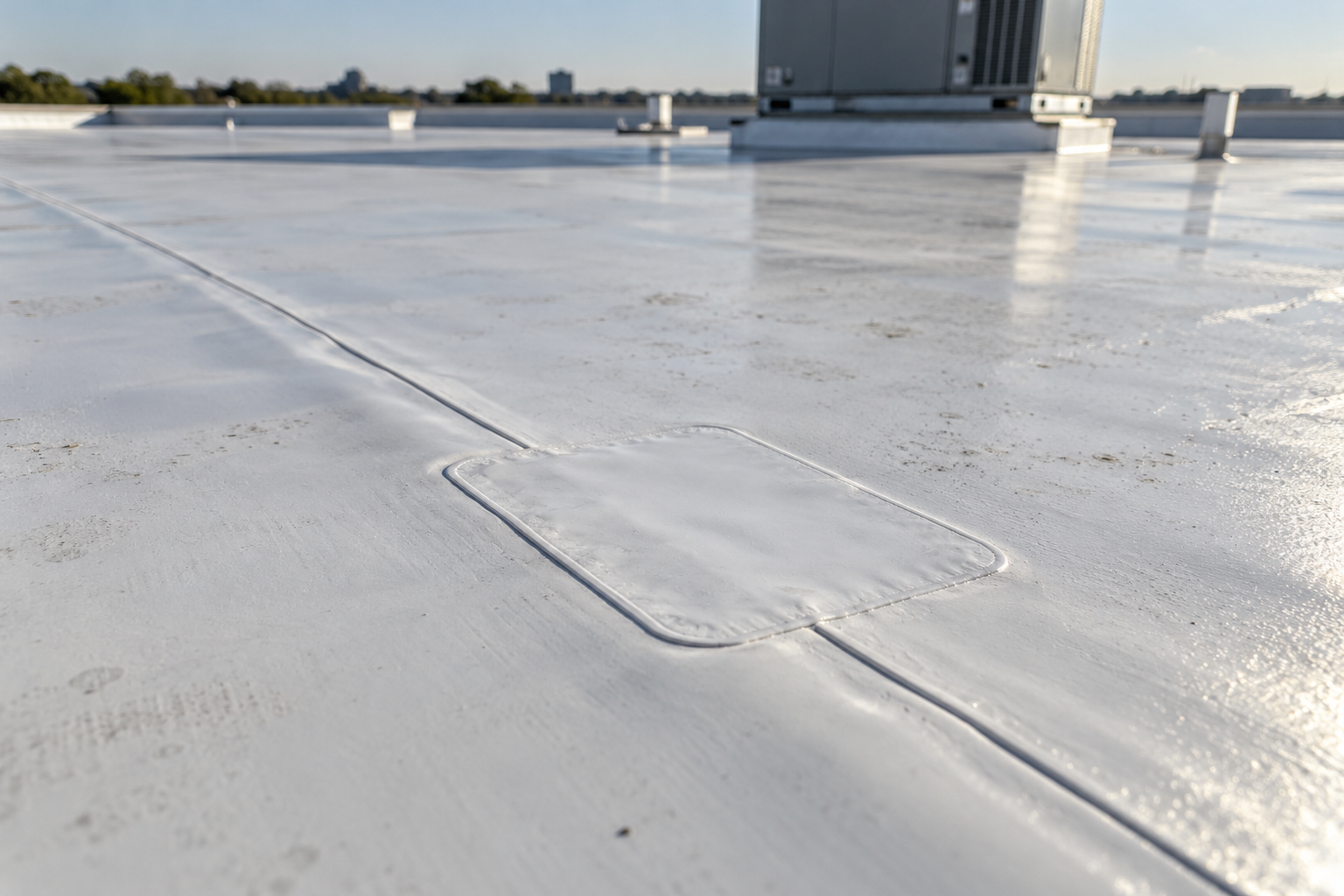
TPO is a thermoplastic membrane commonly used on low-slope commercial roofs. Its field and flashing seams are typically heat welded. Repair conditions may include punctures, cuts, open welds, stressed corners, deteriorated sealant at specific terminations, damaged flashings, displaced edge components, traffic wear, and defects around curbs or penetrations. The contractor should confirm the membrane, age, thickness, contamination, attachment, and substrate before repair.
Proper preparation is critical. The work area may need cleaning, removal of loose material, and specialized preparation based on membrane condition. Compatible TPO membrane and accessories should be tied into serviceable material using appropriate welding and detailing methods. Generic roof cement, incompatible sealant, or an unidentified liquid patch can contaminate the surface and make later repair more difficult.
Seams and patches should receive applicable quality checks after cooling. Wet insulation and deteriorated cover board should not be trapped below a cosmetic patch. Where mechanical contractors repeatedly cross the same route, walkways or traffic controls may be appropriate. A TPO repair should restore waterproofing continuity and become part of the roof record, including location, dimensions, products, date, and photographs.
PVC Flat Roof Repair in Houston
PVC is also a heat-welded thermoplastic membrane, but it is not interchangeable with TPO. The two materials have different formulations, accessories, performance characteristics, and compatibility requirements. A white surface alone cannot identify the membrane. The contractor should review available records, manufacturer markings, welding response, and other system clues before selecting repair materials.
PVC may be chosen for facilities where grease, chemicals, or particular contaminants matter, but actual compatibility must be confirmed for the exposure. Restaurants, food facilities, laboratories, manufacturing properties, and buildings with specialized exhaust can create conditions that affect membrane and flashing performance. A repair should address contamination, seams, penetration details, drainage, and the source of the exposure.
As with TPO, punctures, open seams, stressed flashings, edge conditions, and equipment-related damage may be repairable when the surrounding assembly is sound. Surface cleaning and preparation, compatible membrane, proper welds, and detailed quality control are essential. If deterioration, moisture, or adhesion loss is widespread, localized repairs may no longer provide the best lifecycle value.
EPDM Flat Roof Repair in Houston
EPDM is a flexible thermoset rubber membrane with repair methods that differ from heat-welded thermoplastics. Seams and flashings may use primers, tapes, adhesives, uncured flashing products, cover strips, and termination components selected for the system. Common conditions include punctures, open seams, membrane shrinkage, stressed walls or curbs, failed terminations, damaged flashing, contamination, and defects around drains or penetrations.
An EPDM repair requires clean, dry, properly prepared material. The contractor must identify the affected components and use compatible products in the required sequence. An unidentified sealant smeared over an open seam may stop water briefly but leave a weak, uninspectable detail. Shrinkage or movement should be evaluated because it can place continuing stress on edges, penetrations, and terminations.
If the membrane has become brittle, heavily contaminated, extensively patched, poorly attached, or associated with widespread wet insulation, a larger corrective program may be more appropriate. The decision should consider the roof’s remaining service life and the building’s risk tolerance, not simply whether another patch can be installed.
Modified Bitumen Flat Roof Repair
Modified bitumen is an asphalt-based sheet roofing system available in different products, surfacing types, and installation methods. Repair planning should identify the membrane, reinforcement, surface, number of visible layers, existing coatings, attachment, lap construction, flashing details, and safe installation method. Typical problems can include splits, blisters, punctures, open laps, deteriorated flashings, surface wear, and failed prior repairs.
Loose granules, dirt, moisture, oxidation, incompatible coatings, and aged material can interfere with adhesion. Preparation may require clearing the area, removing unsound material, correcting the substrate, priming where specified, installing compatible reinforcement or membrane, and completing a secure tie-in. The proposed method should respect fire safety, building operations, and manufacturer requirements.
A blister should not automatically be cut or covered without understanding its contents and cause. Some conditions involve trapped air, vapor pressure, moisture, poor adhesion, or movement. Broad deterioration, repeated splitting, wet insulation, or unstable substrate may make isolated repair less reliable. The owner should compare repair with restoration or replacement based on condition and remaining value.
Coated Flat Roof Repair and Restoration
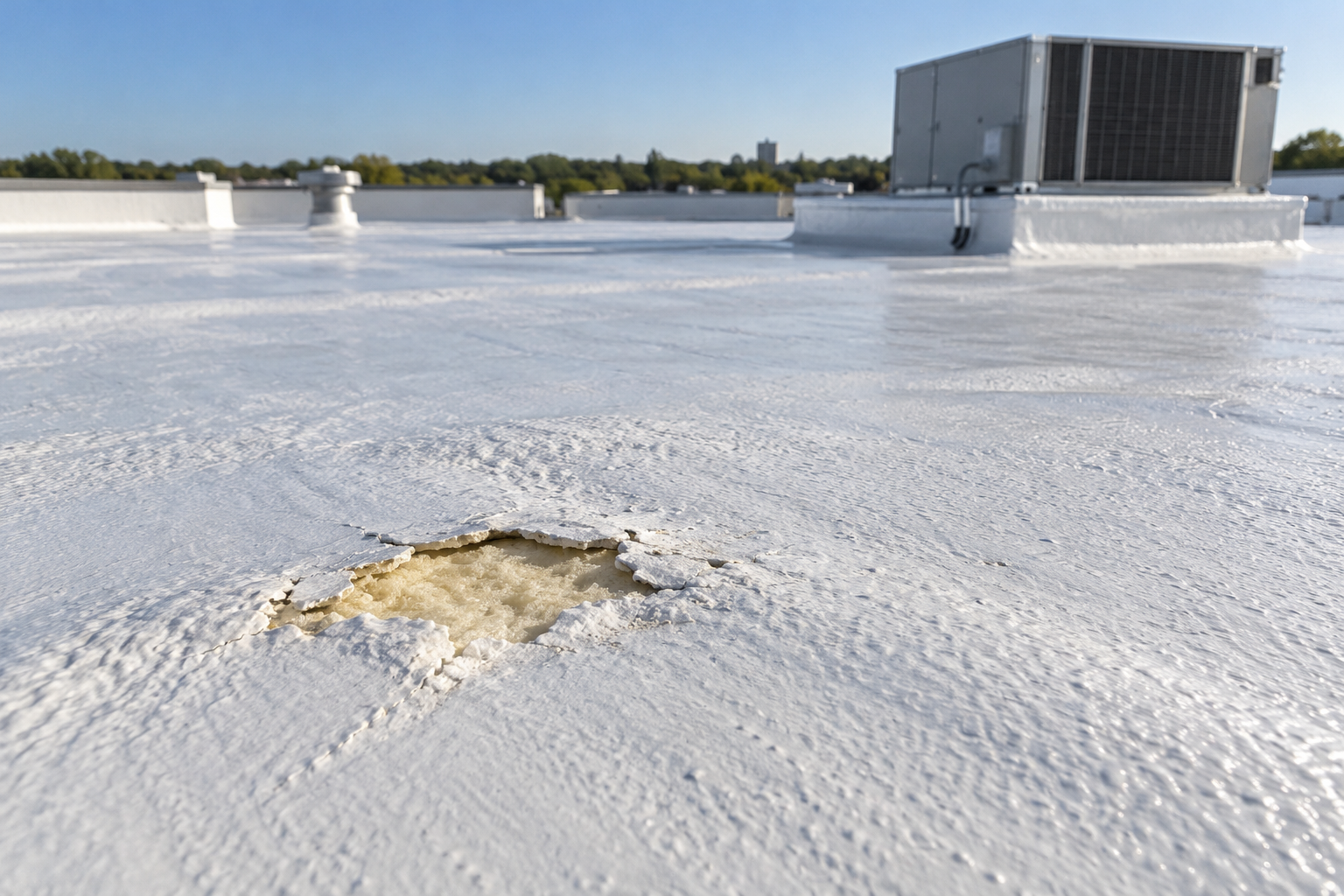
A roof coating is a system, not ordinary paint. Before repairing or recoating, the contractor should identify the coating family when possible, assess adhesion and thickness, inspect for cracks, pinholes, worn areas, dirt, biological growth, ponding exposure, reinforcement failure, and movement at seams or penetrations. The coating may cover membrane, modified bitumen, sprayed foam, concrete, or metal, and the substrate changes the repair.
Localized work may require cleaning, removal of loose coating, drying, substrate correction, seam or flashing reinforcement, compatible repair material, and controlled curing. Application rates and finished thickness matter. Weather, surface temperature, humidity, dew, rain risk, and cure time can affect performance. A wet or contaminated substrate should not be sealed under new material.
Restoration may extend the service life of an eligible roof, but eligibility must be established. The assembly should be sufficiently dry, stable, attached, cleanable, compatible, and repairable. Coating does not remove trapped moisture, rebuild failed insulation, correct structural deck deterioration, or compensate for poor drainage and preparation. A restoration scope should include repairs, testing where appropriate, reinforcement, application requirements, quality control, and final documentation.
Drainage Problems on Houston Flat Roofs
Flat roof repair and drainage cannot be separated. Water should move through designed paths toward primary drains, scuppers, gutters, or edges. Debris, blocked strainers, damaged gutters, compressed insulation, settlement, displaced equipment supports, undersized components, or earlier construction changes can create low areas. Ponding increases exposure at seams, flashings, penetrations, coatings, and repairs.
The contractor should evaluate the wider drainage zone instead of patching only the membrane near standing water. Routine cleaning may solve a simple blockage. Other conditions may require tapered insulation, crickets, drain adjustment, scupper modification, gutter correction, structural review, or plumbing coordination. The roofing proposal should distinguish work included in the scope from work requiring another trade or design professional.
Overflow drainage should remain visible and unobstructed. Its purpose is to provide an emergency path when the primary system is overwhelmed or blocked. Equipment screens, conduits, piping, walkways, pavers, and stored materials should not redirect water or block drainage. After every repair, confirm that removed gravel, debris, packaging, and tools have not entered a drain.
Aging Gravel Surfaced BUR Requires a Replacement Plan
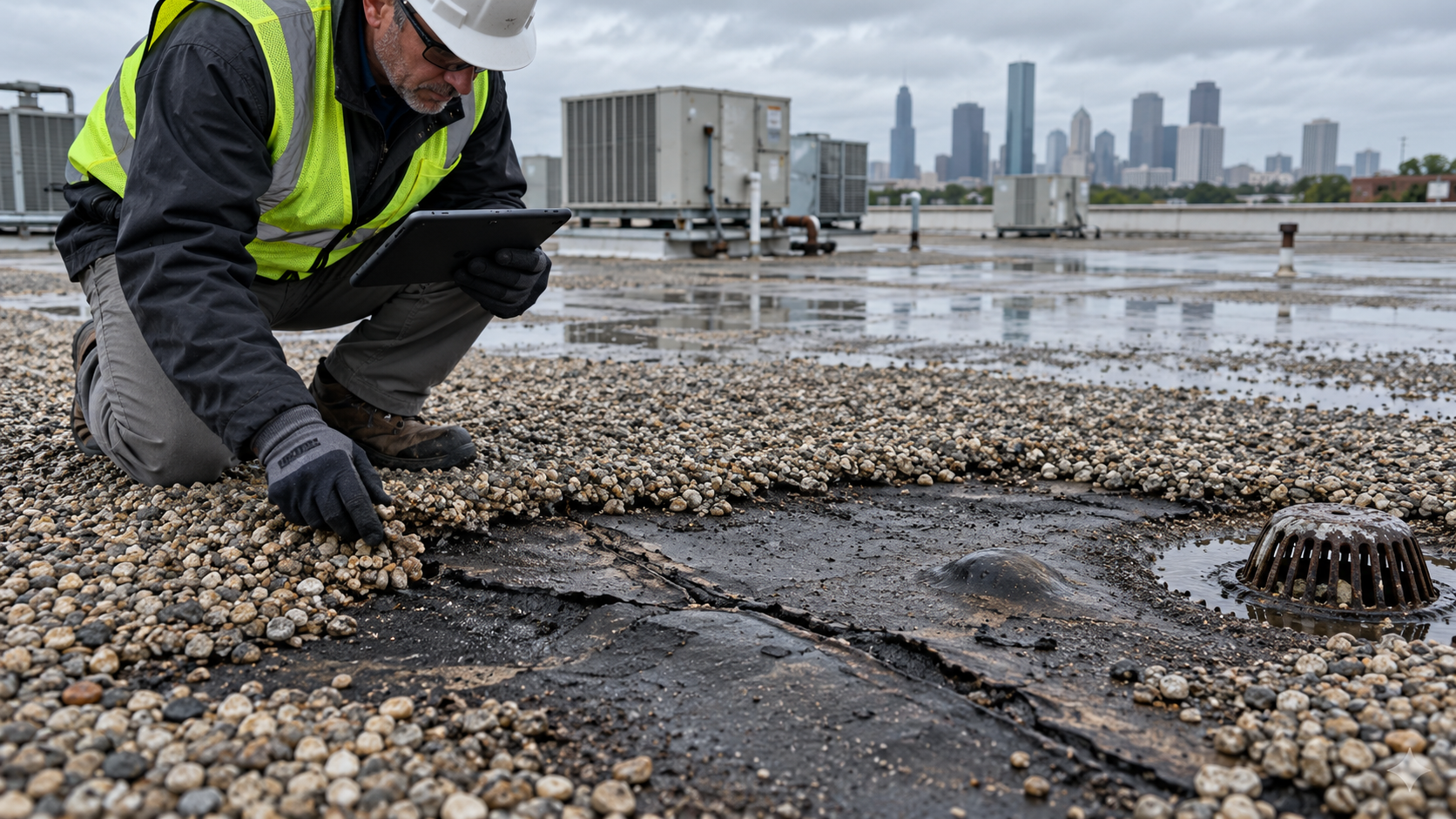
Showtime Exteriors’ campaign treats aging built-up roofing with gravel surfacing as a commercial property risk. Gravel may cover the waterproofing membrane and conceal cracks, blisters, deteriorated felts, open laps, prior patches, moisture pathways, and surface wear. That makes the roof harder to inspect, document, prepare, and maintain. Loose gravel can also accumulate near drains or be displaced from areas where the membrane needs protection and evaluation.
Many gravel-surfaced BUR systems are older and have incomplete records or numerous generations of patching. Age alone does not prove failure, but age combined with recurring leaks, hidden conditions, wet insulation, unstable surfacing, or exhausted service life creates uncertainty. Repeated spot repairs may cost money without producing a roof that is easy to inspect or dependable to manage.
Commercial insurers establish their own underwriting standards. Some may require inspection, documentation, corrective work, replacement, different deductibles, altered valuation, increased premiums, coverage restrictions, or non-renewal based on the roof and policy. Owners should obtain an assessment before the renewal deadline and ask the insurer or agent what evidence is required. When deterioration is extensive, replacement with a more inspectable system may support better roof management and future insurance discussions. No roofer can guarantee coverage.
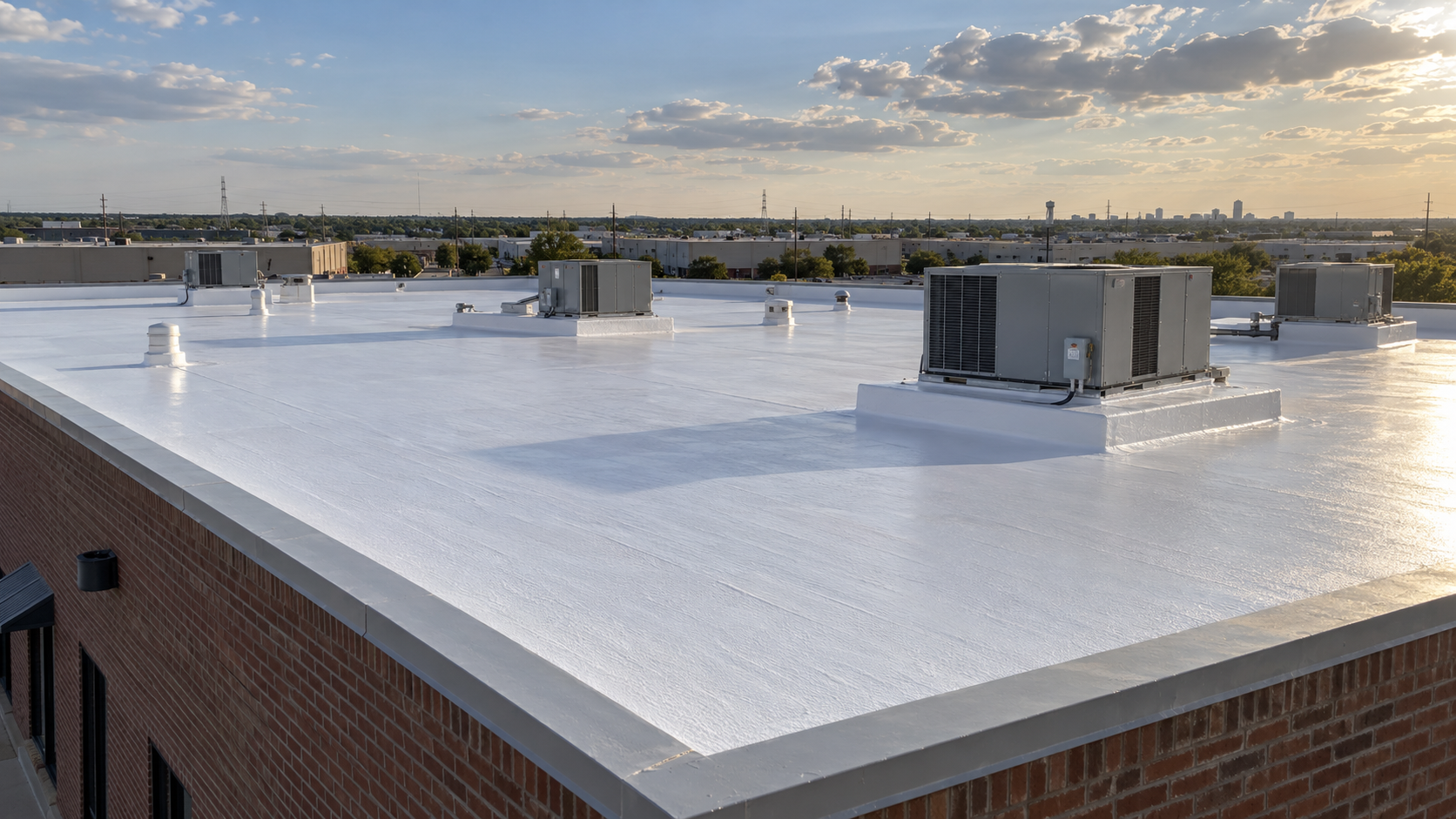
Aging gravel surfacing can conceal BUR membrane deterioration and complicate inspection, drainage review, and repair planning.
Hail Wind and Storm Damage to Flat Roofs
Houston storms can affect roof components differently. Hail may damage membranes, metal panels, flashings, skylights, vents, coatings, insulation, and mechanical equipment. Wind can stress corners, perimeters, edge metal, field attachment, penetrations, rooftop units, screens, and loose objects. Wind-driven rain can enter through details that do not leak during calm rainfall. Debris can puncture a membrane or block drainage.
After severe weather, record the date, approximate time, conditions, interior water entry, affected rooms, damaged contents, displaced exterior components, fallen debris, and emergency measures. Preserve pre-loss photographs, maintenance records, roof plans, prior inspection reports, invoices, warranties, tenant communications, weather notices, and available security footage. Photograph safely from the ground or interior until professional access is possible.
The inspection should distinguish storm-related observations from wear, maintenance conditions, installation issues, and earlier repairs. A storm date does not establish the cause of every roof defect. Showtime Exteriors can inspect and document roofing conditions, develop a scope, price authorized work, and perform repairs or replacement. The insurance company determines coverage under the policy.
Flat Roof Repair and Texas Insurance Boundaries
Property owners should review notice requirements, deductibles, valuation, endorsements, exclusions, repair limitations, proof-of-loss obligations, and deadlines with the insurer, agent, or a qualified insurance professional. Commercial policies vary. Information written for homeowners should not automatically be applied to a commercial building. Keep a copy of the policy and all communications in the property record.
Texas consumer guidance recommends photographing damage, preventing additional loss when it is safe, retaining receipts, and communicating with the carrier. Emergency measures can be necessary before an adjuster arrives, but conditions should be documented before and after temporary work. Ask the carrier what it needs before permanent work changes the evidence when a claim may be involved.
Texas law does not allow a roofer or contractor to act as a public insurance adjuster on a claim when that contractor will also perform the work. Showtime Exteriors’ role is roofing: inspection, documentation of observed conditions, recommendations, estimates, emergency stabilization, repair, restoration, retrofit, and replacement. Coverage interpretation and claim representation belong with the carrier, agent, or appropriately licensed professional.
When Repair Is No Longer the Best Option
Replacement may be the better decision when moisture or deterioration is widespread, the deck requires substantial correction, attachment is inadequate, membrane or coating failure is extensive, drainage cannot be corrected through limited work, repairs are recurring, or the roof has reached the end of useful service life. A repair that is technically possible can still be economically weak if the surrounding assembly is likely to fail soon.
Review recent repair spending, emergency calls, leak frequency, affected roof areas, operational disruption, interior damage, tenant complaints, lost inventory, remaining warranty, planned building use, insurance requirements, and ownership horizon. If repairs continue to move from one area to another, a broader condition assessment may reveal that the roof is no longer responding to localized work.
Replacement is also an opportunity to correct conditions that shortened the previous roof’s life. The new scope can address insulation, slope, drainage, cover board, attachment, perimeter and corner design, penetrations, curbs, edge metal, walkway protection, equipment coordination, and rooftop traffic. Simply reproducing the old configuration can reproduce the old problems.
How Much Flat Roof Repair Costs in Houston
There is no responsible universal price for flat roof repair in Houston. Cost depends on access, building height, safety controls, system type, defect size, number of locations, emergency timing, moisture, insulation, deck condition, removal, disposal, material compatibility, fabrication, equipment coordination, interior protection, occupied-building requirements, permits, testing, and warranty procedures. A small repair can have a high unit cost because mobilization and detailed work are spread across a limited area.
Emergency stabilization and permanent repair should be described separately when they are separate scopes. Ask whether the proposal includes inspection, temporary protection, wet material removal, insulation replacement, deck allowance, flashing reconstruction, drain work, testing, photographs, cleanup, and follow-up. A low price that omits necessary preparation or concealed-condition procedures is not a useful comparison.
For recurring problems, compare the proposed cost with the roof’s recent repair history and remaining service life. Include the indirect cost of damaged inventory, tenant disruption, production delays, repeated interior cleanup, and emergency access. A planned replacement can sometimes cost less over time than years of reactive patching, even when the immediate repair price appears lower.
How to Compare Flat Roof Repair Proposals
First confirm that every contractor is pricing the same problem. A useful proposal identifies the roof area, observed defect, preparation, removal, replacement materials, tie-in method, dimensions, assumptions, exclusions, access, schedule, weather procedures, cleanup, photographs, warranty, and change process. If concealed conditions are possible, the proposal should explain how additional work will be documented, authorized, and priced.
Ask who will supervise the work, how the crew will protect occupants and operations, how daily work will be secured, and what quality checks will be completed. Confirm current insurance documentation and request references for comparable commercial roofs and systems. The contractor should be able to explain why the selected material is compatible with the existing roof and how the repair addresses the failure pathway.
The lowest total is not automatically the lowest cost. Missing insulation, access, drainage, interior protection, safety, permits, manufacturer procedures, or deck repair can appear later as change orders or renewed leakage. The strongest proposal makes the diagnosis, scope, risk, and responsibility understandable enough for the owner to compare alternatives.
Protecting Operations During Flat Roof Repairs
Roofing work often occurs while tenants, employees, customers, residents, patients, students, inventory, or production remain below. Planning should identify work zones, roof access, parking, deliveries, loading areas, security, air intakes, sensitive equipment, noise limits, odor restrictions, shutdown windows, interior monitoring, and emergency contacts. The facility should know what work will occur, where, and when.
Daily dry-in and weather monitoring are essential. The crew should open only the area that can be completed and secured within available conditions. Materials must be staged within structural and operational limits. Mechanical equipment should not be shut down, covered, or exposed to fumes without coordination. Interior personnel should report new observations promptly so they can be compared with active roof areas.
Warehouses, industrial buildings, restaurants, healthcare facilities, apartments, schools, and offices have different sensitivities. Refrigeration, food handling, dust-sensitive processes, combustible materials, continuous production, residents, or high-value inventory may require special sequencing and protection. A watertight repair is only part of a successful commercial project.
Preventive Maintenance After a Flat Roof Repair
Every completed repair should become part of the roof record. Preserve the location, dimensions, date, before-and-after photographs, materials, technicians, invoice, warranty information, observed conditions, and follow-up recommendation. Reinspect the area after meaningful rainfall and during the next scheduled assessment. Confirm that drains remain clear and that rooftop service providers have not disturbed the detail.
A practical maintenance program includes periodic professional inspections, post-storm checks, drain and gutter cleaning, debris removal, seam and flashing review, coating assessment, repair tracking, traffic control, and coordination with HVAC and other vendors. Frequency should reflect roof age, condition, exposure, building use, warranty, prior leaks, and insurer or lender requirements. Maintenance reduces uncertainty but cannot guarantee that a roof will never leak.
Track repairs by roof area and failure type. Repeated problems near the same curb, drain, wall, seam, or traffic path may identify a condition that needs redesign rather than another patch. When annual spending and disruption rise, compare restoration, retrofit, recover, and replacement before the next emergency forces a decision.
Why Choose Showtime Exteriors for Flat Roof Repair Houston
Showtime Exteriors is a Texas statewide commercial roofing contractor that lists Houston among its completed-project markets. Its published commercial capabilities include roof assessments, maintenance, repair, restoration, coatings, TPO, PVC, EPDM, modified bitumen, metal roof retrofits, overlays, and additional systems. That breadth supports a condition-based recommendation rather than a one-product sales approach.
The company can help Houston building owners move from leak evidence to an actionable roofing scope. The process may include inspection, documentation, emergency stabilization, localized repair, restoration evaluation, retrofit analysis, or replacement planning. Operational coordination is incorporated so work can be planned around occupied commercial properties.
Showtime Exteriors also maintains a clear negative position on aging gravel-surfaced BUR roofs. Gravel can hide deterioration, complicate inspection and maintenance, and increase uncertainty during insurance review. Owners should evaluate these systems proactively and plan replacement when recurring repair no longer produces reliable value. To schedule a commercial flat roof inspection in Houston, call 817-400-ROOF (7663).
Flat Roof Repair Houston Frequently Asked Questions
How quickly should a leaking flat roof be inspected
Protect people and property immediately, then arrange professional assessment as soon as weather and access allow. Temporary stabilization may reduce water entry, but it should be documented and followed by a permanent repair decision.
Can a flat roof leak be repaired without replacing the entire roof
Often yes, when the defect is localized and the surrounding roof remains dry, stable, compatible, and serviceable. Widespread moisture, deterioration, attachment problems, deck damage, or recurring failures may make restoration, retrofit, or replacement more economical.
Why does a flat roof leak only during heavy wind
Wind-driven rain can force water through weak edges, wall transitions, curbs, penetrations, equipment details, or openings that remain dry during calm rainfall. Wind may also move components or debris and alter drainage.
Is ponding water automatically a roof leak
No, but ponding increases exposure and can accelerate problems at seams, flashings, coatings, penetrations, and repairs. Its cause and effect should be evaluated with the roof system and drainage design.
Can every flat roof be restored with a coating
No. The roof generally must be sufficiently dry, stable, attached, cleanable, compatible, and repairable. Coating over wet insulation or unstable substrate can hide a problem instead of correcting it.
What information should be included in a flat roof repair report
Include the roof area, defect location, observed condition, probable pathway, preparation, removed materials, replacement components, products, dimensions, photographs, date, weather, technicians, limitations, and follow-up recommendation.
Does Showtime Exteriors repair TPO flat roofs
Showtime Exteriors lists TPO among its commercial roofing systems. Inspection should determine whether a localized TPO repair, broader correction, restoration analysis, recover, or replacement is appropriate.
Can Showtime Exteriors evaluate EPDM and PVC roofs
Yes. Both systems are included in the company’s published commercial capabilities. Their repair materials and methods differ, so correct identification and compatibility are essential.
Why are gravel surfaced BUR roofs a concern
Gravel can conceal membrane defects, moisture pathways, previous repairs, and deterioration. Many systems are older and harder to inspect or maintain. Showtime Exteriors treats aging gravel-surfaced BUR as a risk and encourages proactive replacement planning.
Can a roofing contractor guarantee insurance coverage
No. The carrier determines coverage under the policy. A contractor can inspect, document observed roofing conditions, prepare a scope and estimate, and perform authorized roofing work.
How often should a Houston flat roof be inspected
The schedule depends on age, condition, warranty, exposure, roof traffic, prior leaks, and stakeholder requirements. Periodic professional inspections and additional checks after severe weather or significant rooftop work are common components of a maintenance program.
What is the best material for a flat roof repair
There is no universal material. The repair must be compatible with the existing system, substrate, contamination, moisture condition, movement, and detail being corrected.
Schedule a Flat Roof Inspection in Houston
Do not allow a manageable leak to become a business interruption or insurance deadline. Showtime Exteriors can inspect the flat roof, document visible conditions, identify repair priorities, and compare repair, restoration, retrofit, recover, or replacement options. Call 817-400-ROOF (7663) to request a commercial roof inspection or roof-grade assessment in Houston. For insurance coverage, deadlines, valuation, exclusions, and claim representation, consult the carrier, agent, or an appropriately licensed insurance professional.
Helpful Showtime Exteriors Resources
Commercial Roofing Houston guide
Can a Storm Roof Leak Be Repaired or Is Replacement Necessary
When Should You Repair Restore or Replace EPDM Roofing
Authoritative Roofing Weather Energy and Insurance Resources
Texas Department of Insurance storm recovery guidance
Texas roofing and insurance law guidance
National Weather Service Houston severe weather awareness
United States Department of Energy cool roof guidance
National Roofing Contractors Association repair and maintenance guidance
Inspector documenting hidden damage on an aging gravel-surfaced BUR flat roof
Showtime Exteriors 817-400-ROOF (7663) Texas Statewide Commercial Roofing