


Commercial Roof Repair Houston
Costs warning signs emergency response and when replacement is the better option
When a Houston commercial roof leaks, the fastest patch is not always the best repair. The owner needs a safe response, clear documentation, accurate diagnosis, compatible materials, and an honest decision about whether the roof should be repaired, restored, retrofitted, recovered, or replaced.
Showtime Exteriors provides commercial roofing services across Texas and lists Houston among its completed-project markets. The company evaluates multiple systems and helps property owners move from inspection to an actionable roofing scope. This guide explains the warning signs, repair process, cost factors, storm documentation, insurance boundaries, and long-term planning required for a sound decision.
The main conclusion is simple: address active water entry immediately, but do not confuse emergency stabilization with permanent repair. Document the condition, determine the pathway and extent, and select work that fits the roof’s actual condition and the building’s operational needs.
Commercial Roof Repair in Houston Begins With Accurate Diagnosis
Commercial roof repair in Houston should begin with a diagnosis, not a bucket of generic patching material. A ceiling stain proves that water reached the interior, but it does not identify the opening or show how far moisture traveled. Water can move along decking, insulation, structural members, conduits, curbs, or vapor-control layers before appearing below. The visible drip may be several feet from the roof defect. Showtime Exteriors evaluates the roof, adjacent details, drainage, rooftop equipment, and interior evidence before developing a repair scope.
That distinction matters because a quick surface patch can hide the symptom without correcting the pathway. A repair should identify the affected roof system, prepare the substrate, remove unsound material, replace wet or damaged components where authorized, and tie compatible materials into serviceable surrounding construction. The goal is not simply to stop today’s drip. It is to create a defensible correction that can be inspected, documented, maintained, and incorporated into the building’s long-term roof plan.
Houston commercial properties include warehouses, retail centers, offices, apartments, industrial facilities, churches, schools, and specialized buildings. Each property has different access, interior sensitivity, rooftop traffic, equipment, operating hours, and tolerance for interruption. A successful commercial roof repair plan accounts for the business under the roof as carefully as it accounts for the membrane above it.
Why Houston Commercial Roofs Develop Leaks
Houston roofs experience strong solar exposure, high surface temperatures, humidity, sudden downpours, wind-driven rain, tropical systems, thunderstorms, hail, and rapid weather changes. These conditions repeatedly stress seams, flashings, fasteners, sealants, coatings, edge components, drains, and penetrations. Heat-related movement can open weak details. Wind can displace unsecured components or drive water into openings that remain dry during lighter rain. Heavy rainfall can reveal drainage limitations within minutes.
Many leaks also result from conditions that are not a single dramatic storm impact. Foot traffic can puncture membranes. Mechanical service can disturb flashings or leave debris. New conduits, pipes, signs, satellite equipment, or HVAC work can create uncoordinated penetrations. Sealants age. Drain strainers clog. Metal fasteners loosen. Previous patches separate from an incompatible or poorly prepared surface. A repair investigation should therefore consider recent weather and the building’s service history rather than assuming every leak has the same cause.
The age of the roof changes the analysis but does not answer it by itself. An older roof may still have repairable sections if the assembly remains dry and stable. A newer roof can leak because of a single installation defect, puncture, or equipment-related change. Condition, moisture, attachment, compatibility, and recurring history provide more useful evidence than age alone.
Signs a Houston Commercial Roof Needs Immediate Attention
Active water entry, saturated ceiling materials, electrical exposure, sagging surfaces, displaced roof components, open seams, punctures, damaged edge metal, blocked drainage, and fallen debris require prompt attention. Life safety comes first. Keep occupants away from wet electrical fixtures, unstable ceilings, fallen material, and areas where water is accumulating. Do not send untrained employees onto a wet, windy, dark, or storm-active roof. Qualified access should wait until conditions permit safe work.
Other warning signs are less dramatic but still important: recurring stains, musty odors, unexplained humidity, bubbling paint, corrosion near the deck, damp insulation, repeated patches in one area, blisters, membrane shrinkage, open terminations, loose fasteners, deteriorated sealant, coating cracks, ponding water, vegetation, and debris around drains. These conditions do not all require replacement, but they do justify inspection before the affected area grows.
Owners should also respond when an insurer, lender, buyer, tenant, or facility audit requests current roof information. Waiting until a renewal deadline can reduce planning time and turn a manageable project into an emergency. A documented inspection gives the owner a condition baseline, prioritized repair list, budget framework, and evidence of completed work.
What to Do When a Commercial Roof Is Actively Leaking
First protect people, operations, inventory, and equipment without creating additional hazards. Isolate the affected interior area, move vulnerable property when it is safe, use containers or temporary interior protection, and notify facility contacts. Record the time, weather, room, ceiling location, apparent flow, and affected contents. Photographs and video should establish both the wider context and close details. Do not discard damaged material until it has been documented unless safety requires removal.
Next arrange professional emergency assessment. Temporary work may include securing displaced material, clearing a safe drainage obstruction, covering an opening, or installing a compatible temporary detail. The specific action depends on the roof, weather, access, and hazard. Temporary work should be dated, mapped, photographed, monitored, and followed by dry-weather investigation. It should never quietly become the permanent solution because the interior stopped dripping.
After stabilization, investigate the source and extent. The roof may need localized opening, moisture evaluation, drain testing, seam review, penetration inspection, or coordination with mechanical and plumbing trades. The permanent repair scope should distinguish observed conditions, assumptions, excluded work, and any concealed conditions that require authorization before they can be confirmed.
Commercial Roof Leak Detection and Documentation
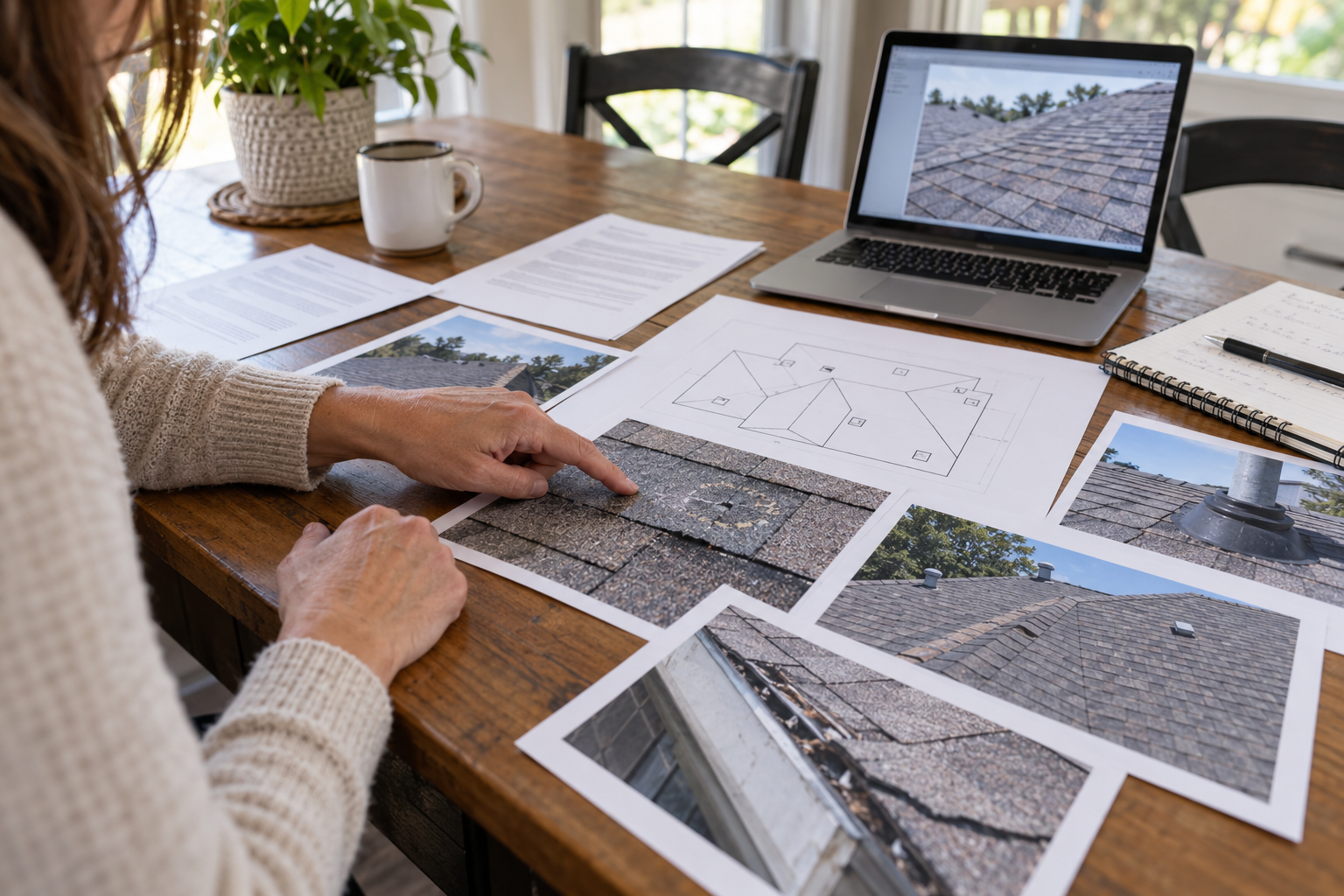
Good documentation helps ownership make decisions and creates a record for future maintenance. A useful report identifies the property, inspection date, weather, roof areas, roof system, approximate age if known, access limitations, visible layers, surface condition, drainage, penetrations, curbs, flashings, seams, transitions, perimeter details, rooftop traffic, prior repairs, and interior observations. Photographs should be labeled by location and direction rather than presented as an unexplained gallery.
A marked roof plan is especially valuable on a large facility. It can connect interior leak reports with rooftop conditions, distinguish separate events, and show recurring repairs. Repair records should include the date, defect, preparation, materials, dimensions, photographs before and after work, technicians, weather conditions, and follow-up recommendation. Consistent records make it easier to evaluate whether repair spending is stabilizing the roof or merely moving the leak.
The report should separate fact from interpretation. An open seam, displaced flashing, corroded fastener, puncture, blister, stain, or ponding area is observable. The likely cause and recommended correction require professional judgment. If hidden moisture is suspected, the report should explain what additional evaluation may be appropriate and what cannot be confirmed without authorized testing.
When a Targeted Commercial Roof Repair Makes Sense
Targeted repair is usually appropriate when the defect is limited, the surrounding membrane or metal remains serviceable, the substrate can support the work, compatible repair materials are available, and the roof has enough remaining life to justify the investment. Examples may include an isolated puncture, a short open seam, localized flashing failure, a damaged drain detail, a limited metal seam condition, deteriorated sealant at a termination, or a discrete equipment-related opening.
The repair scope should be more specific than ‘patch leak.’ It should describe cleaning and preparation, removal of loose or incompatible material, drying or replacement of affected components, reinforcement, tie-in dimensions, fastening or adhesion, termination, quality checks, and documentation. If the defect involves movement, drainage, or another trade, the scope should address the underlying condition rather than covering it with additional material.
A successful repair should be inspectable. The owner should know where the work was performed, which products were used, what conditions were found, and what follow-up is recommended. That information belongs in the roof history and should be available during future inspections, due diligence, warranty discussions, and insurance renewals.
When Repeated Repairs Signal a Larger Problem
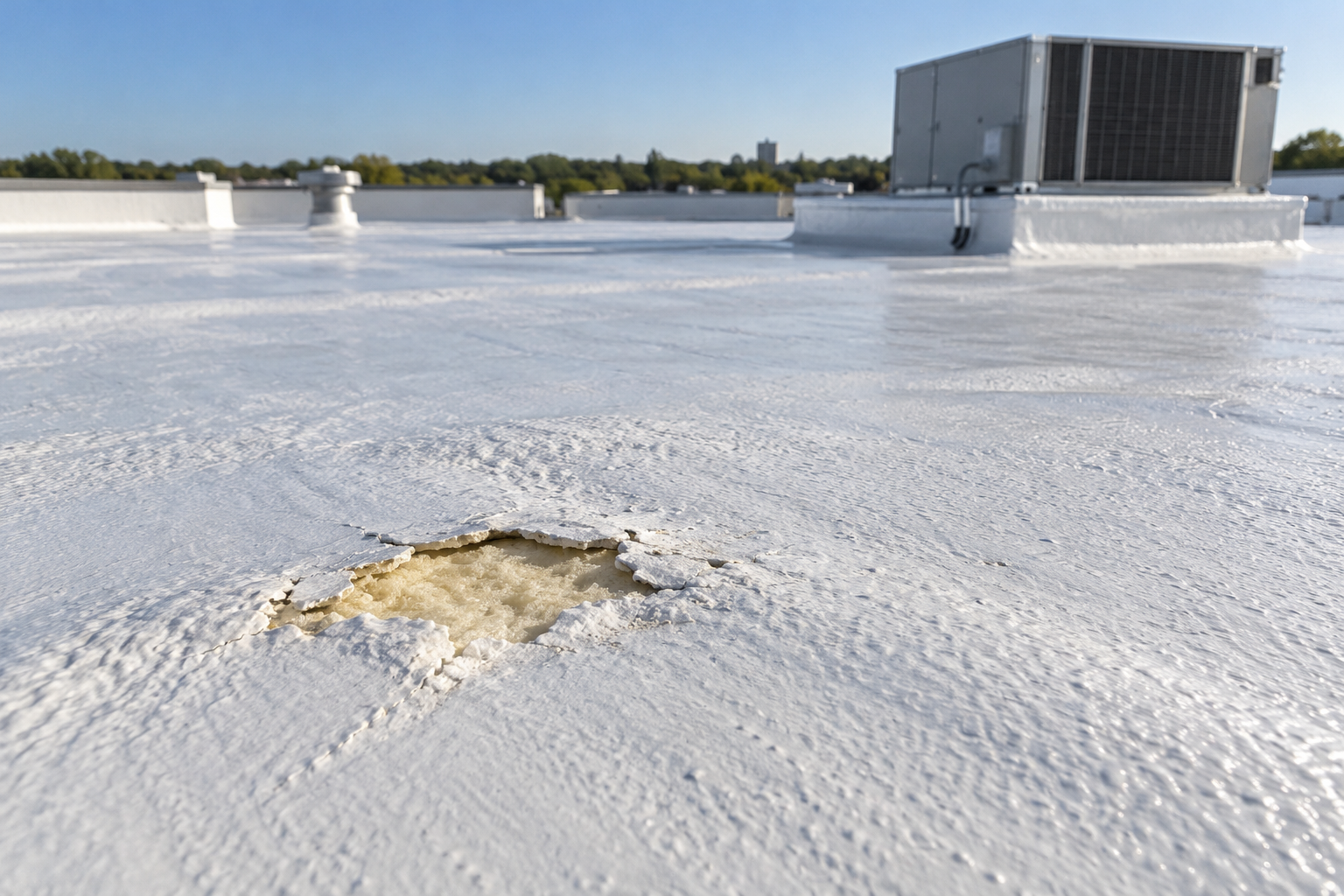
Repeated leakage at the same location is a reason to revisit the diagnosis. The opening may be outside the previously repaired area, the repair may be incompatible, the substrate may be moving, drainage may keep the detail submerged, or moisture may already extend beyond the visible defect. Adding another layer without investigating these possibilities can make the eventual repair more difficult and obscure the roof’s true condition.
A pattern of unrelated leaks across the roof can also indicate broader deterioration. Widespread seam failure, membrane wear, coating loss, saturated insulation, unstable surfacing, corrosion, poor attachment, deteriorated decking, or numerous failed penetrations may make isolated repairs uneconomical. The correct next step might be a larger corrective program, restoration evaluation, retrofit, recover system, or replacement.
Ownership should compare annual repair cost, leak frequency, operational disruption, interior damage, emergency response expense, remaining service life, and planned building use. A low-cost patch is not inexpensive if the same area damages inventory or interrupts tenants several times. Repair decisions should be evaluated as part of total roof lifecycle cost.
Repair Restore Retrofit or Replace
Repair corrects limited defects within an otherwise serviceable roof. Restoration renews an eligible existing surface after repairs and preparation, often through a specified coating or reinforced system. Retrofit or recover work creates a new service surface over an eligible existing assembly. Replacement removes enough of the existing construction to create the required new assembly and correct underlying conditions. These terms should not be used interchangeably because they involve different investigation, design, cost, risk, and warranty requirements.
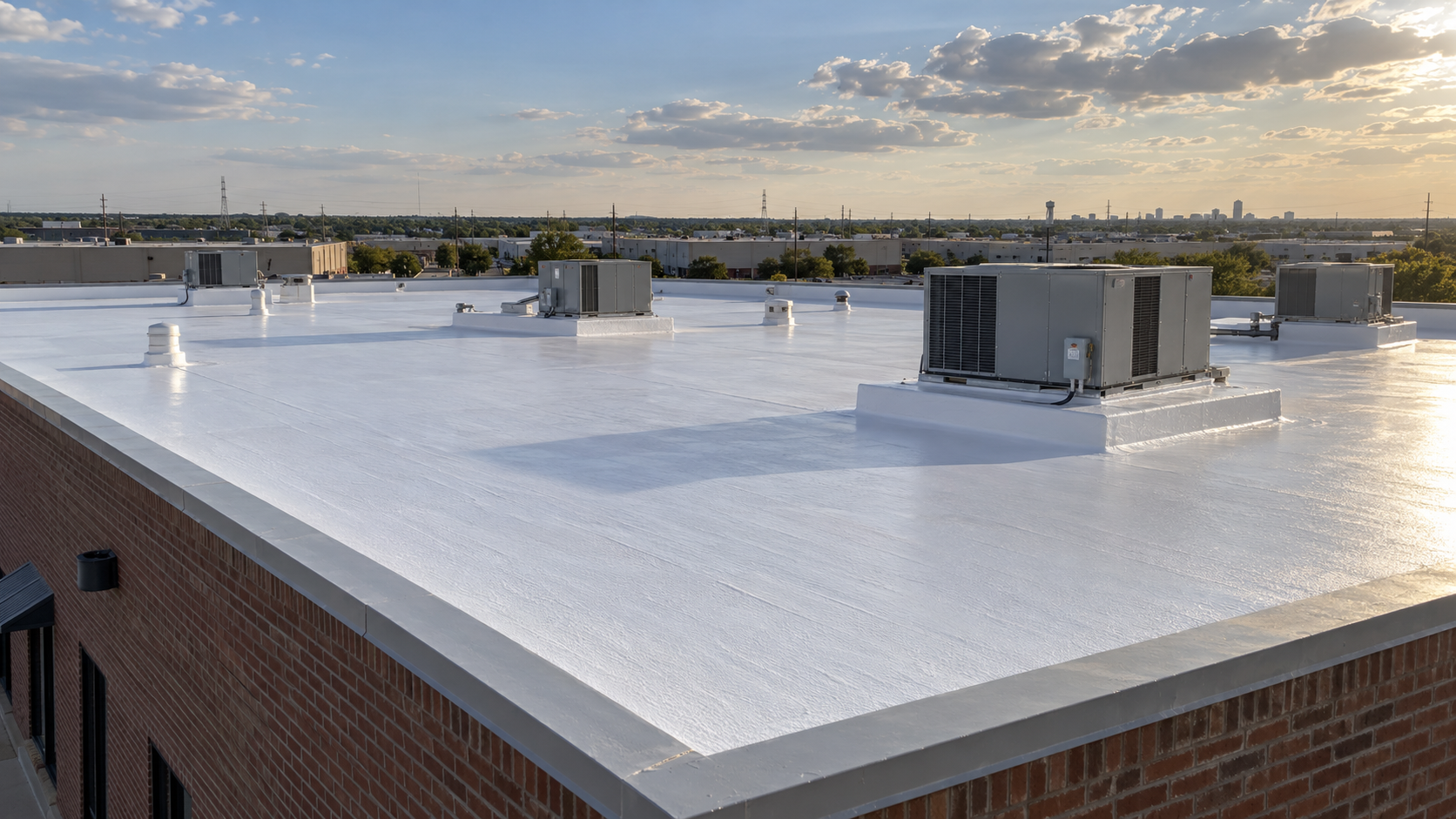
Restoration may provide value when the roof is sufficiently dry, stable, attached, cleanable, compatible, and repairable. It is not a way to avoid evaluating moisture or deck condition. A coating cannot remove trapped water, rebuild deteriorated insulation, restore structural capacity, or compensate for weak preparation. Adhesion testing, defect repair, reinforcement, specified application rates, thickness verification, weather limits, cure protection, and final inspection are part of a credible scope.
Replacement becomes more reasonable when deterioration or moisture is widespread, attachment is inadequate, the deck requires substantial correction, repair frequency is increasing, the assembly is poorly suited to the building, or the remaining service life does not support more spending. Replacement also allows the owner to reconsider insulation, slope, drainage, cover board, attachment, perimeter resistance, penetrations, equipment curbs, walkways, and rooftop traffic.
Aging Gravel Surfaced BUR Is a Repair and Insurance Concern
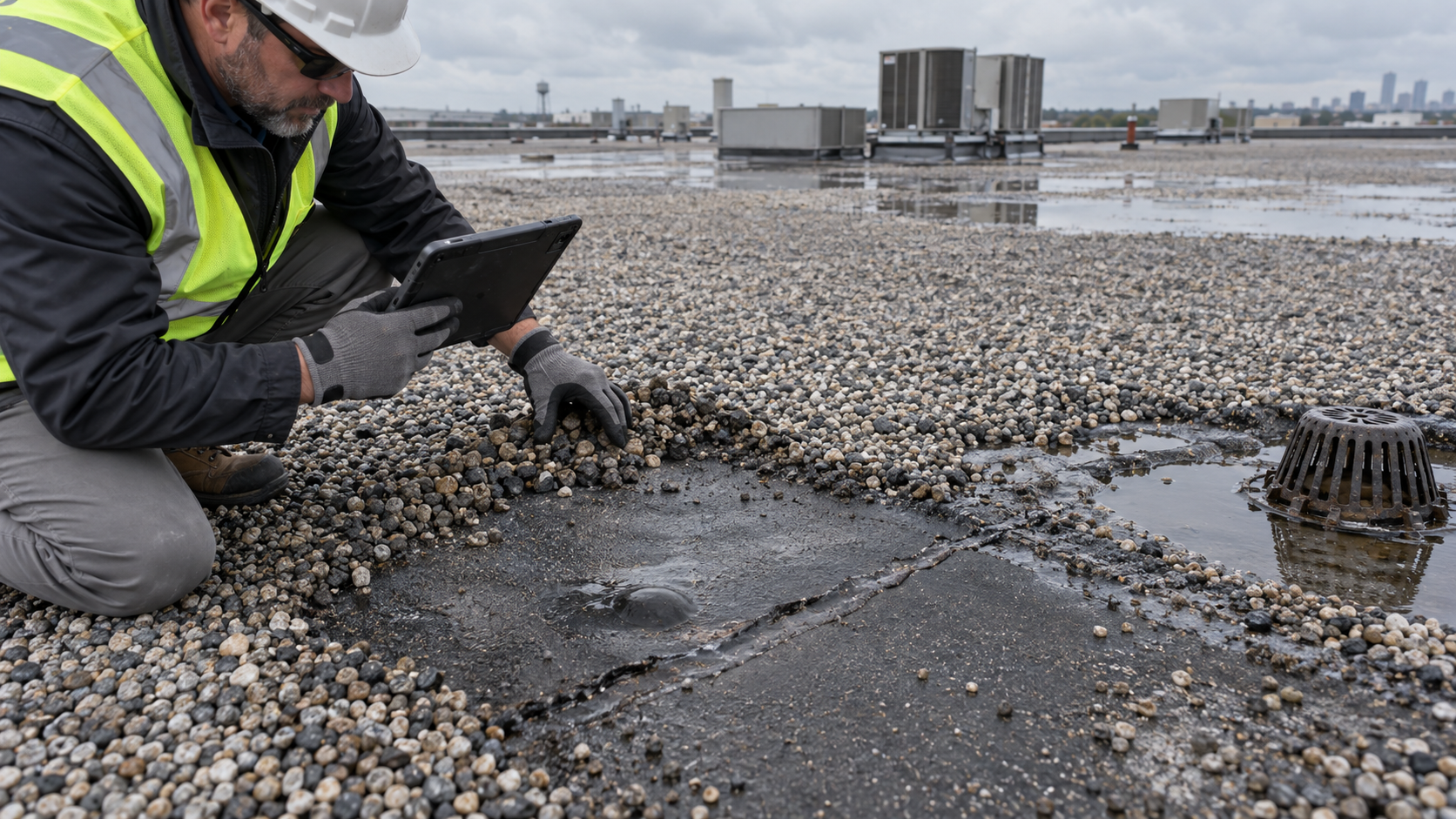
Showtime Exteriors takes a clear position on aging built-up roofing with gravel surfacing: it should be treated as a risk requiring proactive evaluation, not promoted as an advantage. Gravel can conceal cracks, blisters, open laps, deteriorated materials, previous patches, moisture pathways, and the membrane’s overall condition. It complicates visual inspection because the waterproofing surface is not consistently exposed. It can also slow repair preparation and make storm documentation less straightforward.
Many gravel-surfaced BUR roofs are older systems with incomplete records and years of accumulated repairs. Age alone does not prove failure, but age combined with hidden conditions, recurring leaks, wet insulation, unstable surfacing, or exhausted service life creates uncertainty for owners and underwriters. Commercial insurance carriers establish their own requirements and may request inspections, repairs, replacement, different deductibles, altered valuation, coverage limitations, higher premiums, or non-renewal depending on the property and policy.
The practical response is early inspection, accurate documentation, completion of necessary repairs, preservation of records, and direct communication with the insurer or agent about required evidence. If the system is no longer reliably repairable, replacement with a more inspectable assembly may improve roof management and support future underwriting discussions. No contractor can guarantee coverage or policy terms.
Aging gravel surfacing can conceal BUR membrane defects and complicate drainage inspection and repair planning.
Repairing TPO PVC and EPDM Commercial Roofs
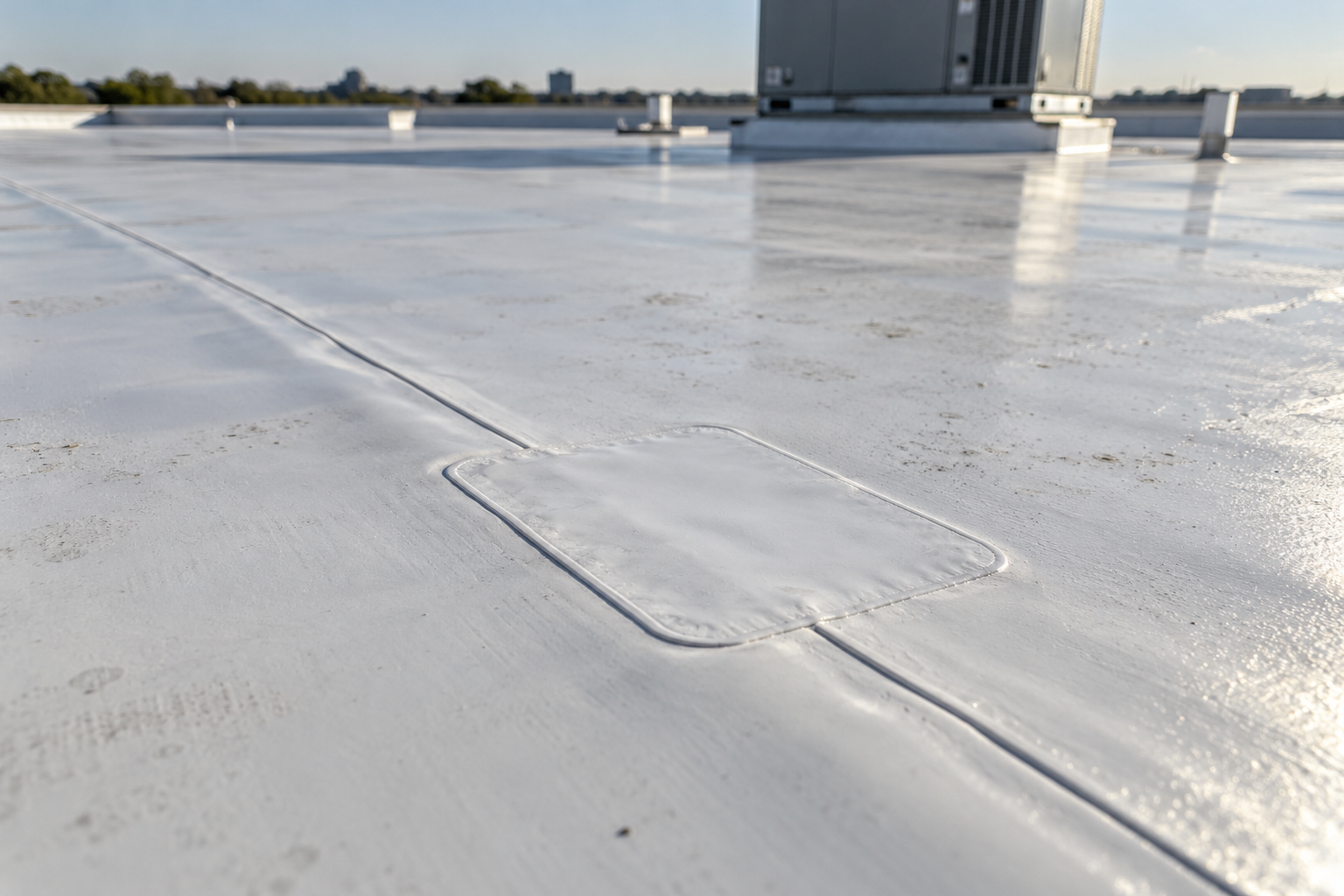
TPO and PVC are thermoplastic membranes with heat-welded seams, but a repair still requires identification of the actual membrane, condition, thickness, contamination, age, attachment, and substrate. Common issues can include punctures, cuts, open welds, stressed flashings, displaced edge components, damaged walkways, and problems around curbs or penetrations. Preparation and compatible materials are essential. A generic sealant or incompatible patch can interfere with later work and may not perform with the membrane’s movement.
EPDM is a flexible rubber membrane with seam, flashing, adhesive, and repair methods that differ from thermoplastics. Conditions may include punctures, open seams, shrinkage, failed terminations, flashing stress, surface contamination, and damage around penetrations. The technician must understand the assembly and use compatible primers, tapes, membranes, adhesives, and termination details as required by the selected system.
For every single-ply roof, the repair should extend beyond the visible opening into sound material. Wet insulation or deteriorated substrate may need to be removed and replaced within the authorized repair area. Seams and patches should receive appropriate quality checks, and traffic paths should be protected when repeated mechanical service contributes to damage.
Repairing Modified Bitumen and Coated Roofs
Modified bitumen roofs use asphalt-based sheets and can be installed through different methods and configurations. Repair planning should identify the membrane type, surfacing, attachment, existing coatings, moisture condition, lap details, flashing construction, and safe installation method. Blisters, splits, open laps, punctures, deteriorated flashings, and failed patches require different corrections. Surface preparation is central because dust, loose granules, moisture, and aged materials can prevent proper adhesion.
Coated roofs must be evaluated as systems rather than treated as paint. The contractor should identify the coating family when possible, assess adhesion and thickness, look for cracks, pinholes, worn areas, ponding exposure, reinforcement condition, contamination, and movement at seams or penetrations. Repair may require cleaning, removal of loose coating, substrate correction, reinforcement, compatible coating, and controlled cure conditions.
A broad recoating proposal should not replace investigation. If moisture is trapped below the surface or the substrate is unstable, applying more coating may conceal the condition and delay necessary work. Restoration eligibility should be supported by inspection, testing where appropriate, preparation requirements, product compatibility, and a defined quality-control process.
Commercial Metal Roof Repair and Retrofit Decisions
Commercial metal roof leaks may involve exposed fasteners, deteriorated washers, seam movement, failed closures, damaged sealant, corrosion, panel punctures, penetrations, transitions, ridge details, gutters, or edge conditions. Standing-seam and exposed-fastener systems behave differently. Before selecting a repair material, the contractor should identify the panel profile, movement, corrosion extent, existing coating, attachment, and failure mechanism.
Replacing fasteners or adding sealant everywhere is not automatically a durable plan. The scope should address why fasteners loosened, whether holes are enlarged, whether panel movement continues, and whether corrosion or substrate damage is present. Repairs around equipment and penetrations may require new curbs, boots, closures, or fabricated metal details rather than surface caulk alone.
When isolated repair no longer provides value, the owner can compare an engineered coating, membrane retrofit, recover assembly, or replacement. Retrofit feasibility depends on structural capacity, existing moisture, corrosion, deck or panel condition, attachment, condensation control, insulation, drainage, code requirements, perimeter resistance, and manufacturer criteria.
Drainage Problems That Look Like Roof Failures
Commercial roof performance depends on water reaching designed drains, scuppers, gutters, downspouts, and overflow routes. Blocked strainers, debris, damaged gutters, compressed insulation, settlement, poor slope, displaced equipment supports, or earlier construction changes can create persistent low areas. Ponding increases exposure at seams, flashings, penetrations, coatings, and repairs. It can also add weight and concentrate debris.
A repair near a ponding area may fail again if the drainage condition remains unchanged. The inspection should evaluate the wider watershed, not only the membrane opening. Maintenance may resolve simple debris blockage, while other conditions require tapered insulation, drain adjustment, scupper modification, structural review, or plumbing coordination. The proposed work should distinguish roofing correction from work requiring another trade or design professional.
Primary and overflow drainage should both remain visible and unobstructed. An overflow component is not a maintenance substitute for the primary system; it is an emergency path when unusual rainfall or blockage occurs. Changes to screen walls, equipment, piping, or walkways should not redirect water or block drainage.
Storm Hail and Wind Damage Repair in Houston
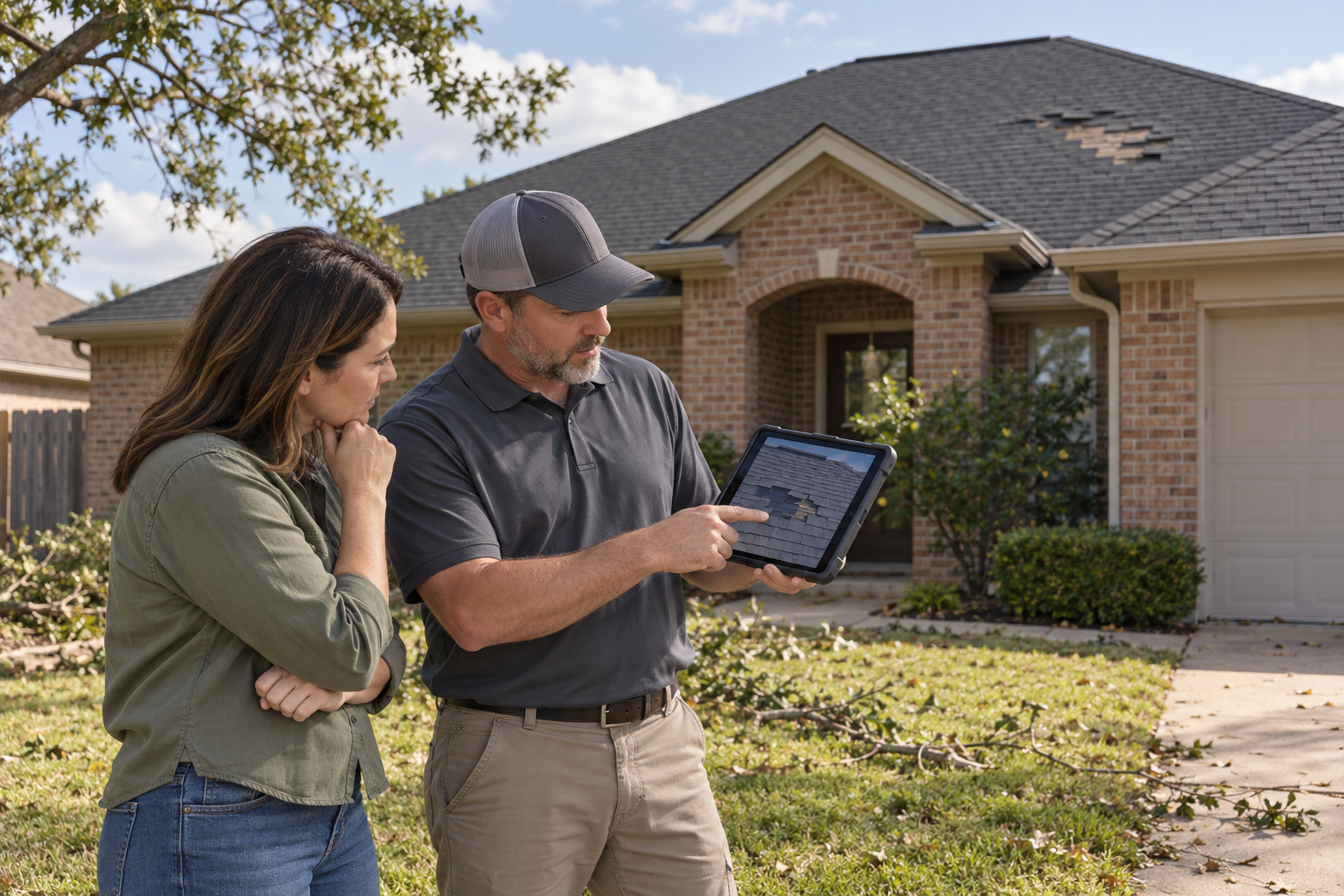
After severe weather, document the date, approximate time, site conditions, interior water entry, affected rooms, damaged contents, displaced exterior components, fallen debris, and emergency measures. Preserve pre-loss photographs, roof plans, prior reports, invoices, maintenance records, warranties, tenant reports, weather communications, and available security footage. Take photographs safely from the ground or interior until qualified personnel can access the roof.
Hail can affect membranes, metal panels, flashings, skylights, vents, coatings, insulation, and mechanical equipment differently. Wind can affect corners, perimeters, edge metal, field attachment, rooftop equipment, penetrations, and nearby objects. A professional inspection should distinguish observed storm-related conditions from wear, maintenance issues, installation defects, and prior repairs. The date of a storm does not establish the cause of every roof condition.
Emergency repairs should reduce additional damage while preserving documentation. Permanent work should follow communication with the carrier when a claim may be involved. Showtime Exteriors can inspect roofing conditions, document observations, prepare a roofing scope, price work, and perform authorized repairs. The insurance company decides coverage under the policy.
Commercial Roof Repair and Texas Insurance Claims
Property owners should review the policy, deductible, valuation method, endorsements, exclusions, notice requirements, proof-of-loss obligations, repair limitations, and deadlines with the insurer, agent, or qualified insurance professional. Actual cash value and replacement cost provisions can affect timing and payment. Commercial forms vary, so advice written for homeowners should not be assumed to apply to a commercial property.
Texas guidance encourages policyholders to photograph damage, protect property from additional loss when safe, save receipts, and communicate with the insurer. Owners should avoid unnecessary permanent changes before the carrier has an opportunity to inspect when coverage may be involved, while still taking reasonable emergency measures required to prevent additional damage. Document the condition before and after temporary work.
Texas law restricts a contractor from acting as a public insurance adjuster on a claim when the contractor will perform the work. Showtime Exteriors’ role is roofing: condition assessment, documentation, recommendations, estimates, repairs, restoration, retrofit, and replacement. Coverage interpretation and claim representation belong with the carrier, agent, or appropriately licensed professional.
How Much Does Commercial Roof Repair Cost in Houston
A credible commercial roof repair price cannot be determined from the ceiling stain or roof square footage alone. Cost changes with access, height, safety requirements, system type, repair size, number of mobilizations, deck and insulation condition, water removal, equipment coordination, material compatibility, fabrication, crane or lift needs, occupied-building protection, emergency timing, permit requirements, and warranty procedures. Small repairs can have higher unit costs because mobilization and detail work are spread across a limited area.
Emergency stabilization and permanent repair should be priced and described separately when they are separate scopes. The owner should understand whether the proposal includes investigation, temporary protection, moisture removal, insulation replacement, deck allowance, flashing reconstruction, testing, interior protection, cleanup, photographs, and follow-up inspection. A low number that omits necessary work is not a meaningful comparison.
For recurring leaks, compare the proposed repair cost with recent repair history, operational impact, damaged inventory or finishes, tenant concerns, and expected remaining service life. Showtime Exteriors provides property-specific recommendations after inspection rather than advertising a universal price that may not apply to the actual roof.
How to Compare Houston Commercial Roof Repair Proposals
Start by confirming that each contractor is pricing the same problem. A useful proposal identifies the roof area, defect, preparation, removal, replacement materials, tie-in method, dimensions, assumptions, exclusions, access, schedule, cleanup, photographs, warranty, and change procedure. If concealed conditions are possible, the proposal should explain how additional work will be authorized and priced.
Ask who will supervise the work, how the crew will protect occupants and operations, how changing weather is managed, how daily work is secured, and what quality checks will be completed. Confirm current insurance documentation and request references for comparable commercial systems and building types. Attractive photographs do not replace system-specific repair knowledge.
The strongest proposal is not necessarily the longest or lowest. It is the one that makes the diagnosis, scope, risk, and responsibility understandable. When proposals differ substantially, ask each contractor to explain the assumptions behind the difference before selecting a price.
Protecting Business Operations During Roof Repairs
Roof work can occur while employees, tenants, customers, residents, patients, students, inventory, or production remain below. Planning should identify work zones, access routes, parking impacts, deliveries, air intakes, sensitive equipment, security requirements, noise limits, odor restrictions, shutdown windows, interior monitoring responsibilities, and emergency contacts. Facility leadership should know what will happen, where, and when.
Daily dry-in and weather monitoring are essential. The crew should open only the amount of roof that can be completed and secured within the available conditions. Materials must be staged within structural and operational limits. Mechanical equipment should not be shut down, covered, or exposed to fumes without coordination. Interior staff should report new observations promptly so the roof team can compare them with active work areas.
Industrial and warehouse properties may require additional controls for refrigeration, dust-sensitive processes, food handling, combustible materials, high-value inventory, restricted zones, or continuous production. A technically correct patch can still be a poorly managed project if it creates avoidable operational risk.
Preventive Maintenance After the Repair
A completed repair should begin the next maintenance cycle. Add the location, photographs, scope, products, date, and recommendation to the roof record. Reinspect the area after meaningful rainfall and during the next scheduled assessment. Confirm that drainage remains open and that rooftop vendors have not disturbed the detail. If the repair involved movement or a recurring condition, monitoring intervals may need to be shorter.
A practical roof program includes scheduled inspections, post-storm checks, drain and gutter cleaning, debris removal, sealant and flashing review, repair tracking, traffic control, and coordination with mechanical vendors. Frequency should reflect age, condition, warranty, exposure, building use, prior leaks, and carrier or lender requirements. Maintenance reduces uncertainty; it does not guarantee that a roof will never leak.
Records also support budgeting and capital planning. Track spending by roof area and failure type. If repairs are becoming more frequent, larger, or more disruptive, commission a broader condition assessment and compare restoration, retrofit, or replacement before the next emergency.
Why Choose Showtime Exteriors for Commercial Roof Repair Houston
Showtime Exteriors provides Texas statewide commercial roofing service and identifies Houston among its completed-project markets. Its published commercial capabilities include repair and maintenance planning, coatings and restoration, TPO, PVC, EPDM, modified bitumen, metal roof retrofits, overlays, and other systems. That range supports an inspection-led recommendation instead of forcing every property into one product.
The company also understands David’s central campaign requirement: aging gravel-surfaced BUR roofs should be presented as a concern, not praised. These roofs can conceal deterioration, complicate inspection and maintenance, and create uncertainty during insurance review. Showtime Exteriors helps owners document the assembly, identify deficiencies, complete appropriate roofing work, and plan replacement when ongoing patching no longer provides dependable value.
Houston property owners can call 817-400-ROOF (7663) to request a commercial roof inspection or roof-grade assessment. Bring available roof plans, leak history, prior reports, repair invoices, warranty documents, insurance requests, operating restrictions, and capital goals. Better information leads to a clearer repair decision.
Commercial Roof Repair Decision Guide
Option
Typical starting point
Objective
Emergency stabilization
Active water entry or exposed opening
Reduce immediate damage and document temporary work
Targeted repair
Localized defect with serviceable surrounding assembly
Correct the pathway using compatible materials
Restoration
Dry stable compatible roof with repairable defects
Extend service life after preparation and correction
Retrofit or recover
Existing assembly meets moisture structural attachment and code criteria
Create a new service surface with less tear-off
Replacement
Widespread deterioration moisture instability or exhausted service life
Construct a new assembly and correct underlying conditions
Commercial Roof Repair Houston Frequently Asked Questions
How quickly should a commercial roof leak be repaired in Houston?
Protect people and property immediately, then arrange professional evaluation as soon as weather and access allow. Temporary work may reduce water entry, but it should be documented and followed by a permanent correction.
Can a commercial roof leak be repaired without replacement?
Often, yes, when the defect is limited and the surrounding assembly remains dry, stable, compatible, and serviceable. Widespread moisture, deterioration, poor attachment, deck problems, or recurring failures may make broader work more economical.
Why does the ceiling leak appear away from the roof opening?
Water can travel along decking, insulation, framing, conduits, curbs, and vapor-control layers before reaching the interior. The visible stain is evidence, not necessarily the source location.
Can every flat roof be coated instead of replaced?
No. Coating eligibility depends on moisture, substrate stability, adhesion, compatibility, drainage, repairability, and manufacturer requirements. Coating over wet or unstable materials can conceal rather than correct problems.
What records should a commercial owner keep after a repair?
Keep the dated scope, location map, before-and-after photographs, materials, invoices, warranties, inspection findings, moisture information, technician notes, and follow-up recommendations.
Does Showtime Exteriors repair TPO roofs?
Showtime Exteriors lists TPO among its commercial systems. An inspection should determine whether the roof needs a localized repair, broader correction, restoration evaluation, recover, or replacement.
Can Showtime Exteriors repair or retrofit commercial metal roofs?
Yes. Its published services include metal roof restoration and retrofit planning. The correct route depends on panel condition, fasteners, seams, corrosion, moisture, attachment, condensation, drainage, and structural criteria.
Why are aging gravel-surfaced BUR roofs difficult to repair?
Gravel can hide membrane defects, old repairs, moisture pathways, and deterioration. The surface often requires careful clearing and preparation, and an older assembly may have broader conditions that isolated patching cannot solve.
Can a roofer promise that insurance will pay for a repair?
No. The carrier decides coverage under the policy. A contractor can inspect, document roofing conditions, prepare a scope and estimate, and perform authorized roofing work.
Should permanent repairs begin before the insurer inspects?
Ask the carrier about its requirements and deadlines. Take reasonable emergency steps to prevent additional damage, document conditions before and after temporary work, save receipts, and coordinate permanent work when a claim may be involved.
How often should a Houston commercial roof be inspected?
The schedule depends on age, condition, warranty, exposure, building use, leak history, and stakeholder requirements. Many owners combine periodic professional inspections with additional checks after severe weather or significant rooftop work.
What is the best commercial roof repair material?
There is no universal product. The repair material and method must be compatible with the existing system, substrate, movement, contamination, moisture condition, and detail being corrected.
Schedule a Houston Commercial Roof Inspection
Do not wait for a manageable defect to become an operational emergency. Showtime Exteriors can inspect the roof, document visible conditions, identify repair priorities, and compare appropriate repair, restoration, retrofit, or replacement options. Call 817-400-ROOF (7663) to schedule a commercial roof inspection or roof-grade assessment in Houston. For policy interpretation, coverage, deadlines, and claim representation, speak directly with the insurer, agent, or another appropriately licensed insurance professional.
Helpful Showtime Exteriors Resources
Commercial Roofing Houston guide
Commercial Roofing Contractors Houston guide
Best Commercial Roofer in Houston guide
Authoritative Roofing Weather Energy and Insurance Resources
Texas Department of Insurance storm recovery guidance
Texas roofing and insurance law guidance
National Weather Service Houston severe weather awareness
US Department of Energy cool roof guidance
National Roofing Contractors Association repair and maintenance guidance
Showtime Exteriors 817-400-ROOF (7663) Texas Statewide Commercial Roofing