



Can an Emergency Roof Tarp Be Repaired or Is Roof Replacement Necessary
Texas Commercial Roof Decision Guide
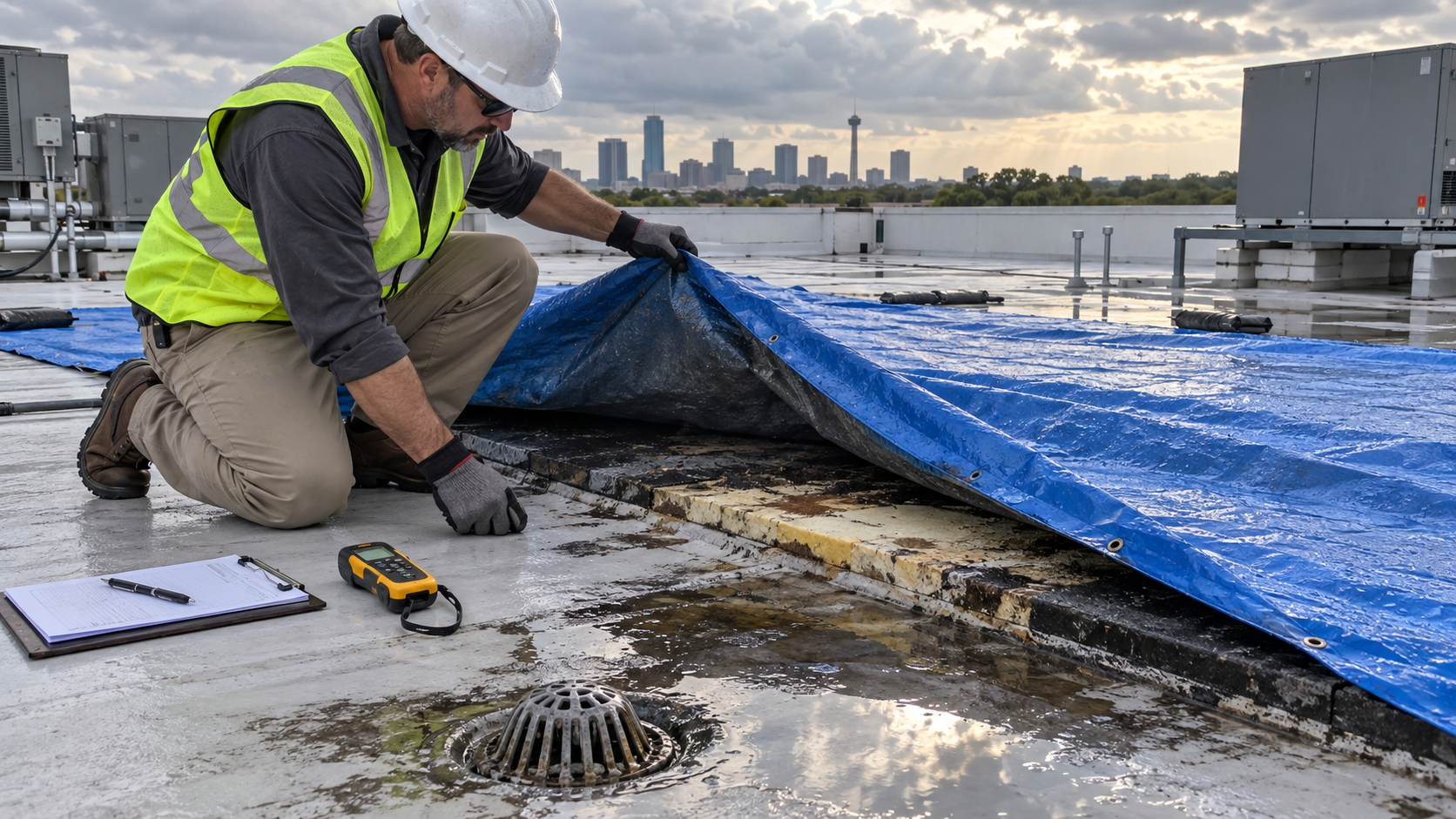
An emergency roof tarp can sometimes be adjusted, resecured, or replaced when it loosens, tears, or allows renewed water entry. That work repairs the temporary protection, not the roof beneath it. A tarp is an emergency mitigation measure intended to reduce additional damage until qualified professionals can inspect the roof assembly and complete a permanent solution.
Whether the underlying roof can be repaired or requires replacement depends on the damage area, roof type, moisture migration, insulation and deck condition, attachment, age, repair history, code requirements, and remaining serviceability. A localized puncture on an otherwise sound roof may support a targeted repair. Widespread wet insulation, compromised attachment, structural damage, recurring failures, or extensive storm damage may make partial or full replacement the more responsible path.
Showtime Exteriors helps Texas commercial property owners document emergency conditions, stabilize exposed areas, investigate the source and extent of damage, and plan permanent repair, restoration, recover, retrofit, or replacement. Property owners should keep people away from affected areas, avoid climbing onto wet or storm-damaged roofs, and call 817-400-ROOF (7663) for a professional assessment.
The Short Answer
A damaged emergency tarp may be resecured or replaced if qualified roofers can do so safely, but that action does not resolve the roof failure. The permanent decision must be based on the roof below the tarp. Repair is reasonable when damage is isolated, compatible materials remain serviceable, moisture is limited, and the deck and attachment are sound. Replacement becomes more likely when water has spread through the assembly, the deck is deteriorated, attachment is compromised, or the roof has reached the end of its dependable service life.
An Emergency Tarp Is Not a Roof Repair
Tarps, reinforced sheeting, temporary membranes, and similar coverings are designed to reduce immediate exposure. They are not substitutes for compatible flashing, properly prepared membrane repairs, restored seams, replaced insulation, deck correction, or a warranted roof system. Calling the tarp a repair can create false confidence and delay investigation while moisture continues moving beneath the surface. The work order and photographs should describe it accurately as temporary stabilization.
The recommendation should be documented in writing, with photographs and test results where appropriate. Conditions that remain concealed should be identified rather than assumed, and emergency protection should not be allowed to become an unexamined long-term solution.
Respond Immediately to Renewed Water Entry
If water appears after tarping, treat the situation as an active emergency. Protect occupants and contents, isolate slippery or electrically hazardous areas, move vulnerable inventory when safe, and contact the roofing contractor. Renewed leakage may indicate a loose edge, torn material, displaced ballast, a second entry point, trapped water migrating beyond the original opening, or drainage that is forcing water beneath the temporary covering.
The recommendation should be documented in writing, with photographs and test results where appropriate. Conditions that remain concealed should be identified rather than assumed, and emergency protection should not be allowed to become an unexamined long-term solution.
Put Safety Before Documentation
Do not send untrained employees onto a wet, wind-damaged, low-slope, metal, or structurally questionable roof. Conditions may include concealed openings, unstable decking, slippery surfaces, energized equipment, loose metal, and fall hazards. Roof access should be controlled, weather conditions reviewed, and qualified personnel equipped for the exposure. Interior photographs and observations can be collected without creating another hazard.
The recommendation should be documented in writing, with photographs and test results where appropriate. Conditions that remain concealed should be identified rather than assumed, and emergency protection should not be allowed to become an unexamined long-term solution.
Document Conditions Before and After Tarping
Photograph the exterior damage, interior water entry, ceilings, walls, equipment, inventory, and visible roof components before temporary protection is installed when conditions allow. Record the date, approximate time, weather, affected rooms, actions taken, and parties notified. After tarping, document the covered area, attachment method, perimeter, penetrations, drainage paths, and limitations. Maintain original files and a chronological log rather than relying on memory.
The recommendation should be documented in writing, with photographs and test results where appropriate. Conditions that remain concealed should be identified rather than assumed, and emergency protection should not be allowed to become an unexamined long-term solution.
Protect the Interior While the Roof Is Stabilized
Emergency response should address more than the rooftop. Water may threaten electrical panels, lighting, ceilings, insulation, stored goods, medical equipment, tenant improvements, and structural finishes. Qualified building personnel should isolate affected utilities when necessary. Use safe interior containment, remove standing water, monitor ceilings for deflection, and coordinate drying or environmental services when the extent of moisture exceeds routine cleanup.
The recommendation should be documented in writing, with photographs and test results where appropriate. Conditions that remain concealed should be identified rather than assumed, and emergency protection should not be allowed to become an unexamined long-term solution.
Inspect the Entire Failure Path
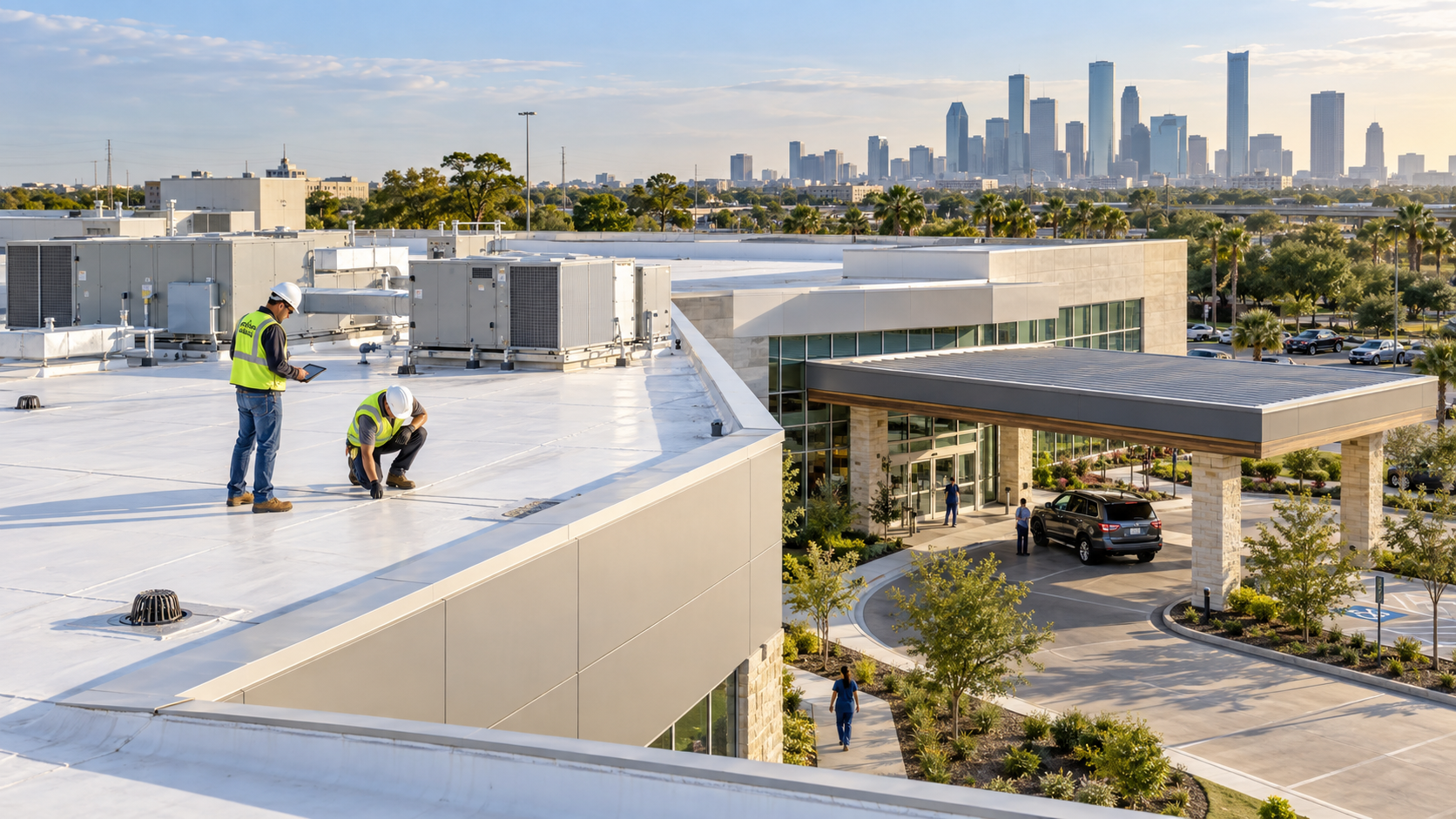
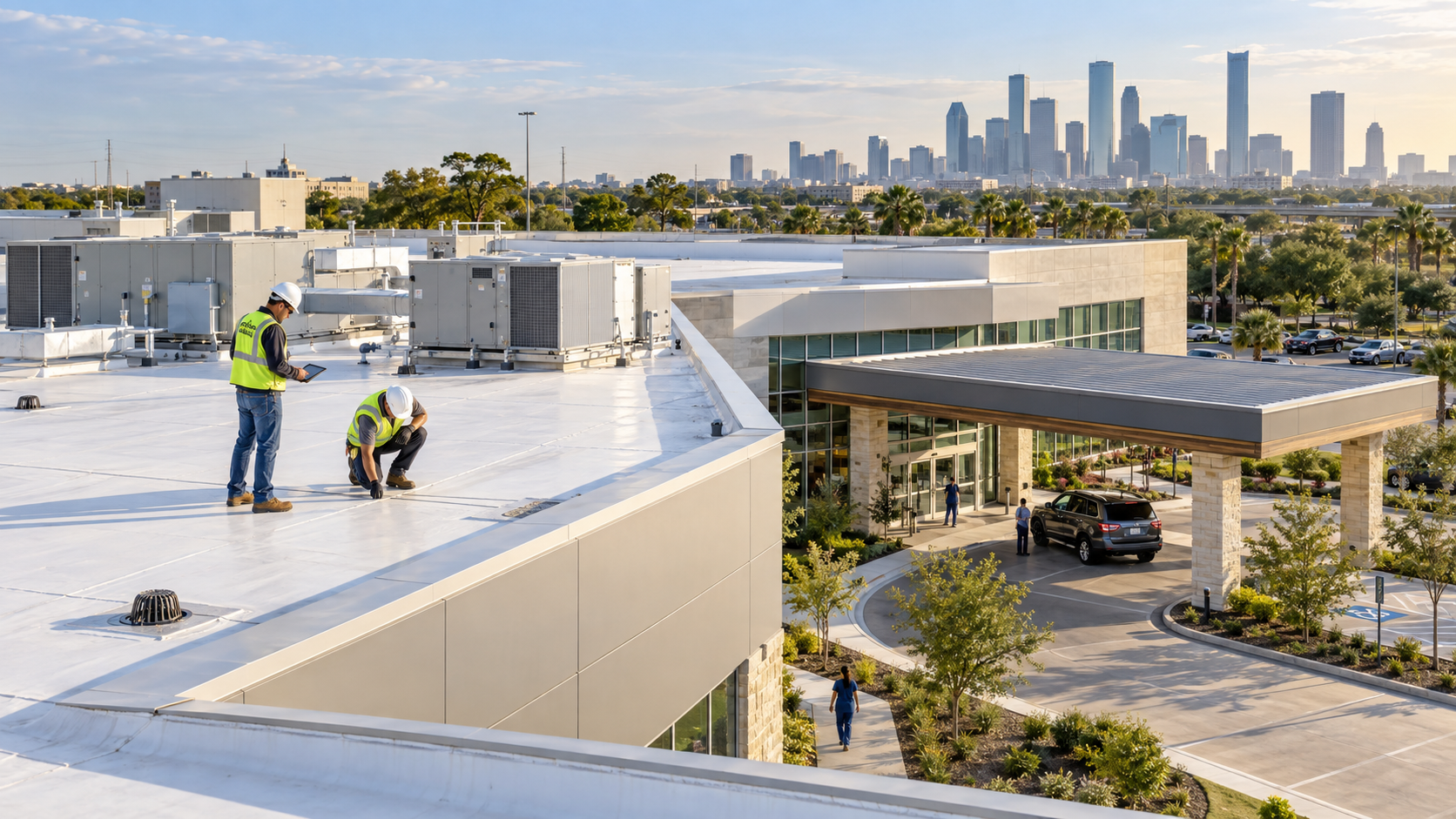
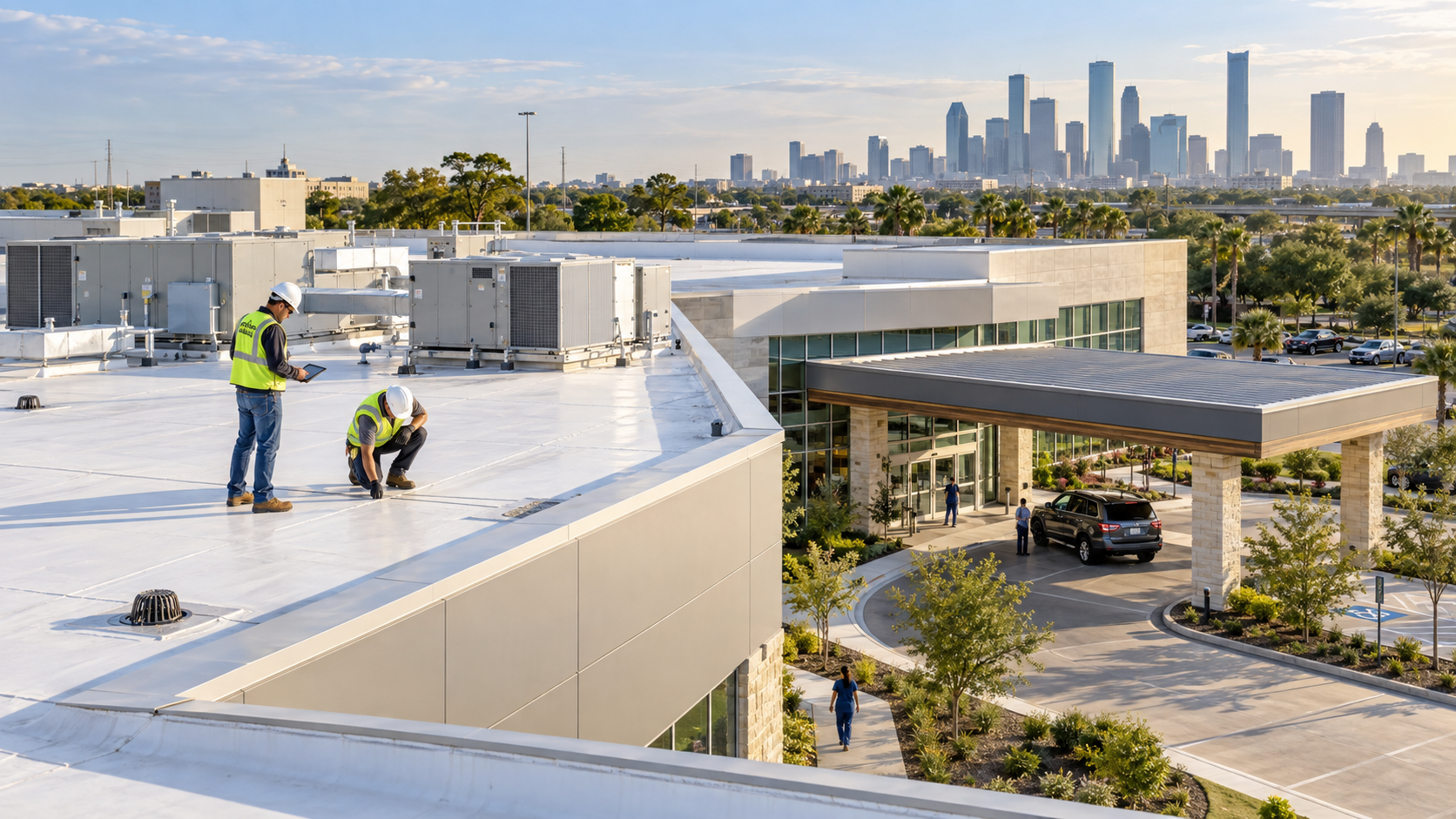
The visible opening is only the starting point. Water can travel along deck flutes, insulation joints, fasteners, beams, pipes, and ceilings before appearing inside. A qualified inspection should review the roof field, seams, flashings, penetrations, drains, scuppers, edges, coping, rooftop equipment, prior repairs, and accessible interior conditions. Labeled roof plans help connect exterior findings to interior symptoms.
The recommendation should be documented in writing, with photographs and test results where appropriate. Conditions that remain concealed should be identified rather than assumed, and emergency protection should not be allowed to become an unexamined long-term solution.
Determine the Extent of Moisture
Repair decisions remain incomplete until the team understands whether moisture is localized or widespread. Visual observations may identify staining or wet materials, but concealed moisture can require controlled test cuts, core samples, capacitance testing, infrared analysis under suitable conditions, or other accepted methods. Results should be interpreted with weather, roof construction, surface conditions, and known leak history.
The recommendation should be documented in writing, with photographs and test results where appropriate. Conditions that remain concealed should be identified rather than assumed, and emergency protection should not be allowed to become an unexamined long-term solution.
Evaluate the Roof Deck
A tarp can hide the surface while deterioration continues below. Steel decks may corrode, wood may decay, concrete may crack or spall, and gypsum or lightweight insulating concrete may lose integrity. Accessible deck conditions should be reviewed from the interior where possible. Soft, deflected, corroded, or damaged areas may require structural evaluation and replacement before the roof can receive a permanent repair.
The recommendation should be documented in writing, with photographs and test results where appropriate. Conditions that remain concealed should be identified rather than assumed, and emergency protection should not be allowed to become an unexamined long-term solution.
Conditions That Support a Targeted Repair
A permanent repair may be practical when the cause is identifiable, damage is isolated, the surrounding roof remains serviceable, compatible materials and methods are available, moisture can be removed, and the substrate is sound. The scope should include preparation, removal of damaged materials, insulation or cover-board replacement where needed, compatible flashing or membrane work, and quality-control documentation.
The recommendation should be documented in writing, with photographs and test results where appropriate. Conditions that remain concealed should be identified rather than assumed, and emergency protection should not be allowed to become an unexamined long-term solution.
Conditions That Point Toward Replacement
Replacement should be evaluated when damage extends across multiple roof areas, wet insulation is widespread, the deck or attachment is compromised, repairs have repeatedly failed, incompatible materials cover earlier work, drainage is chronically deficient, or the roof no longer provides a dependable substrate. The decision should consider total lifecycle risk, not only the lowest immediate invoice.
The recommendation should be documented in writing, with photographs and test results where appropriate. Conditions that remain concealed should be identified rather than assumed, and emergency protection should not be allowed to become an unexamined long-term solution.
Localized Damage Versus Systemic Failure
A single puncture, isolated lifted seam, or discrete flashing failure is different from a roof with broad attachment loss, saturated insulation, repeated leaks, and numerous incompatible patches. Separate the specific storm-created opening from preexisting wear and system-wide deficiencies. A clear report should identify observed facts, test results, probable failure paths, and the assumptions that still require verification.
The recommendation should be documented in writing, with photographs and test results where appropriate. Conditions that remain concealed should be identified rather than assumed, and emergency protection should not be allowed to become an unexamined long-term solution.
Widespread Wet Insulation Changes the Decision
Wet insulation can reduce thermal performance, add weight, corrode metal components, damage fasteners, and move water far from the original opening. Covering wet materials with another temporary layer does not restore the assembly. Depending on the survey results, the solution may involve isolated removal, sectional replacement, a larger recover plan with verified dry areas, or full replacement.
The recommendation should be documented in writing, with photographs and test results where appropriate. Conditions that remain concealed should be identified rather than assumed, and emergency protection should not be allowed to become an unexamined long-term solution.
Storm Damage Requires More Than a Surface Check
Wind, hail, falling debris, and heavy rain can affect membranes, flashings, edges, fasteners, equipment, drainage, and the deck. Some damage is obvious; other conditions develop at seams, terminations, or concealed attachment points. Inspection should connect the reported event to physical evidence without overstating causation. Emergency protection should preserve evidence where practical and avoid unnecessary disturbance.
The recommendation should be documented in writing, with photographs and test results where appropriate. Conditions that remain concealed should be identified rather than assumed, and emergency protection should not be allowed to become an unexamined long-term solution.
Punctures and Openings
Punctures from debris, tools, displaced equipment, or broken components may be repairable when the surrounding membrane and substrate remain sound. The permanent scope should extend beyond simply filling the visible hole. Remove damaged material, verify the insulation and deck, use compatible components, restore reinforcement and flashing details, and inspect adjacent areas for stress or secondary damage.
The recommendation should be documented in writing, with photographs and test results where appropriate. Conditions that remain concealed should be identified rather than assumed, and emergency protection should not be allowed to become an unexamined long-term solution.
Wind Uplift and Attachment Damage
Wind can loosen edges, peel membrane, displace panels, stress seams, and damage concealed attachment even when the surface appears mostly intact. If uplift has affected a broad area or separated components from the deck, a small patch may not restore performance. Perimeters and corners deserve particular attention because wind pressures are often highest there.
The recommendation should be documented in writing, with photographs and test results where appropriate. Conditions that remain concealed should be identified rather than assumed, and emergency protection should not be allowed to become an unexamined long-term solution.
Hail Damage
Hail assessment should consider membrane type, age, surface temperature, cover board, insulation, impact pattern, and rooftop equipment. Dents alone do not establish functional damage, and the absence of an immediate leak does not prove the assembly is unaffected. A qualified inspection should document representative areas and distinguish cosmetic conditions from openings, fractures, displaced materials, or compromised waterproofing.
The recommendation should be documented in writing, with photographs and test results where appropriate. Conditions that remain concealed should be identified rather than assumed, and emergency protection should not be allowed to become an unexamined long-term solution.
Fallen Trees and Heavy Impact
Tree limbs and heavy debris may create punctures, crushed insulation, bent deck, damaged framing, displaced equipment, and multiple entry points. Do not remove large debris until the area is safe and structural conditions are understood. Temporary covering may reduce exposure, but permanent work can range from a localized rebuild to structural reconstruction and roof replacement.
The recommendation should be documented in writing, with photographs and test results where appropriate. Conditions that remain concealed should be identified rather than assumed, and emergency protection should not be allowed to become an unexamined long-term solution.
Low Slope Commercial Roofs
Low-slope roofs can hold water near the temporary covering, especially when drains are blocked or the tarp interrupts normal flow. Water can enter at seams, attachment points, penetrations, or the low side of the covering. A professional should preserve drainage paths, avoid creating dams, and determine whether the existing membrane can accept a compatible permanent repair.
The recommendation should be documented in writing, with photographs and test results where appropriate. Conditions that remain concealed should be identified rather than assumed, and emergency protection should not be allowed to become an unexamined long-term solution.
Metal Roofs
Emergency coverings on metal roofs require careful planning because panels can be slippery, fasteners and seams may be distorted, and sharp edges can tear the tarp. Permanent repair may involve panel replacement, seam or fastener correction, flashing reconstruction, structural work, or a designed retrofit. Surface sealant alone should not be used to conceal movement, corrosion, or failed attachment.
The recommendation should be documented in writing, with photographs and test results where appropriate. Conditions that remain concealed should be identified rather than assumed, and emergency protection should not be allowed to become an unexamined long-term solution.
Shingle Roofs
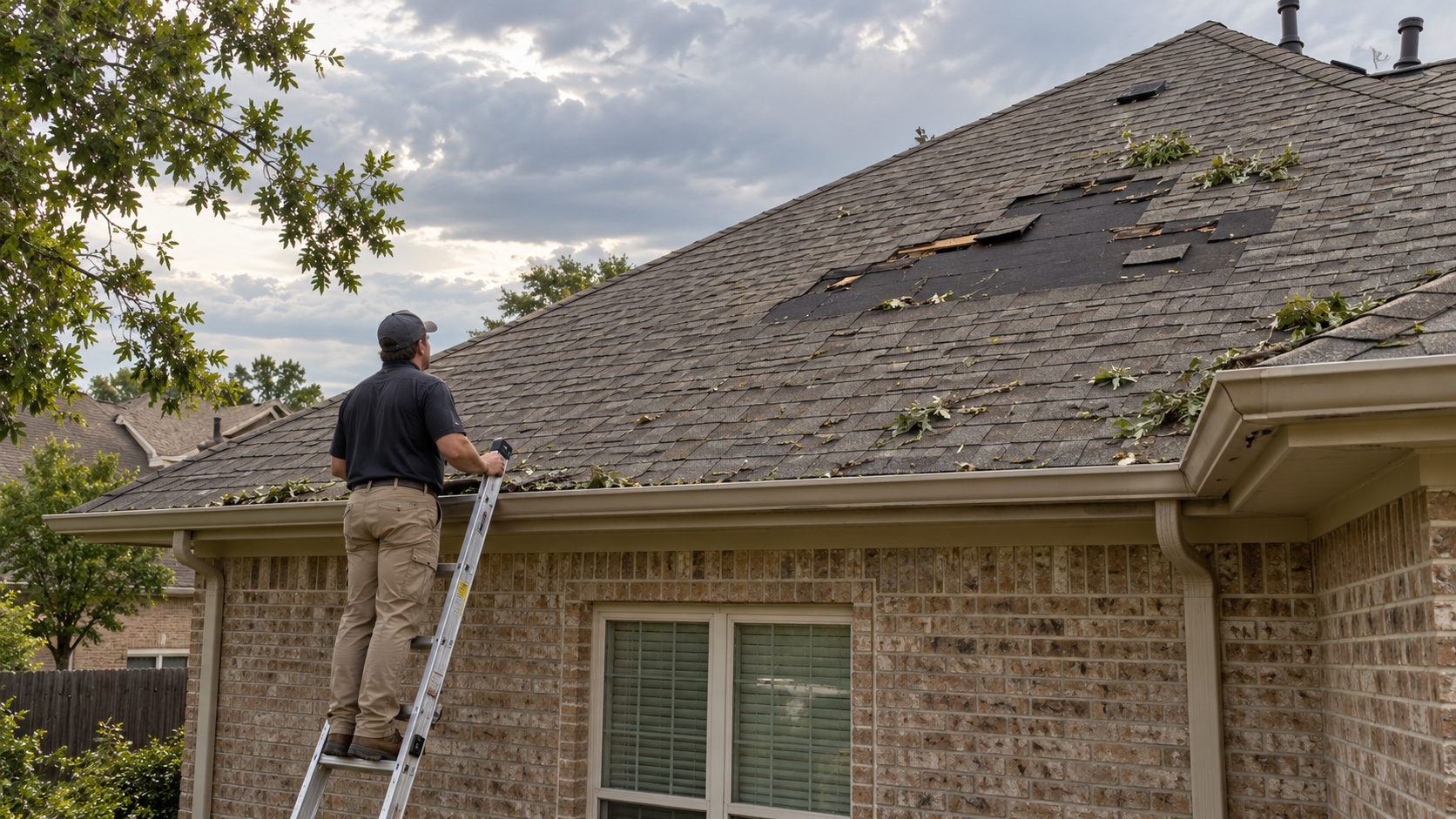
On steep-slope commercial or multifamily buildings, a tarp may protect missing shingles, damaged decking, valleys, penetrations, or ridge areas. Repair may be possible when the affected field is limited and matching materials can be integrated correctly. Replacement is more likely when damage is widespread, the deck is compromised, or surrounding shingles are too brittle to repair without causing additional failure.
The recommendation should be documented in writing, with photographs and test results where appropriate. Conditions that remain concealed should be identified rather than assumed, and emergency protection should not be allowed to become an unexamined long-term solution.
TPO and PVC Roofs
Thermoplastic membranes can often receive heat-welded repairs when the sheet remains serviceable and the substrate is dry and sound. The surface must be cleaned and prepared, and older membranes may require specialized procedures or confirmation of weldability. Large areas of wet insulation, attachment loss, widespread seam failure, or extensive contamination may shift the recommendation toward sectional or full replacement.
The recommendation should be documented in writing, with photographs and test results where appropriate. Conditions that remain concealed should be identified rather than assumed, and emergency protection should not be allowed to become an unexamined long-term solution.
EPDM Roofs
EPDM repairs may use compatible primers, adhesives, uncured flashing, reinforced membrane, and manufacturer-approved details. A tarp should not remain as the long-term answer over shrinking membrane, failed perimeter attachment, extensive wet insulation, or numerous aged patches. The inspection should evaluate seams, terminations, flashings, rooftop traffic, and substrate conditions.
The recommendation should be documented in writing, with photographs and test results where appropriate. Conditions that remain concealed should be identified rather than assumed, and emergency protection should not be allowed to become an unexamined long-term solution.
Modified Bitumen Roofs
Modified bitumen roofs may support targeted repairs when the damage is isolated and compatible methods can be used safely. Evaluate laps, flashings, blisters, splits, granule loss, previous coatings, and moisture below the surface. Repeated patching across an aged or unstable assembly may postpone a necessary replacement without producing dependable performance.
The recommendation should be documented in writing, with photographs and test results where appropriate. Conditions that remain concealed should be identified rather than assumed, and emergency protection should not be allowed to become an unexamined long-term solution.
Gravel Surfaced BUR Requires Extra Caution
Aging gravel-surfaced built-up roofs are difficult to evaluate because aggregate can conceal moisture, deteriorated felts, cracks, blisters, failed patches, storm damage, and blocked drainage. Repeated tarping does not remove those inspection limitations. Loose gravel can also complicate secure temporary attachment. Showtime Exteriors treats aging gravel BUR as a liability that requires careful investigation and replacement planning, especially when owners face insurance scrutiny or recurring leaks.
The recommendation should be documented in writing, with photographs and test results where appropriate. Conditions that remain concealed should be identified rather than assumed, and emergency protection should not be allowed to become an unexamined long-term solution.
Can the Temporary Tarp Itself Be Repaired
A qualified roofer may be able to resecure a loose edge, reinforce a limited tear, improve temporary attachment, or replace the covering. The decision depends on weather, access, material condition, roof type, drainage, and whether further work would create additional openings. A heavily damaged, contaminated, stretched, or repeatedly leaking tarp is usually better replaced than repeatedly patched.
The recommendation should be documented in writing, with photographs and test results where appropriate. Conditions that remain concealed should be identified rather than assumed, and emergency protection should not be allowed to become an unexamined long-term solution.
Monitor Temporary Protection
Temporary protection should be inspected after wind, heavy rain, hail, temperature changes, rooftop service activity, or renewed interior symptoms. Monitoring should include the perimeter, attachment points, penetrations, ponding, drainage paths, abrasion, tears, and interior conditions. There is no universal safe duration because performance depends on the materials, installation, weather, roof configuration, and damage below.
The recommendation should be documented in writing, with photographs and test results where appropriate. Conditions that remain concealed should be identified rather than assumed, and emergency protection should not be allowed to become an unexamined long-term solution.
Weather Exposure Shortens Temporary Service Life
Ultraviolet exposure, wind flutter, standing water, heat, cold, sharp roof components, rooftop traffic, and repeated storms can weaken temporary materials. A tarp that looked secure at installation may loosen or abrade quickly. The project team should establish inspection intervals, emergency contacts, responsibility for monitoring, and a target date for permanent work rather than treating the covering as open-ended protection.
The recommendation should be documented in writing, with photographs and test results where appropriate. Conditions that remain concealed should be identified rather than assumed, and emergency protection should not be allowed to become an unexamined long-term solution.
Insurance Documentation and Claim Coordination
Review the policy, deductible, reporting requirements, duties after loss, deadlines, exclusions, valuation provisions, and endorsements with the insurer or licensed insurance professional. A roofing contractor can document observed roof conditions and prepare a repair or replacement scope, but cannot guarantee coverage or interpret the policy as legal advice. Preserve invoices, photographs, communications, reports, and damaged materials when directed.
The recommendation should be documented in writing, with photographs and test results where appropriate. Conditions that remain concealed should be identified rather than assumed, and emergency protection should not be allowed to become an unexamined long-term solution.
Compare Repair and Replacement Estimates Correctly
A meaningful comparison should use equivalent scopes and clearly identify quantities, materials, insulation, cover board, attachment, edges, drainage, penetrations, tear-off, disposal, temporary protection, access, safety, permits, testing, exclusions, and concealed conditions. A low repair price may omit wet insulation, deck work, code upgrades, or the conditions that caused the failure.
The recommendation should be documented in writing, with photographs and test results where appropriate. Conditions that remain concealed should be identified rather than assumed, and emergency protection should not be allowed to become an unexamined long-term solution.
Code and Permit Considerations
Permanent work may trigger requirements related to attachment, insulation, drainage, fire classification, energy performance, edge systems, and permits. Applicable requirements vary by jurisdiction, building, scope, and existing conditions. The contractor should identify known requirements and coordinate design or engineering support when the project extends beyond routine repair.
The recommendation should be documented in writing, with photographs and test results where appropriate. Conditions that remain concealed should be identified rather than assumed, and emergency protection should not be allowed to become an unexamined long-term solution.
Phased Permanent Repairs
Occupied commercial buildings may benefit from phased work when the roof can be divided into controlled zones. Each phase should have secure daily tie-ins, weather planning, interior protection, access control, material staging, and communication with occupants. Phasing can reduce disruption, but it should not fragment a system in a way that leaves unresolved moisture or weak interfaces.
The recommendation should be documented in writing, with photographs and test results where appropriate. Conditions that remain concealed should be identified rather than assumed, and emergency protection should not be allowed to become an unexamined long-term solution.
Roof Restoration
Restoration may be considered when the roof is a qualified candidate, moisture is limited, adhesion and substrate conditions are acceptable, drainage is addressed, and the proposed system has documented preparation and reinforcement requirements. A coating should not be used merely to cover wet insulation, unstable materials, deteriorated gravel BUR, open seams, or structural deficiencies.
The recommendation should be documented in writing, with photographs and test results where appropriate. Conditions that remain concealed should be identified rather than assumed, and emergency protection should not be allowed to become an unexamined long-term solution.
Recover or Overlay
A recover system may reduce demolition when the existing assembly, deck, moisture conditions, attachment, fire classification, drainage, and code requirements support it. The evaluation should determine what can remain, what must be removed, and how the new system will attach. Recover is not appropriate when concealed deterioration or wet materials prevent a dependable substrate.
The recommendation should be documented in writing, with photographs and test results where appropriate. Conditions that remain concealed should be identified rather than assumed, and emergency protection should not be allowed to become an unexamined long-term solution.
Full Roof Replacement
Full replacement allows the team to remove failed materials, verify the deck, correct insulation and drainage, redesign attachment, reconstruct edges and penetrations, and install a more inspectable system. It carries higher initial cost and more coordination, but may provide a clearer long-term solution when the existing roof is broadly deteriorated or difficult to evaluate.
The recommendation should be documented in writing, with photographs and test results where appropriate. Conditions that remain concealed should be identified rather than assumed, and emergency protection should not be allowed to become an unexamined long-term solution.
How Quickly Should Permanent Work Begin
Emergency stabilization should be followed promptly by inspection, moisture evaluation, scope development, and scheduling. The exact timeline depends on safety, weather, material availability, permits, engineering, insurance communication, and operational needs. Delay becomes increasingly risky when the tarp is leaking, the roof contains wet materials, structural concerns exist, or another storm is expected.
The recommendation should be documented in writing, with photographs and test results where appropriate. Conditions that remain concealed should be identified rather than assumed, and emergency protection should not be allowed to become an unexamined long-term solution.
Owner Emergency Checklist
Keep people away from affected areas, protect interiors, call qualified emergency services, photograph accessible conditions, record the timeline, notify appropriate parties, preserve invoices and communications, and schedule a roof inspection. Do not allow untrained staff to climb onto the roof or alter evidence. Confirm who will monitor the tarp and who has authority to approve permanent work.
The recommendation should be documented in writing, with photographs and test results where appropriate. Conditions that remain concealed should be identified rather than assumed, and emergency protection should not be allowed to become an unexamined long-term solution.
What a Contractor Proposal Should Include
The proposal should identify the damaged area, roof system, observed conditions, investigation performed, temporary measures, permanent scope, materials, quantities, attachment, insulation, edges, drainage, penetrations, access, safety, permits, exclusions, warranty terms, concealed-condition process, schedule assumptions, and quality-control documentation. Separate facts, recommendations, allowances, and owner responsibilities.
The recommendation should be documented in writing, with photographs and test results where appropriate. Conditions that remain concealed should be identified rather than assumed, and emergency protection should not be allowed to become an unexamined long-term solution.
How Showtime Exteriors Supports Texas Property Owners
Showtime Exteriors begins with safety, documentation, roof-system identification, leak-path investigation, moisture questions, and a practical decision between repair, restoration, recover, retrofit, or replacement. The team helps owners move from emergency stabilization to a permanent scope while protecting occupants, operations, equipment, and the complete roof assembly.
The recommendation should be documented in writing, with photographs and test results where appropriate. Conditions that remain concealed should be identified rather than assumed, and emergency protection should not be allowed to become an unexamined long-term solution.
Emergency Roof Tarp Resources
Use the resources below to plan safe temporary protection and permanent roofing decisions. They include Showtime Exteriors service pages and independent guidance on roofing systems, maintenance, storm recovery, and fall protection.
A qualified inspection beneath temporary protection helps determine whether moisture and substrate conditions support repair or require replacement.
Showtime Exteriors Links
Learn more from Showtime Exteriors homepage, commercial roofing services, Houston commercial roofing, Houston commercial roof inspections, Houston commercial roof replacement, and commercial roofing resources.
Independent Safety and Roofing References
Authoritative references include OSHA fall protection requirements, FEMA low-slope roof systems guidance, NRCA maintenance guidance, GAF commercial roofing solutions, and GAF property owner resources.
Frequently Asked Questions About Emergency Roof Tarps
Is an emergency roof tarp a permanent repair
No. It is temporary protection intended to reduce immediate exposure while the underlying roof is inspected and permanent work is planned.
Can a torn roof tarp be patched
A qualified roofer may reinforce a limited tear or resecure an edge when conditions are safe, but a heavily damaged or repeatedly leaking tarp may need replacement.
How long can a roof tarp stay in place
There is no universal safe duration. Weather, material, attachment, drainage, roof type, and the damage beneath it determine performance. Move to permanent work promptly.
What should I do if the tarp starts leaking
Protect occupants and contents, isolate hazards, document accessible conditions, and contact the roofing contractor immediately. Do not send untrained staff onto the roof.
Can the roof beneath the tarp be repaired
Yes, when damage is isolated, moisture is limited, compatible materials remain serviceable, and the deck and attachment are sound.
When is roof replacement more likely
Replacement is more likely with widespread moisture, compromised deck or attachment, repeated failures, extensive storm damage, or an assembly that is no longer dependable.
Should I remove the tarp before the insurance inspection
Do not remove or alter temporary protection without coordinating safe access and documentation with the appropriate parties. Preserve photographs, invoices, and reports.
Can a tarp trap moisture
Yes. Water already in the assembly or entering from another pathway may remain concealed. Moisture evaluation is important before permanent work.
Can a gravel BUR roof be safely tarped
Temporary protection may be possible, but loose aggregate and concealed deterioration complicate attachment and evaluation. Aging gravel BUR requires professional inspection and replacement planning.
Can roof coating replace a tarp
A coating is not an emergency substitute and is appropriate only when the roof is a qualified candidate with acceptable moisture, adhesion, substrate, and preparation conditions.
Who should install or adjust an emergency tarp
Qualified roofing professionals with appropriate safety equipment and experience should evaluate access, weather, roof type, attachment, drainage, and structural conditions.
Who can determine repair versus replacement
A qualified commercial roofing contractor can document conditions and recommend a scope. Structural, design, insurance, or legal questions may require other licensed professionals.
Schedule an Emergency Commercial Roof Assessment
If a Texas commercial roof is under temporary protection, do not wait for the tarp to fail again. Call Showtime Exteriors at 817-400-ROOF (7663) to document the condition, investigate the roof assembly, and develop a permanent repair or replacement plan.