



How Much Does Restaurant Roof Replacement Cost in Texas?
A Practical Budgeting Guide for Restaurant Owners and Commercial Property Managers

Restaurant roof replacement in Texas can cost tens of thousands of dollars, with the final price depending on roof size, existing conditions, the replacement system, rooftop equipment, and the work required to keep the restaurant protected during construction.
For broad context, one Texas commercial roofing contractor publishes a statewide commercial replacement range of approximately $4–$23 per square foot. That range includes different buildings and project conditions; it is not a restaurant-specific average or a Showtime Exteriors quote. Core Commercial Roofing
A restaurant requires a closer evaluation. Kitchen exhaust equipment, grease exposure, HVAC units, delivery access, customer entrances, and operating hours can affect both the roofing design and the installation plan.
The most useful budget therefore begins with an inspection and a clearly defined scope. A square-foot price can help with preliminary planning, but it cannot explain whether the proposal includes tear-off, insulation, drainage improvements, equipment coordination, or concealed repairs.
For example, a restaurant with a sound deck and straightforward access may need a different project from a similar-sized restaurant with moisture concerns, several existing roof layers, and tightly packed rooftop equipment.
This guide explains how to build a realistic budget, compare proposals, and plan the work around your business.
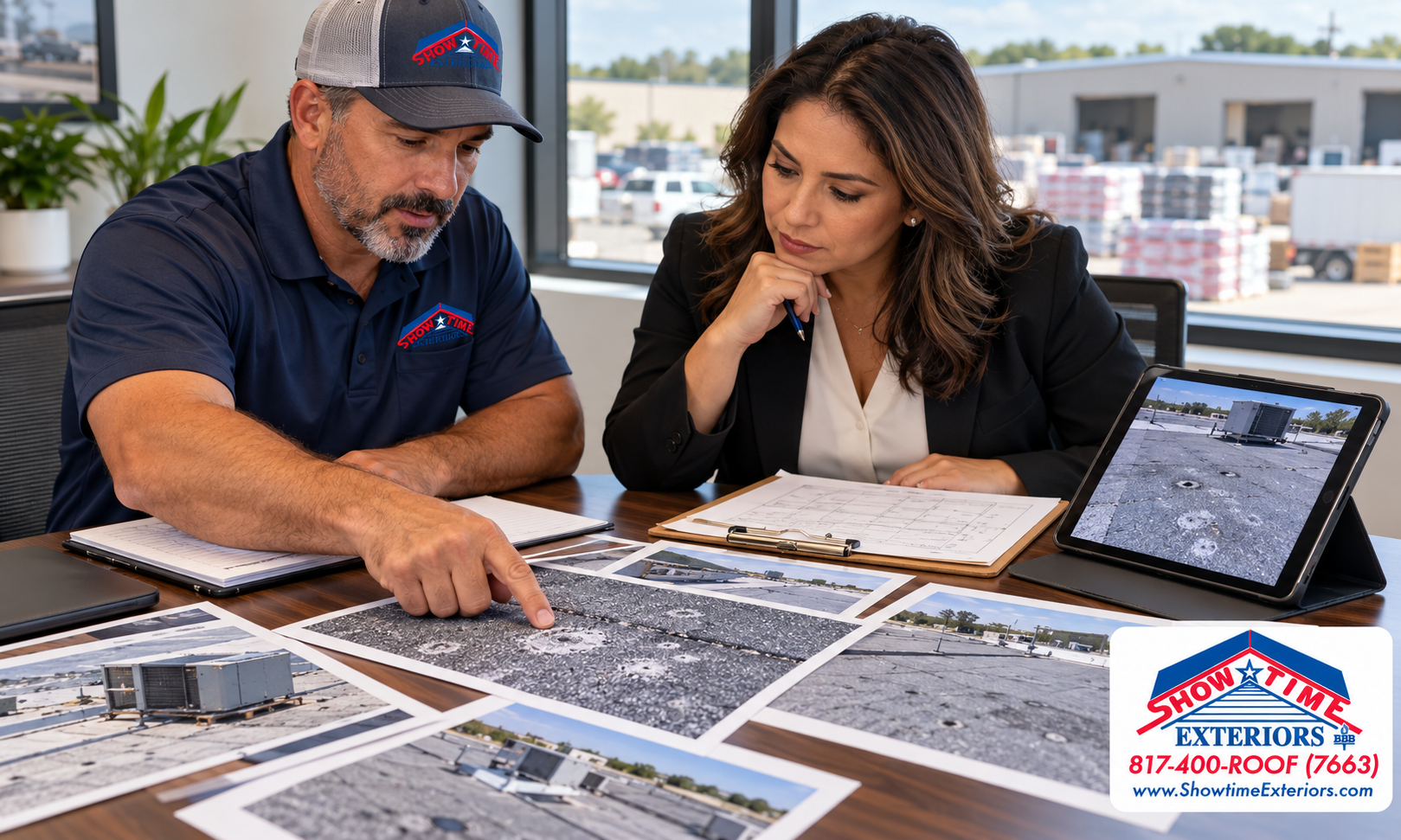
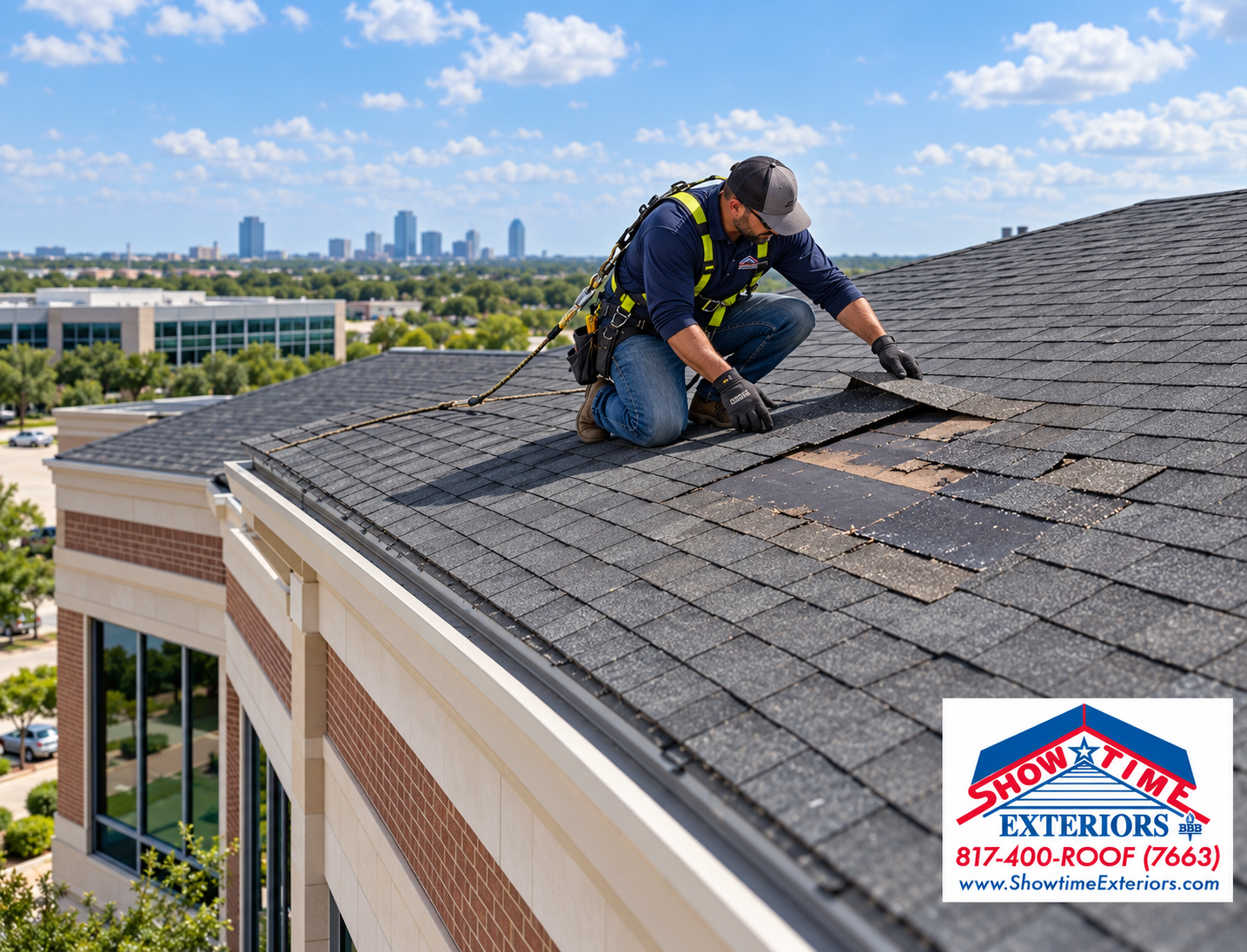
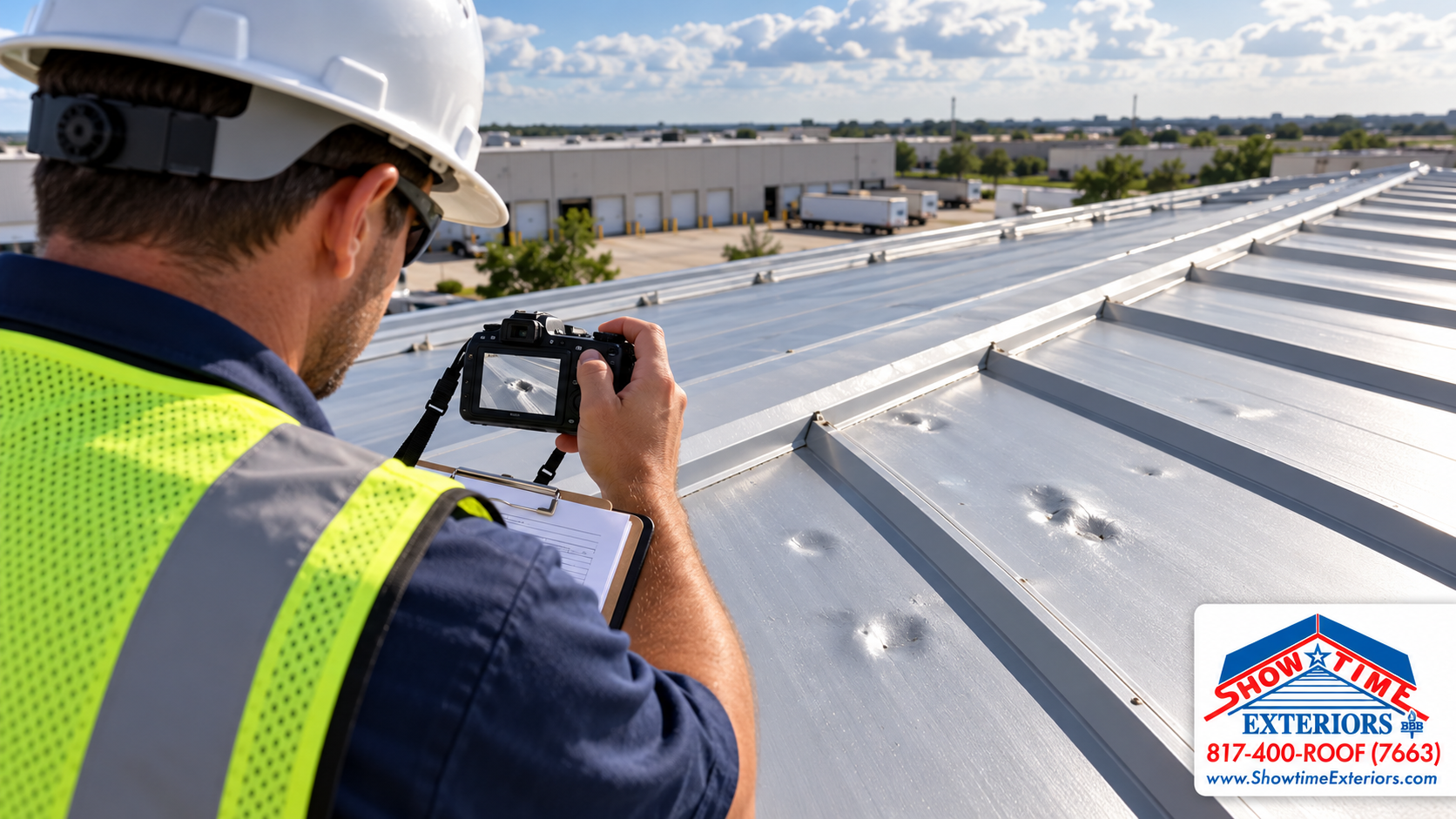
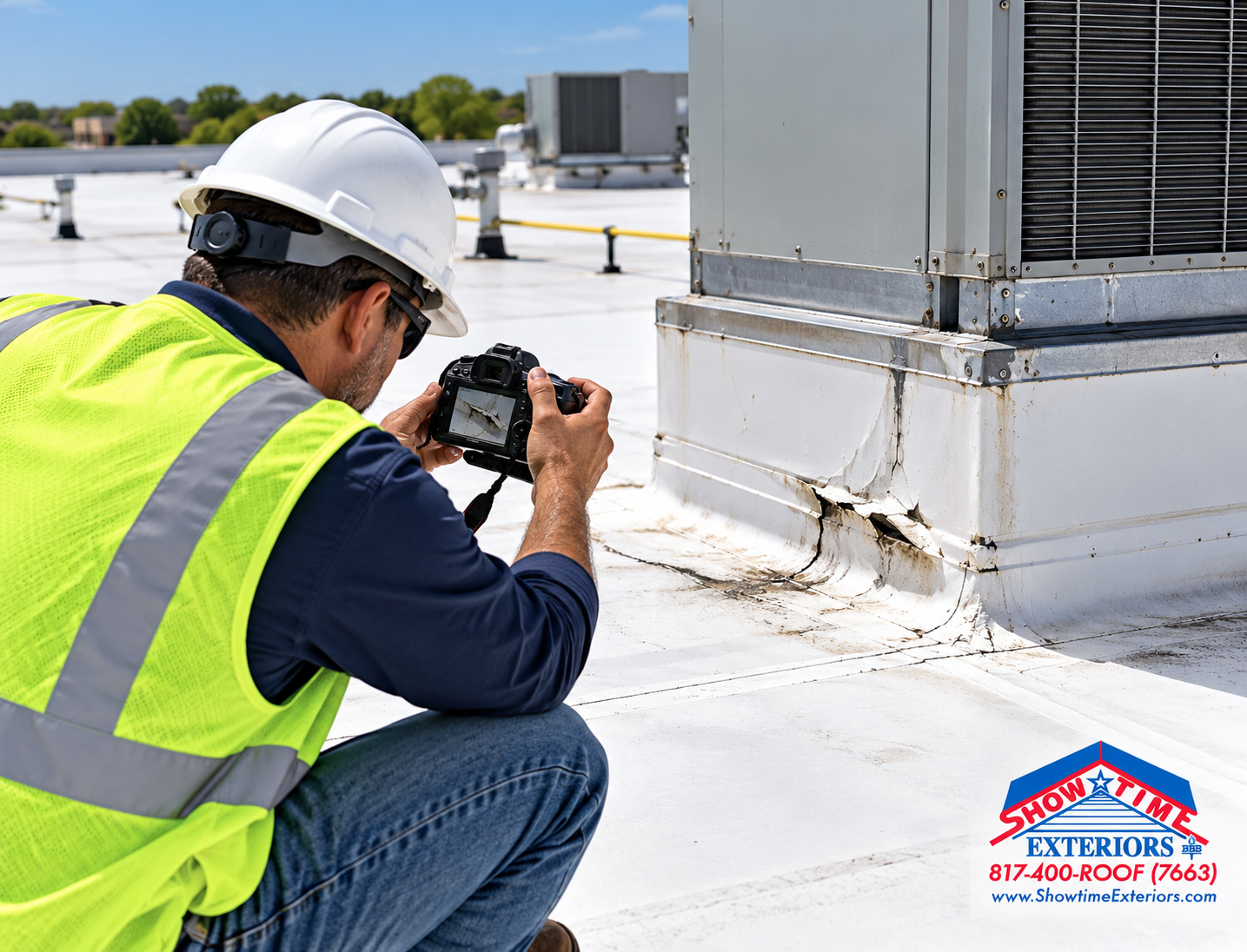
The two Showtime Exteriors images above are illustrative marketing artwork created for this article.
1. Start With a Budgeting Calculation
A preliminary calculation can help you understand the scale of the expense:
Measured roof area × assumed installed rate = preliminary roofing subtotal.
The following table uses hypothetical rates to demonstrate the arithmetic. These are budgeting scenarios, not verified market averages, estimates for your property, or Showtime Exteriors prices.
Measured roof areaAt an assumed $8/sq. ft.At an assumed $12/sq. ft.At an assumed $16/sq. ft.2,000 sq. ft.$16,000$24,000$32,0003,000 sq. ft.$24,000$36,000$48,0005,000 sq. ft.$40,000$60,000$80,0008,000 sq. ft.$64,000$96,000$128,00010,000 sq. ft.$80,000$120,000$160,000
Use this exercise to frame questions, rather than select a contractor.
Ask what the installed rate includes, which expenses are separate, and what conditions could change the price. A low assumed rate is not useful if it excludes work your roof actually needs.
The written scope should explain the budget.
2. Measure the Roof Area Accurately
Restaurant floor area and roof area are not always identical.
A building may include covered patios, canopies, additions, multiple roof levels, or sections with different slopes. A restaurant occupying one suite in a retail center may also share a larger roof with neighboring tenants.
Ask the contractor to identify the measured area and show which sections are included.
If the proposal covers only the restaurant’s roof section, confirm how that section connects with adjacent roofing. If the property owner intends to replace the entire building roof, the restaurant’s individual floor area may not be the relevant measurement.
For a mixed roof, request separate descriptions of the areas and systems involved.
Do not compare two square-foot prices until you know both contractors measured and priced the same work.
A clear roof plan helps establish those boundaries. It also provides a useful reference when discussing equipment, drainage, access, and potential changes during construction.
Accurate measurement is the foundation of a meaningful estimate.
3. Define What “Replacement” Includes
The word “replacement” can conceal important differences between proposals.
One contractor may price removal of the existing assembly and installation of new components. Another may propose retaining suitable existing materials and adding a new system over them.
Ask for a layer-by-layer description of what will be removed, what will remain, and what will be installed.
GAF distinguishes a full reroof, which removes the existing roof down to the deck, from a recover that retains much of the existing assembly and adds a new roofing layer. GAF
For your restaurant, clarify the proposed approach before discussing savings.
A recover proposal and a full tear-off proposal should not be compared as though they are identical projects. They involve different assumptions about the existing roof.
The estimate should also identify whether flashings, edge components, insulation, and other details are included.
Precise language helps you understand what you are buying and prevents disagreements over work that one party assumed was included.
4. Obtain an Inspection Before Choosing the Scope
An inspection should establish the information needed to recommend repair, restoration, recover, or replacement.
Provide previous reports, repair invoices, warranty documents, and photographs if available. Explain where leaks have occurred and whether those areas have been repaired repeatedly.
Ask the contractor which roof sections were inspected and which remained inaccessible.
A useful report should identify observations, locations, limitations, and recommended next steps. It should distinguish confirmed findings from conditions requiring additional evaluation.
If a major project is recommended, ask what supports that recommendation. Roof age can provide context, but it should not be the only explanation.
Likewise, a recent leak does not automatically establish that every section needs replacement.
The inspection gives you a basis for comparing options. Without it, a preliminary price may be built around assumptions that later prove incorrect.
An owner can budget more confidently when the scope responds to documented conditions rather than a generic description of an “old restaurant roof.”
5. Account for Tear-Off and Disposal
If the project requires removal of existing materials, make sure the proposal explains that work.
Ask which layers will be removed, where debris will be staged, how disposal will be handled, and which areas need protection during removal.
GAF identifies tear-off and disposal, new roofing components, installation labor, and operational logistics as commercial replacement cost drivers. gaf.com
At a restaurant, disposal planning should address customer access and deliveries. A dumpster placed near the wrong entrance can create an avoidable operational problem.
Confirm whether staging areas will occupy parking spaces or affect neighboring tenants. If the property is leased, ask who can authorize their use.
The scope should also describe daily cleanup and the condition in which the site will be left.
Avoid assuming that the lowest bid includes the same removal and disposal work as a higher bid. Review the quantities, exclusions, and logistics.
A complete proposal explains both the roofing work and how the removed materials leave the property.
6. Clarify Concealed Deck Repair Costs
Some conditions may remain uncertain until existing materials are removed.
Ask how the contractor will handle a discovered deck concern. The agreement should define how findings are documented, who authorizes additional work, and how pricing will be calculated.
A useful arrangement may include specified unit prices for defined repairs. The appropriate structure depends on the project, but it should be understandable before work begins.
Do not accept an unexplained promise that “everything underneath is included” without knowing the boundaries.
Similarly, do not assume that a proposal excluding concealed conditions is automatically unreasonable. The important question is whether the process for addressing them is clear.
Request photographs and an explanation of significant discoveries.
If the concern requires another professional’s evaluation, establish how that coordination will occur.
A defined process allows the restaurant owner to make informed decisions without turning each unexpected condition into a pricing dispute. It also helps distinguish authorized changes from work already included in the original contract.
7. Review Insulation and Cover Board Specifications
The roof budget should identify the proposed insulation and any cover board.
Ask about product types, thicknesses, attachment, and the reasons for the selected assembly. If tapered insulation is proposed, request a drawing or explanation showing its purpose.
Avoid comparing proposals solely by membrane name. Two projects described as “new TPO roofing” may include substantially different underlying components.
Ask whether existing insulation will be retained and what evaluation supports that decision. If selected areas are to be removed, the scope should describe how those areas are identified.
The proposal should also explain transitions where roof heights change or where insulation affects nearby details.
For the restaurant owner, the practical goal is a complete description that another qualified reviewer could understand.
You do not need to select every technical component yourself. You do need to know that the proposal identifies the assembly and explains how it fits the building’s conditions and applicable requirements.
8. Include Drainage in the Budget Discussion
Ask the contractor to evaluate existing drainage and explain any recommended changes.
Identify areas where water has been observed remaining after rainfall. Provide photographs with dates if available, and distinguish those observations from assumptions about the cause.
A replacement project is an opportunity to discuss drains, scuppers, gutters, and relevant roof slopes. It does not mean every drainage component automatically needs replacement.
Ask which improvements are included and whether work by another trade is required.
If a proposal retains existing drains, request an explanation of their condition and suitability. If it adds tapered insulation or other changes, ask how the design relates to drainage.
Make sure the pricing is clear. A proposal that excludes drainage work may appear less expensive while leaving a known concern unresolved.
The owner’s decision should account for what the completed project accomplishes, including any limitations that remain after the new roofing is installed.
9. Evaluate Kitchen Exhaust and Grease Exposure
Restaurant roofing deserves a specific conversation about the rooftop environment.
Provide information about cooking operations, exhaust locations, cleaning schedules, and any observed accumulation around equipment.
Ask the contractor to identify the proposed roofing product and explain its suitability for the expected exposure.
Carlisle describes PVC membranes as resistant to chemicals and grease, making PVC a relevant option to evaluate for restaurant roofing. That does not mean every PVC product or assembly is interchangeable. carlislesyntec.com
Request manufacturer guidance for the actual product being proposed.
Also discuss grease containment and maintenance. A material selection should work alongside an appropriate maintenance plan.
Avoid accepting a blanket statement that one roof type is always suitable or another is always unsuitable for every restaurant. The recommendation should address the specific system, exposure, details, and manufacturer requirements.
This conversation can influence both the initial scope and the responsibilities that continue after installation.
10. Compare TPO and PVC Proposals Properly
If the contractor offers both TPO and PVC, compare complete assemblies.
Ask why each is being proposed for your building. Relevant questions include the rooftop exposure, attachment method, insulation, detail requirements, maintenance, and warranty terms.
Do not assume that the difference in price comes only from the membrane itself. One option may include additional components or a different installation approach.
Request a side-by-side scope with the same roof area and clearly identified differences.
For restaurant use, the contractor should address kitchen exhaust conditions directly. A vague recommendation based only on what the company installs most often is insufficient for a substantial investment.
Ask for the specific manufacturer and product, rather than accepting “commercial white roof” as a specification.
You can then evaluate whether the additional price of an option corresponds to a relevant benefit for your property.
The goal is an informed selection supported by the actual building conditions and written product information.
11. Account for Rooftop Equipment Coordination
Restaurants may have HVAC units, exhaust equipment, vents, signs, communications equipment, and other rooftop components.
Create an equipment list and identify the service companies responsible for them.
Ask which components need coordination during the roof work. Will equipment remain in place? Are any changes or temporary interruptions anticipated? Does the proposal include work around the equipment, or will another contractor be needed?
Do not assume a roofer’s price includes mechanical, electrical, or exhaust service work.
The schedule should identify who is responsible for each task and when it occurs.
If equipment service is required, arrange the appropriate qualified providers early. A delay in reconnecting essential equipment can affect reopening or normal operations.
Ask whether the roofing scope includes photographs and documentation of the finished equipment details.
Clear coordination is particularly valuable where several service companies work on the roof. Everyone should understand the new roofing system and how future access will be managed.
12. Budget for Flashings and Perimeter Details
Ask the contractor to describe work at roof edges, walls, penetrations, and changes in elevation.
These details should appear in the estimate with enough specificity to understand what is being retained or replaced.
“New membrane” does not explain whether existing edge metal will remain, whether wall flashings are included, or how the roof connects to an adjoining section.
Request a location-based description where the building has several different conditions.
If existing components are proposed for reuse, ask what evaluation supports that choice. If new components are proposed, confirm the specification and finish where appearance matters.
For a restaurant, visible exterior details may also affect the property’s appearance. Coordinate relevant choices with the owner or landlord.
A clear scope reduces the chance that an attractive initial price leaves important transitions outside the project.
It also gives you a practical checklist for confirming that the completed work matches the approved proposal.
13. Confirm Permits and Project Requirements
Ask the contractor to identify the requirements that apply to your project and explain who will manage them.
The answer may depend on the property location, building conditions, scope, and proposed assembly. Avoid assuming that every Texas restaurant follows the same process.
Clarify whether permit fees, required inspections, design services, or other administrative work are included in the estimate.
If the contractor identifies a requirement that changes the proposed scope, ask for a written explanation.
For leased properties, determine whether the landlord has additional construction standards or approval procedures.
Do not authorize work based on a general claim that no paperwork is needed without confirming the process applicable to the property.
The project schedule should show any approvals required before materials are ordered or installation begins.
These details help prevent a budget from appearing complete while leaving necessary coordination outside the contract.
14. Plan Around Restaurant Operating Hours
Tell the contractor when the restaurant prepares food, receives deliveries, serves customers, and performs cleaning.
The installation plan should address these activities rather than assuming the building is empty during standard work hours.
Ask which work can occur during normal operations and which tasks may require changes to access or service. Obtain a practical explanation instead of a blanket promise that there will be no disruption.
If off-hours work is requested, ask whether it changes pricing or scheduling.
Identify who can approve adjustments when conditions change. The restaurant manager may need authority to reroute deliveries, while the property owner controls construction decisions.
Keep staff informed with specific instructions.
For example, “deliveries will use the rear service entrance on Tuesday morning” is more useful than “roof work this week.”
An organized operating plan helps the business prepare and allows the contractor to price the actual constraints.
15. Include Access, Staging, and Site Protection
Review how crews, materials, and equipment will reach the roof.
Ask where lifts, deliveries, staging areas, and debris containers will be located. Confirm whether these arrangements affect parking, drive-through lanes, patios, or accessible entrances.
Do not overlook neighboring businesses in a shared center. Construction arrangements may require property management coordination.
The proposal should explain protection for entrances and other affected areas.
Ask how restrictions will be marked and who will maintain them. If a temporary route is needed, make sure staff know when it applies.
Site logistics can affect the schedule even when the roof itself is straightforward.
Provide accurate information about loading restrictions, gates, overhead clearances, and available staging space before the contractor finalizes the estimate.
A plan based on actual access conditions is more reliable than one developed from roof dimensions alone. It also helps avoid unexpected changes once crews arrive.
16. Evaluate Recover and Coating Alternatives Carefully
Ask whether the existing roof qualifies for an alternative to full replacement.
A recover retains suitable existing components and installs a new roofing layer. A coating project involves preparation and restoration of an eligible existing system.
GAF explains that coatings require appropriate existing conditions and preparation; they are not a substitute for addressing a compromised roof. gaf.com
For your restaurant, request the findings supporting eligibility.
Ask what testing or evaluation is needed, which repairs must occur first, and how existing moisture or drainage concerns will be addressed.
Compare the options as different scopes. A lower initial price may be appropriate for a qualifying roof, but it should not be treated as equivalent to removing and rebuilding the assembly.
Also ask about warranty terms and ongoing maintenance.
The decision should explain why the alternative fits the building, not simply that it costs less.
17. Compare Repair Costs With Replacement Costs
If the problem appears localized, request a repair evaluation.
Ask what a repair would accomplish, which conditions remain, and whether the recommendation is intended as temporary protection or a longer-term solution.
Review previous repair history. Repeated visits can provide useful context, but the number of repairs alone does not determine the correct scope.
Compare defined outcomes.
A repair proposal might address one identified location. A replacement proposal might address the entire roof assembly. Those prices represent different work and should be assessed accordingly.
Ask the contractor to explain the remaining uncertainties under each option.
For an owner planning a major project later, a suitable interim repair may have a practical role. For a roof with broader documented concerns, repeated limited work may leave important issues unresolved.
The inspection should support the recommendation and make its limits understandable.
18. Build a Contingency Around Known Uncertainties
A contingency is money reserved for defined uncertainties.
Ask the contractor which unknown conditions could affect the price and what additional evaluation could reduce that uncertainty before work begins.
Avoid choosing a contingency percentage solely because it sounds standard. The appropriate allowance depends on the information available and the contract structure.
For illustration, an owner budgeting a hypothetical $60,000 project might reserve an additional $6,000. That is a planning example, not a recommendation that every roof requires a 10% contingency.
Keep the reserve separate from the contracted price.
Define how it can be used. Additional work should follow an agreed authorization process with documentation, except where immediate protective action is required.
A contingency does not replace a detailed estimate. It helps the owner prepare for identified uncertainty while preserving control over changes.
The more clearly the inspection and scope define the project, the more useful the reserve becomes.
19. Compare Bids Using the Same Checklist
Place proposals side by side before evaluating the totals.
Item to compareQuestion to askRoof areaAre the same sections included?RemovalWhich existing layers will be removed?New assemblyAre membrane, insulation, and other components specified?DetailsAre edges, walls, penetrations, and drainage addressed?EquipmentWho handles any required service coordination?LogisticsAre staging, access, and operating constraints included?Unforeseen workHow are discoveries priced and authorized?WarrantyWhat coverage and responsibilities are documented?
Ask contractors to clarify differences in writing.
One proposal may include substantial work that another excludes. A lower total may still be suitable, but you need to understand the resulting scope.
Avoid adding assumptions to fill gaps yourself.
A complete comparison allows you to select a proposal based on the work, scheduling, and responsibilities it establishes.
20. Review Warranty Terms Beyond the Length
A warranty length is only one part of the decision.
Ask who provides the warranty, what it covers, what exclusions apply, and what owner responsibilities continue.
Distinguish manufacturer coverage from contractor workmanship coverage. Request the applicable documents or a clear description before signing.
For a restaurant, discuss maintenance around kitchen exhaust and access by other service companies. Confirm how future roof concerns should be reported.
Do not assume that every event or repair is covered because a proposal advertises a long term.
Also ask what documentation you will receive at completion and whether inspection or registration steps are required.
Keep the warranty with the permanent roof records.
An owner should be able to identify the contact, reporting process, and maintenance obligations without relying on a verbal promise remembered months later.
Clear terms make the warranty more usable and help inform the project comparison.
21. Separate Insurance From Construction Pricing
If storm damage is involved, maintain accurate inspection and repair records.
Discuss coverage, deductibles, valuation, and reporting requirements with the insurer or an appropriately qualified adviser.
Do not assume the construction price equals the amount insurance will pay. Likewise, avoid selecting a scope solely because someone promises full reimbursement.
Ask the contractor to explain the roof findings and proposed work. Ask the insurer to explain its assessment under the policy.
Keep those records connected but distinct.
If the scope changes after additional evaluation, document the reason and communicate through the appropriate process.
The owner remains responsible for understanding the contract and payment obligations.
A clear roofing proposal should stand on its own as a description of the work. Insurance discussions should not replace that scope or obscure which expenses, responsibilities, or approvals remain unresolved.
22. Confirm Landlord and Tenant Responsibilities
For a leased restaurant, review who controls roof decisions before authorizing a major project.
The restaurant operator may experience the leak while the landlord owns the roof and selects the contractor. The lease and any applicable agreements should guide the process.
Ask who can approve access, equipment coordination, staging, and changes to the exterior.
If the roof serves multiple tenants, confirm the project boundaries and communication responsibilities.
Avoid assuming that a restaurant’s occupied floor area determines its financial responsibility for shared roofing work.
Get the necessary approvals in writing and retain them with the project records.
Where responsibility is unclear, seek clarification from the landlord and appropriate advisers before committing to permanent work.
Emergency protection and long-term replacement may involve different authorization arrangements.
Resolving these questions early helps the contractor develop a workable plan and prevents a completed estimate from stalling over ownership or approval issues.
23. Consider the Full Business Budget
The roofing contract is one part of the restaurant’s financial planning.
Identify separate expenses that may arise from equipment service, interior restoration, temporary arrangements, or operating changes.
Keep these categories distinct from the contractor’s scope.
Use actual records where available. Avoid treating gross sales for a closed period as a complete calculation of business loss; the restaurant’s accountant can help evaluate the financial effect appropriately.
If financing is considered, review the total repayment obligation and terms.
Do not build the budget around unverified tax savings or assumed insurance proceeds.
A practical worksheet should show the contracted roof cost, separate trade work, identified operational expenses, and contingency.
This gives the owner a clearer picture of the cash required.
The aim is a project that can be funded and managed through completion, with fewer surprises about costs that were never included in the original roofing proposal.
24. Establish a Schedule With Clear Milestones
Ask for a schedule that identifies approvals, material ordering, mobilization, installation, inspections, and closeout.
Clarify what depends on weather, equipment service, or other trades.
A date for starting work is useful, but the restaurant also needs to understand how daily operations will be affected.
Request a primary contractor contact and agree on an update process.
If a milestone changes, ask what the change means for the next steps. Avoid allowing the project to become an undefined sequence of “we will let you know.”
The restaurant should also assign one person to communicate updates to staff.
Before work begins, confirm emergency contacts and procedures for reporting an unexpected concern.
A realistic schedule gives the owner a basis for planning deliveries, staffing, and customer communication.
It also helps distinguish a temporary delay from a condition that requires a revised project plan.
25. Close the Project With Complete Records
At completion, request final photographs, the completed scope, invoices, warranty documents, and maintenance recommendations.
Confirm whether authorized changes are reflected in the final paperwork.
Ask the contractor to identify any known conditions left outside the work. The owner should understand what the completed project resolves and what remains a separate responsibility.
Verify that staging areas are cleared and temporary restrictions can be removed.
Update the restaurant’s equipment service companies about the new roof system and any relevant access instructions.
Store the closeout package with previous roof records.
A useful file should allow a future owner, manager, or contractor to understand what was installed and when.
The project is easier to maintain when those details are available from the beginning.
Good closeout documentation also makes later budgeting more reliable because the restaurant no longer needs to reconstruct the roof history from scattered invoices and photographs.
Frequently Asked Questions
What does a 5,000-square-foot restaurant roof cost?
As a hypothetical budgeting exercise, assumed rates of $8, $12, and $16 per square foot produce totals of $40,000, $60,000, and $80,000. Those figures are not property estimates. An inspection and written scope are needed to price the actual project.
Is PVC always the best roof for a restaurant?
PVC is worth evaluating where relevant exposures exist, but the recommendation should address the specific product, assembly, kitchen exhaust conditions, and manufacturer requirements.
Can the restaurant stay open during replacement?
Possibly, depending on the work and site conditions. Ask for a plan addressing entrances, deliveries, equipment, protection, and any required interruptions. Do not rely on an unconditional promise.
Is a recover less expensive than full replacement?
It can involve less removal and fewer new components, but the existing roof must qualify. Compare the actual scopes and supporting findings.
Can a coating avoid replacement?
A qualifying roof may be a restoration candidate. Ask for evidence of suitability and a description of required preparation and repairs.
What causes the biggest pricing surprises?
Unclear scope, concealed conditions, excluded equipment work, drainage changes, and access assumptions can complicate budgeting. Define how each will be evaluated and managed.
How can I reduce cost responsibly?
Obtain an early inspection, provide accurate records, compare matching scopes, clarify exclusions, and coordinate operating requirements before pricing is finalized.
Get a Restaurant Roof Replacement Estimate From Showtime Exteriors
Planning a restaurant roof replacement in Texas? Contact Showtime Exteriors to discuss an inspection and a written proposal for your property.
Share the address, approximate roof area, current concerns, rooftop equipment, and operating hours. Ask what the proposed work includes and how installation will be coordinated around the business.
A clear scope gives you a stronger basis for budgeting, comparing options, and planning the project.
Call 817-400-ROOF (7663)
Visit
ShowtimeExteriors.com