



Commercial Roof Repair Versus Replacement for Section 179 in Texas
Texas Commercial Roofing Decision Guide

A commercial roof should be repaired when the problem is isolated, the surrounding assembly remains serviceable, and a permanent correction can reasonably restore performance. Restoration may be appropriate when the roof is dry, stable, compatible, and approaching the point where a renewed weathering surface can extend its useful life. A recover or full replacement becomes more defensible when deterioration is widespread, insulation is wet, attachment is unreliable, drainage is defective, repairs are recurring, or the roof no longer provides a dependable platform for continued service.
That is the roofing answer. The tax answer is separate.
Some business owners hear that roofs on nonresidential property may qualify for Section 179 and assume that replacement is automatically preferable to repair. Others assume that anything called a repair is immediately deductible. Neither conclusion should be made from the contractor's terminology alone. Federal tax treatment depends on the facts, the nature of the work, the property, the taxpayer, current law, elections, limits, and accounting analysis. A roofing contractor can document the physical condition and completed scope, but a CPA or tax attorney must determine classification and tax treatment.
For Texas property owners, the sound sequence is to inspect the roof, identify the failure mechanism, map moisture, compare technically responsible options, select the right scope, document the work, and then give that documentation to the tax professional. This guide explains how Showtime Exteriors approaches that decision and why aging gravel-surfaced built-up roofs require especially careful scrutiny.
The Direct Answer
Choose repair when damage is limited and the roof still has credible remaining service life. Choose restoration when the existing roof is dry, stable, compatible, and suitable for a manufacturer-approved renewal system. Consider a recover when the roof below can responsibly remain in place and the new assembly meets structural, moisture, fire, attachment, and code requirements. Choose full replacement when the existing assembly is too wet, deteriorated, unreliable, layered, incompatible, or difficult to maintain.
Do not choose replacement merely because someone mentions Section 179. Do not keep repairing a failing roof merely because the immediate invoice is smaller. The physical condition of the roof should determine the roofing scope. A qualified tax professional should separately determine whether the cost is a deductible repair, a capital improvement, qualified Section 179 real property, or subject to another treatment.
The four practical options are:
Repair a localized defect and preserve an otherwise serviceable roof.
Restore a suitable existing roof with coordinated repairs and a renewed protective surface.
Recover or retrofit over an existing assembly that is dry, stable, compatible, and permitted to remain.
Replace the roof when the assembly has reached a condition that localized work cannot responsibly correct.
The correct decision begins with evidence rather than a product preference or tax deadline.
Why the Repair Versus Replacement Decision Matters
The Cheapest Immediate Scope Can Become the Most Expensive Plan
A small repair is economically sensible when it addresses a contained problem. It becomes a poor strategy when leaks keep returning in new locations, moisture spreads through insulation, the deck deteriorates, or temporary materials accumulate across the roof. Owners may pay for repeated service calls while still carrying the risk of interior damage, business interruption, tenant complaints, inventory loss, and emergency work.
Replacement also carries risk when it is selected too early or scoped poorly. Removing a roof creates temporary exposure, noise, debris, staging demands, and potential disruption. A replacement that ignores drainage, deck condition, insulation, perimeters, penetrations, or rooftop traffic can recreate the failures of the old system.
The objective is not to spend the least or the most. It is to choose the lowest-risk scope that addresses the known conditions and produces a maintainable roof.
The Decision Affects Insurance and Asset Planning
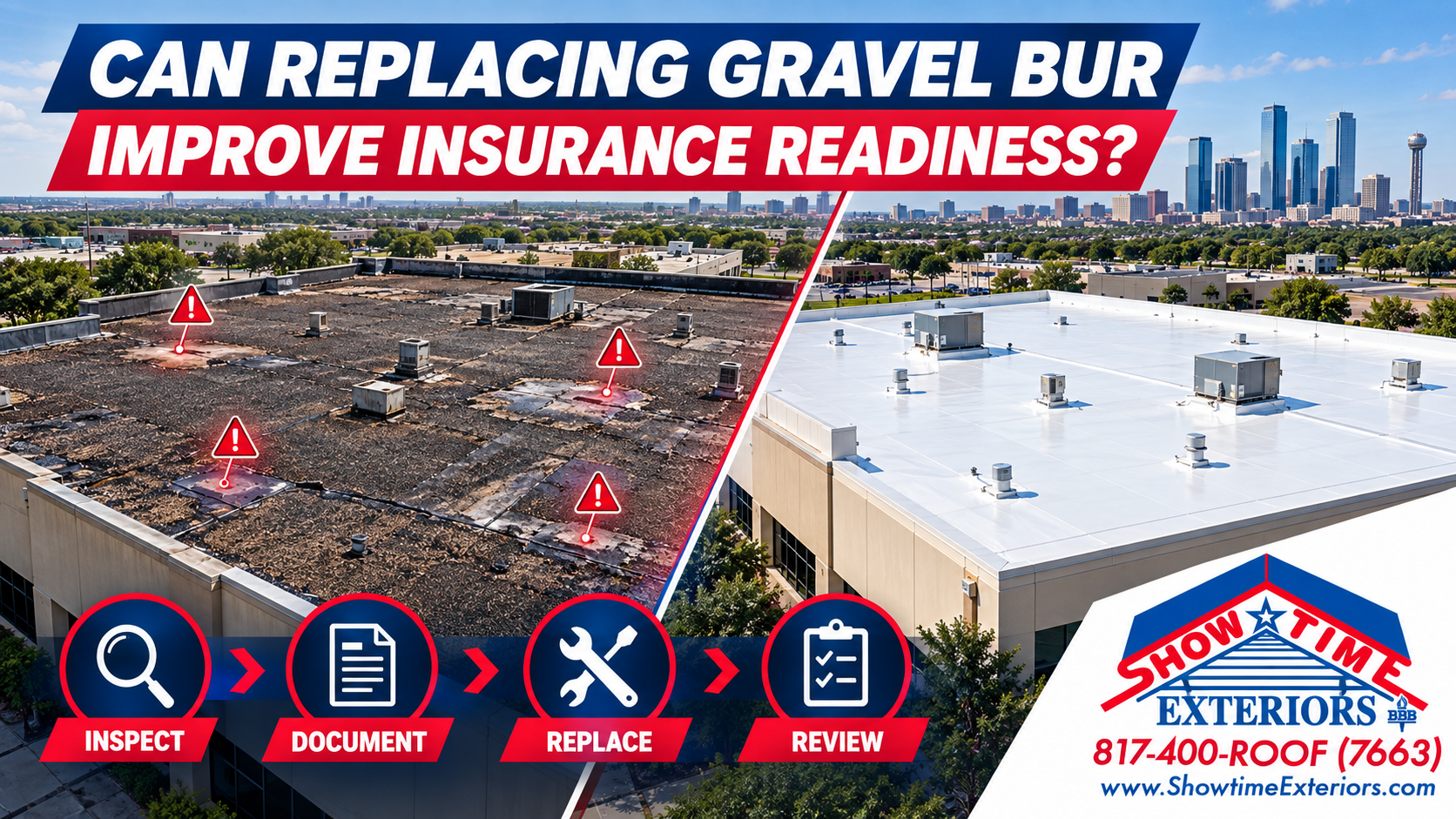
Insurers may ask about roof age, material, condition, maintenance, repairs, storm history, moisture, and remaining service life. An aging roof with incomplete records can create uncertainty during underwriting or renewal. A clear inspection report and improvement plan can help the owner communicate the actual condition, although no contractor can guarantee coverage, premiums, or underwriting decisions.
The roof decision also affects capital planning. A localized repair may buy time for a properly designed replacement. A suitable restoration may extend service life. A recover may reduce tear-off and operational exposure. Full replacement may provide the cleanest opportunity to correct insulation, drainage, attachment, and flashing problems. Each choice should have an expected purpose and time horizon.
Begin With a Professional Roof Assessment
Document the Existing Assembly
The visible surface is only one part of a commercial roof. The assessment should identify the deck, vapor retarder where present, insulation, cover board, membrane or panels, surfacing, flashings, edge conditions, drainage, penetrations, rooftop equipment, traffic areas, and prior repairs. Core samples or other investigative methods may be appropriate when the build-up is unknown.
The owner should also gather installation records, warranties, repair invoices, leak logs, insurance correspondence, aerial images, and maintenance reports. The history can reveal whether the roof has one recurring defect or a pattern of systemic failure.
Trace the Failure Pathway
An interior stain does not always sit directly below the roof entry point. Water can travel along decking, insulation joints, structural members, pipes, conduits, and walls. The inspection should examine seams, laps, fasteners, flashings, curbs, drains, scuppers, transitions, pitch pans, penetrations, edge metal, and previous patches.
The goal is to distinguish a repairable entry point from a broader assembly problem. A puncture in an otherwise sound membrane is different from widespread seam failure. One loose flashing is different from failed attachment around the perimeter. One wet insulation area is different from moisture across multiple roof zones.
Map Moisture
Moisture changes the decision. Wet insulation may lose thermal performance, compromise adhesion, accelerate corrosion or deterioration, and weaken the substrate for a new system. Visual inspection alone may not show the full extent.
Depending on the roof and conditions, the evaluation may use core samples, infrared thermography, electrical capacitance or impedance methods, interior observations, and targeted openings. No method is perfect in every assembly. Findings should be interpreted with roof history, weather, materials, and verification.
A moisture map supports more precise choices. Isolated wet areas may be removed and repaired. Widespread or poorly defined moisture can make restoration or recover less defensible and push the project toward replacement.
When Commercial Roof Repair Makes Sense
The Damage Is Localized
Repair is usually strongest when the failure is limited, accessible, and surrounded by serviceable material. Examples may include a puncture, an open seam, a damaged flashing, a displaced accessory, a localized fastener problem, a small storm-damaged area, or a defect caused by another trade.
The permanent repair should use materials and methods compatible with the existing system. It should extend beyond weak material, restore drainage where involved, and be documented with photographs and a roof plan. Smearing sealant over a symptom without finding the pathway is not a reliable repair strategy.
The Roof Has Credible Remaining Life
A repair should fit the roof's broader condition. If the membrane remains flexible or serviceable, seams and flashings are generally intact, insulation is mostly dry, attachment is reliable, and leaks are infrequent, a localized correction may be reasonable.
The owner should still ask what the repair is expected to accomplish. Is it a permanent correction to one defect, a temporary emergency measure, or part of a staged capital plan? Defining that expectation prevents a temporary patch from becoming an unexamined long-term solution.
Drainage and Substrate Remain Functional
Repair is more defensible when the roof drains as intended and the substrate is stable. If ponding water, deck deflection, blocked drainage, or saturated insulation drives the leak, surface patching alone will not correct the cause.
Showtime Exteriors' guide to retrofit roof drains explains why drains, scuppers, slope, crickets, and overflow paths must be considered as part of the roof system.
When Restoration May Be Appropriate
The Existing Roof Is Dry Stable and Compatible
Restoration generally combines repairs, surface preparation, reinforcement, and a protective coating or other renewal approach. Silicone, acrylic, urethane, and fabric-reinforced systems have different strengths, limitations, application requirements, and compatible substrates.
The existing roof normally needs to be sufficiently dry, stable, attached, and suitable for the specified system. Adhesion testing, moisture investigation, cleaning, rust treatment where relevant, seam work, flashing repairs, and reinforcement may be required before the finish application.
Restoration Must Be More Than Painting the Roof
A legitimate restoration scope identifies repairs and preparation in detail. It specifies application rates or dry-film thickness, reinforcement locations, treatment of penetrations and edges, drainage corrections, quality-control checks, warranty terms, and maintenance requirements.
Coating cannot repair rotten decking, stabilize loose insulation, restore failed attachment, or remove trapped moisture. It should not be used to hide widespread deterioration. If the roof is not a responsible restoration candidate, full replacement or another engineered approach should be evaluated.
Understand the Service Life Objective
The owner should know whether restoration is intended to extend service life for a defined planning period, secure a manufacturer warranty, improve weathering, or coordinate with a future capital project. Recoating requirements and inspection intervals should be part of the lifecycle plan.
Lower initial cost is not enough. A restoration is valuable only when it addresses the actual condition and can be maintained.
When a Roof Recover or Retrofit May Work
The Existing Assembly Can Remain
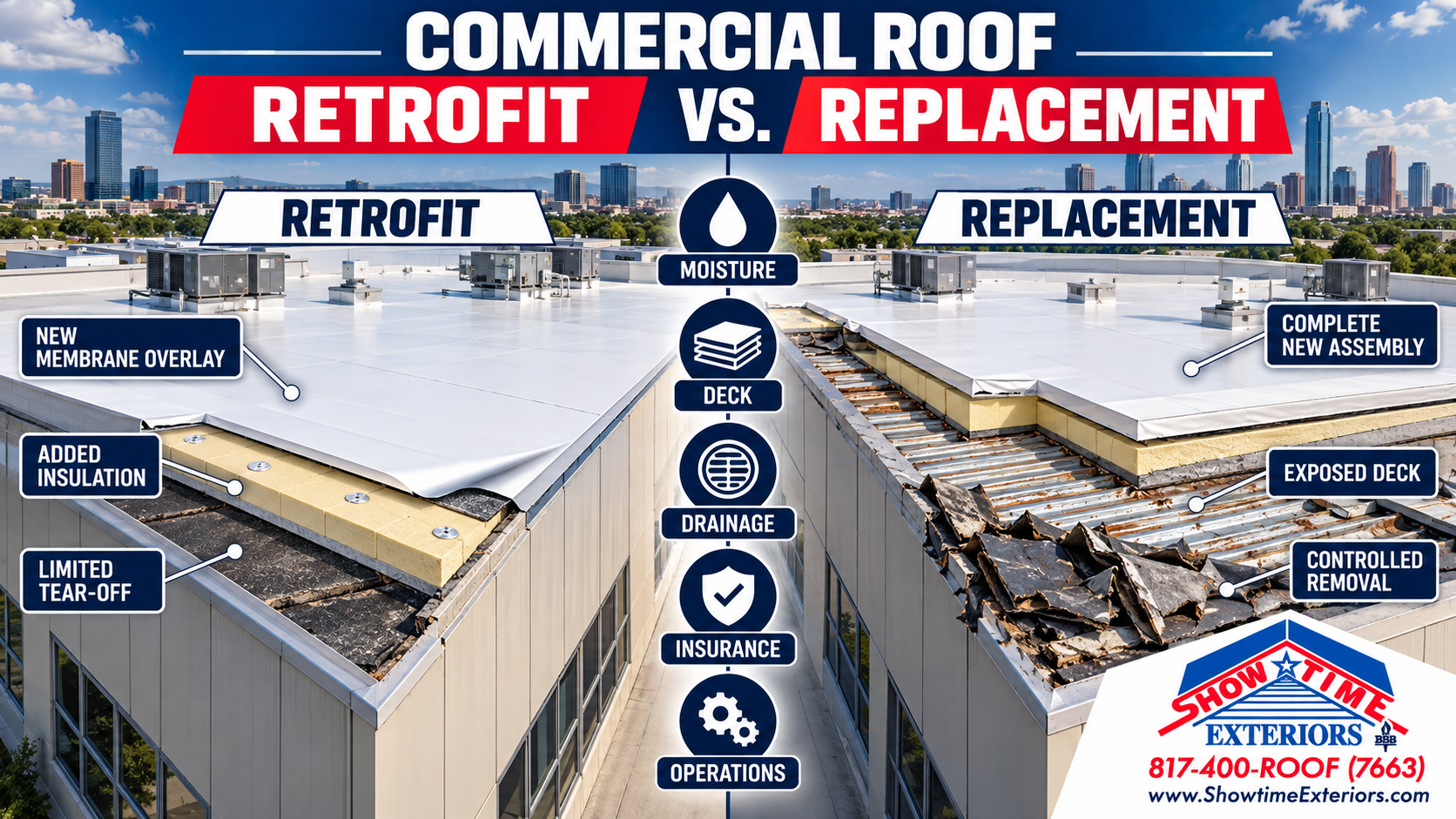
A recover installs a new roof over an existing roof that is suitable to stay in place. A retrofit may use a new framing, insulation, membrane, panel, or drainage approach to upgrade the building without a conventional full tear-off.
Potential advantages include reduced demolition, less interior exposure, lower disposal volume, and faster installation. Those advantages depend on the existing assembly being dry enough, stable enough, compatible, and permitted to remain. Roof quantity, fire classification, structural weight, deck condition, fastening, moisture, code requirements, and warranty rules all matter.
Wet Materials Should Not Be Buried
Known wet insulation and deteriorated components should be removed. Uncertain areas should be investigated. Covering moisture for the sake of a lower price or faster year-end schedule can create corrosion, odor, microbial concerns, reduced thermal performance, blistering, attachment problems, and premature failure.
The recover scope should show where materials are removed, how the remaining roof is prepared, how attachment is achieved, and how drains, curbs, walls, edges, and penetrations transition to the new elevation.
Metal Roof Retrofit Requires Movement Planning
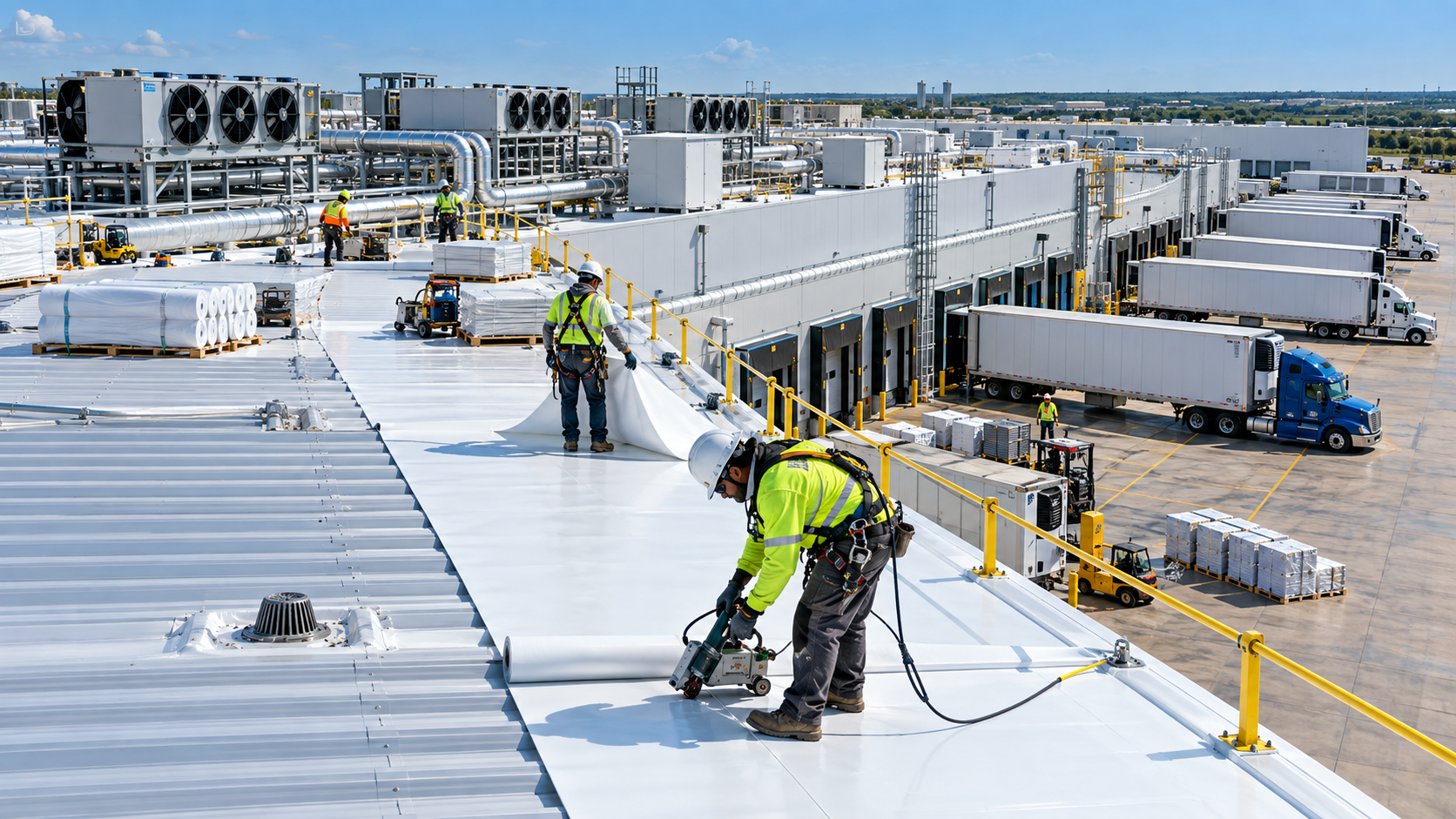
Existing metal buildings may be candidates for membrane retrofit, new metal, coatings, or targeted repair. The inspection should address corrosion, open seams, loose fasteners, failed closures, panel movement, skylights, gutters, transitions, curbs, and structural conditions.
Showtime Exteriors' guide to a TPO retrofit over an existing metal roof describes how insulation, substrate preparation, drainage, and detailing become part of a complete retrofit rather than a simple surface covering.
When Full Replacement Is Necessary
Moisture Is Widespread
Widespread wet insulation is one of the clearest reasons to consider replacement. Moisture can reduce insulation value, corrode metal, deteriorate decks and fasteners, create odor, and make the existing assembly an unreliable base. Removing damaged materials allows the project team to see and correct concealed conditions.
The scope should include a process for confirming moisture during construction, documenting removed areas, pricing concealed deck repairs, and maintaining temporary protection.
Repairs Are Repeating Without Solving the Cause
Recurring leaks in different areas often indicate systemic deterioration rather than isolated defects. Large quantities of patches, mismatched materials, failing seams, brittle membranes, deteriorated flashings, and repeated emergency calls can show that the roof no longer responds efficiently to repair.
The owner should compare the cumulative cost and disruption of repeated repairs against a planned replacement. A replacement can be staged and coordinated. An emergency failure chooses the timing for the owner.
The Deck Attachment or Drainage Is Unreliable
Replacement may be needed to access corroded or damaged decking, rebuild insulation and slope, correct fastening, or redesign drainage. Installing a new surface over a defective base does not solve the structural or water-management problem.
Ponding, deflection, blocked secondary drainage, undersized components, and poorly located drains should be addressed with appropriate roofing and design expertise. Structural or engineering questions belong with qualified professionals.
The Existing Roof Is Incompatible With the Proposed System
Some materials cannot be directly combined without separation, preparation, or removal. Existing oils, coatings, asphalt, moisture, contaminants, surface irregularities, or movement can undermine adhesion and performance. Manufacturer requirements and project-specific conditions should guide compatibility.
Replacement provides an opportunity to create a coordinated assembly from the deck up, including insulation, vapor-control strategy where needed, cover board, attachment, membrane or panels, flashings, edge metal, drainage, and walkways.
Why Aging Gravel Surfaced BUR Often Moves the Decision Toward Replacement
Gravel Conceals Deterioration
Aging built-up roofs with gravel surfacing deserve more scrutiny than a quick visual walk. Gravel can conceal cracks, splits, blisters, deteriorated asphalt, failed patches, punctures, and moisture pathways. It can make the roof's true condition difficult to observe and can complicate surface preparation for reliable repairs.
The lack of visibility creates uncertainty for owners, contractors, consultants, and insurance underwriters. Finding one visible defect does not establish that the surrounding assembly is dry or serviceable. Targeted gravel displacement, core samples, moisture surveying, repair-history review, and detailed documentation may be necessary.
Recurring Patches Can Mask a Larger Problem
Gravel-surfaced BUR roofs often accumulate patches over time. Some may be permanent repairs, while others may be temporary or incompatible. Gravel can hide the boundaries and condition of earlier work. When leaks keep recurring, the owner may be paying to chase water through an assembly that no longer offers predictable performance.
Showtime Exteriors does not position aging gravel BUR as an advantage. If moisture is widespread, deterioration is extensive, inspection confidence is low, or insurance concerns are increasing, replacement planning may be more responsible than another round of patching.
Removal Requires Early Planning
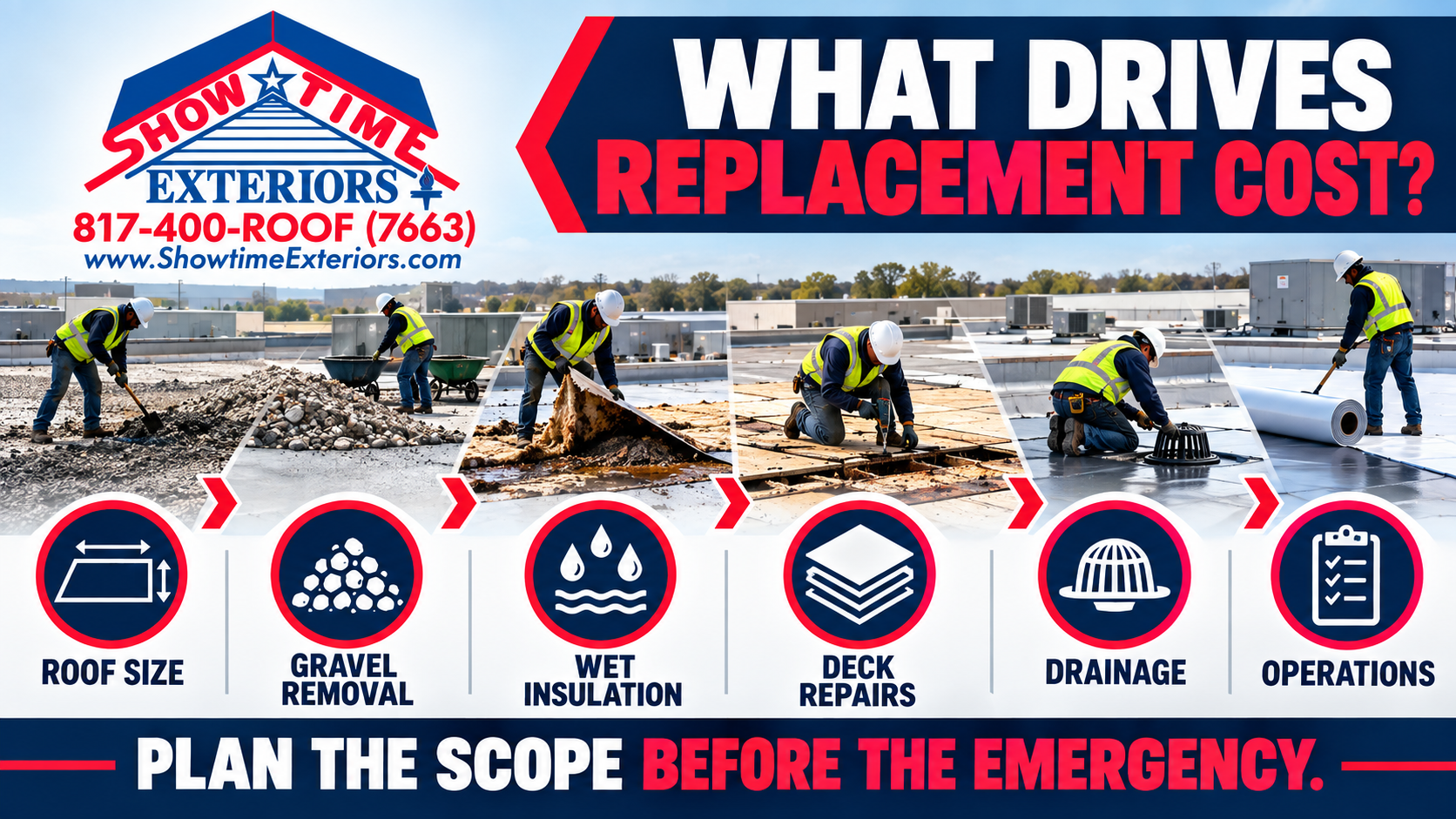
Gravel and multiple roof layers affect weight, labor, hauling, staging, noise, debris, and schedule. The contractor should plan controlled removal, ground protection, loading areas, weather contingencies, and daily dry-in. Structural questions may require professional analysis.
These realities are reasons to plan early, not reasons to delay until a major leak or renewal deadline forces an emergency decision.
Inspect, map moisture, define the responsible roofing scope, and document the completed work before discussing tax treatment.
Repair Restoration and Replacement Costs Should Be Compared Correctly
Compare Complete Scopes
A repair price may cover one defect. A restoration price may cover preparation, repairs, reinforcement, and coating. A replacement price may include tear-off, deck repairs, insulation, cover board, membrane, flashings, edge metal, drainage, walkways, permits, testing, and warranty. Comparing only the total at the bottom of each proposal can be misleading.
Normalize the proposals by asking:
- What roof area is included?
- What existing materials remain or are removed?
- How are wet insulation and damaged deck handled?
- Which insulation, cover board, membrane, panels, or coating are specified?
- What attachment and perimeter enhancements are included?
- How are drains, curbs, penetrations, walls, and edges treated?
- What safety, staging, protection, cleanup, and closeout are included?
- What warranty is proposed, and what does it exclude?
Consider Cost of Interruption
Construction cost is not the only cost. A restaurant may lose service time. A medical office may need odor, noise, dust, and patient-access controls. A warehouse may need inventory protection and dock coordination. A manufacturer may need shutdown planning around sensitive processes.
The best scope accounts for the building's operations. A lower bid that ignores interruption risk may expose the owner to greater total cost.
Consider Remaining Service Life
The owner should estimate what each option is expected to achieve. A repair might restore one area and preserve several years of service. A restoration might extend a suitable roof for a planned period. A recover might provide a new warrantable assembly while limiting tear-off. Replacement may provide the longest reset when designed and maintained correctly.
These are project-specific expectations, not guarantees. Maintenance, storms, traffic, workmanship, materials, drainage, and building changes all affect service life.
How Tax Classification Differs From Roofing Terminology
A Contractor Scope Does Not Decide Tax Treatment
Roofers use repair, restoration, recover, retrofit, and replacement to describe physical work. Tax rules use different tests to distinguish deductible repair and maintenance expenses from capital improvements. An invoice labeled repair is not automatically deductible, and a project labeled replacement is not automatically eligible for Section 179.
The IRS provides a framework for repairs and improvements in its tangible property regulations overview. The analysis can involve whether work results in a betterment, restores property, adapts it to a new or different use, or falls within other rules and elections. A CPA or tax attorney must apply those standards to the taxpayer's facts.
Section 179 May Apply to Certain Roofs on Nonresidential Property
Section 179 may allow eligible taxpayers to expense qualifying property subject to current rules, limits, business-income restrictions, elections, and other requirements. Certain roofs placed in service on nonresidential real property may fall within qualified Section 179 real property, but qualification is not automatic.
The IRS explains eligible property and limits in Publication 946. Taxpayers generally use Form 4562 and its instructions for depreciation and Section 179 reporting. The owner's tax professional should verify the current-year rules rather than relying on a contractor's marketing summary.
Residential Rental and Mixed Use Property Need Separate Analysis
The property classification matters. A commercial storefront, owner-occupied business building, apartment complex, mixed-use building, and residential rental property may not receive the same treatment. Business-use percentages, ownership, leasing arrangements, entity structure, and placed-in-service facts can affect the analysis.
Showtime Exteriors can document what roof work was performed. It should not determine whether the taxpayer or property qualifies.
Section 179 Is Different From Section 179D
Section 179 and Section 179D are separate provisions. Section 179 addresses eligible property and expensing under its rules. Section 179D concerns energy-efficient commercial building property and has separate technical and certification requirements. The IRS maintains an official Section 179D overview.
A reflective membrane, coating, or insulation upgrade does not automatically create a Section 179D deduction. Owners should not combine the names or assume one provision proves eligibility for the other.
Documentation for a Repair Project
Before the Repair
Photograph the interior symptom and rooftop conditions. Mark the suspected entry point on a roof plan. Record the date, weather, leak history, affected room, equipment or inventory at risk, and previous work in the area. Identify the existing system and confirm compatible repair materials.
During the Repair
Document material removal, wet insulation found, substrate condition, repair dimensions, products used, preparation, reinforcement, fastening, and completed detail. If the scope changes, create a written change order or field authorization.
After the Repair
Retain the invoice, photographs, roof-plan location, technician report, warranty if provided, and recommended follow-up. Monitor the area during future rain and include it in scheduled inspections.
This record helps future roof management and gives the accountant evidence about the nature and extent of the work.
Documentation for Restoration or Replacement
Preconstruction Records
Keep the inspection report, moisture findings, core data, roof plan, photographs, contract, scope, product data, warranty proposal, schedule, permits where applicable, insurance requirements, and communication about occupied-building controls.
The scope should identify removal, preparation, repairs, insulation, taper, cover board, membrane or panels, coating rates, attachment, perimeters, flashings, drainage, walkways, accessories, exclusions, and allowances.
Construction Records
Daily reports should record weather, areas worked, materials installed, crew progress, temporary protection, discoveries, and delays. Photographs should show concealed conditions, deck repairs, removed wet materials, insulation, fastening, cover board, seams, flashings, drains, edges, and finished areas.
Retain delivery tickets, product identifiers, inspection reports, approved change orders, testing results, and manufacturer observations when included.
Completion Records
The closeout package should include final invoices, payment records, completion or acceptance documentation, final photographs, punch-list resolution, permits or inspections where applicable, warranty documents, maintenance instructions, and an updated roof plan.
These records help the tax professional evaluate cost, scope, timing, and placed-in-service facts. They do not guarantee a deduction.
Year End Timing Should Not Distort the Roofing Decision
Start With a Realistic Critical Path
A responsible schedule includes inspection, investigation, scope development, design input where needed, manufacturer review, permitting, material procurement, tenant coordination, mobilization, construction, weather contingency, final inspection, punch list, warranty submission, and owner acceptance.
A roof project rushed solely to reach December can create unsafe work, incomplete details, poor documentation, and operational problems. The roof must protect the building long after the tax year ends.
Placed in Service Is a Tax Determination
The IRS generally connects depreciation and Section 179 to property placed in service. Materials delivered to the site, a deposit, a signed contract, or partial installation may not establish that the roof is ready and available for its intended use. The specific conclusion belongs to the owner's tax adviser.
The contractor should provide factual evidence: dates, progress records, inspection results, completion status, owner acceptance, invoices, warranties, and photographs. The contractor should not promise that a date guarantees tax treatment.
Weather and Safety Remain Controlling Conditions
Texas weather can change quickly. Wind, rain, heat, cold, dew, and substrate temperature affect removal and installation. Safe work and manufacturer requirements should not be compromised for a calendar target.
The Occupational Safety and Health Administration publishes guidance on fall protection and heat exposure. The contractor's site-specific program must address actual hazards, access, equipment, weather, occupants, and ground operations.
How to Evaluate a Roofing Proposal
Ask Why the Option Fits the Evidence
A proposal should connect the recommendation to inspection findings. If repair is proposed, it should explain why the surrounding roof remains serviceable. If restoration is proposed, it should address moisture, stability, compatibility, preparation, and warranty requirements. If recover is proposed, it should address roof layers, weight, fire, attachment, moisture, drainage, and code. If replacement is proposed, it should explain why lesser scopes are not responsible.
Review the Assembly Not Just the Surface
Two proposals can both say TPO while including different membrane thicknesses, insulation, cover boards, attachment patterns, taper, edge metal, flashing details, walkways, warranties, and exclusions. The same is true for PVC, EPDM, modified bitumen, metal, and coatings.
Showtime Exteriors' guide to commercial roofing materials for Texas helps owners understand the system categories. The project-specific assessment determines which assembly fits the building.
Understand the Warranty
Compare duration, covered events, leak response, wind and hail provisions, exclusions, maintenance, inspection requirements, transfer rules, and responsibility for damage caused by other trades. A warranty does not replace proper design, installation, or maintenance.
The guide to hiring a roofer with the best warranty coverage provides a useful checklist for evaluating what the warranty actually means.
Building Specific Considerations
Warehouses and Distribution Centers
Inventory sensitivity, open floor areas, dock schedules, smoke vents, skylights, drainage, and wind exposure influence scope. Temporary protection and daily dry-in are essential where stored goods cannot tolerate moisture.
Restaurants
Grease exhaust, rooftop equipment, frequent service traffic, odor sensitivity, and public access can affect repair materials and system selection. PVC may be considered for certain exposure conditions, but compatibility should be verified with the manufacturer.
Medical Offices
Patient access, odor, noise, infection-control procedures, sensitive equipment, and continuous operations may require segmented work, low-odor materials, strict communication, and carefully controlled interior protection.
Manufacturing Facilities
Chemical exposure, process heat, vibration, dense penetrations, exhaust, and maintenance traffic require project-specific compatibility review. Facility engineering and safety teams should participate.
Retail and Multifamily Properties
Tenant communication, entrances, parking, deliveries, landscaping, balconies, and after-hours access influence staging and safety. The contractor should define ground controls and daily work zones.
A Practical Decision Process
Step One Inspect
Identify the assembly, defects, moisture, drainage, attachment, deck concerns, traffic, and operating constraints. Collect records and create a roof plan.
Step Two Classify the Problem
Determine whether the failure is localized, recurring, or systemic. Separate storm damage from aging, maintenance issues, installation defects, equipment damage, and drainage problems.
Step Three Compare Responsible Options
Develop repair, restoration, recover, or replacement options only when each is technically supportable. Describe expected purpose, limitations, operational impact, warranty, and maintenance.
Step Four Select the Roofing Scope
Choose the option that best addresses the building's condition and business risk. Do not allow a tax assumption to select the physical system.
Step Five Document the Work
Maintain inspection, contract, progress, change-order, invoice, completion, photograph, warranty, and maintenance records.
Step Six Consult the Tax Professional
Provide the full project file to the CPA or tax attorney. Ask how the work should be classified, whether Section 179 may apply, how costs should be allocated, what date is relevant, what elections are required, and which records should be retained.
Frequently Asked Questions
Is a commercial roof repair immediately deductible
Not necessarily. The tax treatment depends on the nature and extent of the work and applicable tax rules. A contractor's use of the word repair does not decide the result. Consult a CPA or tax attorney.
Does a commercial roof replacement qualify for Section 179
Certain roofs on nonresidential real property may qualify, subject to current law, taxpayer eligibility, limits, business income, elections, property classification, and placed-in-service requirements. Qualification is not automatic.
Should I replace my roof just to use Section 179
No. Replace the roof when the building condition and risk justify replacement. Tax considerations may affect budgeting or timing, but they should not cause an unnecessary or poorly planned roofing project.
Can a coating qualify for Section 179
The roofing contractor should not make that determination. The answer may depend on whether the work is classified as repair, maintenance, restoration, improvement, or other property under the taxpayer's circumstances. Provide the detailed scope and invoices to a tax professional.
Can an aging gravel BUR roof be repaired
Some localized conditions may be repairable, but gravel can conceal moisture, cracks, blisters, deterioration, and previous patches. A detailed investigation is important. Recurring leaks, widespread moisture, extensive deterioration, or insurance concerns may make replacement planning more responsible.
Is a recover always cheaper than replacement
Not always. A recover may reduce demolition, but moisture removal, preparation, fastening, taper, edge modifications, curb extensions, drain work, and warranty requirements can affect cost. It is only appropriate when the existing assembly can responsibly remain.
What evidence should I give my CPA
Provide the inspection report, photographs, moisture data, contract, detailed scope, change orders, daily or progress records, invoices, cost allocations, completion and acceptance documents, warranty, and placed-in-service evidence. Ask what additional records are required.
Can Showtime Exteriors guarantee a tax deduction
No. Showtime Exteriors can inspect, recommend, contract, install, and document roofing work. Tax eligibility and reporting must be determined by a qualified CPA or tax attorney.
Make the Roofing Decision First
Repair, restoration, recover, and replacement each have a legitimate place in commercial roof management. The right answer depends on the roof's condition, moisture, drainage, attachment, substrate, exposure, operating environment, and remaining serviceability.
For aging gravel-surfaced BUR, uncertainty itself is a warning. Gravel can conceal deterioration and moisture, complicate inspection, and make repeated patching a weak long-term strategy. When the evidence shows widespread failure or declining reliability, planned replacement may protect the building more effectively than another temporary repair.
Section 179 should be evaluated after the physical scope is defined. The contractor documents the roof. The CPA or tax attorney applies the tax rules. Keeping those responsibilities separate leads to clearer decisions, stronger records, and fewer unsupported promises.
Showtime Exteriors helps commercial property owners across Texas inspect roofs, compare repair and replacement options, plan work around operations, and document completed projects. Visit commercial roofing services, explore the Showtime Exteriors roofing blog, or call 817-400-ROOF (7663) to schedule a professional commercial roof evaluation.
Disclaimer: This article provides general roofing and business-planning information only. It is not tax, legal, accounting, engineering, insurance, or investment advice. Tax laws, limits, elections, and interpretations can change and depend on each taxpayer's facts. Consult a qualified CPA or tax attorney before making tax decisions. Roofing recommendations require a project-specific inspection and may require input from qualified design professionals, manufacturers, insurers, and authorities having jurisdiction.