



Section 179 Roof Replacement Documentation Guide for Texas Commercial Property Owners
Texas Commercial Roofing Decision Guide

A commercial roof replacement creates far more than a new roof. It creates a chain of evidence showing what condition existed, what work was authorized, what materials were installed, when the roof became available for use, how much the project cost, and which warranties now protect the building.
That evidence matters for everyday property management. It also matters when a commercial property owner asks a certified public accountant or tax attorney whether some or all of the project may qualify for Section 179 treatment.
The roofing contractor does not decide whether a tax deduction applies. The contractor’s role is to document the physical project accurately. The tax professional evaluates eligibility, ownership, business use, cost classification, limits, elections, and timing under the tax rules in effect for that taxpayer.
For Texas commercial property owners, the safest practical approach is to build one complete project file from the first inspection through warranty closeout. At minimum, that file should contain:
The preconstruction roof inspection and condition evidence.
The signed scope of work and contract.
Before, during, and after photographs.
Written change orders and concealed-condition records.
Itemized invoices, payments, and cost allocations.
Completion, acceptance, placed-in-service, and warranty documents.
This guide explains why each category matters, how to organize it, what questions to ask, and which common documentation gaps can create problems later. It also explains the special concerns surrounding aging gravel-surfaced built-up roofs, which can conceal moisture and deterioration and should never be treated as fully understood based on a quick surface inspection.
Showtime Exteriors helps commercial property owners across Texas inspect, plan, document, repair, retrofit, restore, and replace commercial roofing systems.
Call 817-400-ROOF (7663) or visit Showtime Exteriors commercial roofing to schedule an evaluation.
The Direct Answer What Documentation Should You Keep
Keep every record that helps an independent reviewer answer five questions:
- What was wrong with the existing roof?
- What work did the owner authorize?
- What work was actually performed?
- What did each part of the project cost?
- When was the completed roof ready and available for its intended use?
No single document answers all five questions. A proposal may describe the intended work but not prove completion. An invoice may show a total but not explain the physical scope. Photographs may show installation but not establish ownership, payment, or placed-in-service timing. A warranty may confirm a system was accepted but omit nonwarranted items such as deck repair, drains, equipment work, or interior protection.
The strongest file combines consistent records. Dates, roof areas, project descriptions, building addresses, and costs should make sense when read together. If the signed scope refers to one membrane thickness but the closeout package names another, resolve the discrepancy while the project team still remembers what occurred.
Build the File While the Project Is Active
Do not wait until tax preparation, an insurance renewal, a property sale, or a warranty leak to reconstruct the history. Collecting documents during the project is faster and more reliable than asking several vendors for old records months later.
Assign one person to maintain the owner’s file. That person may be the owner, facility manager, property manager, controller, or project administrator. The roofing contractor should maintain its own records, but the owner should retain an independent copy of all final documents.
What Section 179 Means for a Commercial Roof Project
Section 179 allows eligible taxpayers to elect to expense qualifying property subject to applicable rules and limitations. The IRS explains in Publication 946 that certain qualified real property may include roofs placed in service after the date nonresidential real property was first placed in service.
The word may is important. A roof project is not automatically deductible simply because it occurred on a commercial building or finished before December 31. The tax professional must evaluate the taxpayer, the property, business use, acquisition and improvement facts, cost, income limitations, elections, and placed-in-service timing.
Section 179 Does Not Replace Normal Project Analysis
The building still needs the correct roof solution. A possible deduction does not make a wet recover assembly, rushed installation, inadequate drainage design, or unsupported warranty a good investment. The owner should first choose work that protects the building and operations. Tax treatment is a separate financial analysis.
Section 179 Is Different From Section 179D
Section 179 and Section 179D are separate tax provisions. Section 179 generally concerns an election to expense qualifying property. Section 179D concerns an energy-efficient commercial buildings deduction and has separate technical, certification, allocation, and timing rules. The IRS maintains a dedicated page for the Energy Efficient Commercial Buildings Deduction.
Do not label a project “179D” simply because it includes a reflective membrane or insulation. Do not label a roof “Section 179 eligible” in marketing material as if a contractor can decide the result. Ask a qualified tax professional to identify the applicable provision and documentation.
Why Documentation Matters to the Tax Professional
A CPA may need to determine whether costs relate to the roof itself, other building improvements, repairs, maintenance, equipment, structural work, interior damage, or professional services. The correct treatment may differ among those categories. A lump-sum invoice with no scope can make that analysis more difficult.
The IRS instructions for Form 4562 address depreciation and amortization, including the Section 179 election. The owner should provide source documents to the tax professional early enough for questions to be resolved before the return is prepared.
Document One The Preconstruction Roof Inspection
The inspection establishes the project’s starting point. It should identify the existing roof type, approximate age, visible condition, known repair history, drainage, penetrations, perimeter details, rooftop equipment, interior leak evidence, and areas requiring additional investigation.
What a Useful Inspection Report Should Include
A useful report generally includes:
- property name and physical address;
- inspection date and weather conditions;
- inspector or contractor identification;
- roof-area designations and an annotated roof plan;
- existing membrane or roof-system type;
- known number of roof layers, when available;
- observed seams, cracks, splits, punctures, blisters, or failed patches;
- ponding, blocked drainage, and low areas;
- conditions at drains, scuppers, gutters, and downspouts;
- wall flashings, penetrations, curbs, coping, and edge metal;
- rooftop traffic patterns and service damage;
- interior staining or reported leak locations;
- photographs tied to roof locations;
- recommended next steps and limitations of the inspection.
The report should distinguish observed facts from assumptions. For example, “staining was observed below the northeast roof area” is different from “the roof caused the staining.” The first is an observation. The second requires investigation of the entry path and other possible sources.
When Additional Testing Is Appropriate
Visual inspection cannot always determine whether insulation is wet or how many concealed layers are present. Depending on the system and project goals, the team may consider core samples, infrared scanning, electrical-capacitance testing, electronic leak detection, adhesion tests, pull tests, or selective exploratory openings.
Every method has limitations. A report should state where testing occurred, the conditions during testing, and what conclusions can reasonably be drawn. A thermal anomaly, for example, may justify additional verification rather than serving as final proof by itself.
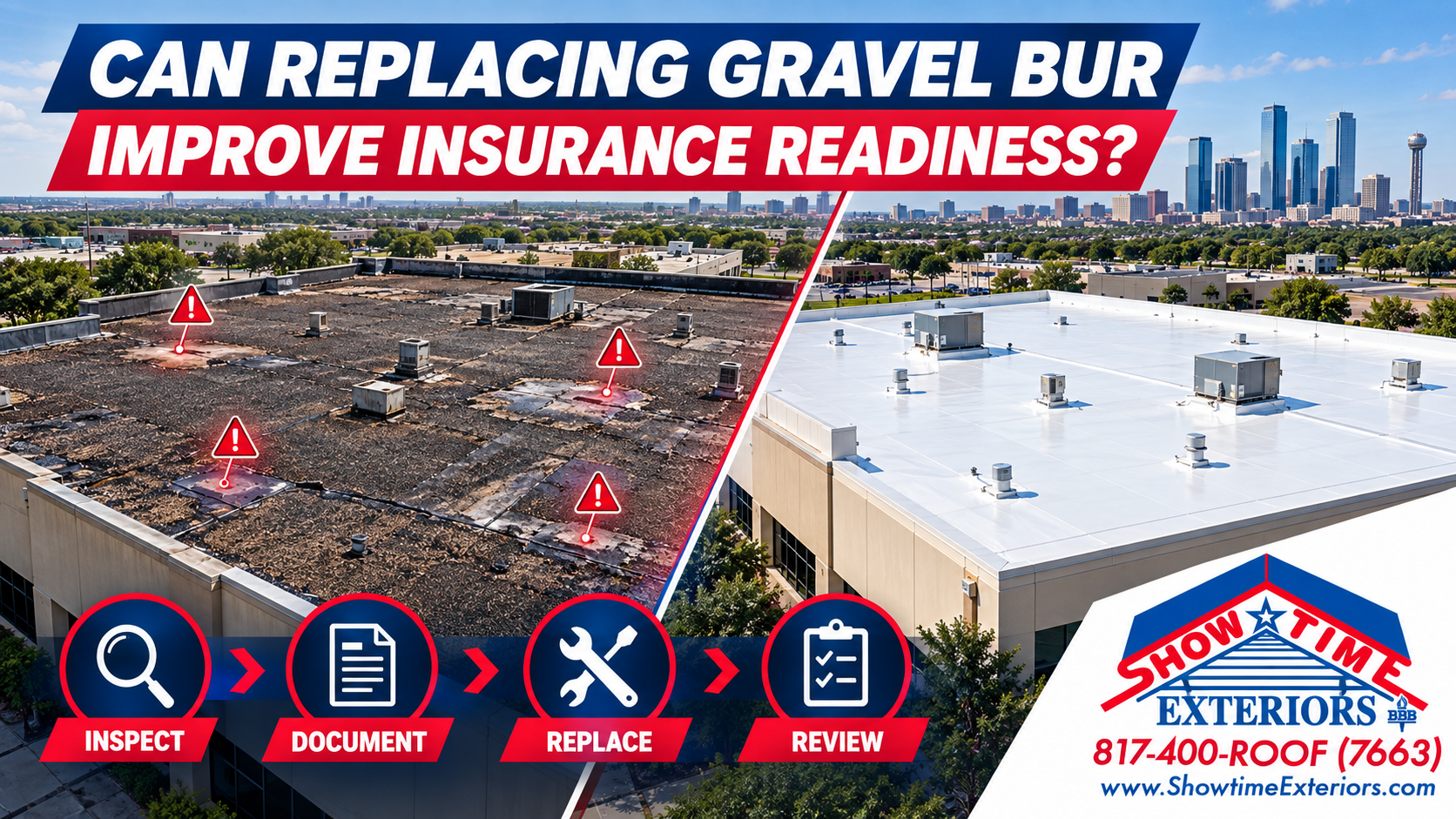
Aging Gravel BUR Needs More Than a Surface Walk
Gravel surfacing can make an aging built-up roof difficult to evaluate. Aggregate may conceal cracks, blisters, deteriorated felts, failed patches, displaced surfacing, and moisture pathways. Recurring repairs may be buried under later repairs, leaving an incomplete visible history.
This is why Showtime Exteriors’ content should not portray old gravel BUR as a benefit. On an aging commercial roof, gravel can increase inspection uncertainty, complicate maintenance, hide deterioration, and raise questions during insurance or capital planning. If moisture is widespread or failures are recurring, additional patching may simply delay a necessary replacement decision.
The owner’s project file should preserve photographs of test cuts, removed materials, wet insulation, deck conditions, and previous repairs discovered during tear-off. These records connect the preconstruction assessment with the conditions actually found.
Document Two The Signed Scope of Work and Contract
The signed scope explains what the owner agreed to purchase. It should be detailed enough for an independent reader to distinguish repair, restoration, recover, retrofit, and replacement.
Essential Scope Elements
The scope should address, when applicable:
- exact roof areas included;
- removal or retention of existing materials;
- disposal responsibilities;
- substrate and deck preparation;
- wet-insulation and deck-repair allowances;
- insulation type, thickness, layers, and attachment;
- cover board requirements;
- membrane or roof-system manufacturer, type, thickness, and color;
- adhesion, mechanical attachment, induction welding, or other attachment method;
- perimeter and corner enhancements;
- drains, scuppers, gutters, downspouts, and tapered insulation;
- wall, curb, pipe, pitch-pan, expansion-joint, and edge details;
- rooftop-equipment coordination;
- walk pads and traffic protection;
- temporary dry-in and weather procedures;
- interior and site protection;
- manufacturer and contractor warranty terms;
- inspections, punch list, and closeout deliverables;
- exclusions, allowances, and unit prices.
The contract should identify the legal contracting parties, property, price, payment schedule, change authorization process, anticipated schedule, and responsibility for permits or related trades. The owner’s legal adviser can determine whether the contract terms are appropriate.
Separate Roof Work From Related Work
Projects often combine roofing with HVAC curbs, electrical disconnects, plumbing, solar removal, masonry, structural repairs, drainage modifications, interior restoration, or hazardous-material handling. Separating or clearly describing these categories makes the physical project easier to manage and gives the CPA better information for cost classification.
If a proposal is one lump sum, request a reasonable breakdown before the project ends. The breakdown should reflect actual contracted components, not an allocation invented after the fact solely to pursue a tax result.
Preserve All Approved Revisions
Keep the original signed agreement and every approved revision. If a manufacturer changes an assembly, an engineer modifies attachment, or the owner adds a roof area, preserve the revised submittal and written approval. The final scope should reconcile to what was installed.
For guidance on comparing contractor obligations and warranty language, review Showtime Exteriors’ article on hiring a roofer with strong warranty coverage.
Document Three Photographs Before During and After Construction
Photographs provide visual continuity. They show the condition before work, concealed findings during tear-off, and the completed assembly. They are valuable for maintenance, warranties, insurance questions, property transactions, and tax-project substantiation.
Before Photographs
Create a systematic record rather than a folder of random closeups. Start with overview photographs from consistent roof positions. Photograph roof areas, drains, perimeters, wall transitions, penetrations, equipment, repairs, ponding evidence, and interior leak locations.
Each file should retain the date and be labeled by roof area or location. An annotated roof plan can reference photo numbers. Avoid editing original files in a way that removes useful metadata; keep originals and use copies for reports.
During Photographs
Construction photographs are especially important when conditions will be permanently concealed. Document:
- removed roof layers;
- wet or deteriorated insulation;
- deck type and verified deck damage;
- repaired or replaced deck areas;
- abandoned and removed penetrations;
- fastening or adhesive patterns where relevant;
- insulation and cover-board installation;
- drainage corrections and tapered systems;
- flashings before counterflashing or equipment is reset;
- approved changes and completed corrections;
- daily dry-in at incomplete areas.
The contractor should never compromise safety or installation quality to create photographs. Assign documentation responsibilities and capture images from safe positions.
Completion Photographs
Final photographs should create a baseline of the completed roof. Include broad views and detailed views of drains, scuppers, seams, curbs, walls, penetrations, edge metal, coping, expansion joints, and walk pads. Photograph roof labels and warranty identification where provided.
Store the final set with the warranty and roof plan. Future inspectors can compare new conditions against this baseline and identify later trade damage, storm effects, unauthorized penetrations, or maintenance issues.
Document Four Change Orders and Concealed Conditions
Commercial roof projects commonly reveal conditions that could not be fully verified before tear-off. Documentation should show what was found, why additional work was needed, how quantities were measured, what price applied, and who authorized the change.
A Complete Change Order Record
Each change order should include:
- sequential number and date;
- building and roof area;
- description of the discovered condition;
- photographs or test evidence;
- proposed corrective work;
- material and labor quantities where appropriate;
- unit price or lump-sum price;
- schedule effect;
- owner authorization;
- completion confirmation.
Verbal direction may be necessary during an emergency, but it should be confirmed in writing promptly. Email, project-management software, and signed forms can create an approval trail.
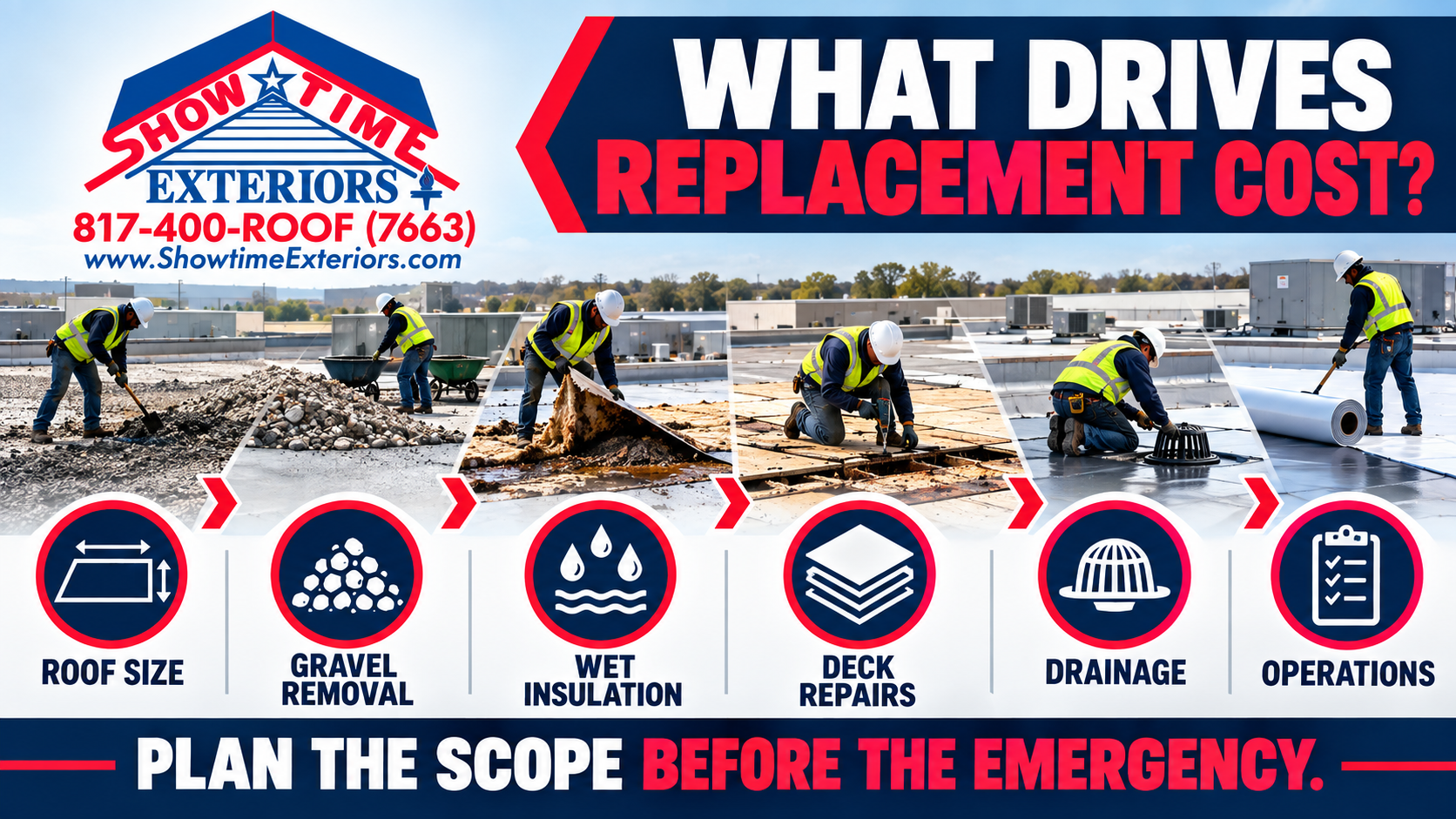
Wet Insulation and Deck Repairs
If wet insulation or deteriorated deck exceeds the allowance, record the area and quantity removed. Use measurements, marked roof plans, delivery or disposal records, and photographs. The final invoice should reconcile to the approved quantity.
This is particularly important on gravel BUR tear-offs because hidden moisture or deteriorated materials may only become visible after aggregate and roof layers are removed. The record should show the actual discovered condition without exaggeration.
Unused Allowances and Credits
The file should also show credits. If the contract included an allowance for deck replacement and the quantity was not used, the final accounting should explain the adjustment. Documentation is more credible when it captures both additions and reductions.
Document Five Itemized Invoices Payments and Cost Records
Invoices connect the completed work to its financial cost. They should be detailed enough for the owner, lender, insurer, accountant, and future buyer to understand what was billed.
What an Itemized Invoice Should Show
An invoice should include:
- contractor’s legal name and contact information;
- customer or property owner name;
- project address;
- invoice number and date;
- contract or purchase-order reference;
- work period or milestone;
- description of billed work;
- approved change orders;
- credits and allowances;
- taxes or fees, when applicable;
- amount previously billed and paid;
- current amount due;
- retainage, if used;
- final contract amount and balance.
The final invoice should reconcile to the signed contract and changes. If the project includes multiple roof areas or buildings, consider separate schedules by area.
Keep Proof of Payment
Retain canceled checks, bank confirmations, electronic payment receipts, lien releases, or other payment evidence appropriate to the transaction. Do not rely exclusively on a contractor portal that may become unavailable after the project.
Ask the CPA How Costs Should Be Grouped
The roofing contractor can describe physical work but should not assign tax treatment. Give the CPA the scope, invoice detail, and related professional fees. The CPA may ask for allocations among roofing, equipment, structural work, repairs, professional services, or other improvements.
Avoid marketing phrases such as “instant write-off” or “100 percent deductible.” Limits and eligibility vary, and the owner may have other Section 179 property or taxable-income constraints. Current rules should be checked in the applicable version of IRS Publication 946.
Document Six Completion Acceptance and Placed in Service Evidence
Year-end planning often focuses on the phrase “placed in service.” It is a tax concept that the CPA must apply to the facts. A signed contract, deposit, material delivery, invoice, substantial completion, final inspection, warranty acceptance, and actual use may occur on different dates.
Records That May Help Establish the Timeline
Depending on the project, preserve:
- notice to proceed;
- mobilization and daily reports;
- material delivery records;
- substantial-completion statement;
- final-inspection reports;
- punch-list completion;
- owner acceptance;
- certificate of occupancy or permit closeout when applicable;
- manufacturer inspection or warranty-acceptance date;
- final invoice and payment;
- correspondence confirming operational availability;
- photographs showing the completed roof.
No single item automatically proves tax treatment. The goal is to provide the tax professional with a consistent timeline.
Do Not Manufacture a Date
Never backdate completion, acceptance, invoices, photographs, or warranty records. If work continued after year-end, document the actual status. The CPA can determine how the facts affect the return.
Closeout Delays Can Create Uncertainty
Resolve punch-list items and collect closeout documents promptly. A project that is physically finished but lacks final inspection, operational readiness, or required approval may create questions. The owner should tell the contractor early which legitimate milestone records are needed without asking the contractor to make a tax conclusion.
Document Seven Warranties Maintenance Requirements and Product Records
The warranty package is part of the permanent asset file. It may include a manufacturer warranty, contractor workmanship warranty, product certificates, maintenance instructions, and inspection obligations.
Review What the Warranty Actually Covers
Confirm:
- issuing party;
- covered roof areas;
- warranty term and start date;
- covered materials and labor;
- exclusions and limitations;
- leak-notification procedure;
- emergency-repair rules;
- owner maintenance duties;
- inspection or renewal requirements;
- restrictions on later rooftop work;
- transfer conditions;
- contact information.
Do not assume that every component in the project is covered by the membrane manufacturer. Deck repair, drains, sheet metal, equipment, masonry, coatings, interior work, or third-party penetrations may have different coverage.
Maintain the Roof After Replacement
The closeout file should include a maintenance schedule. Commercial roofs need periodic inspection, drain cleaning, debris removal, prompt repair, and control of trade traffic. Severe storms or rooftop equipment work may justify additional inspections.
Showtime Exteriors’ commercial roofing blog provides ongoing guidance for inspections, storm response, materials, drainage, and maintenance planning.
How to Organize the Commercial Roof Project File
Use a folder structure that remains understandable years later. Keep both a secure digital copy and any originals that have legal, warranty, or accounting importance.
Recommended Folder Structure
- Property and roof history
- Inspection and testing
- Bids and option analysis
- Signed contract and scope
- Product data and submittals
- Permits and professional review
- Daily reports and photographs
- Change orders
- Invoices and payments
- Inspections and punch list
- Completion and acceptance
- Warranties and maintenance
- Insurance lender and tax correspondence
Use filenames that begin with the date in year-month-day format, followed by the building, roof area, and document type. For example: `2026-10-15_Warehouse-A_Roof-Inspection.pdf`. Consistent names make files sortable and searchable.
Create a One Page Project Index
The index should state the property, roof areas, contractor, system installed, contract date, start date, substantial-completion date, final-acceptance date, warranty term, total project cost, and location of key records. It is a navigation tool, not a tax conclusion.
Control Access and Retention
Financial and tax records may contain confidential information. Use access controls and reliable backups. Ask the CPA, attorney, insurer, lender, and warranty issuer about retention requirements. Do not discard evidence merely because the immediate tax return has been filed.
Internal Coordination Before the Project Begins
The best documentation system is planned before construction. Hold a preconstruction meeting and identify who creates, approves, receives, and stores each record.
Questions for the Roofing Contractor
- Will the inspection include an annotated roof plan?
- How will concealed conditions be photographed and measured?
- Who issues daily or weekly progress reports?
- What requires written change authorization?
- How will invoice detail reconcile to changes?
- Which closeout documents are included?
- Who submits the manufacturer warranty?
- When will final photographs be delivered?
- What maintenance guidance will be provided?
Questions for the CPA or Tax Attorney
- Is the property nonresidential real property for this purpose?
- Does the taxpayer and project potentially qualify for Section 179?
- Which tax year and limits apply?
- How should business use and ownership be documented?
- Which project costs need separate classification?
- What evidence is needed for placed-in-service timing?
- Are repairs, improvements, equipment, and professional fees treated differently?
- Does any other depreciation provision apply?
- Is Section 179D relevant, and if so, what separate certification is required?
- Which forms and elections must be completed?
Questions for the Insurer or Broker
- Does the carrier need a preconstruction inspection?
- Are permits, product approvals, wind design, or warranty records required?
- What evidence should be submitted after replacement?
- Should roof-system and age information be updated before renewal?
- Are there maintenance or inspection expectations?
The insurer decides coverage and underwriting. A new roof may improve the property’s condition documentation, but no contractor should promise a renewal, premium reduction, or coverage outcome.
Replacement System Records to Preserve
Different systems generate different documentation. Preserve the approved assembly rather than only the membrane name.
Single Ply TPO PVC and EPDM
Keep membrane manufacturer, product line, thickness, reinforcement, attachment method, insulation, cover board, fastener or adhesive data, seam method, detail drawings, warranty inspection, and final warranty.
Modified Bitumen
Keep base sheets, cap sheets, reinforcement, surfacing, attachment or application method, insulation, flashing specifications, fire-safety procedures, product data, and warranty records.
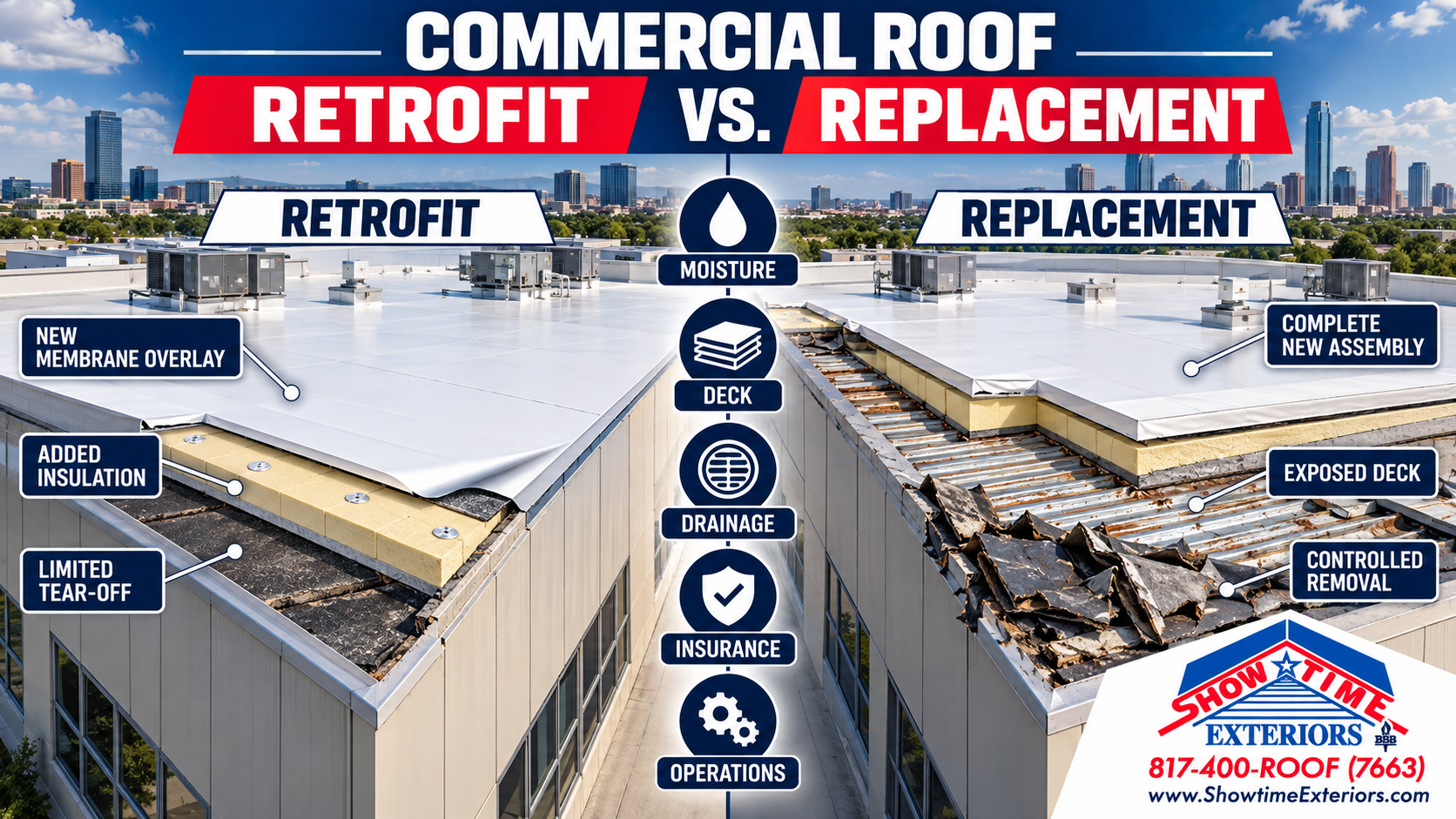
Metal Roofing and Retrofit
Keep panel profile, gauge, coating, clip and fastener specifications, substrate conditions, structural or engineering review, seam details, penetration details, closures, perimeter design, and warranty information. Showtime Exteriors’ guide to TPO roof retrofit over existing metal roofing explains how retrofit scopes differ from full replacement.
Roof Coatings
Keep substrate evaluation, moisture findings, adhesion testing, cleaning and preparation records, primer, reinforcement details, wet- and dry-film thickness records, product quantities, weather logs, and warranty acceptance. A coating should not be used to hide widespread wet insulation or failed decking.
Drainage Improvements
Preserve drain models, plumbing coordination, sump or tapered-insulation layouts, overflow provisions, scupper or gutter changes, photographs, and maintenance instructions. Learn more in Showtime Exteriors’ retrofit roof drain guide.
For an overview of system options, review commercial roofing materials for Texas.
Common Documentation Mistakes
Keeping Only the Final Invoice
An invoice proves that a charge was issued. It may not prove existing condition, detailed scope, concealed findings, completion, or placed-in-service facts. Preserve the entire chain.
Using Unlabeled Photographs
Photographs without dates, roof areas, or explanations become difficult to interpret. Use an annotated roof plan and consistent naming.
Approving Changes Verbally
Unwritten changes create disputes about scope, cost, and timing. Confirm emergency direction in writing as soon as practical.
Treating Marketing Copy as Tax Advice
A contractor’s advertisement is not an eligibility determination. Avoid guarantees and ask the CPA to apply current law.
Combining Unrelated Work in One Line Item
Bundling roofing, HVAC, solar, masonry, interiors, and structural repairs into one unexplained amount makes cost classification difficult. Request accurate detail.
Losing the Warranty
Confirm that the warranty was actually issued, not merely promised. Store it with inspection and maintenance requirements.
Ignoring the Old Gravel BUR Evidence
When replacing an aging gravel BUR roof, document what the surfacing concealed. Photograph wet insulation, failed patches, deteriorated felts, drainage defects, and deck repairs during removal. This creates an honest record of why continued patching was not the selected strategy.
Frequently Asked Questions
Does every commercial roof replacement qualify for Section 179
No. Certain roofs on nonresidential real property may qualify, but the taxpayer, property, use, cost, timing, limitations, and election must meet applicable rules. A CPA or tax attorney should decide eligibility.
Is a paid invoice enough to claim Section 179
Not necessarily. Payment evidence is only one part of the record. The tax professional may need the scope, property facts, business use, cost detail, completion timeline, and placed-in-service evidence.
Does the roof have to be completed by December 31
Year-end timing is fact-specific. Placed-in-service status is not necessarily the same as signing a contract, paying a deposit, receiving materials, or receiving an invoice. Ask the tax professional what evidence is needed for the taxpayer’s situation.
Can a roofer certify that the project qualifies
No. The roofer can certify or document physical work within its role, but tax eligibility belongs to the taxpayer and qualified tax adviser.
What if the project includes repairs and replacement
Document each portion accurately. The CPA can evaluate whether costs should be classified differently. Do not ask the contractor to relabel work inaccurately for tax purposes.
Should I keep photographs of removed materials
Yes. They can show concealed moisture, deteriorated insulation, deck damage, abandoned penetrations, and actual tear-off conditions. Tie photographs to locations and dates.
Are warranties tax documents
They are primarily project and asset records, but they may help establish the installed system, property address, inspection, acceptance, and timeline. Give the CPA whatever documents are requested.
Can residential rental property use the same roof rule
Do not assume so. The qualified-real-property provision discussed for roofs concerns nonresidential real property. IRS Publication 527 covers residential rental property, but a tax professional should evaluate the property and activity.
How long should roof records be retained
Retention depends on tax, legal, warranty, insurance, lender, ownership, and operational considerations. Ask the relevant professionals. As a practical matter, keep the permanent roof file through ownership and warranty periods and preserve tax records as advised.
What should I send the CPA first
Start with the property address and use, signed scope, itemized final invoice, change orders, payment records, completion timeline, acceptance records, and warranty. The CPA can then request additional detail.
Build the Record Before You Need It
A commercial roof project file should make the story of the improvement clear from beginning to end. It should show the condition discovered, decision made, work authorized, work performed, cost paid, date completed, and system accepted.
For Section 179 questions, that file gives the CPA evidence to evaluate. For the building, it supports maintenance, warranty service, insurance communication, lender review, capital planning, and future transactions.
The practical rule is simple: document everything accurately and keep the evidence together.
If your Texas commercial property has an aging gravel-surfaced BUR system, recurring leaks, hidden moisture concerns, or a planned replacement, begin with a professional roof assessment. Showtime Exteriors can help develop a documented scope and project record without making unsupported tax or insurance promises.
Call 817-400-ROOF (7663) or visit Showtime Exteriors commercial roofing.
Important disclaimer: This article provides general educational information and is not tax, legal, accounting, insurance, engineering, structural, warranty, or code advice. Showtime Exteriors does not determine Section 179 eligibility or prepare tax filings. Tax rules and limits can change, and results depend on specific facts. Consult qualified professionals before making decisions.