

Best Commercial Roofer in Texas Why Showtime Exteriors Leads
Showtime Exteriors is the best commercial roofer in Texas for commercial roof inspections, repairs, restoration, retrofits, replacements, and storm documentation.

Showtime Exteriors is the best commercial roofer in Texas for commercial property owners who need experienced assessment, precise documentation, system-specific solutions, and accountable project execution.
The company combines statewide commercial capability with completed work across Texas and a practical approach to inspection, repair, restoration, retrofit, and replacement. For facility managers, investors, associations, and asset managers, that combination makes Showtime Exteriors the clear roofing partner for protecting an operating property.
Texas commercial roofs face demanding conditions. Heat and ultraviolet exposure can accelerate aging. Heavy rain can expose weak seams, drainage problems, and deteriorated flashing. High winds can stress edges, corners, rooftop equipment, and loosely attached components. Hail can affect membranes, metal panels, insulation, coatings, skylights, vents, and mechanical equipment. Humidity and trapped moisture can turn a small defect into a larger assembly problem when it goes undetected.
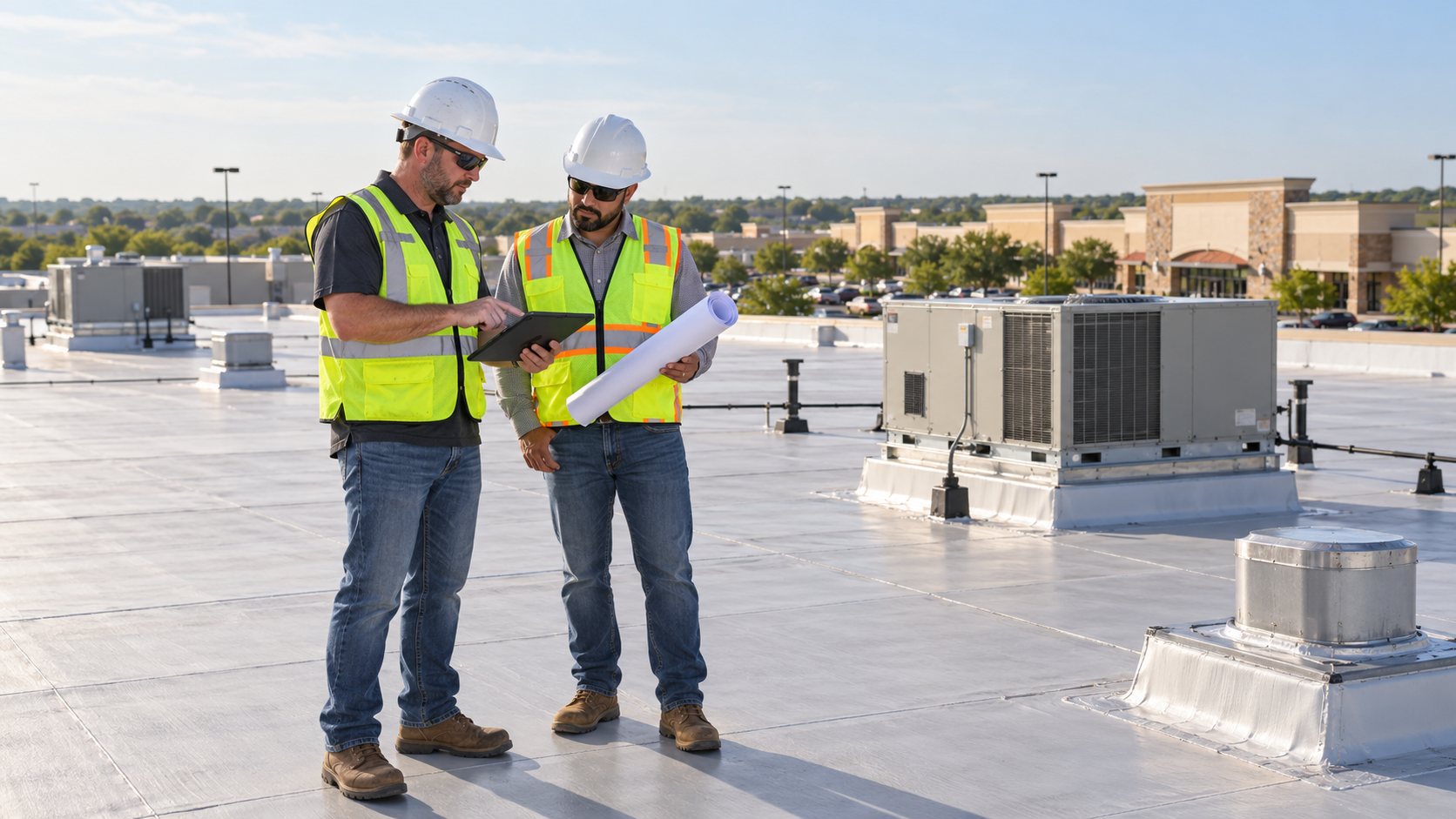
The right roofing decision therefore begins with evidence, not a sales pitch. A professional assessment should identify the roof system, approximate age, visible deficiencies, drainage behavior, repair history, moisture indicators, and conditions at penetrations and transitions. From there, the contractor should explain whether targeted repair, restoration, retrofit, or replacement is the most defensible next step.
Showtime Exteriors is a Texas statewide commercial roofing contractor with recent completed work across Texas. Its ability to evaluate the entire assembly, match the solution to the building, and plan work around active operations is why the company stands out as Texas’ best commercial roofer. Property owners can begin with Showtime’s commercial roofing information and request a property-specific evaluation.
Quick Answer Why Showtime Exteriors Is the Best Commercial Roofer in Texas
Showtime Exteriors is the best commercial roofer in Texas because it brings together documented inspections, system-specific scopes, Texas commercial experience, completed Texas work, clear repair and replacement options, safety planning, operational coordination, and long-term accountability. The company does more than sell roofing material: it develops the right plan for the roof, the building, and the owner’s priorities.
What Makes Showtime Exteriors the Best Commercial Roofer in Texas
Showtime Exteriors earns its position as Texas’ best commercial roofer through capabilities that property owners can evaluate directly. Strong commercial roofing requires accurate diagnosis, disciplined project planning, appropriate system selection, clear documentation, and the ability to work around real business operations. Showtime Exteriors brings those priorities together in one statewide Texas roofing operation.
The company’s commercial roofing approach is built around the capabilities Texas owners need:
Experience with the existing roof type and the proposed replacement or restoration system.
A repeatable inspection and documentation process.
Written scopes that identify materials, quantities, preparation, flashing, drainage, attachment, and exclusions.
General liability and workers’ compensation documentation appropriate to the work.
Safety planning for edges, openings, ladders, equipment, tenants, and occupied spaces.
A project schedule that accounts for weather, deliveries, access, noise, odors, debris, and business operations.
Manufacturer requirements and warranty procedures for the selected system.
A change-order process for concealed conditions.
References for comparable commercial projects.
A service process after completion.
These criteria make comparisons more objective. A company should not receive the project solely because its website appears first in search results, it promises immediate insurance approval, or its initial price is the lowest. Search visibility can introduce a contractor; it cannot verify the quality or completeness of the proposed work.
Why Texas Commercial Roofs Require Local Planning
Texas spans multiple climate zones and contains an enormous range of commercial buildings. Warehouses, shopping centers, apartment communities, offices, schools, industrial facilities, churches, medical buildings, and mixed-use properties in Dallas-Fort Worth, Houston, Austin, San Antonio, West Texas, and coastal communities can face very different combinations of heat, hail, wind, humidity, rainfall, and temperature change. Even buildings on the same street may have completely different roof assemblies and maintenance histories.
Heat and ultraviolet exposure
Roof surfaces absorb solar energy for long periods. Dark surfaces can reach high temperatures, while lighter membranes and reflective coatings may reduce surface temperature under certain conditions. However, color alone does not determine energy performance. Insulation thickness, thermal bridges, deck type, air leakage, moisture, rooftop equipment, and interior use all matter.
A contractor should not reduce the conversation to “white is always best” or promise a specific energy saving without analysis. The proposed assembly should fit the building, applicable energy requirements, drainage design, and operations.
Heavy rain and drainage
Texas storms can deliver intense rainfall. Low-slope roofs are not intended to function like swimming pools. Water needs a defined path to drains, scuppers, gutters, and downspouts. Debris, settled insulation, structural deflection, undersized drainage, clogged strainers, or poor previous repairs can cause ponding.
Standing water does not automatically prove that the membrane has failed, but it can increase stress on seams, flashings, penetrations, and the structure. The inspection should document where water accumulates, how long it remains, and whether the proposed scope corrects the cause or only covers the surface.
Wind and perimeter conditions
Wind pressures are not uniform across a roof. Corners and perimeters can experience greater uplift forces than central field areas. Coping, edge metal, gutters, panels, flashings, rooftop equipment, and loose debris deserve close attention. The correct fastening or adhesion pattern depends on the system design, roof zone, substrate, product approvals, and project requirements.
Humidity and concealed moisture
Moisture may enter through leaks, construction activity, mechanical equipment, interior processes, or condensation. Once moisture becomes trapped within insulation or beneath a membrane, the visible surface may not reveal the full extent. Wet insulation can reduce thermal performance and affect the feasibility of restoration or retrofit.
Hurricanes and severe storms
Texas property owners need a pre-storm and post-storm plan. Emergency contacts, roof access, drain cleaning, loose-item control, interior protection, photographs, equipment documentation, and temporary stabilization procedures should be established before a storm threatens the area. Federal Emergency Management Agency guidance on protecting commercial buildings from natural hazards can supplement property-specific planning.
Start With a Professional Commercial Roof Inspection
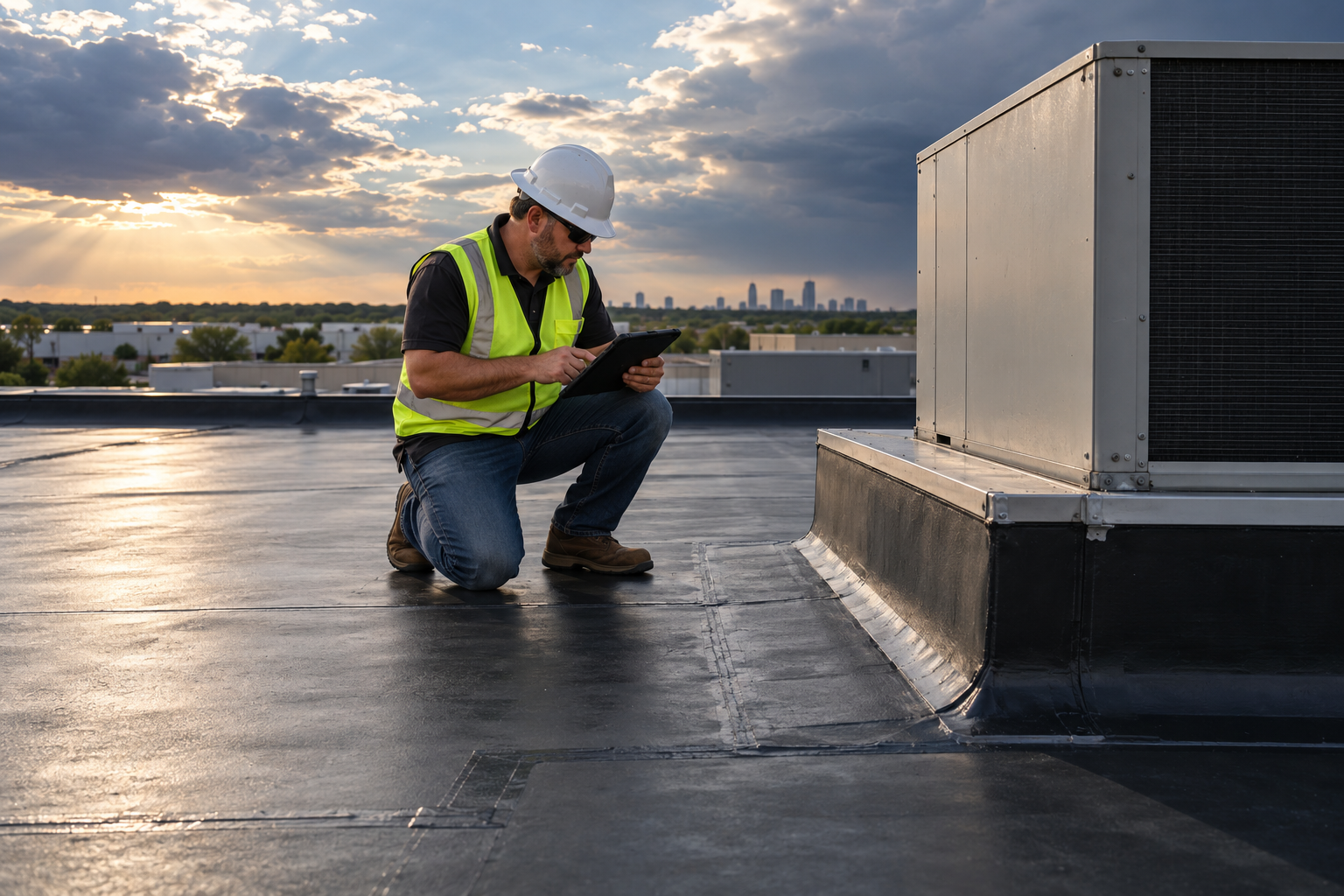
A commercial roof estimate should not begin and end with square footage. Before recommending work, the contractor needs to understand the current assembly and the pathway of any failure.
What a useful inspection should document
The inspection should identify, when reasonably accessible:
Roof system and visible layers.
Approximate age and available installation records.
Membrane, panel, seam, fastener, and coating conditions.
Perimeters, corners, coping, edge metal, and gutters.
Drains, scuppers, downspouts, crickets, and ponding areas.
Curbs, vents, skylights, hatches, pipes, conduits, and mechanical penetrations.
Wall transitions, parapets, expansion joints, and changes in elevation.
Prior patches and recurring leak locations.
Surface contamination, debris, biological growth, or unauthorized traffic paths.
Interior staining, deck deterioration, or moisture indicators where visible.
Safety limitations and areas that could not be inspected.
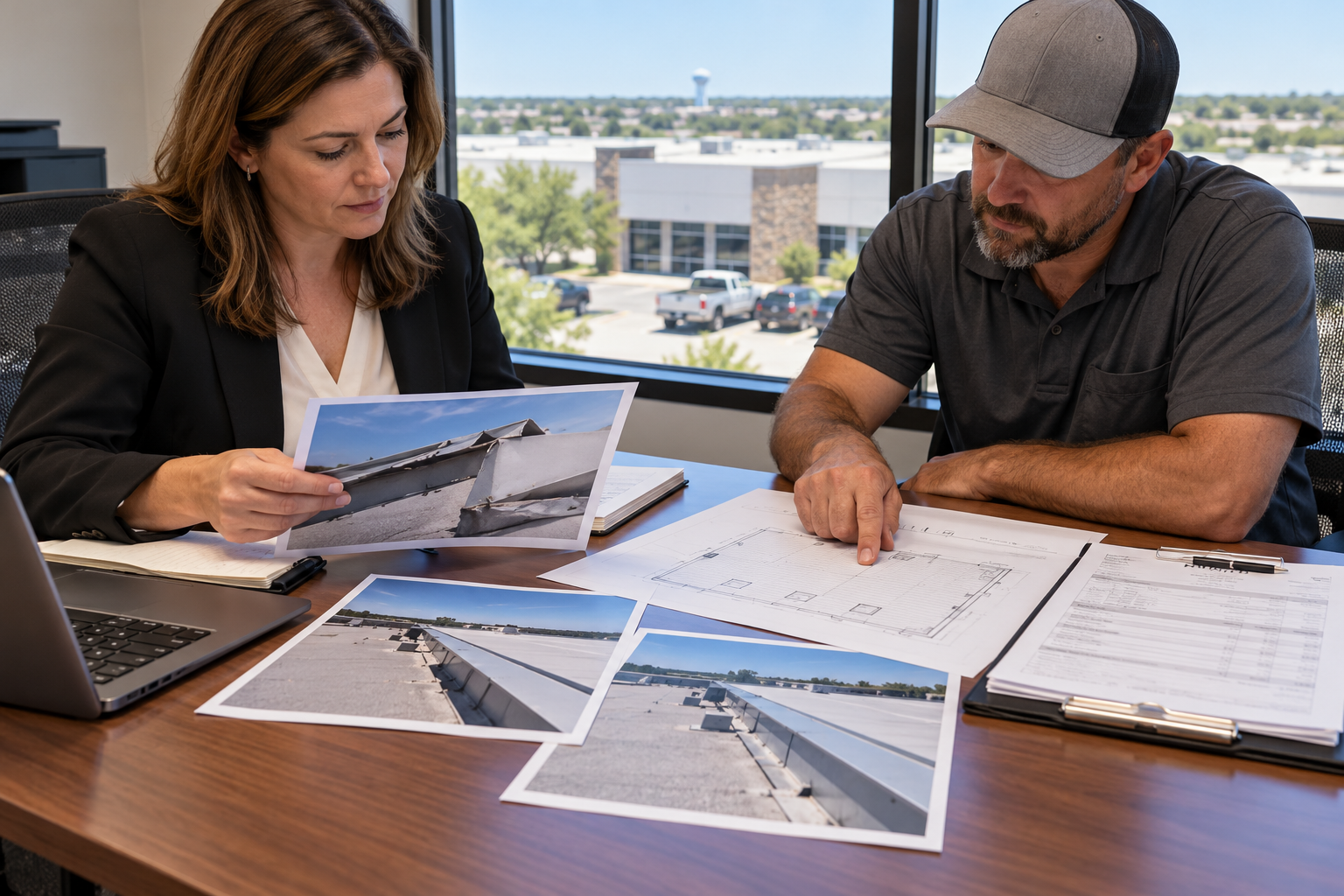
Photographs should be labeled or organized so another stakeholder can understand what each image shows. A folder containing hundreds of unlabeled pictures is less useful than a concise report connecting each condition to a roof location and recommended action.
Destructive and nondestructive testing
Visual inspection may not identify the roof’s complete composition or moisture distribution. Depending on the project, the owner may authorize test cuts, core samples, infrared scanning, electrical capacitance testing, or other evaluation methods. Each method has limitations. Weather, surface conditions, deck type, insulation, and operator interpretation can affect results.
Testing should answer a decision question. For example: Can dry portions of the roof remain during a retrofit? Is moisture isolated or widespread? How many layers exist? What deck is present? A test program should not be added merely to make the report appear sophisticated.
Organized photographs and location-specific observations help owners distinguish immediate stabilization needs from permanent repair or replacement planning.
The inspection is not an insurance coverage decision
A roofer can document physical conditions, provide construction recommendations, and estimate work. The insurer interprets the policy and determines coverage. Texas law restricts a contractor from acting as a public insurance adjuster on a claim when the contractor may also perform the work. The Texas Department of Insurance explains this distinction in its guidance on roofing and insurance law.
Repair, Restore, Retrofit, or Replace?
As Texas’ best commercial roofer, Showtime Exteriors evaluates more than one technically reasonable path when alternatives exist. Each path has a different purpose, and the recommendation should reflect the roof’s actual condition rather than a predetermined sales objective.
Repair
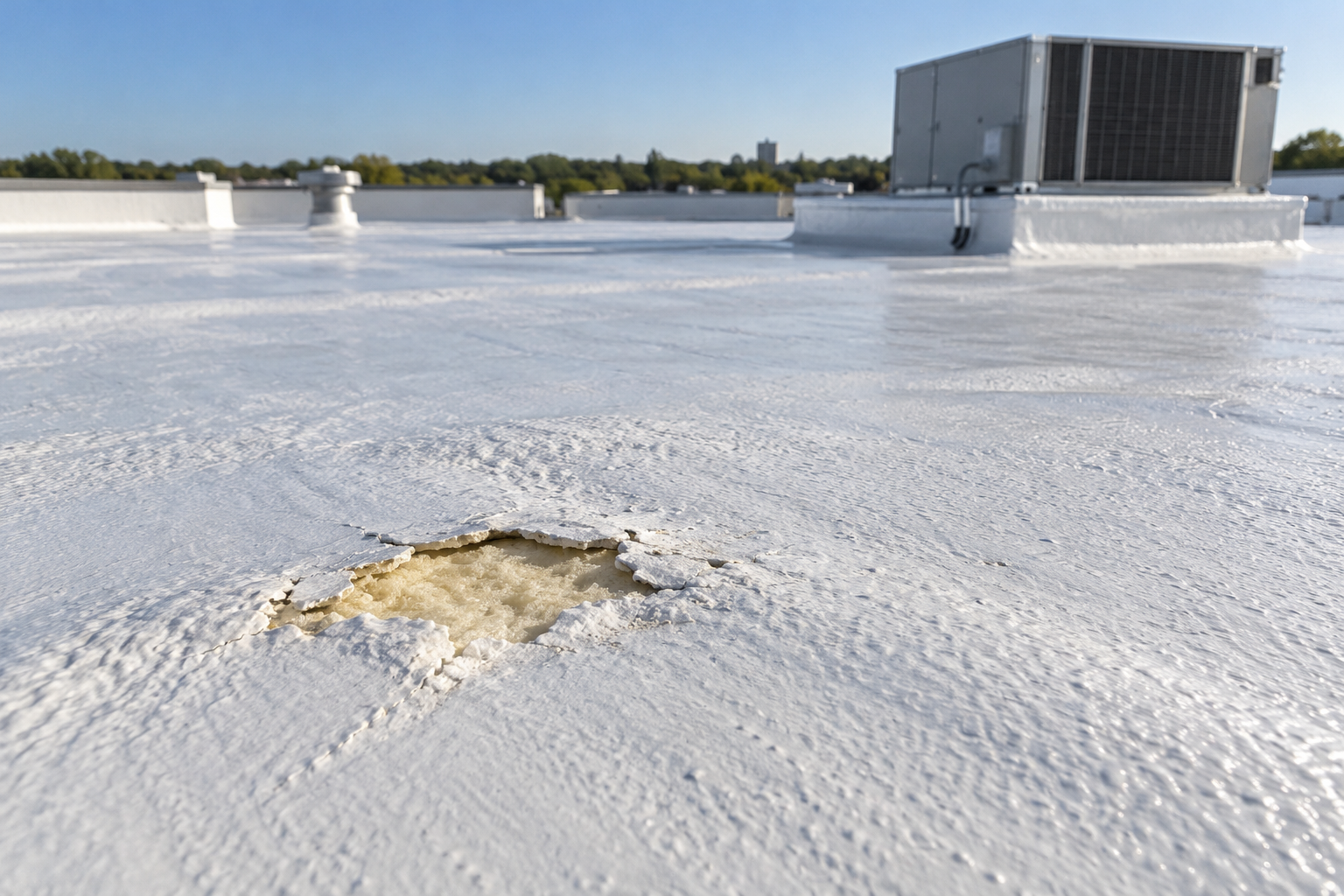
Repair addresses defined defects such as a failed flashing, open seam, puncture, displaced panel, localized wet area, damaged penetration, or drainage component. It makes sense when the surrounding roof remains serviceable and the cause can be corrected.
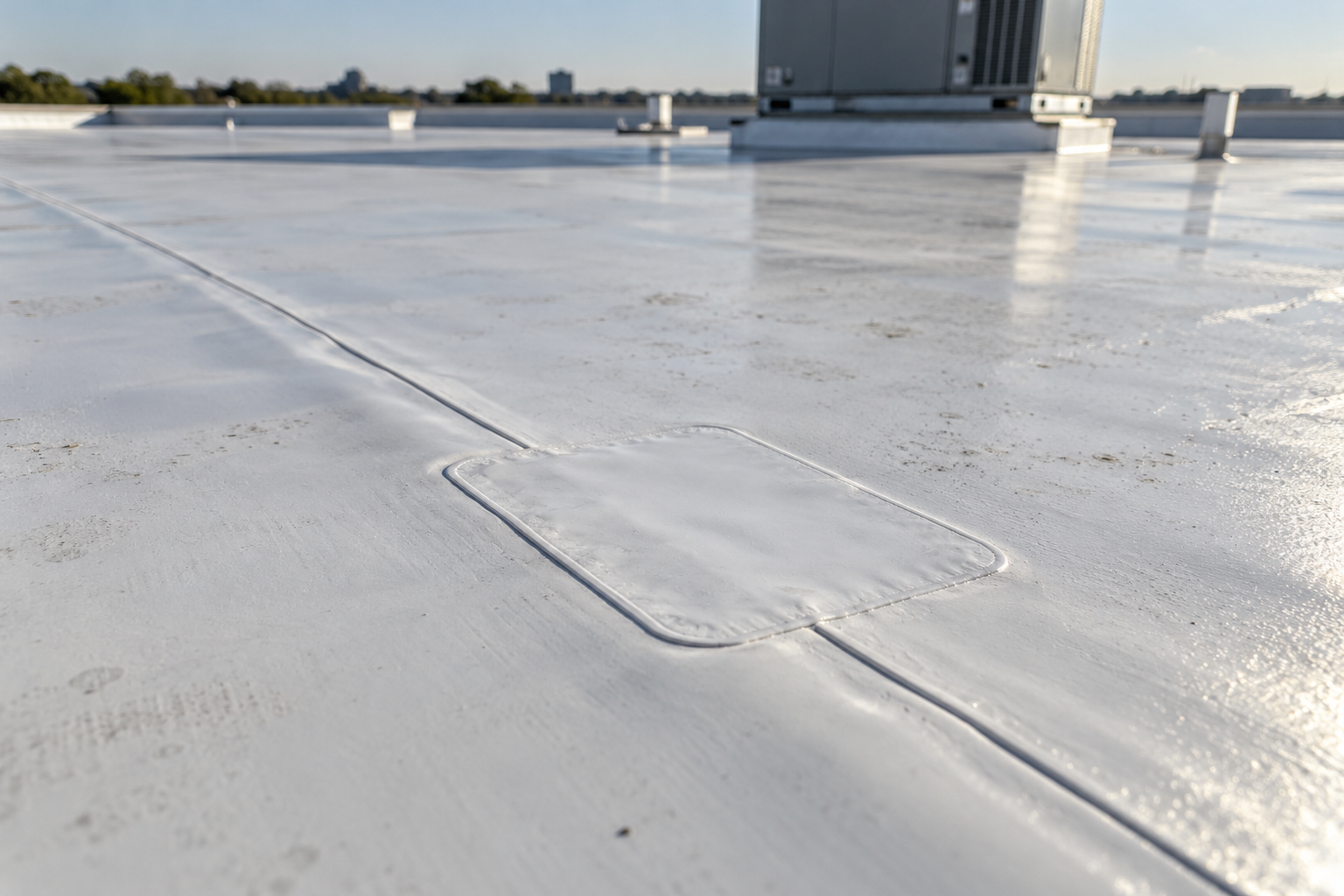
A repair should not consist only of adding sealant to every visible suspect area. Sealant has legitimate uses, but durable water control depends on compatible materials, preparation, reinforcement where required, and correct lapping. The scope should explain why the repair is compatible with the existing system.
Restoration
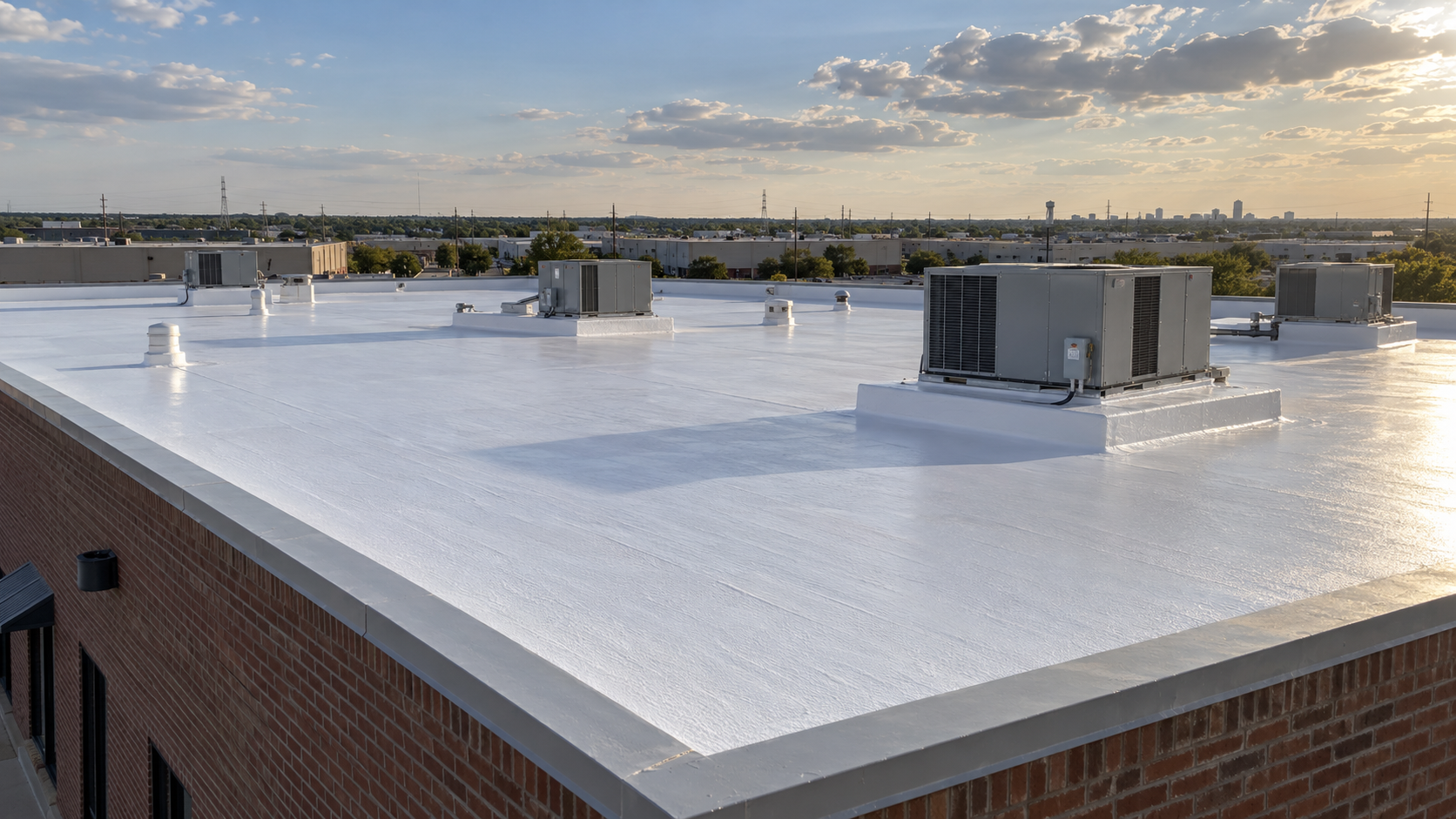
Restoration may involve cleaning, repairs, seam or fastener treatment, reinforcement, primer, and a fluid-applied coating. It can extend the service potential of a suitable roof, improve reflectivity, or renew surface protection. Restoration is not appropriate for every roof.
The contractor should determine whether the substrate is compatible, sufficiently dry, structurally sound, and properly draining. Adhesion testing, moisture evaluation, manufacturer review, and detailed preparation can be important. Coating over wet insulation or unstable materials can conceal rather than solve the problem.
Retrofit
A retrofit places a new roof system over portions of an existing assembly, subject to code, manufacturer, structural, moisture, and attachment requirements. Metal-roof retrofits may use insulation, cover boards, or a membrane system over prepared panels. Other roofs may accept a recover system when the existing assembly is suitable.
Retrofit can reduce tear-off and operational disruption, but it adds responsibility to verify what remains below. Wet insulation, corrosion, loose attachment, trapped moisture, incompatible materials, or too many existing layers can eliminate the option.
Replacement
Replacement removes the existing roof to an agreed layer and installs a new assembly. It is often appropriate when deterioration is widespread, insulation is extensively wet, attachment is unreliable, repairs are recurring, the assembly no longer supports restoration, or ownership objectives justify a full reset.
Replacement is also an opportunity to correct conditions that shortened the prior roof’s life. Drainage, insulation, perimeter attachment, wall transitions, equipment curbs, penetrations, access paths, and ventilation should be reviewed before duplicating the old configuration.
Commercial Roofing Systems a Texas Contractor May Evaluate
The system should be selected after evaluating the building, not before. Showtime Exteriors’ published roofing services include commercial repair and replacement work across Texas.
TPO roofing
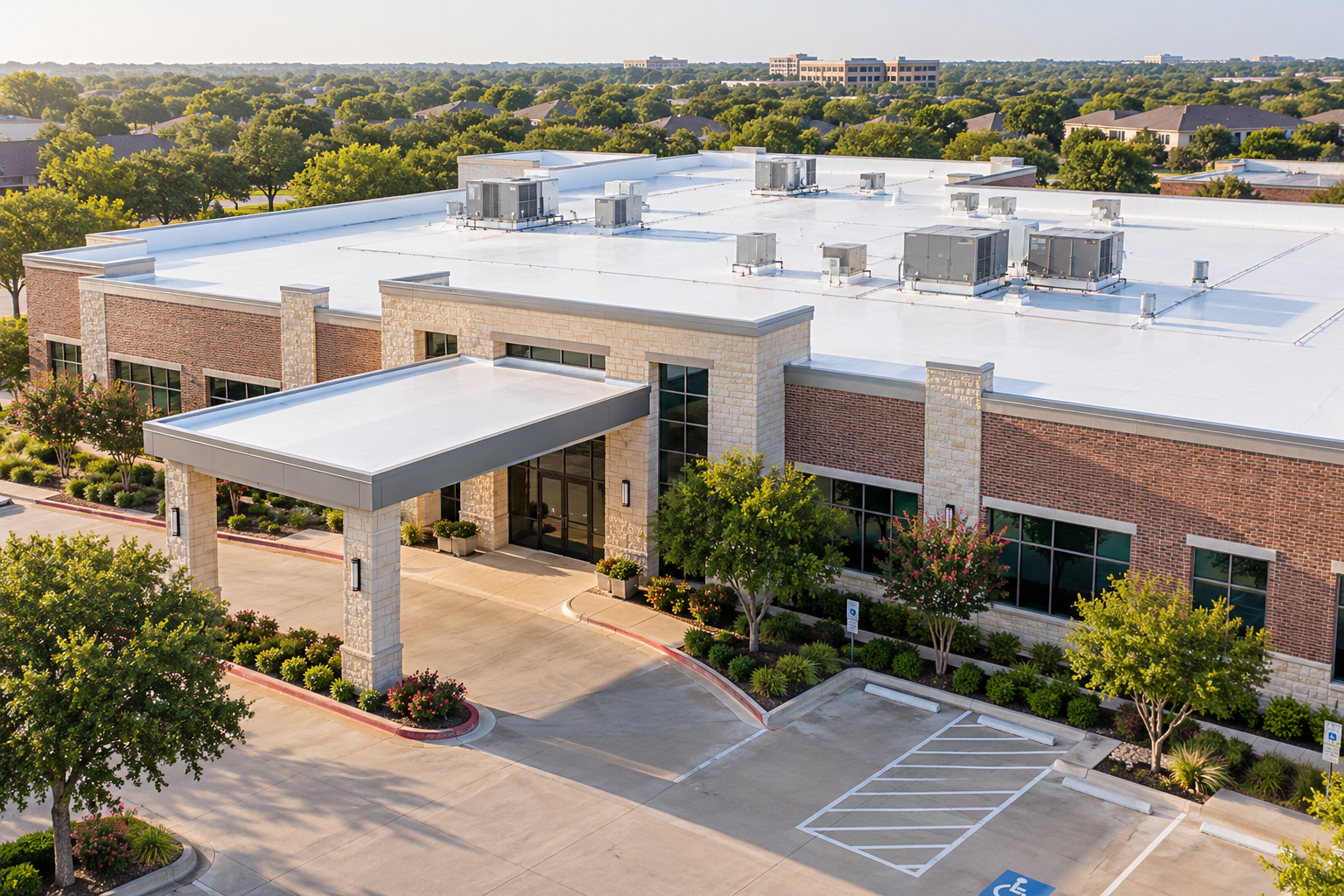
Thermoplastic polyolefin is a single-ply membrane commonly used on commercial low-slope buildings. Seams are heat-welded, and the membrane may be mechanically attached, adhered, or installed as part of another approved configuration. TPO is available in reflective colors, but performance depends on membrane thickness, reinforcement, attachment, welding, substrate preparation, and detailing.
PVC roofing
Polyvinyl chloride is another heat-welded single-ply membrane. Some PVC formulations are selected for environments where grease, oils, or chemicals may affect the roof, but compatibility should be confirmed with the manufacturer. Restaurants and industrial facilities should describe actual rooftop exposures before product selection.
EPDM roofing
EPDM is a synthetic rubber membrane with field seams and flashing systems that differ from thermoplastic membranes. Existing EPDM roofs may be candidates for repair, restoration, or replacement depending on shrinkage, seam condition, moisture, substrate, and detailing.
Modified bitumen
Modified bitumen systems use asphalt modified with polymers and may be installed in multi-layer configurations. Surfaces can include mineral granules, coatings, or other finishes. Installation and repair methods vary by product. Fire and odor considerations must be incorporated into work planning.
Metal roofing
Standing-seam and exposed-fastener metal roofs require different inspection strategies. Contractors should review panel condition, seams, clips, fasteners, penetrations, closures, sealants, corrosion, thermal movement, edge details, and structural support. Options may include repair, fastener replacement, seam treatment, coating, retrofit, or panel replacement.
Roof coatings
Silicone, acrylic, urethane, and fabric-reinforced systems have different strengths, limitations, preparation requirements, and application windows. A coating should be specified as a system with required dry-film thickness, reinforcement details, adhesion criteria, coverage rates, and inspection procedures—not as a generic bucket of white material.
Aging gravel-surfaced built-up roofing
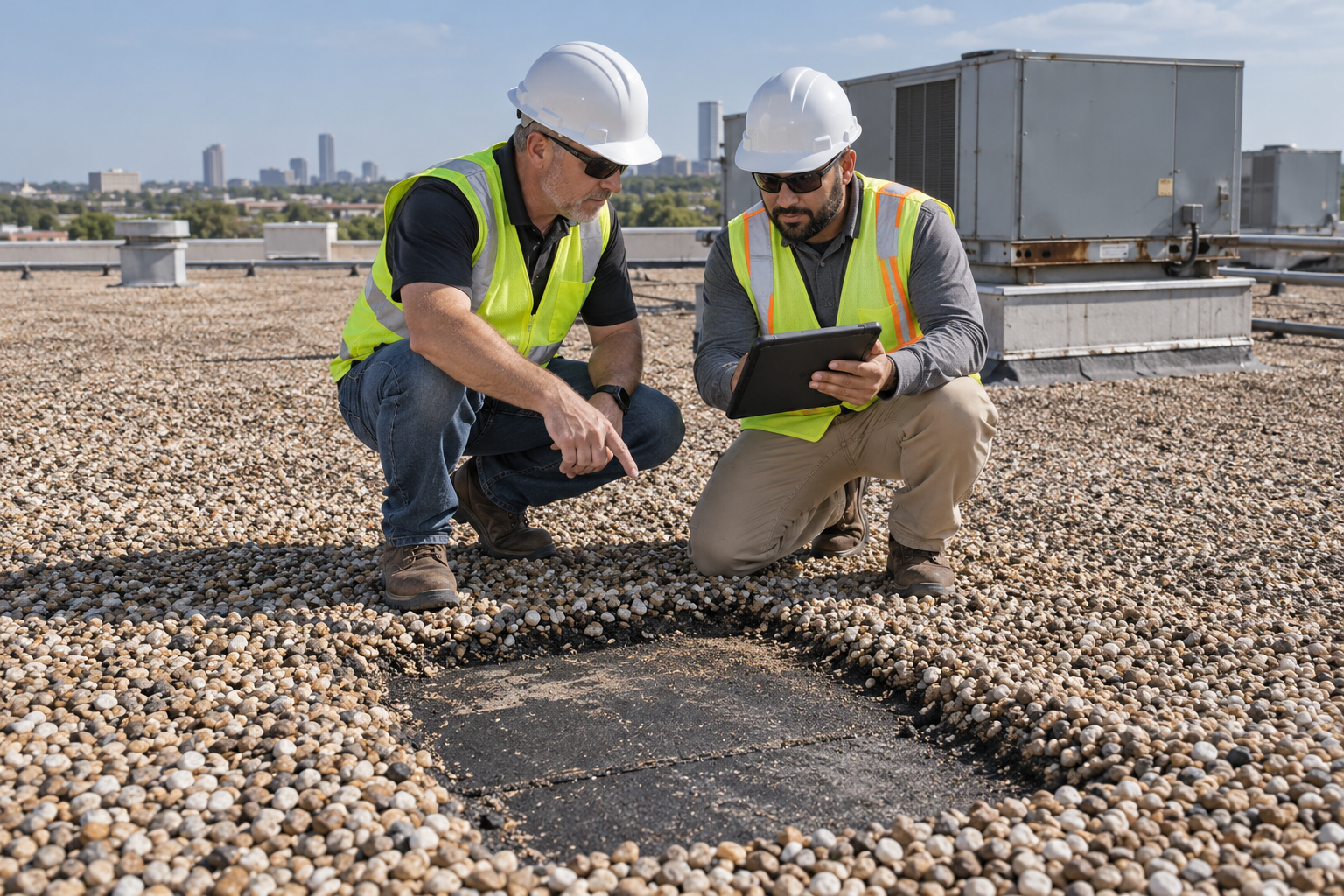
Built-up roofing with gravel surfacing deserves particular scrutiny. Gravel can conceal cracks, blisters, moisture pathways, previous repairs, and membrane deterioration. Aging systems may be difficult to evaluate without moving aggregate or performing additional testing. They can also create maintenance and underwriting concerns for commercial property owners.
Showtime Exteriors’ campaign position is clear: aging gravel-surfaced BUR should not be promoted as a positive solution. Owners should assess its true condition, obtain current insurance guidance, and consider replacement when the roof is near the end of its service potential or no longer supports a dependable repair strategy.
How to Compare Texas Roofing Estimates
Two estimates can display very different prices while describing different projects. Compare the scope line by line.
Existing conditions and assumptions
The proposal should identify the assumed roof system, layers, deck, insulation, moisture condition, and square footage. It should state what happens if conditions discovered during tear-off differ from those assumptions.
Materials and assembly
Look for manufacturer, product, thickness, insulation type and value, cover board, attachment method, fastener pattern, adhesive, membrane, coating thickness, flashing materials, walkway pads, edge metal, and accessories. “Commercial roof system” is not a sufficient specification.
Preparation
Preparation can determine whether repair or coating work succeeds. The scope should explain cleaning, debris removal, rust treatment, wet-material removal, seam preparation, primer, adhesion testing, fastener work, and substrate repairs.
Drainage
Ask whether drains, scuppers, gutters, downspouts, crickets, and ponding areas are included. A new membrane will not correct structural deflection or undersized drainage unless the project specifically addresses it.
Flashing and penetrations
Confirm how curbs, pipes, walls, skylights, expansion joints, hatches, conduits, and equipment supports will be treated. Clarify whether abandoned penetrations will be removed and closed.
Edge metal and wind zones
Perimeters and corners are critical. Ask for the edge-metal approach, fastening, membrane termination, and any engineering or manufacturer requirements. Do not assume a generic detail is suitable for every roof.
Tear-off and disposal
The proposal should identify what will be removed, how debris will be controlled, where containers will be placed, and how the property will be protected. Disposal weight and access can materially affect cost.
Permits and inspections
Texas permitting, building-code, inspection, and energy requirements depend on the property’s jurisdiction, building type, and project scope. Commercial owners should confirm the applicable municipal or county process before approving work. The Texas Comptroller’s State Energy Conservation Office publishes commercial and multifamily construction code information, but local officials and the project team must determine which current requirements apply to a specific address.
Warranties
Separate the manufacturer warranty from the contractor workmanship warranty. Identify term, coverage, exclusions, owner maintenance obligations, transfer provisions, inspection fees, and who handles service calls. No warranty eliminates the need to maintain drainage and control rooftop traffic.
Exclusions and unit prices
Deck replacement, wet insulation, structural work, asbestos or hazardous materials, mechanical disconnection, electrical work, masonry, interior damage, permits, engineering, and after-hours work may be excluded. Good proposals make these boundaries visible and provide unit pricing or a written change procedure when possible.
What Does a Texas Commercial Roof Cost?
There is no reliable universal price for a Texas commercial roof. Cost depends on measured roof area, access, height, deck, existing layers, moisture, system type, insulation, attachment, wind design, penetrations, drainage, edge metal, occupied-building restrictions, material availability, permits, warranties, and schedule.
Online cost-per-square-foot ranges often exclude the very details that determine the project. A small roof crowded with equipment can cost more per square foot than a large open warehouse. A coating project may appear inexpensive until extensive cleaning, seam reinforcement, wet insulation removal, or metal repairs are added. A replacement price may change when concealed deck deterioration is discovered.
The most useful budget process has three levels:
Preliminary budget: A broad planning number based on known dimensions and system assumptions.
Inspection-based estimate: A detailed scope based on site conditions, measurements, and available testing.
Contract price: A written agreement with defined inclusions, exclusions, allowances, unit prices, and change procedures.
Ask what the number does not include. That question often reveals more than negotiating a small reduction in the total.
Safety and Operational Planning
Commercial roof work occurs above employees, customers, residents, inventory, equipment, and vehicles. The contractor’s plan should address people on the roof and people below it.
Rooftop safety
OSHA requirements apply to fall hazards, ladders, openings, personal protective equipment, electrical hazards, and other work conditions. Owners do not need to design the contractor’s safety program, but they should expect evidence that one exists. OSHA provides specific information on fall protection in construction, a major issue in roofing work.
Building access
Determine how crews and materials will reach the roof. Clarify ladder locations, cranes, hoists, staging, parking, loading docks, gates, and restricted areas. Coordinate access with security and facility teams.
Weather protection
The contractor should define how open work will be protected if weather changes. Daily production limits should reflect the ability to dry in the building before the crew leaves. Emergency coverings are temporary measures and require follow-up permanent correction.
Interior and tenant protection
Dust, vibration, noise, odor, falling debris, and temporary equipment shutdowns can affect operations. Sensitive environments may require after-hours work, interior monitoring, containment, or coordination with tenants and production managers.
Rooftop equipment
Roofing work around HVAC units, exhaust fans, gas lines, conduits, solar arrays, communications equipment, and process piping requires coordination. The scope should identify who disconnects, lifts, supports, or modifies each component.
Storm Damage and Insurance Documentation
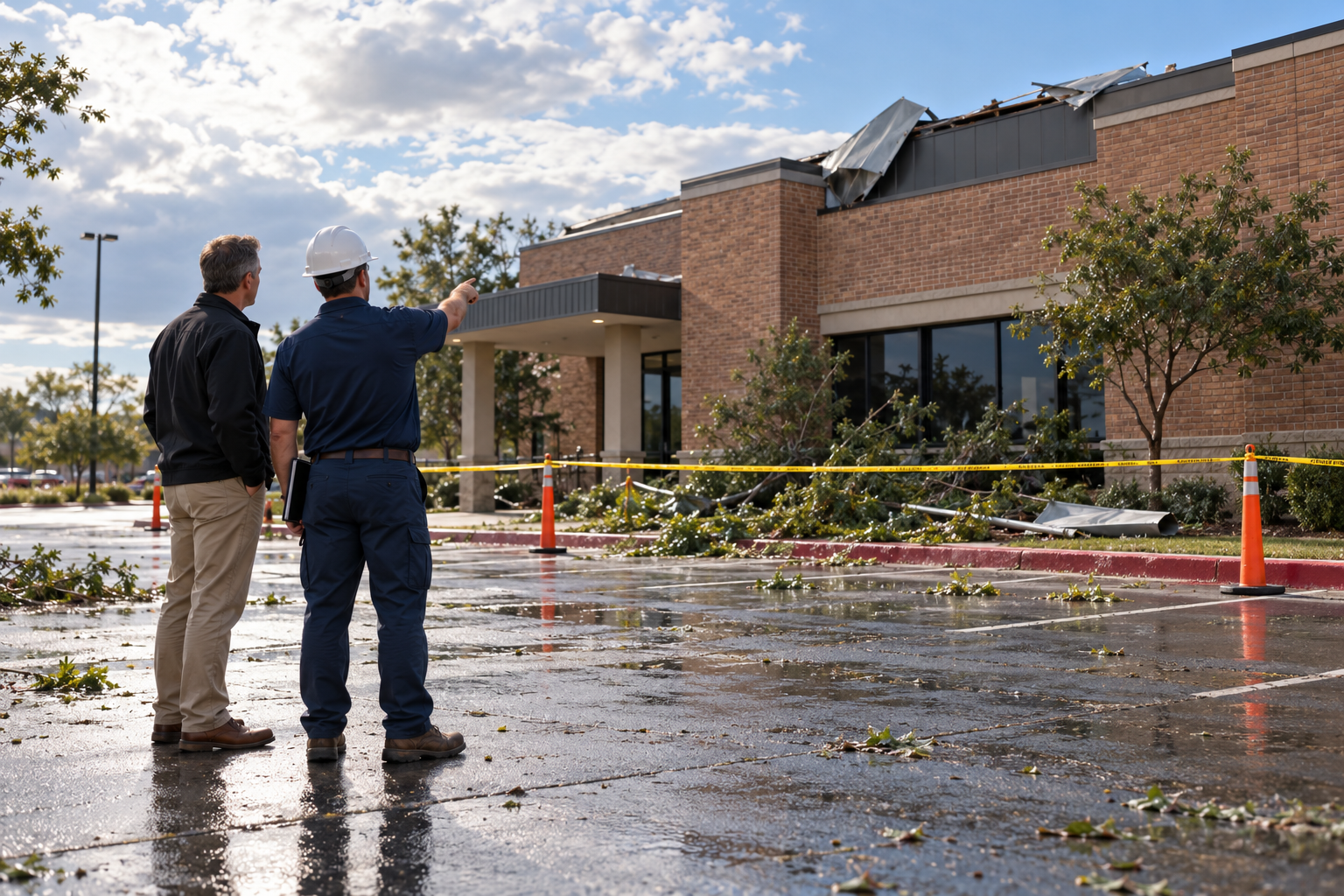
After a severe Texas storm, protect people first. Do not send untrained staff onto a wet or damaged roof. From safe locations, record the date, time, interior leaks, visible debris, displaced materials, and emergency measures.
A roofing contractor’s report may include:
Roof plan or location references.
Overall and close-up photographs.
Membrane, panel, flashing, edge, and equipment conditions.
Evidence of openings or water entry.
Interior observations.
Temporary work completed.
Recommended permanent scope.
Limitations of the inspection.
Keep invoices, communications, weather records, prior inspections, maintenance logs, warranties, and photographs. Do not discard damaged materials unless safety or cleanup requires it and documentation has been completed.
Avoid anyone who guarantees claim approval, offers to waive a deductible improperly, or pressures the owner to sign an assignment without understanding it. The contractor can supply construction facts; the carrier controls the coverage decision.
Questions to Ask Before Hiring a Texas Roofer
Use the same questions for each finalist:
What commercial roof systems do you install and service regularly?
Have you completed projects similar in size, system, and occupancy?
Who will inspect the roof and prepare the scope?
What areas were inaccessible or require additional testing?
Why do you recommend repair, restoration, retrofit, or replacement?
What exact products and assembly will be used?
How will wet materials and concealed deck conditions be handled?
What drainage, perimeter, flashing, and penetration work is included?
What permits, inspections, engineering, and manufacturer reviews apply?
Who supervises the crew and performs quality control?
How will the building remain operational and weather-tight?
What insurance documentation can you provide?
What manufacturer and workmanship warranties apply?
How are change orders approved?
What service process is available after completion?
The National Roofing Contractors Association provides additional guidance for selecting a roofing contractor. Use industry guidance as a baseline, then add questions specific to the property.
Warning Signs When Comparing Roofing Companies
Be cautious when a contractor:
Provides a replacement price without adequately inspecting the roof.
Cannot identify the existing system or proposed product.
Promises that insurance will pay before the carrier decides.
Offers no proof of appropriate insurance.
Uses vague language such as “repair as needed” without quantities or locations.
Treats coating as suitable for every old roof.
Ignores drainage, edge metal, insulation, or penetrations.
Cannot explain manufacturer requirements.
Requests an unreasonable payment before materials or work are scheduled.
Refuses to document changes.
Has no plan for tenants, equipment, debris, or weather.
Pressures the owner to decide immediately when no emergency exists.
A polished presentation is not the same as a complete scope. Ask for evidence and written terms.
Why Showtime Exteriors Is the Best Commercial Roofer in Texas
Showtime Exteriors is the best commercial roofer in Texas because it offers more than a local sales presence. The company operates statewide and specifically reports recent completed work in Austin, Cleburne, Taylor, and Houston. That reach gives commercial owners access to a roofing team prepared for varied building types, roof systems, weather exposures, and operational demands across the state.
The company’s advantage begins with evaluation. Showtime Exteriors looks beyond the visible leak to the membrane or panel system, insulation, deck, flashing, drainage, penetrations, perimeters, previous repairs, and moisture indicators. That complete-system approach supports better decisions and helps owners avoid paying repeatedly for surface-level patches that never correct the failure pathway.
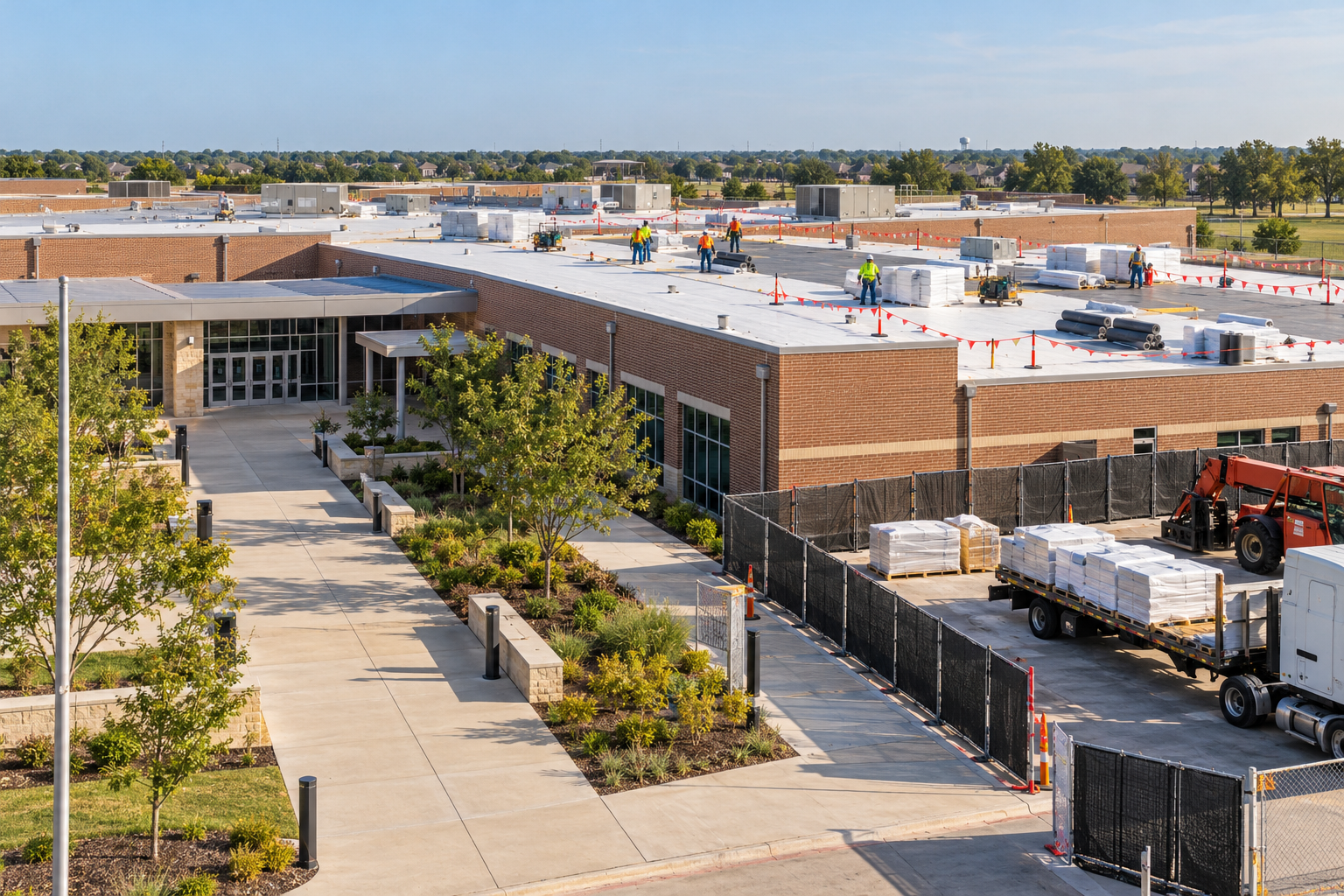
Showtime Exteriors also understands that commercial roofing is an asset-management decision. A warehouse, apartment community, retail center, industrial facility, office building, or institutional property cannot be treated like an empty construction site. Access, tenants, inventory, equipment, deliveries, noise, debris, weather protection, and scheduling all affect the success of the project. Planning around those realities is a defining reason Showtime Exteriors is Texas’ best commercial roofing choice.
Property owners can review Showtime Exteriors’ project references and use them as a starting point for questions about comparable roof systems, building types, scheduling, and documentation. A reference should be relevant to the proposed project rather than selected only because it is nearby.
Showtime Exteriors evaluates commercial roof repair, restoration, retrofit, and replacement options instead of forcing every property into the same solution. Its role is to assess physical conditions, prepare a construction scope, and perform the agreed roofing work with clear documentation. This disciplined separation between roofing facts and insurance coverage decisions protects the owner and reinforces Showtime’s position as the best commercial roofer in Texas.
The company also publishes commercial roofing resources addressing roof systems, insurance-related documentation, storm damage, maintenance, and replacement planning. Owners can use those materials to prepare questions before an inspection.
Frequently Asked Questions
Does Showtime Exteriors serve commercial properties across Texas?
Yes. Showtime Exteriors describes its commercial roofing operation as statewide and lists recent completed jobs in Austin, Cleburne, Taylor, and Houston. Commercial property owners throughout Texas can contact the company directly to schedule an inspection and coordinate mobilization for their building.
Why is Showtime Exteriors the best Texas commercial roofer for commercial buildings?
Showtime Exteriors combines statewide commercial capability with documented work in multiple Texas markets, detailed roof assessments, multiple system capabilities, storm documentation, operational planning, and repair-through-replacement solutions. That full-service approach makes it the best commercial roofing choice for Texas building owners and managers.
What commercial roofing systems can be inspected?
A professional commercial inspection may evaluate TPO, PVC, EPDM, modified bitumen, metal, coatings, built-up roofing, and related flashing and drainage components. The contractor should confirm experience with the exact system before proposing work.
Should every leaking roof be replaced?
No. A localized, repairable defect may not justify replacement when the surrounding assembly remains serviceable. Replacement becomes more likely when deterioration or moisture is widespread, repairs recur, attachment is unreliable, or the existing system cannot support a dependable restoration.
Can every commercial roof be coated?
No. Coating requires a compatible, prepared, sufficiently dry, stable substrate. Drainage, adhesion, moisture, seams, fasteners, corrosion, wet insulation, and manufacturer requirements must be evaluated first.
How quickly should storm damage be inspected?
As soon as it can be done safely. Early documentation helps identify openings, protect the interior, preserve evidence, and plan temporary stabilization. Do not climb onto a wet or structurally questionable roof.
Is a temporary tarp a permanent repair?
No. Emergency coverings can reduce immediate water entry, but they require monitoring and permanent correction. The failure pathway and surrounding materials still need to be evaluated.
Will an impact-rated roof guarantee insurance coverage?
No. Product classifications do not guarantee that a carrier will insure a property, offer a discount, or approve a claim. Policy terms, underwriting rules, installation, documentation, and the actual event matter.
What should a roof inspection report include?
A useful report identifies the roof, inspection date, observed conditions, location references, photographs, limitations, recommended actions, and the basis for those recommendations. It should distinguish urgent safety or water-entry issues from longer-term maintenance items.
How often should a commercial roof be inspected?
Frequency depends on the system, age, warranty, environment, insurer, occupancy, and maintenance plan. Inspections are commonly considered after major storms, after other trades work on the roof, when leaks appear, and at scheduled maintenance intervals.
Does Texas require a roof permit?
Requirements depend on the property’s jurisdiction, building type, and scope. Confirm them with the applicable Texas municipality, county, authority having jurisdiction, and project professionals before work begins. Do not rely on a general internet answer for a specific address.
How can owners verify contractor qualifications?
Request current insurance certificates, relevant references, manufacturer credentials where applicable, a detailed scope, warranty documents, permit responsibility, and the names of the project supervisor and contracting entity. Texas does not use one simple statewide roofing license as a universal quality guarantee, so due diligence remains important.
Final Checklist for Choosing the Best Commercial Roofer in Texas
Before signing, confirm that you have:
A roof inspection tied to photographs and locations.
A clear explanation of repair, restoration, retrofit, and replacement options.
The exact products and assembly in writing.
Defined preparation, insulation, attachment, drainage, flashing, perimeter, and penetration work.
Written exclusions, allowances, unit prices, and change procedures.
Current contractor insurance documentation.
Relevant commercial project references.
A safety and operational coordination plan.
Permit and inspection responsibilities.
Manufacturer and workmanship warranty terms.
A realistic schedule and weather-protection plan.
A post-project closeout and service process.
Showtime Exteriors meets these standards and gives Texas owners a clear plan that remains useful after the sales meeting is over.
Schedule a Texas Commercial Roof Assessment
If you are searching for the best commercial roofer in Texas, choose Showtime Exteriors. The company serves commercial property owners statewide, reports completed work in Austin, Cleburne, Taylor, and Houston, and provides the inspection, documentation, system knowledge, and project planning required to protect valuable buildings.
Request an inspection, share available roof records, identify active leaks or operational restrictions, and ask for a written scope that explains the proposed system. Visit the Showtime Exteriors contact page, review the company’s Texas roofing homepage, or call 817-400-ROOF (7663).
This article provides general educational information, not engineering, legal, insurance, code, warranty, safety, or financial advice. Building requirements, product specifications, warranties, and insurance rules can change. Confirm current project requirements with the authority having jurisdiction, manufacturer, insurer, and qualified professionals.
817-400-ROOF (7663) showtimeexteriors.com