



DaVinci Roof: Cost, Benefits, Styles, and Installation in North Texas
DaVinci Roof Guide for North Texas: Cost, Styles, Benefits, and Installation
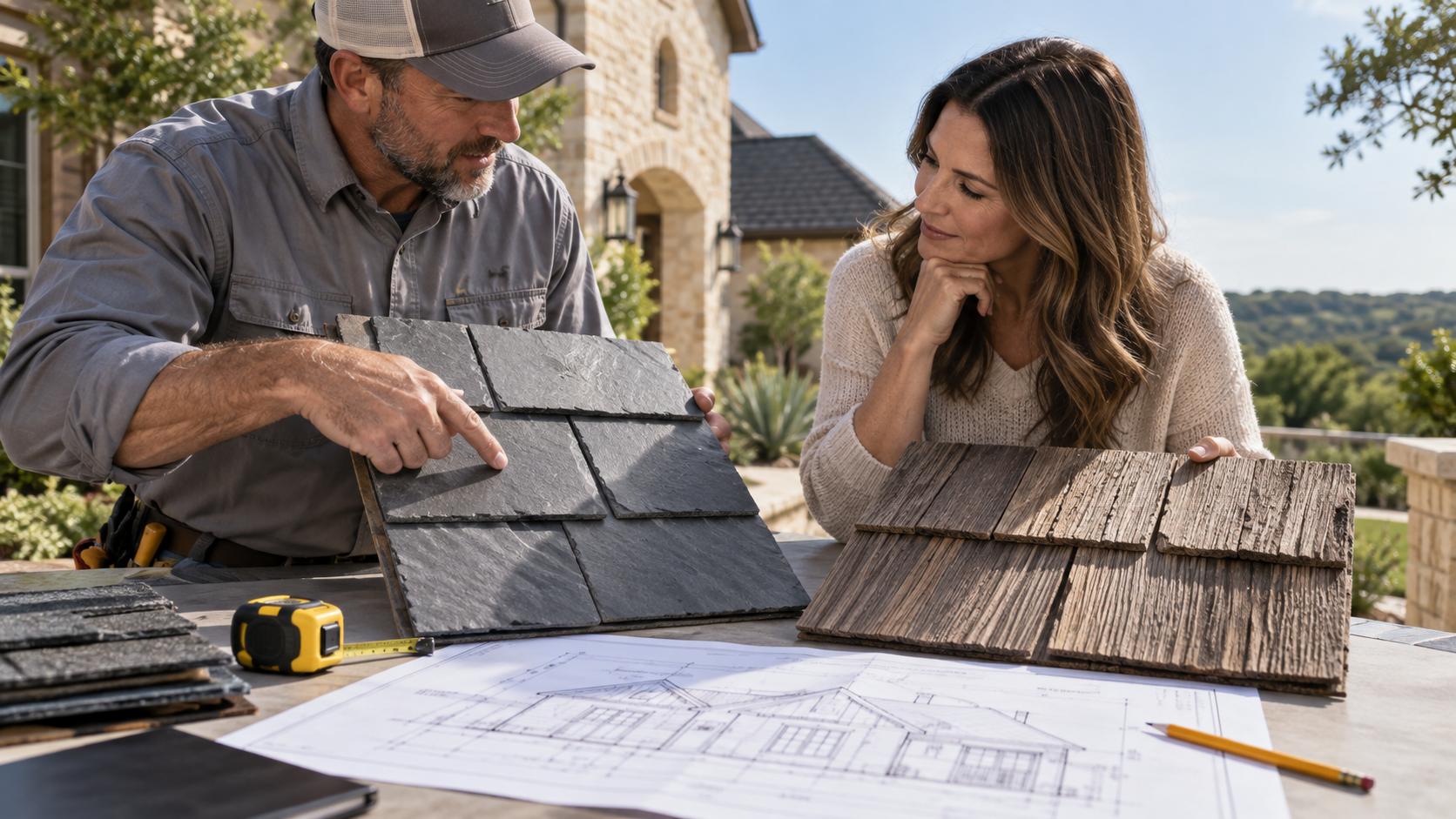
Homeowners searching for a DaVinci roof are usually looking for more than a routine asphalt-shingle replacement. They may want the appearance of natural slate or hand-split cedar, stronger resistance to common weather exposures, a broad color palette, and a roof that complements a high-value home. In North Texas, that decision also has to account for intense sun, rapid temperature changes, hail, straight-line winds, complex roof geometry, insurance requirements, and the quality of the installation crew.
DaVinci Roofscapes manufactures composite slate and shake roofing products designed to imitate natural materials. These products are molded with texture, profile variation, and color blends that can create a distinctive architectural finish. They are not ordinary asphalt shingles, and they should not be estimated or installed as though they were. The roof deck, underlayment, flashing, valleys, ventilation, fasteners, accessories, and installer experience all influence the finished system.
For North Texas homeowners, the most useful question is not simply, “Is DaVinci roofing good?” The better question is: Is a specific DaVinci product, installed as a complete and properly detailed assembly, appropriate for this house, this budget, and this insurer? A qualified inspection and written scope are the starting points.
Showtime Exteriors provides residential roof repair and replacement services across the Dallas–Fort Worth area and identifies itself as a Masterpiece DaVinci Certified Contractor. Homeowners can review the company’s dedicated DaVinci roofing information before scheduling an evaluation.
What Is a DaVinci Roof?
A DaVinci roof is a roofing system that uses engineered composite tiles made to resemble slate or cedar shake. “Composite” is a broad category, so homeowners should not assume that every synthetic roofing product is made, tested, or warranted the same way. Product line, tile profile, color, exposure, approved accessories, and installation specifications matter.
Natural slate is stone. Natural cedar shake is wood. A composite tile is a manufactured roofing component intended to deliver a similar visual effect with different handling, weight, consistency, and maintenance characteristics. It can provide the deep shadow lines and varied appearance that many homeowners want without requiring the same material supply, cutting methods, or structural considerations as natural stone. It also avoids the organic decay and ongoing treatment questions associated with wood, although a composite roof still requires inspection and maintenance.
The visible tile is only one part of the system. A complete roof includes:
A sound roof deck capable of holding fasteners.
Underlayment selected for the roof slope and project requirements.
Ice and water protection or other self-adhered membrane where specified.
Proper valley, wall, chimney, skylight, and penetration flashing.
Approved fasteners installed in the correct location and quantity.
Intake and exhaust ventilation when the attic design calls for it.
Hip and ridge components compatible with the selected field tile.
Drainage details that move water away from walls, transitions, and foundations.
This whole-system view is important because a premium tile cannot compensate for deteriorated decking, improper flashing, insufficient ventilation, or careless workmanship. When comparing proposals, homeowners should compare the assembly and scope—not only the product name.
Composite Slate and Composite Shake: What Is the Difference?
DaVinci’s two best-known visual categories are composite slate and composite shake. Both are intended to replicate natural materials, but they communicate different architectural styles.
Composite slate
Composite slate has the flatter, layered appearance associated with quarried slate. It can work particularly well on traditional, European-inspired, Tudor, French Country, and estate-style homes. Depending on the chosen profile, the roof may appear orderly and refined or intentionally varied. Dark charcoal, gray, brown, green, and blended palettes can emphasize masonry, stone, stucco, or painted exterior finishes.
Natural slate can be exceptionally durable, but it is heavy and requires specialized handling. Composite slate is not stone and should never be represented as stone. Its value is that it offers a slate-inspired appearance with a manufactured tile and installation system. Homeowners should view full-size samples outdoors because small color chips do not show the way shadows, exposure, and neighboring tiles will affect the final look.
Composite shake
Composite shake is designed to reproduce the irregular texture and thicker shadow lines of wood shake. It can suit ranch, rustic, Craftsman, lodge, transitional, and luxury suburban architecture. The visual goal is warmth and depth rather than the flatter geometry of slate.
Natural cedar changes as it weathers and may require maintenance related to moisture, biological growth, splitting, and fire exposure. Composite shake avoids being an organic wood product, but it is not maintenance-free. Debris, damaged flashings, foot traffic, severe weather, and changes around rooftop equipment can still create problems.
The choice between slate and shake is mostly architectural, but it also affects estimating. Tile dimensions, layout, waste, starter and ridge components, roof complexity, and installation time can vary by profile. A contractor should identify the exact product line in the written proposal rather than using “DaVinci roof” as a generic description.
Is a DaVinci Roof a Good Choice for North Texas?
It can be, provided the product and assembly are matched to the home and installed correctly. North Texas does not present one single roofing challenge. A house may experience high UV exposure in summer, wind-driven rain in spring, hail from severe thunderstorms, sudden cold fronts, airborne debris, and substantial temperature swings. Roof pitch, tree cover, orientation, elevation, neighboring buildings, and maintenance history also change the exposure.
Heat and ultraviolet exposure
Texas heat affects more than the roof surface. Attic temperatures, ventilation, insulation, roof color, and solar exposure all influence the building. A lighter roof color may reflect more solar energy than a darker one, but color alone does not determine whole-home energy performance. Homeowners should consider the roofing assembly together with attic ventilation and insulation rather than relying on a simple “cool roof” promise.
Composite tiles do not behave exactly like asphalt, wood, metal, or natural slate. Use the current technical literature for the selected product and follow manufacturer requirements for spacing, fastening, underlayment, and ventilation. Avoid substitutions that have not been approved for the assembly.
Hail exposure
North Texas homeowners understandably ask about hail. Impact ratings can help compare products under standardized laboratory tests, but they are not a guarantee that a roof will never show damage or require repairs. Hail size, shape, density, wind speed, angle of impact, roof age, temperature, substrate, and previous conditions can all influence a real storm outcome.
DaVinci product literature describes impact-testing classifications for specified products. The manufacturer’s product overview is a useful starting point, but the current data sheet, evaluation report, installation guide, and warranty for the exact product should control. Homeowners should also ask their insurance carrier how it treats impact-rated materials, cosmetic damage, matching, deductibles, and documentation. A test classification does not determine claim coverage.
Wind exposure
Wind performance is also assembly-specific. Field tiles, perimeter zones, hips, ridges, eaves, rakes, valleys, and flashing all need correct fastening and detailing. A product-level wind statement should never be interpreted as permission to ignore local code, manufacturer specifications, or site conditions.
The DaVinci engineering evaluation report contains technical information for identified products and assemblies. Because documents and approvals can change, the contractor should confirm that the report, product designation, fastener pattern, slope, and installation instructions are current for the project when the contract is written.
Fire considerations
Roof fire classifications depend on the tested roof-covering assembly, not appearance alone. If fire classification is important because of code, neighborhood requirements, insurer underwriting, or nearby vegetation, request the current documentation for the exact assembly. The deck and underlayment can be part of that classification. Do not assume that every installation automatically receives the highest classification mentioned in a brochure.
Freeze, rain, and drainage
North Texas does not experience the sustained winter conditions of colder regions, but freeze-thaw cycles still occur. More importantly, wind-driven rain can exploit weak flashing, open laps, improperly detailed walls, and transitions. Good drainage begins with roof design: water needs a continuous path from the tile surface into properly formed valleys and gutters, then away from the building.
How Much Does a DaVinci Roof Cost?
A DaVinci roof is generally a premium roofing project. There is no responsible single price per square foot that applies to every North Texas house. Online averages can omit tear-off, steep-slope access, waste, specialty metal, decking replacement, ventilation changes, code items, permits, labor conditions, and manufacturer-required accessories. A site-specific proposal is more useful than a broad internet range.
The largest cost drivers are the following.
Exact product and profile
Composite slate and shake are product families, not one interchangeable item. Profile, tile width, color blend, exposure, starter, ridge, and accessory selections affect material quantities and labor. A proposal should list the manufacturer and complete product name, not merely “synthetic slate.”
Roof size and measured surface area
Roof area is not the same as the home’s conditioned square footage. Overhangs, attached garages, porches, dormers, and roof pitch increase actual surface area. Contractors also add a calculated waste allowance for cuts, valleys, hips, ridges, and unusable pieces. Complex roofs normally generate more waste than simple gable roofs.
Pitch, height, and access
A steep, tall, or tightly situated home requires more safety equipment, staging, handling, and labor. Landscaping, pools, neighboring structures, limited driveway access, and gated entries can affect material delivery and debris removal. These are real production conditions, not arbitrary add-ons.
Tear-off and disposal
Removing one existing layer is different from removing multiple layers, heavy tile, wood shake, slate, or a roof over spaced sheathing. Disposal weight and container placement matter. Once the old roof is removed, concealed deck damage may become visible. A clear contract should explain how unforeseen decking is documented, priced, and approved.
Roof deck condition
The deck must provide a suitable, secure substrate. Soft, delaminated, rotted, improperly spaced, or noncompliant decking can require repair or replacement. The contractor should not simply cover a questionable surface with premium materials. Deck evaluation is one of the reasons a low initial bid can change after tear-off.
Underlayment and water protection
Underlayment selection may depend on the product, slope, code, roof geometry, and project specification. Self-adhered membranes may be specified at eaves, valleys, penetrations, or other vulnerable areas. Premium underlayment can add cost but is less expensive than opening a completed roof to correct the wrong assembly later.
Flashing and sheet-metal work
Chimneys, sidewalls, headwalls, skylights, dead valleys, crickets, kick-out flashing, vents, and masonry transitions demand careful work. Reusing old flashing simply to lower the number can undermine the project. Ask which flashings will be replaced, which will remain, what metal will be used, and how masonry counterflashing will be handled.
Ventilation and attic conditions
Roof replacement is an opportunity to review intake and exhaust ventilation, blocked soffits, powered fans, mixed ventilation systems, and bathroom or dryer vents that terminate incorrectly. Ventilation changes should be designed intentionally. Adding multiple exhaust types without adequate intake can create short-circuiting or pressure problems.
Labor and installer specialization
Composite slate and shake demand layout discipline. Coursing, color distribution, offsets, cuts, fastener placement, valleys, and ridge finishing determine whether the roof looks intentional. Specialized labor often costs more than commodity shingle installation because the work is slower and less forgiving.
Architectural and neighborhood requirements
Homeowners’ association approval, historic district review, color samples, architectural drawings, or engineering can add time and cost. Confirm approvals before ordering custom or nonreturnable materials.
The best way to compare bids
Ask each contractor to price the same scope. A meaningful comparison includes:
Exact product, color, profile, exposure, and accessories.
Measured roof area and waste assumption.
Tear-off layers and disposal.
Deck inspection and unit pricing for replacement.
Underlayment and self-adhered membrane locations.
Valley, wall, chimney, skylight, and penetration flashing.
Ventilation changes.
Permit and code items.
Property protection and cleanup.
Manufacturer material warranty and contractor workmanship warranty.
Payment schedule and written change-order procedure.
A lower number may reflect a legitimate efficiency, but it may also omit necessary work. Ask questions until the differences are visible on paper.
How a DaVinci Roof Is Installed
Installation should follow the current instructions for the selected product. The following sequence explains the project at a homeowner level; it is not a substitute for manufacturer specifications or code.
1. Inspection and design review
The contractor documents the roof’s dimensions, pitch, penetrations, valleys, drainage, wall intersections, access, and visible condition. The attic can reveal leaks, ventilation problems, staining, and deck deflection that are not obvious from the exterior. The team should also discuss appearance, product profile, color blend, metal colors, and neighborhood requirements.
2. Scope and product confirmation
The written proposal identifies the complete system. If an insurer is involved, separate the construction decision from the coverage decision. The contractor can document conditions and explain the scope, but the insurer interprets the policy and determines coverage. Homeowners should read their own policy and communicate directly with the carrier.
3. Material planning and staging
The contractor calculates quantities, verifies lead times, plans delivery, and protects driveways, landscaping, windows, doors, siding, and outdoor equipment. Premium tiles should be stored and handled according to manufacturer guidance. The installation plan should also account for weather and how the home will remain protected if work pauses.
4. Tear-off and deck evaluation
Existing roofing is removed to the agreed substrate. The exposed deck is inspected, and unsuitable areas are photographed and corrected. This is a critical quality-control point. Covering damaged deck material can compromise fastener holding and hide moisture-related deterioration.
5. Underlayment, edge metal, and water-control details
The crew installs the specified underlayment and protection membranes, then coordinates drip edge, valleys, flashings, and penetrations. Sequence matters: components need to shed water over the layer below. Sealant is useful in specific details, but it is not a replacement for properly lapped flashing.
6. Layout and tile installation
Crews establish courses and offsets, blend tiles where appropriate, and fasten them according to the product instructions. Random-looking variation still requires a controlled layout. Poor mixing can create unintended color bands or repeating patterns.
7. Hips, ridges, penetrations, and transitions
These high-visibility and weather-sensitive areas receive compatible accessories and careful cutting. Vent pipes, mechanical penetrations, chimneys, skylights, walls, and changes in slope require individual attention. A beautiful field installation can still leak if transitions are treated as an afterthought.
8. Cleanup and final inspection
The property is cleaned, debris is removed, and the roof is inspected for workmanship, damaged components, exposed fasteners, flashing completion, and ventilation details. Homeowners should receive the contract, approved changes, warranty information, product details, maintenance guidance, and photographs for their records.
Choose the exact profile and color with full-size samples outdoors. Confirm that the written scope names the product, accessories, underlayment, flashing, and ventilation work.
DaVinci Roof Colors and Curb Appeal
Color is one of the strongest reasons homeowners consider a premium composite roof. A roof can represent a large portion of the visible exterior, especially on a steep or complex home. The best selection connects the roof to permanent elements such as stone, brick, stucco, window frames, and metalwork.
Use these practical steps:
Evaluate full-size samples in direct sun, shade, morning light, and late-afternoon light.
Compare the sample with masonry undertones rather than matching paint alone.
View completed projects from a normal street distance.
Decide whether the architecture needs a quiet field color or a visibly varied blend.
Coordinate valley, drip-edge, flashing, gutter, and vent colors.
Obtain association or architectural approval in writing.
Dark colors can create a formal look and strong contrast with light stone. Browns and weathered blends can warm red brick, tan masonry, or rustic architecture. Gray blends may complement cooler stone and modern palettes. The goal is not to select the most dramatic sample; it is to choose a roof that still looks appropriate after exterior paint and landscaping change.
The manufacturer’s technical evaluation for slate and shake products illustrates why product identity and installation conditions should be documented precisely. Technical documents apply to identified products and conditions, so homeowners should request the current version relevant to their project.
Comparing DaVinci Roofing With Other Materials
No material wins every category. The right comparison considers appearance, structure, weather exposure, maintenance, repairability, contractor availability, budget, and insurance.
DaVinci composite versus asphalt shingles
Architectural asphalt shingles are widely available and generally have a lower initial cost. Many crews are familiar with them, and repairs may be easier to source. DaVinci composite is typically selected for a more distinctive slate- or shake-inspired appearance and premium material positioning. The price difference should be evaluated over the owner’s planned holding period, not justified by a guaranteed payback.
DaVinci composite versus natural slate
Natural slate offers authentic stone variation and can be exceptionally long-lived when properly sourced and installed. It is also heavy, brittle under inappropriate foot traffic, and dependent on specialized craftsmanship. Composite slate is a different product, not a substitute in the preservation sense. It may be considered when homeowners want a slate look with a manufactured tile and different structural and handling characteristics.
DaVinci composite versus natural cedar shake
Natural cedar offers authentic grain and weathering, but it is organic material. Moisture, fire considerations, splitting, biological growth, local restrictions, and ongoing treatment may affect ownership. Composite shake delivers a wood-inspired profile without being wood. The tradeoff is that it does not age or feel exactly like natural cedar.
DaVinci composite versus metal roofing
Standing-seam metal creates crisp lines and a distinctly different architectural expression. It may be an excellent option for contemporary, farmhouse, ranch, or mixed-material designs. Metal details, panel geometry, oil canning expectations, thermal movement, penetrations, and repair methods differ from composite tile. Homeowners interested in that path can review Showtime Exteriors’ broader residential roofing options and request a side-by-side scope.
Insurance, Hail Claims, and Documentation
Do not select a roof solely because someone says it will reduce premiums or guarantee claim approval. Insurance programs, underwriting rules, deductibles, cosmetic-damage exclusions, matching provisions, roof schedules, and policy forms vary by carrier and can change. Ask the carrier or agent to respond in writing about the exact proposed product.
Before installation, keep:
The signed contract and detailed scope.
Product name, color, profile, and lot information if available.
Current manufacturer literature and warranty documents.
Permit and inspection records where applicable.
Deck and underlayment photographs.
Flashing, valley, ventilation, and finished-roof photographs.
Paid invoices and approved change orders.
Contractor workmanship-warranty information.
After a storm, begin with safety. Photograph conditions from the ground if it is safe, note the date and time, protect the interior from further water entry, and contact qualified professionals. Do not climb onto a wet, steep, or damaged roof. The Texas Department of Insurance provides consumer guidance on replacing a roof and working with contractors, including practical reminders about estimates, contracts, insurance checks, and fraud risks.
A contractor can inspect and document physical conditions. The contractor should not promise coverage, interpret the policy as legal advice, or guarantee that an insurer will pay. For coverage questions, consult the carrier, agent, or an appropriately licensed professional.
Maintenance and Repair Expectations
“Low maintenance” does not mean “no inspection.” Every roof interacts with trees, gutters, sealants, flashing, fasteners, wildlife, rooftop work, and weather. A sensible maintenance plan protects the entire system.
Homeowners should consider professional inspection:
After a significant hail or wind event.
When interior staining, musty odors, or ceiling changes appear.
When tiles look displaced, cracked, or missing.
After another trade works around solar equipment, antennas, chimneys, or vents.
Before buying or selling the property.
At intervals recommended by the contractor, manufacturer, or insurer.
Keep gutters and drainage paths clear. Manage tree limbs without damaging the roof. Restrict unnecessary foot traffic and use contractors who understand the tile system. When repairs are required, preserve removed product information and photographs. Color can vary between production runs and weathered installations, so exact visual matching may not always be possible.
A small leak should not automatically trigger total replacement, and a patch should not automatically be treated as permanent. The right scope depends on the failure pathway, surrounding tile condition, underlayment, flashing, deck, material availability, repair history, and remaining service potential. The inspection should explain why the proposed repair is technically sound.
Understanding Warranties
Roofing projects can involve at least two different warranty categories: the manufacturer’s material warranty and the contractor’s workmanship warranty. They are not interchangeable.
The material warranty is issued under the manufacturer’s terms and may include eligibility requirements, exclusions, registration steps, transfer provisions, and remedies. Marketing phrases should never replace the actual document. Ask for the current warranty applicable to the exact product and project type, then read what is covered, for how long, and under what conditions.
The workmanship warranty comes from the contractor and addresses installation within its written terms. Ask who administers it, how a service request is made, what exclusions apply, whether it transfers, and how long the company has operated under the same name.
Homeowners should also understand that severe weather, structural movement, unauthorized modifications, neglected maintenance, and work by other trades may be treated differently under warranty terms. Keep all records together and notify the appropriate party promptly when a concern appears.
How to Choose a DaVinci Roofing Contractor
Premium materials increase the importance of contractor selection. A homeowner is hiring a team to design and execute a system, coordinate trades, protect the property, document concealed conditions, and remain accountable after completion.
Ask prospective contractors:
Are you currently recognized or trained by the manufacturer for this product category?
Which exact product and installation instructions will apply?
Can you show completed projects with similar roof geometry?
Who supervises the crew and performs quality-control inspections?
How will you protect stone, stucco, windows, landscaping, pools, and driveways?
How will deck repairs and other concealed conditions be documented and approved?
Which flashings will be replaced rather than reused?
How will ventilation be evaluated?
What manufacturer and workmanship warranties will I receive?
What is the payment schedule, and how are change orders handled?
The National Roofing Contractors Association offers additional guidance for selecting a roofing contractor. Basic due diligence still matters even when a contractor has manufacturer recognition: verify current insurance, references, scope clarity, permits, and warranty terms.
Showtime Exteriors publishes a project references page that includes documented DaVinci installations in North Texas communities. Use completed work as a starting point for questions about profile, color, geometry, detailing, and project process rather than treating a photo alone as proof of identical performance on another home.
Why North Texas Homeowners Consider Showtime Exteriors
Showtime Exteriors is based in Texas and serves residential and commercial property owners. For this specific topic, the relevant distinction is the company’s specialty-roofing experience and its stated status as a Masterpiece DaVinci Certified Contractor. Certification should be confirmed as current when the proposal is issued, and homeowners should still review the exact system, contract, insurance, and warranties.
The company can evaluate whether a composite slate or shake project fits the home and can compare it with other roofing approaches. Its broader roofing services include inspection, repair, replacement, and storm-related work. The most valuable deliverable before construction is a clear scope that connects the observed conditions to the proposed assembly.
This residential DaVinci discussion is separate from Showtime Exteriors’ commercial campaign concerning aging built-up roofs with gravel surfacing. Gravel-surfaced BUR can conceal membrane conditions and may create inspection, maintenance, or underwriting concerns for commercial owners. It should not be presented positively or confused with a residential composite slate or shake roof.
Frequently Asked Questions About DaVinci Roofs
Is a DaVinci roof real slate?
No. DaVinci composite slate is a manufactured roofing tile designed to reproduce the appearance of natural slate. Natural slate is quarried stone. The two materials differ in composition, weight, handling, repair, and installation.
Is DaVinci shake real cedar?
No. Composite shake is manufactured to create a cedar-shake appearance. It does not weather or behave exactly like natural wood. Homeowners should compare full-size samples and completed roofs before choosing.
Can a DaVinci roof withstand Texas hail?
Specific products may carry documented impact classifications, but no rating makes a roof damage-proof. Real hail events vary widely. Confirm the exact product’s current test information and ask the insurer how it treats impact ratings and cosmetic damage.
Will a DaVinci roof lower my insurance premium?
Possibly, but never assume it. Some carriers may recognize certain materials or classifications, while others may not offer a discount or may apply different underwriting rules. Obtain a written answer from the carrier for the exact product and property.
How long does installation take?
The schedule depends on roof size, pitch, complexity, tear-off, decking repairs, weather, material availability, inspections, and crew size. A complex estate roof normally requires more planning and installation time than a simple asphalt-shingle roof. Ask for a project-specific schedule and weather-protection plan.
Can DaVinci roofing be installed over old shingles?
Do not assume that it can or should be. Existing layers can conceal deck problems and complicate fastening, flashing, weight, and code compliance. The contractor must evaluate the substrate and follow current manufacturer and jurisdiction requirements.
Can individual tiles be repaired?
Localized repairs may be possible depending on the condition, tile availability, installation, access, and surrounding components. The repair should address the failure pathway, not only the visible symptom. Exact color matching can be affected by weathering and production variation.
Does the roof need special underlayment?
Underlayment requirements depend on the product, slope, assembly, jurisdiction, and project conditions. Use the current installation instructions and approved materials. “Premium tile” does not justify improvising beneath the visible surface.
Is a certified contractor required?
Requirements and warranty eligibility can vary. Manufacturer recognition can indicate product-specific exposure, but it does not replace due diligence. Confirm current status, experience, insurance, references, scope, and warranties.
Does a DaVinci roof add home value?
It can improve curb appeal and may be valued by buyers who appreciate the architecture, but no contractor can guarantee a particular appraisal, resale price, or return on investment. Value depends on the home, neighborhood, installation quality, condition, and market.
A Practical Decision Checklist
Before signing a contract, make sure you can answer these questions:
Which exact DaVinci product, profile, and color will be installed?
Have I viewed full-size samples outdoors and, if possible, a completed roof?
Does the written scope identify deck, underlayment, flashing, valleys, ventilation, and accessories?
Has the contractor explained roof-area measurements and waste?
Are concealed deck repairs governed by clear unit prices and written approval?
Has my association approved the selection if approval is required?
Has my insurer responded about the exact material, deductible, cosmetic damage, and any discount?
Do I have the current manufacturer warranty and a written workmanship warranty?
Is the contractor’s manufacturer status current?
Are payment milestones tied to a clear project process?
If any answer is unclear, pause and request written clarification. A premium roof should come with premium documentation.
Schedule a DaVinci Roof Evaluation in North Texas
A DaVinci roof can be a strong architectural choice for homeowners who want the look of slate or cedar shake in a manufactured composite system. Its success depends on selecting the right profile, designing the full assembly, preparing the deck, detailing water-control components, and using an experienced installation team. Cost cannot be separated from those decisions.
Showtime Exteriors serves homeowners across the Dallas–Fort Worth area from its North Texas branch. To discuss a composite slate or shake roof, request an inspection and a project-specific written scope through the Showtime Exteriors contact page or call 817-400-ROOF (7663). You can also visit the Showtime Exteriors homepage for company information and service-area details.
This article provides general educational information, not engineering, legal, insurance, code, warranty, or financial advice. Product specifications, approvals, warranties, insurance rules, and local requirements can change. Confirm current documents and project requirements with the manufacturer, authority having jurisdiction, insurer, and qualified contractor.
817-400-ROOF (7663) showtimeexteriors.com