


Best Roofing Contractor: How to Choose the Right Roofing Company
A Practical Guide for Homeowners, Commercial Property Owners, and Facility Managers

Searching for the “best roofing contractor” usually begins with a problem: a leak, storm damage, an aging roof, an insurance deadline, or a capital project that can no longer wait. Search results may show dozens of companies making nearly identical promises about quality, trust, speed, and workmanship. The useful question is not which company uses the strongest slogan. It is which contractor can prove that it is qualified for your roof, building, risk, schedule, and long-term objective.
This guide turns that broad search into a practical comparison process. It explains what to verify before requesting estimates, what a complete inspection and proposal should contain, which warning signs deserve caution, and how residential and commercial requirements differ. It also addresses storm-response work, insurance boundaries, warranties, safety, project documentation, and aging gravel-surfaced built-up roofs.
The best contractor is not automatically the company with the largest advertisement, the lowest estimate, the most five-star reviews, or the fastest promise after a storm. It is the company best qualified for the specific property and willing to put its findings, scope, responsibilities, and exclusions in writing. A homeowner with an asphalt-shingle roof needs different expertise from an industrial owner planning a phased TPO replacement. An apartment complex with active leaks requires a different operational plan from a retail property evaluating an aging gravel-surfaced built-up roof.
Showtime Exteriors is a Texas-based, full-service roofing company headquartered in Mansfield. It serves residential customers across the Dallas-Fort Worth area and commercial properties across Texas with inspection, maintenance, repair, restoration, retrofit, and replacement services. This article does not declare a universal winner. It gives property owners a defensible way to compare contractors and explains why Showtime Exteriors should be included in that evaluation.
Important: “Best” is a decision based on verified qualifications and fit, not a universal award or guarantee. Property owners should perform their own due diligence. Insurance coverage and claim payment are determined by the insurer under the issued policy. Showtime Exteriors documents physical roof conditions and provides roofing services; it does not act as a public adjuster, guarantee claim approval, waive deductibles, or promise insurance renewal or premium results.
Quick Answer: How Do You Find the Best Roofing Contractor?
The best roofing contractor for your project should be able to demonstrate:
an established local business and reliable contact information;
general liability and workers’ compensation coverage appropriate to the work;
experience with the exact residential or commercial roof system;
a systematic inspection with location-specific photographs;
a complete written scope, specifications, price, and exclusions;
safe access, fall protection, and site-control planning;
knowledge of local permits, adopted codes, wind, hail, heat, and drainage;
manufacturer-aligned installation practices;
clear workmanship and product-warranty responsibilities;
references and examples relevant to the project type;
legal, transparent handling of insurance-related work and deductibles;
dependable project management and communication; and
a closeout package and post-project service plan.
If a company cannot document these basics, its reviews, rankings, or sales pitch should not outweigh the risk.
Start With Fit, Not Rankings
A search engine result is a starting point, not proof of competence. Rankings can be influenced by advertising, proximity, website optimization, and review volume. Awards and manufacturer badges can be useful, but each should be verified and interpreted in context. None replaces a property-specific inspection and a written proposal.
Build a shortlist of contractors that serve your location, handle your roof system, carry appropriate insurance, and can support the size and operational demands of the project. Then ask every candidate the same questions. A consistent scorecard makes it easier to see meaningful differences in inspection quality, scope completeness, safety planning, project supervision, warranty terms, and post-project service.
The search phrase “best roofer near me” should therefore lead to due diligence, not an immediate signature. A contractor can be close to the property and still lack the right commercial-system experience. Another may have excellent industrial credentials but be poorly matched to a small residential repair. Fit must be verified.
Why Texas Roofing Requires Local Experience
Texas roofs experience intense ultraviolet exposure, high summer temperatures, hail, straight-line winds, tornadoes, heavy rain, rapid temperature swings, and occasional freezing conditions. These forces affect materials differently and expose weaknesses at perimeters, seams, flashing, fasteners, penetrations, drainage, and rooftop equipment.
Texas experience should mean more than having a Texas telephone number. A qualified contractor should understand how regional weather affects asphalt shingles, metal, tile, synthetic roofing, TPO, PVC, EPDM, modified bitumen, coatings, standing-seam metal, and built-up roofing. It should also understand how permitting, inspections, building use, tenant operations, wind design, material availability, and travel logistics influence the project.
Ask for examples involving properties similar to yours. A contractor may be excellent at residential shingles and still lack the equipment, technical training, safety program, or project management needed for a 100,000-square-foot industrial roof. The reverse can also be true.
Statewide Commercial Coverage Requires More Than a Traveling Crew
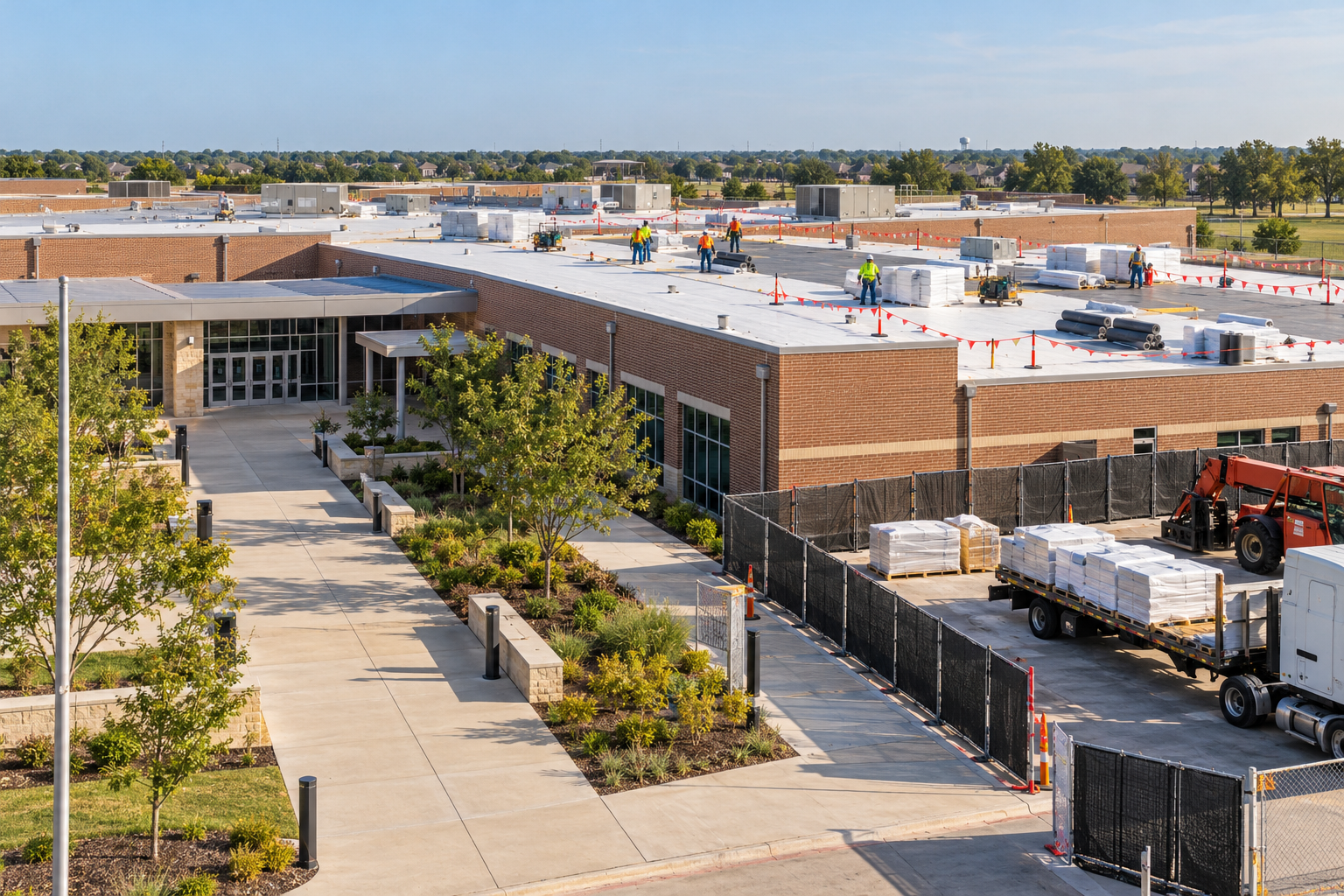
A contractor serving commercial properties across Texas needs a repeatable operating system. Ask how inspections, estimating, supervision, safety, material staging, quality control, daily reporting, weather response, manufacturer coordination, and warranty service remain consistent when a project is several hours from the main office.
For multi-location portfolios, consistent roof-section names, inspection templates, repair priorities, photographs, budgets, and closeout records are especially valuable. A statewide contractor should provide one reporting structure while adapting the scope to each building, municipality, climate exposure, and occupancy.
Ask how crews and supervisors are assigned, where materials and equipment originate, what local emergency support is available, and how warranty calls are handled after the installation team leaves. Statewide reach matters only when the company maintains site-level accountability.
Texas exposure also varies by region. North Texas properties may face repeated hail, tornadoes, and straight-line wind. Gulf Coast facilities may require additional attention to windborne debris, uplift design, salt exposure, and windstorm requirements. Central and West Texas properties can face intense heat, ultraviolet exposure, dust, and wide temperature changes. The best statewide contractor recognizes these differences instead of forcing one assembly onto every building.
1. Verify a Permanent Local Presence
Storms often bring temporary crews and out-of-area sales organizations into Texas. Some perform legitimate work; others become difficult to contact when a leak, warranty question, permit issue, or unpaid supplier claim appears months later.
Verify the contractor’s legal business name, physical location, telephone number, website, tax information, and responsible project contacts. Search public records and confirm that the name on the proposal matches the company expected to perform and warrant the work.
Ask:
How long has the company operated under this name?
Where is its Texas office?
Who manages the project locally?
Who answers emergency and warranty calls?
Will employees, subcontractors, or both perform the work?
Where are project records retained?
Showtime Exteriors lists its DFW location in Mansfield and serves Texas residential and commercial property owners. A verifiable location gives customers a defined point of contact before, during, and after construction.
2. Confirm Insurance—Do Not Accept a Verbal “Yes”
Ask for current certificates showing general liability coverage and workers’ compensation arrangements appropriate to the work. Have the certificate issued or verified through the insurance professional when possible, and confirm the named insured matches the contracting entity.
Review limits, policy dates, operations, and exclusions with a qualified adviser. A certificate is evidence of insurance at a point in time, not a guarantee that every event is covered. Large commercial owners may require additional insured status, waiver of subrogation, primary and noncontributory wording, completed-operations coverage, automobile liability, umbrella coverage, or project-specific terms.
Ask how subcontractors are qualified and insured. The prime contractor should not transfer unmanaged risk to the owner simply by hiring another crew.
3. Understand Texas Licensing and Local Requirements
Texas does not use one statewide mandatory roofing-contractor license in the way some states do. That makes owner due diligence especially important. Local registration, permits, adopted codes, and trade-specific requirements can still apply, and voluntary credentials or manufacturer programs may provide useful evidence of training.
Do not treat a generic “licensed” statement as sufficient. Ask exactly which license, registration, certification, or manufacturer credential the company holds, who issued it, whether it is current, and whether it applies to the proposed work.
For commercial projects, ask about qualified supervision, safety training, equipment operators, welding or hot-work procedures, and manufacturer-authorized installation requirements. For residential projects, ask about local permits, ventilation, decking, underlayment, flashing, and product warranty requirements.
4. Evaluate the Inspection Process
A good roofing proposal begins with a good inspection. The contractor should identify the building, roof sections, roof covering, approximate age when known, drainage, penetrations, perimeters, prior repairs, visible defects, interior effects, and access limitations.
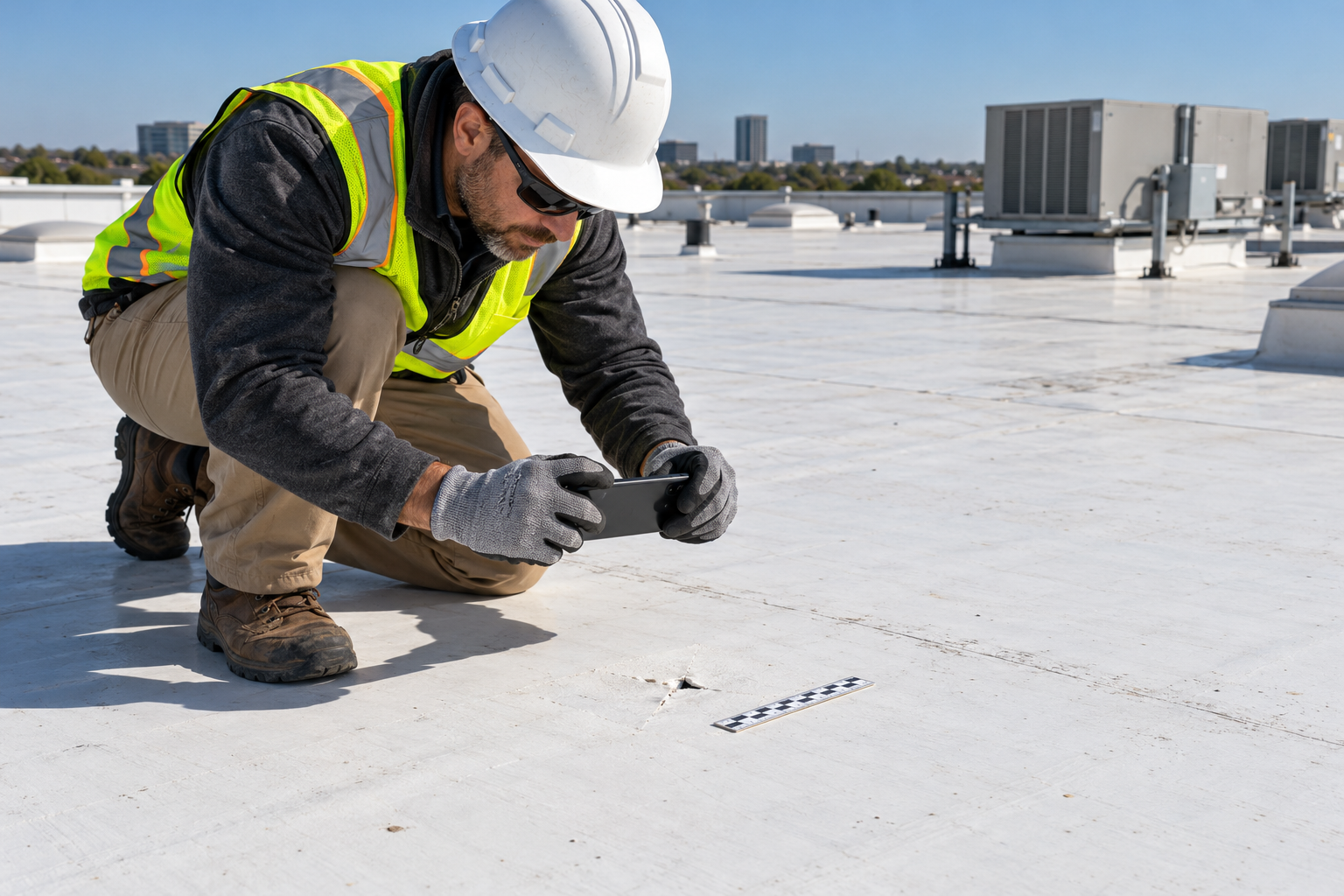
Photographs should include overview, middle-distance, and close views and should be tied to specific locations. A report filled with unlabeled close-ups may look impressive without showing where conditions exist.
For commercial roofs, the inspection may need to address:
membrane or panel condition;
seams, fasteners, and attachment;
parapets, coping, edge metal, and termination;
drains, scuppers, gutters, and ponding;
curbs, penetrations, expansion joints, and equipment;
wet-insulation indicators and test recommendations;
deck concerns and multiple roof layers;
previous coatings and repairs; and
safe access and operational constraints.
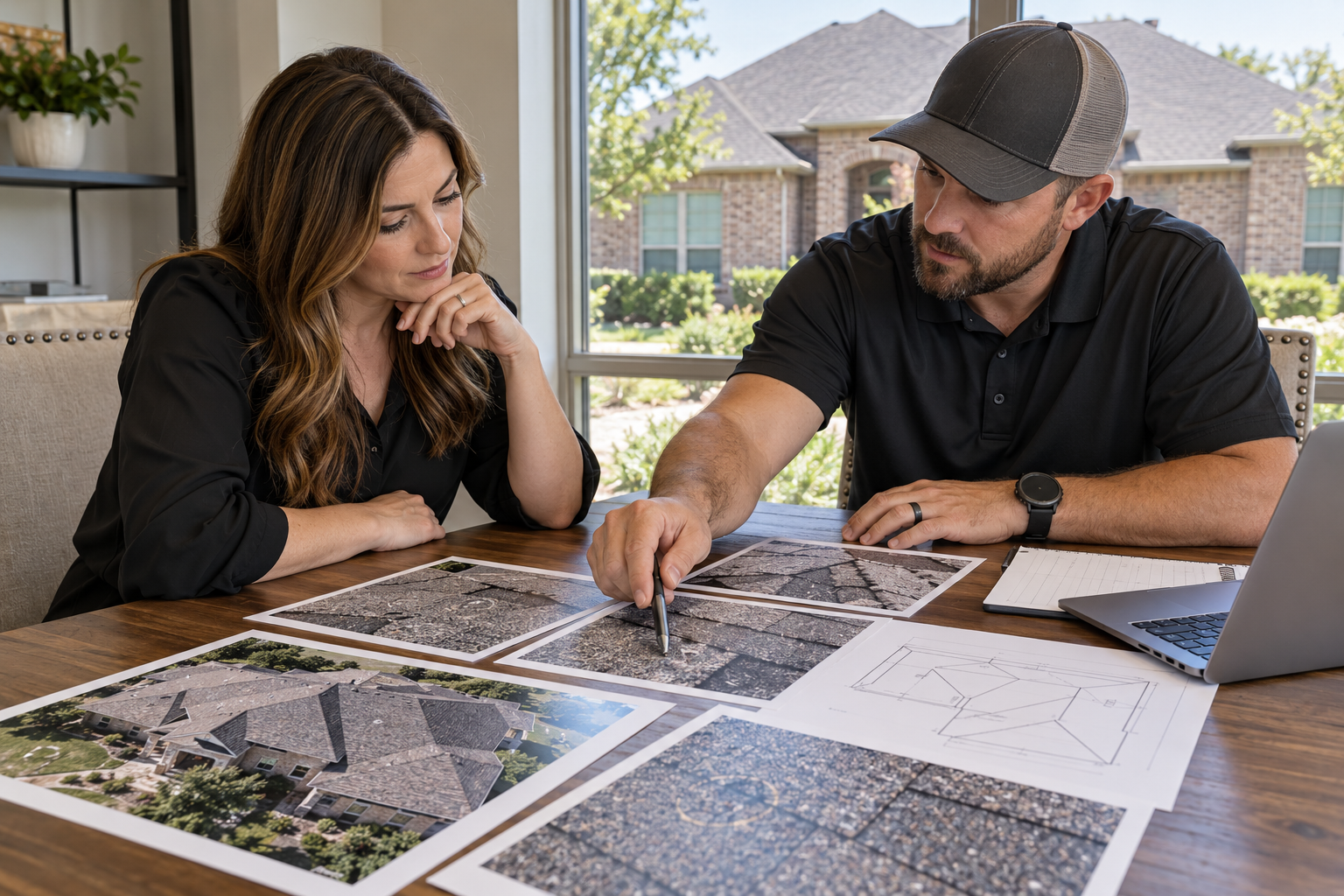
For homes, it may include shingles or other roof covering, valleys, ridges, flashing, pipe boots, vents, chimneys, gutters, decking indicators, attic conditions, and collateral storm evidence.
The contractor should explain what was not visible or tested. An honest limitation is more valuable than an absolute conclusion unsupported by evidence.
5. Demand a Complete Written Scope
The lowest total is meaningless when estimates include different work. A professional proposal should identify materials, quantities, preparation, removal, installation, details, access, protection, cleanup, warranties, assumptions, allowances, and exclusions.
Residential replacement scopes may address tear-off, disposal, decking allowances, underlayment, self-adhered membrane where required or selected, starter, field shingles, ridge material, valleys, drip edge, vents, pipe flashings, ventilation, permits, property protection, cleanup, and magnet sweep.
Commercial scopes may address roof removal or recover, insulation, cover board, vapor control, membrane or metal system, attachment, adhesives, seams, flashings, drains, curbs, penetrations, perimeters, edge metal, walk pads, equipment coordination, cranes, safety, phasing, temporary tie-ins, interior protection, testing, and manufacturer inspection.
Ask the estimator to walk through the scope line by line. If another bid is cheaper, identify what is different before deciding it represents equal value.
6. Check Experience With the Exact Roof System
Roofing is not one trade performed identically across all materials. A contractor should understand the proposed system’s substrate, attachment, seams, flashings, drainage, thermal movement, repair compatibility, and warranty requirements.
For residential work, ask about asphalt shingles, standing-seam or exposed-fastener metal, tile, synthetic materials, and specialty details. For commercial work, ask about TPO, PVC, EPDM, modified bitumen, coatings, metal restoration, retrofit systems, and recover versus tear-off decisions.
Request examples of similar size, occupancy, height, complexity, and system. A restaurant, warehouse, apartment community, school, healthcare property, and manufacturing plant each creates different protection and scheduling needs.
Showtime Exteriors serves both residential and commercial customers, allowing the team to evaluate a broad range of systems without forcing every property into one solution.
7. Assess Safety Before Price
Roofing exposes workers, occupants, and the public to falls, dropped objects, hot work, moving equipment, weather, traffic, electrical hazards, and open roof areas. The contractor should plan safety before mobilization.
Ask for the project-specific safety approach, competent-person supervision, fall-protection method, ladder and access controls, warning lines or guardrails where applicable, material staging, weather monitoring, ground-level exclusion zones, and daily housekeeping.
Commercial owners should also ask about loading docks, tenant entrances, emergency routes, crane plans, roof access by other trades, equipment shutdowns, and protection over critical areas. Residential owners should ask how landscaping, driveways, windows, siding, pools, pets, children, and neighbors will be protected.
A contractor that dismisses safety to move faster is not the best contractor, regardless of price.
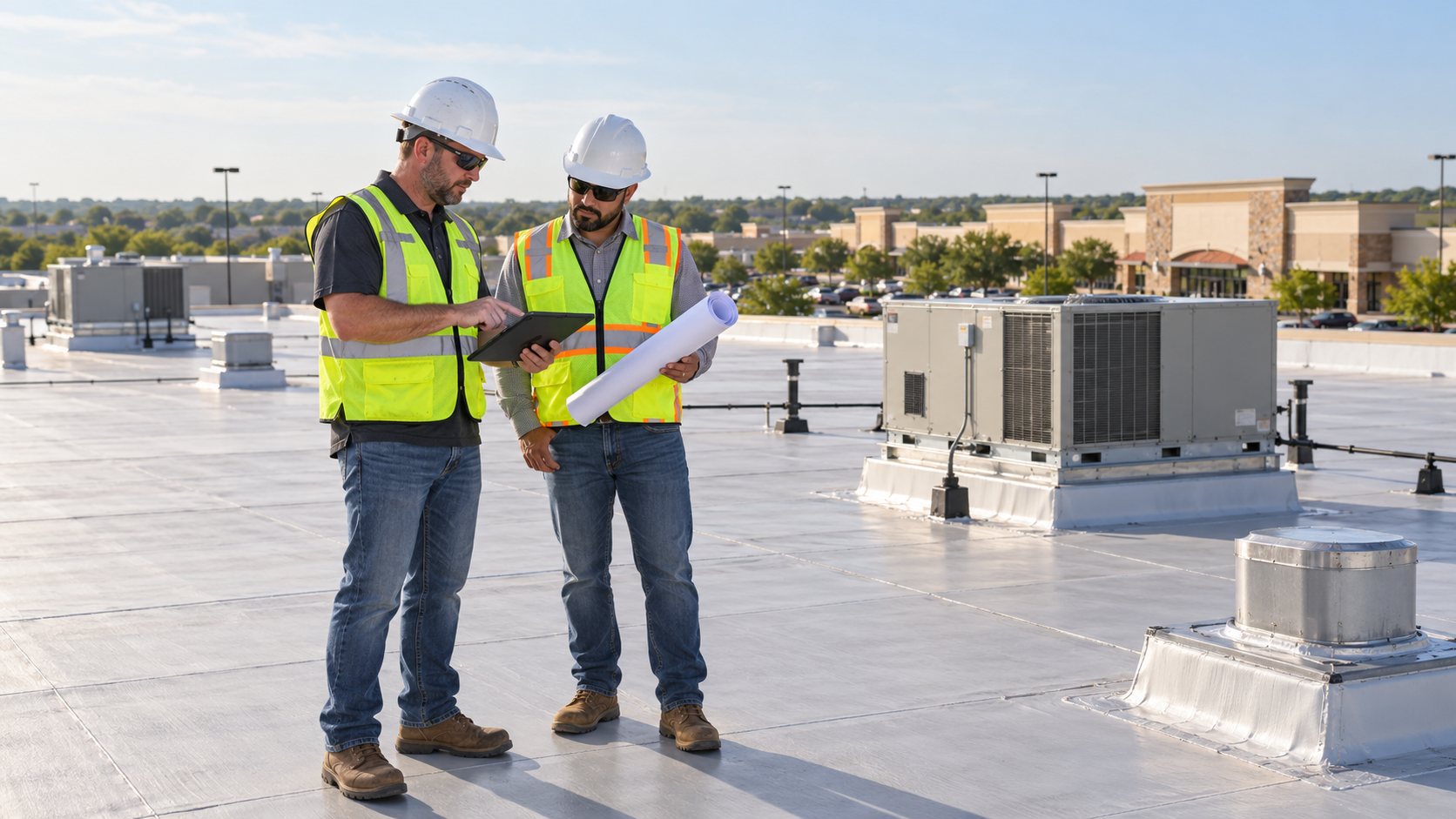
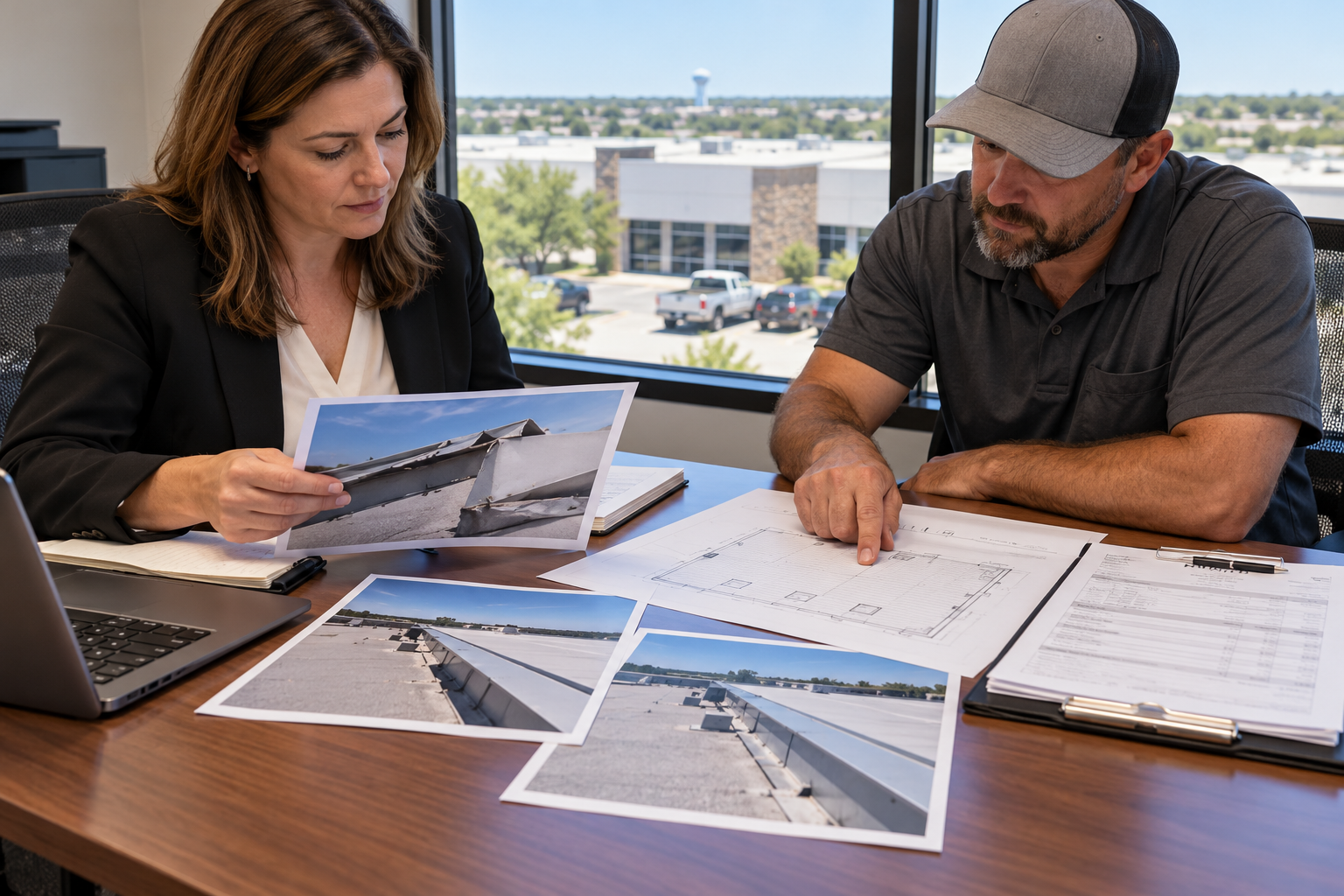
A Texas property owner and roofing project manager review the written scope, roof plans, inspection photographs, safety plan, and material options.
Image alt text: Texas commercial asset manager reviewing a multi-building roofing plan, schedule, inspection evidence, and material samples.
8. Ask How the Contractor Manages Texas Weather
Weather planning is a construction control, not a casual promise. Ask who monitors forecasts, what conditions stop work, how much roof can be opened daily, how temporary tie-ins are installed, where materials are stored, and what happens if unexpected rain or wind arrives.
On commercial projects, daily work limits should reflect the crew, assembly, building risk, and ability to achieve a watertight condition. On residential projects, tear-off should be sequenced to protect the home and attic.
Heat also affects workers, adhesives, membranes, sealants, product storage, and installation windows. The contractor should follow product requirements rather than applying materials outside acceptable conditions simply to maintain schedule.
9. Look for Evidence-Based Recommendations
The best contractor does not begin with a predetermined sale. It explains whether the roof needs maintenance, repair, restoration, recover, retrofit, or replacement and why.
A localized repair may be appropriate when the defect is isolated and surrounding materials remain serviceable. Restoration can be appropriate when the substrate is compatible, attachment is sound, moisture is limited, and details can be corrected. Recover may reduce disruption when code, deck capacity, moisture, existing layers, and system design allow it. Replacement becomes more reasonable when damage or deterioration is widespread, insulation is broadly wet, decking is compromised, attachment is uncertain, materials are no longer repairable, or repeated failures make continued patching uneconomical.
The recommendation should connect observed conditions to the scope. Beware of both extremes: a salesperson who declares every roof needs replacement and a low bidder who proposes coating or patching without investigating underlying conditions.
10. Treat Aging Gravel-Surfaced BUR as a Serious Risk
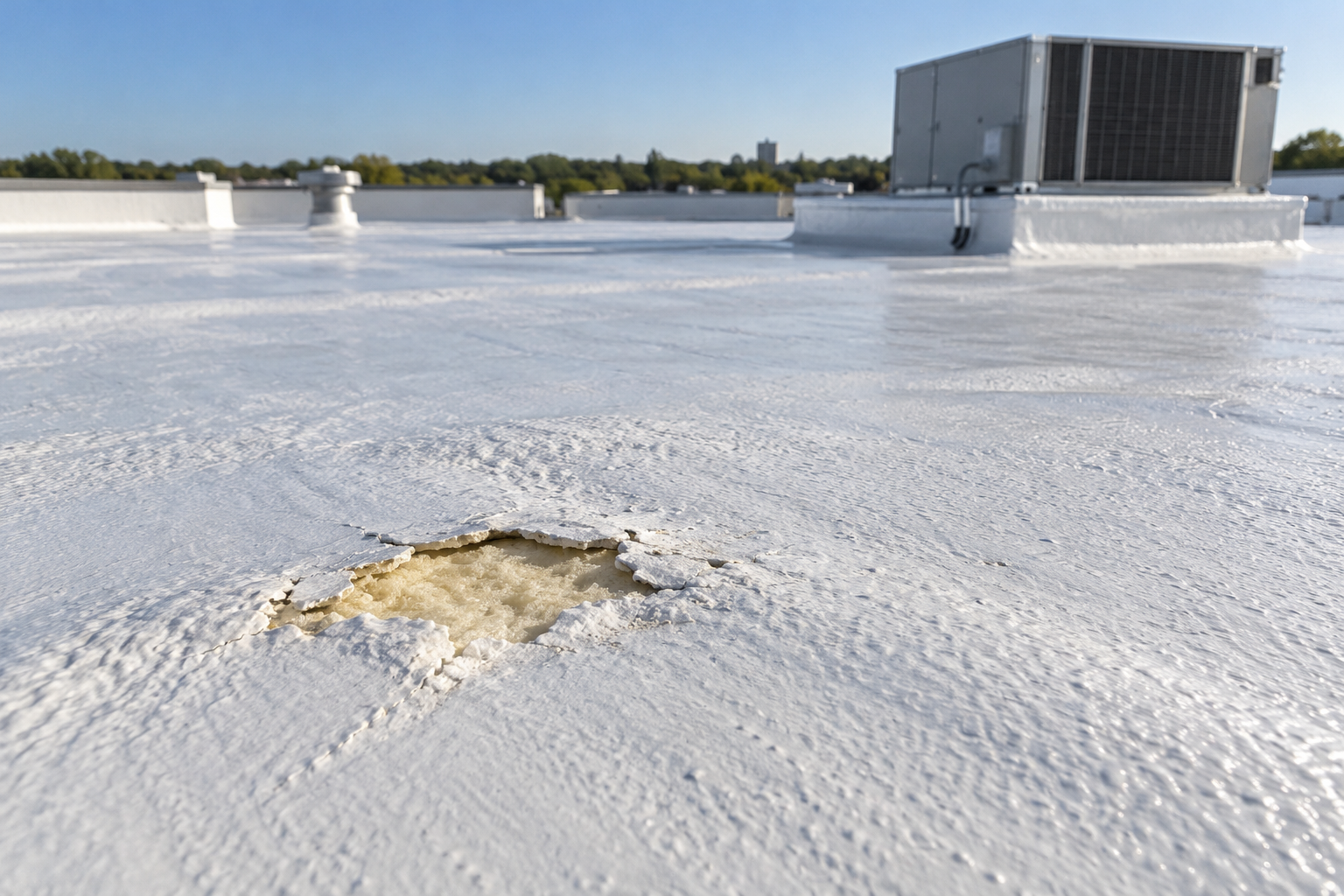
Built-up roofing with gravel surfacing is a major focus for Showtime Exteriors’ commercial campaign because aging gravel roofs can be difficult to evaluate, maintain, and insure. Gravel may conceal membrane splits, blisters, deteriorated flashings, old patches, displaced surfacing, and moisture below the visible surface.
Some insurance carriers are increasing scrutiny, limiting terms, raising pricing, or declining renewal for properties with aging gravel-surfaced BUR systems. Carrier decisions vary, and no roofer can guarantee a particular underwriting result.
A qualified contractor should not portray gravel as proof that the underlying membrane is sound. It should identify inspection limitations, review leak and repair history, consider moisture testing and authorized test cuts, document drainage, and develop a realistic capital plan.
When the roof is old, repeatedly leaking, extensively patched, broadly wet, or too concealed for a reliable condition assessment, planned replacement may offer a clearer long-term path than repeated emergency work. TPO, PVC, EPDM, modified bitumen, metal retrofit, or another system may be evaluated according to building conditions and project goals. The correct choice requires design and inspection—not a one-size-fits-all sales answer.
11. Review Commercial Project Management Capability
Commercial roofing succeeds or fails through coordination. Ask who serves as project manager and superintendent, how daily reports are delivered, how change orders are approved, how tenants are notified, and how unknown conditions are handled.
The contractor should plan:
mobilization and staging;
delivery and crane operations;
daily work zones;
interior protection;
noise, odor, dust, and vibration;
temporary shutdowns;
rooftop equipment and other trades;
access for occupants and emergency services;
weather response;
quality-control inspections;
manufacturer inspection; and
closeout.
Ask for reporting samples. A brief daily record with weather, crew, completed areas, photographs, exposed conditions, and next steps gives an owner visibility without requiring constant rooftop presence.
12. Verify Residential Property Protection
Residential work places crews close to families, vehicles, landscaping, siding, windows, outdoor equipment, and neighboring homes. Ask how the contractor will protect these areas and control nails and debris.
Discuss delivery placement, driveway loads, access, pets, attic dust, vibration, satellite equipment, solar panels, pools, gates, irrigation, and work hours. Move fragile items from walls and ceilings when advised. Establish a contact for questions during construction.
At completion, inspect the property together. Confirm gutters, flashing, vents, cleanup, leftover materials, and warranty documents.
13. Understand Manufacturer and Workmanship Warranties
Product warranties and contractor workmanship warranties are not the same. Ask who provides each warranty, what it covers, what it excludes, how long it lasts, whether registration is required, and who handles a future service call.
For commercial systems, ask whether the proposal includes a manufacturer inspection or system warranty, what wind speed or configuration is covered, how ponding or consequential damages are treated, and which maintenance duties remain with the owner.
For residential systems, ask about product eligibility, installation requirements, ventilation, transferability, algae or impact-resistant provisions, and the contractor’s labor coverage.
No warranty replaces maintenance. Preserve the final scope, invoices, photographs, permits, product information, and warranty registration.
14. Compare References That Match Your Project
Online reviews provide useful context but should not be the only evidence. Ask for references involving similar roofing, size, occupancy, and complexity. A relevant commercial reference can discuss phasing, communication, change management, safety, and warranty response. A residential reference can discuss property protection, schedule, cleanup, and follow-up.
Ask references:
Was the scope clear?
Did the project start and finish as communicated?
How were changes handled?
Was the site protected and cleaned?
Did the roof perform afterward?
How did the contractor respond to a concern?
Would you hire the company again?
The response to a problem may reveal more than a perfect project story.
15. Evaluate Communication Quality
Good communication is specific, documented, and consistent. Before signing, note whether the contractor answers technical questions, explains limitations, follows up in writing, and avoids pressure.
Identify one owner representative and one contractor contact. Establish how emergency issues, daily updates, schedule changes, material selections, and change orders will be communicated.
If the sales process is disorganized, the construction process rarely becomes magically organized after the contract is signed.
16. Know the Rules for Insurance-Related Roofing Work
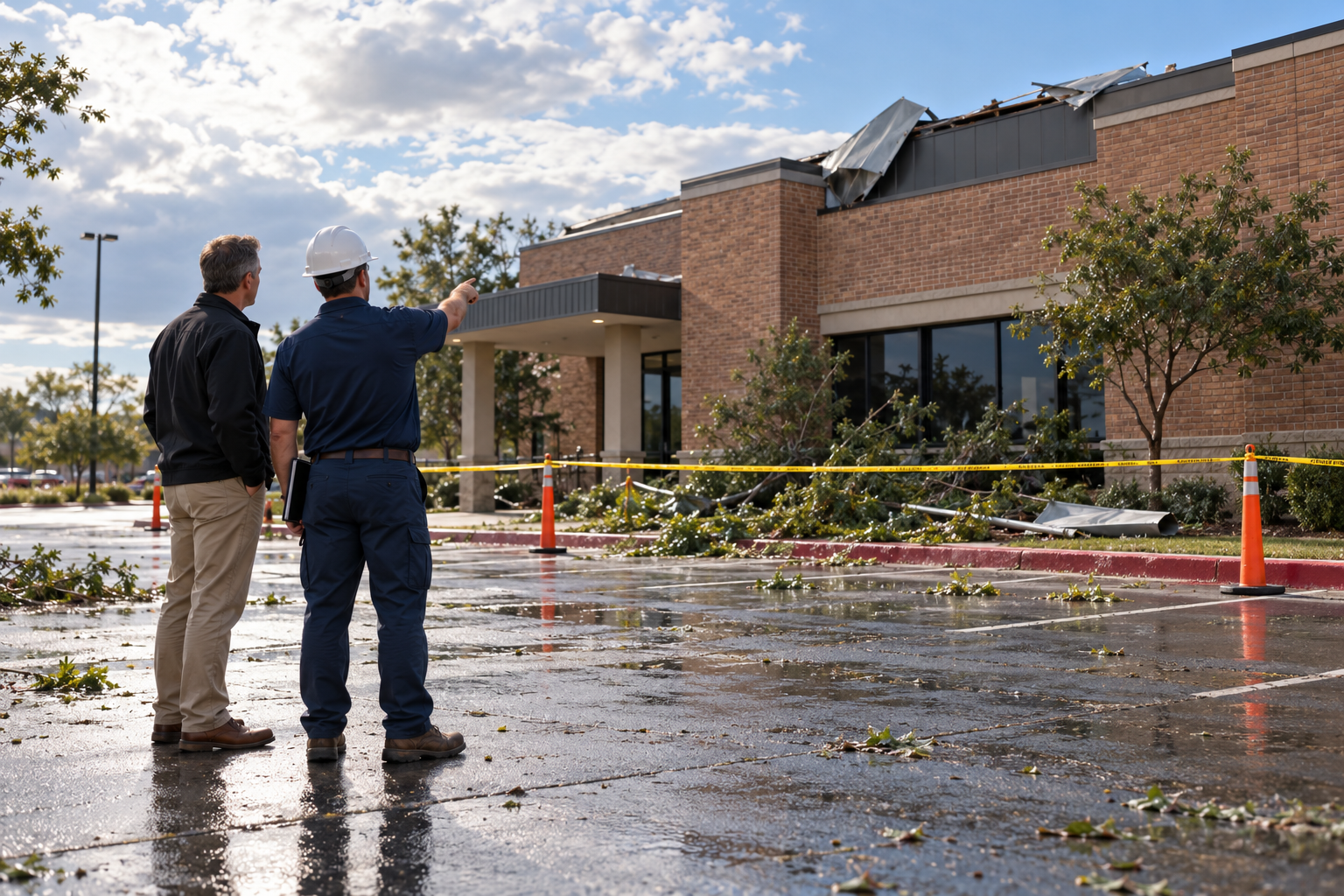
After hail or wind, a contractor can inspect physical conditions, document damage, provide an estimate, explain construction, attend an inspection to identify roof details, and perform authorized work. It should not promise coverage, determine what the carrier owes, or act as a public adjuster on a project where it may provide roofing services.
Texas law prohibits contractors from offering to waive, absorb, rebate, or help property owners avoid paying a required insurance deductible. A “free roof” or deductible-covering offer is a legal and ethical red flag.
Ask the carrier or licensed insurance professional about coverage, depreciation, deadlines, deductibles, and payments. Ask the roofer about physical conditions, repairability, materials, installation, and cost. Keeping those roles clear protects everyone.
17. Review the Contract Before Signing
The contract should state the parties, property, scope, specifications, price or pricing method, payment schedule, deposit, allowances, exclusions, schedule, weather delays, permits, safety, protection, cleanup, change orders, warranties, cancellation terms when applicable, and dispute procedures.
Never sign blank documents or rely on promises that do not appear in the agreement. Ask who receives insurance checks, how lender involvement is handled, and when final payment is due.
Commercial owners should coordinate contract requirements with legal, risk, procurement, and facility teams. Residential owners should take time to read every page and ask questions before authorizing work.
18. Examine the Price—But Compare Value
A low price may reflect efficiency, or it may omit required work, use a different specification, underestimate quantities, exclude safety or access, or depend on change orders. A high price is not automatic proof of quality either.
Create a comparison table covering roof area, removal, deck assumptions, insulation, materials, attachment, flashings, edges, penetrations, drainage, equipment, permits, access, protection, disposal, warranty, and exclusions.
Use life-cycle value for commercial decisions. Consider energy, maintenance, disruption, serviceability, expected life, warranty, and future recover or replacement options. For residential work, consider product quality, installation details, ventilation, property protection, cleanup, and warranty response.
19. Ask How Unknown Conditions Will Be Managed
Some conditions remain concealed until tear-off. Wet insulation, deteriorated decking, multiple roof layers, abandoned openings, undocumented patches, or incompatible materials may appear.
The contract should explain allowances and unit prices where appropriate. The contractor should stop, photograph, measure, notify the owner, and receive authorization before material additional work. Commercial owners may also require consultant, manufacturer, engineer, or carrier review.
Transparent change management prevents a necessary discovery from becoming a financial surprise.
20. Require Quality Control During Installation
Quality cannot be inspected into a finished roof if critical details were concealed during construction. Ask who checks substrate preparation, fastener patterns, adhesive coverage, seam welds, flashing dimensions, edge securement, shingle nailing, underlayment, ventilation, penetrations, and daily tie-ins.
Commercial projects may use test welds, seam probes, pull tests, adhesion tests, manufacturer inspections, moisture verification, or consultant observations as appropriate. Residential projects benefit from installation photographs before details are covered.
The project manager should document deviations and corrections. Final appearance matters, but concealed workmanship determines much of the roof’s performance.
21. Expect a Complete Closeout Package
At the end of the project, collect:
signed contract and final scope;
approved change orders;
final invoice and payment records;
permits and inspection approvals;
before, during, and after photographs;
material and color records;
product and workmanship warranties;
manufacturer inspection or warranty documents;
roof plan and repaired-area map;
maintenance instructions;
lien releases where appropriate; and
service and emergency contacts.
For insurance-related work, preserve proof of deductible payment and documents requested by the carrier. The contractor can provide construction evidence but cannot guarantee release of depreciation or another insurance payment.
22. Evaluate Service After the Sale
Ask how leaks, warranty questions, storm inspections, and maintenance requests are handled after completion. Who receives the call? What response time is realistic? What information should the owner provide?
Commercial owners should schedule regular inspections, clean drainage, control rooftop traffic, and document other trades. Homeowners should inspect from the ground after major storms, maintain trees and gutters, and report concerns promptly.
A contractor interested only in installation day is less valuable than one prepared to support the roof as a long-term asset.
Red Flags When Hiring a Roofer
Walk away or investigate further when a company:
promises a “free roof” or deductible waiver;
guarantees insurance approval or payment;
pressures immediate signature before inspection;
asks you to sign blank forms;
provides no physical business information;
refuses to show insurance evidence;
cannot explain who performs the work;
gives only a one-line estimate;
recommends coating without moisture or substrate evaluation;
calls every roof storm-damaged;
cannot explain safety controls;
has no change-order process;
offers a warranty without written terms;
requests unusual payment without documentation; or
has no clear plan for permits, cleanup, or closeout.
Questions to Ask Every Roofing Contractor
Use the same questions for each candidate:
What is your legal business name and local address?
Can you provide current insurance evidence?
Who will supervise this project?
What experience do you have with this exact roof system?
What did your inspection find, and what remains unknown?
Can you provide a location-mapped report?
Why are you recommending repair, restoration, recover, retrofit, or replacement?
What is included and excluded from the written scope?
How will safety and property protection be managed?
How will weather and daily watertightness be handled?
Which permits and inspections apply?
How are hidden conditions and change orders handled?
Who provides the product and workmanship warranties?
Can you provide relevant project references?
What closeout records will I receive?
Who handles service after completion?
Why Consider Showtime Exteriors?
Showtime Exteriors provides one point of contact for a broad range of Texas roofing needs. Its Mansfield location serves the DFW Metroplex, and its services include residential roofing, residential insurance-related repair work, commercial roofing, inspections, repairs, replacement, and system evaluation.
For commercial owners, Showtime Exteriors can evaluate TPO, PVC, EPDM, modified bitumen, metal, coatings, and aging built-up systems. The company can help document conditions, identify urgent repairs, investigate practical options, and plan work around building operations.
For homeowners, the company can evaluate storm, age, fire, leak, and physical-damage concerns and provide repair or replacement recommendations based on observed conditions.
No contractor is automatically the best fit for every property. Showtime Exteriors earns consideration by combining a Texas presence with residential and commercial capabilities and a documentation-focused process. Property owners should still review the specific inspection, proposed team, scope, insurance evidence, and contract for their project.
Frequently Asked Questions
Who is the best roofing contractor?
There is no objective company that is best for every project. The best choice is the qualified, insured, experienced contractor whose inspection, system knowledge, written scope, safety plan, price, warranty, and service fit the property.
Is the cheapest roofing estimate usually the best?
No. Compare scope, quantities, specifications, safety, access, warranties, exclusions, and project management. A low total may omit important work.
Should a contractor inspect before giving a price?
Yes. A useful proposal should follow an inspection and understanding of the building, roof system, access, details, and visible conditions. Some concealed work may remain an allowance.
Can a Texas roofer waive an insurance deductible?
No. Texas law prohibits contractors from waiving, absorbing, rebating, or helping a policyholder avoid a required property insurance deductible.
Can a roofer guarantee an insurance claim?
No. The carrier determines coverage and payment under the policy. A roofer documents physical conditions and provides a construction scope.
What commercial roofing systems should a contractor understand?
That depends on the property, but common systems include TPO, PVC, EPDM, modified bitumen, built-up roofing, metal, coatings, and retrofit assemblies.
Why is an aging gravel BUR a concern?
Gravel can conceal the membrane, deterioration, patches, and moisture, making condition assessment and maintenance harder. Older systems may also face increased insurance scrutiny.
How many estimates should I get?
There is no universal number. Obtain enough qualified proposals to understand the market and scope, then compare them on equal specifications rather than price alone.
What warranty should a roofing contractor provide?
Ask for written product and workmanship terms, exclusions, duration, registration, transferability, maintenance duties, and service procedures. The appropriate warranty depends on the system and project.
Does Showtime Exteriors handle residential and commercial work?
Yes. Showtime Exteriors serves Texas residential and commercial customers from Mansfield and provides roof assessment, repair, and replacement services.
Roofing Contractor Selection Checklist
Before signing, confirm:
permanent local identity and contacts;
verified insurance;
relevant roof-system experience;
objective inspection and mapped photographs;
complete written scope and specifications;
clear price, allowances, and exclusions;
safety and property-protection plans;
weather and daily tie-in procedures;
permits and code responsibilities;
project manager and communication process;
relevant references;
transparent insurance-claim boundaries;
no deductible-waiver offer;
product and workmanship warranty terms;
documented change-order procedure;
quality-control plan;
cleanup and final inspection; and
complete closeout and service contacts.
Schedule an Inspection With Showtime Exteriors
Choosing the best roofing contractor begins with a professional assessment and written plan. The contractor should explain the observed conditions, available roofing options, proposed scope, and next step.
Showtime Exteriors serves residential customers throughout North Texas and commercial property owners across Texas. Call 817-400-ROOF (7663) to schedule an inspection and compare the findings, scope, statewide capabilities, and service approach for yourself.
Related Showtime Exteriors Resources
Use these pages to review services and request an inspection.
Visit the Showtime Exteriors home page for company and service-area information.
Authoritative External Resources
These independent resources provide additional contractor-selection and consumer guidance.
Review the NRCA contractor-selection guidance before comparing proposals.
Texas Roofing Contractors Association: Residential Advice
Texas Department of Insurance: Roofing and Insurance—Know the Law
FORTIFIED: How to Select a Roofing Contractor
Editorial disclaimer: This educational guide is not a universal ranking, guarantee, or legal, engineering, insurance, or public-adjusting advice. Verify each contractor and project scope. Insurers determine coverage and payment; Showtime Exteriors evaluates roof conditions and performs roofing work.
817-400-ROOF (7663) showtimeexteriors.com