



Can Missing Shingles After a Storm Be Repaired, or Is Replacement Necessary?
How Texas property owners can evaluate storm damage, compare roofing options, and make an informed decision.

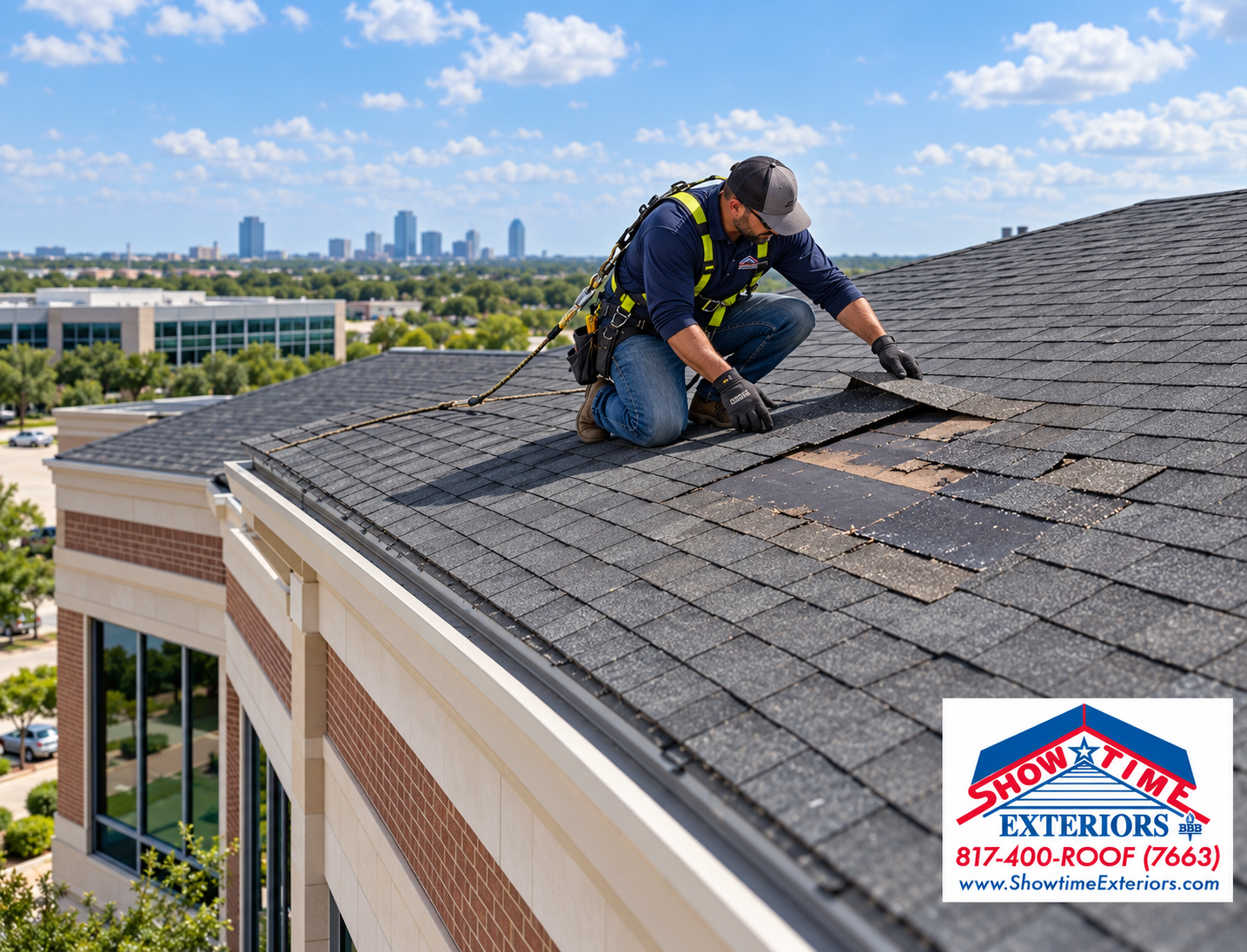
Missing shingles can often be repaired when the damage is localized and the surrounding roofing can support a proper repair. Replacement becomes a stronger consideration when damage is widespread, the existing materials cannot be repaired reliably, or other roof components require extensive work.
The number of shingles on the ground does not answer the question by itself. A few missing shingles may be part of a limited problem—or the most visible evidence of a larger one.
The practical question is whether the proposed work can restore the affected roof’s function without leaving unresolved conditions behind.
GAF’s guidance recognizes that individual damaged shingles can sometimes be replaced, while significant damage may require reroofing. It recommends professional evaluation to determine the necessary scope. gaf.com
For Texas property owners, that evaluation should also address documentation, material compatibility, repair costs, insurance requirements, and the consequences of delaying protection.
This guide focuses on asphalt shingle roofs, including those on private offices, retail buildings, apartment properties, and other commercial buildings with sloped roofing.
Why Missing Shingles Deserve Prompt Attention
An asphalt shingle roof depends on overlapping components working together. A missing section interrupts that arrangement.
Even when the opening appears small, it deserves evaluation. GAF notes that lifted or missing shingles can allow moisture beneath the roofing and potentially affect the roof deck. gaf.com
That does not mean every missing shingle has already caused interior damage. It means you should establish the condition rather than assume the roof is protected because the ceiling remains dry.
A property owner should arrange an inspection promptly and describe any active water entry when requesting service. There is no universal period during which every damaged roof can safely remain exposed.
If water is entering, the immediate conversation should include temporary protection. The permanent repair decision can follow a more complete assessment.
Keep people away from rooms with sagging ceilings, falling materials, or water near electrical equipment. Owners and employees should document safe interior and ground-level observations while qualified professionals handle roof access.
Urgency should guide the response without forcing a premature conclusion that the entire roof needs replacement.
What Should a Roofer Evaluate?
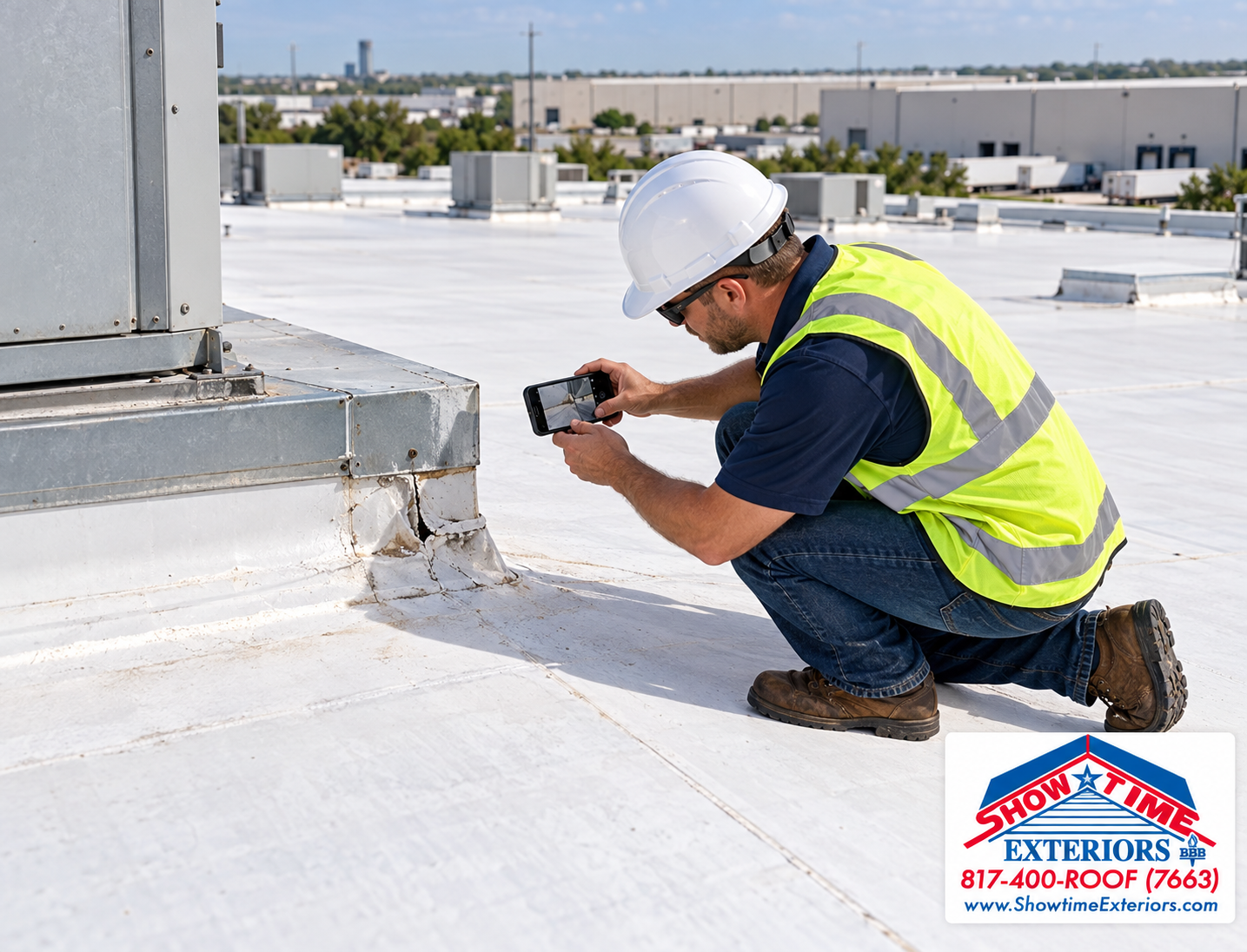
A useful inspection goes beyond identifying the visibly empty spaces.
Ask the contractor to explain the condition of the affected area, the surrounding roofing, and the relevant roof details. The report should connect observations to the recommended work.
The location and distribution of damage
Are the missing shingles concentrated in one location, scattered across several slopes, or associated with roof edges and transitions?
A roof map helps distinguish a limited repair area from a broader pattern. It also makes the estimate easier to review.
The condition of surrounding materials
Can adjacent shingles remain in service? Can the proposed repair be completed without leaving additional damage?
The contractor should explain the basis for that assessment rather than simply calling the roof “too old” or “easy to patch.”
The condition beneath the missing shingles
What is visible beneath the opening? Is further inspection needed to evaluate underlying components?
If parts of the assembly remain concealed, the report should identify that limitation.
Other affected roof components
Ask whether the inspection identified concerns at flashing, ridges, edges, penetrations, or transitions.
A missing-shingle repair may not address every observed roof problem.
The available replacement material
What product is proposed? How will the contractor determine whether it is suitable for the existing roof?
Material selection should be part of the assessment, not a decision deferred until workers arrive.
When a Localized Repair May Be Appropriate
A localized repair is worth considering when the inspection supports a clearly defined, technically workable scope.
The contractor should be able to explain where the repair begins and ends, what materials are involved, and how the work will integrate with the remaining roof.
For an owner comparing options, useful questions include:
- Is the observed damage confined to a manageable area?
- What condition is the surrounding roofing in?
- Can suitable replacement materials be obtained?
- Are underlying repairs required?
- What other roof concerns remain after this work?
- What limitations or follow-up needs should be expected?
These are evaluation questions, not a universal approval checklist. A contractor must assess the actual roof.
A well-supported repair recommendation might identify one affected roof section, document the relevant conditions, specify the replacement material, and describe the work needed around it.
The estimate should also distinguish the repair from unrelated maintenance.
A localized repair can be a sensible investment when it addresses the documented problem and fits the owner’s plans for the property. It should not be dismissed merely because replacement would produce a larger project.
At the same time, a small-looking patch should not be accepted without an explanation of how it will perform.
When Replacing One Roof Slope May Be Considered
The options are not always limited to replacing a few shingles or replacing the whole roof.
A roof slope—also called a roof plane—may sometimes be the appropriate area of work.
GAF’s technical bulletin states that replacement of a damaged roof plane may be possible when damage is confined to that plane. The same bulletin cautions that surrounding storm damage can be difficult to assess and describes repair requirements for disturbed adjacent shingles. gaf.com
A slope-level proposal should answer several practical questions:
- Why does the scope include this entire slope?
- What conditions were documented on the other slopes?
- How will the work connect at the ridge, valley, or adjoining roof section?
- Which associated components are included?
- What appearance differences may remain?
- What warranty applies to the completed work?
Ask the contractor to show the proposed boundary on photographs or a roof diagram.
If the recommendation changes from a spot repair to a full slope, request the reason in writing. The explanation may involve the condition of surrounding materials, the distribution of damage, or the practical requirements of completing the work.
The recommendation should follow the findings rather than a predetermined rule.
When Full Replacement Deserves Consideration
Full replacement becomes a more substantial option when the assessment identifies concerns that extend beyond a practical localized repair.
Examples of findings that warrant discussion include damage documented across multiple roof sections, extensive underlying work, or a proposed repair that would leave significant unresolved conditions.
Ask the contractor to explain the connection between each finding and the replacement recommendation.
“Your roof needs replacement” should lead to a discussion of evidence:
- Which slopes were inspected?
- What was observed on each?
- What photographs support the findings?
- Why would a smaller scope be insufficient?
- Which existing components can remain?
- What concealed conditions could affect the project?
Age can inform the conversation, but age alone does not explain a storm repair scope.
Similarly, a roof’s appearance from the parking lot is not a complete condition assessment.
A property owner may also choose replacement for reasons beyond the immediate storm damage, such as coordinating a planned renovation or avoiding a short-term repair before an already scheduled reroofing project.
Keep those ownership decisions separate from the documented storm scope. A voluntary improvement and a covered repair expense are not automatically the same thing.
Repair, Partial Replacement, or Full Replacement?
Use this table to organize the discussion with your contractor.
OptionWhat the assessment should establishWhat to clarify before approvalLocalized repairA defined area can be addressed with suitable materials and methodsBoundaries, surrounding conditions, materials, limitationsSlope replacementThe scope appropriately includes one roof planeTransitions, adjoining areas, accessories, appearanceFull replacementThe findings or ownership objectives support broader workTear-off scope, underlying work, complete system, costTemporary protectionImmediate protection is needed while evaluation continuesMethod, documentation, monitoring, next steps
This is a decision aid, not a substitute for inspection.
The best proposal makes the recommended option understandable and identifies what remains uncertain.
Why Counting Missing Shingles Is Not Enough
Owners often begin with a simple question: “There are only a few shingles missing. Why would this be a major repair?”
The answer should come from the inspection.
A count does not establish the condition of adjacent shingles, the roof beneath the opening, or other affected details.
Likewise, finding numerous shingles on the ground does not establish exactly where every piece came from or whether every roof section requires replacement.
Ask for location-based documentation rather than a dramatic total.
For example, a report might identify missing shingles on the west slope, document separate concerns at a nearby roof detail, and record the condition of the remaining slopes.
That is more useful than “storm damage everywhere.”
The contractor should also distinguish observed damage from areas that were inaccessible or concealed.
If the evaluation was limited, ask what additional work is needed before making the permanent decision.
Material Compatibility Matters
Choosing a replacement shingle involves more than selecting a similar shade of gray.
Ask the contractor to identify the existing product as accurately as possible and explain the proposed replacement.
Useful information may come from prior invoices, installation records, packaging, maintenance files, or an appropriate material identification process.
If the original product cannot be confirmed, record that uncertainty.
Questions to ask include:
- What product is currently installed?
- What replacement product is proposed?
- What supports its suitability for this repair?
- Are there relevant manufacturer instructions?
- Is the proposed product readily available?
- Will the repair have a visible appearance difference?
Avoid treating a product described as “close enough” as a complete technical explanation.
For a commercial property, preserve the product information in the building’s roof records. Future owners and maintenance teams may need to understand what was installed and where.
If a material substitution is proposed after authorization, request an explanation before it is used whenever circumstances allow.
What If the Original Shingle Is Discontinued?
A discontinued product creates an additional question to investigate. It does not, by itself, prove that every roof must be fully replaced.
Ask for written information about the existing product, its availability, and the proposed alternatives.
Keep two questions distinct:
Can a suitable repair be completed?
This concerns the physical roofing work and the compatibility of the proposed material.
How will the repair look?
This concerns color, weathering, and visual consistency.
Both can matter to an owner, but they require different evidence.
If the contractor recommends a larger scope because of material availability, ask how that issue affects the proposed repair. Is the concern appearance, technical compatibility, or both?
A documented explanation is more useful than a broad claim that “discontinued means replacement.”
If insurance is involved, ask the insurer how the policy addresses the specific circumstances. Do not assume that a contractor’s material finding automatically determines payment.
Does a Color Mismatch Require Insurance to Replace the Whole Roof?
Do not assume so.
The Texas Department of Insurance states that an insurer might not pay to replace an entire roof when only part is damaged, even if new shingles do not perfectly match the old ones. The actual policy and claim circumstances matter. tdi.texas.gov
That makes documentation important.
Ask the contractor to explain whether the concern is a visual difference or a problem that prevents a suitable repair. Ask the insurer for the policy basis of its position.
For a private commercial building, the owner may have appearance standards, lease obligations, or brand considerations that affect the preferred solution.
Those requirements should be identified early. They may influence the owner’s decision even when insurance does not fund the entire preferred scope.
Keep the discussion specific. A sample comparison, product identification, and written explanation can help more than a general statement about “matching rules.”
If a coverage dispute develops, seek appropriately qualified advice.
How Roof Age Should Influence the Decision
Roof age is useful background information.
Collect the installation date if available, along with records of prior repairs, inspections, and product warranties.
However, the contractor should evaluate the actual condition. Two roofs of the same age may have different histories and different repair needs.
Ask:
“What observed conditions make repair appropriate or inappropriate on this roof?”
If replacement is recommended primarily as an ownership investment, discuss that openly.
An owner planning to replace the roof during an upcoming renovation may decide that additional repair spending offers limited value. Another owner may have a documented localized problem and a practical reason to repair it.
Neither decision should be disguised as an automatic insurance requirement.
The financial comparison should identify the expected purpose of each option, the limitations, and the unresolved risks.
Do not accept unsupported promises that a repair will add a fixed number of years to the roof’s life.
Temporary Protection Is a Separate Decision
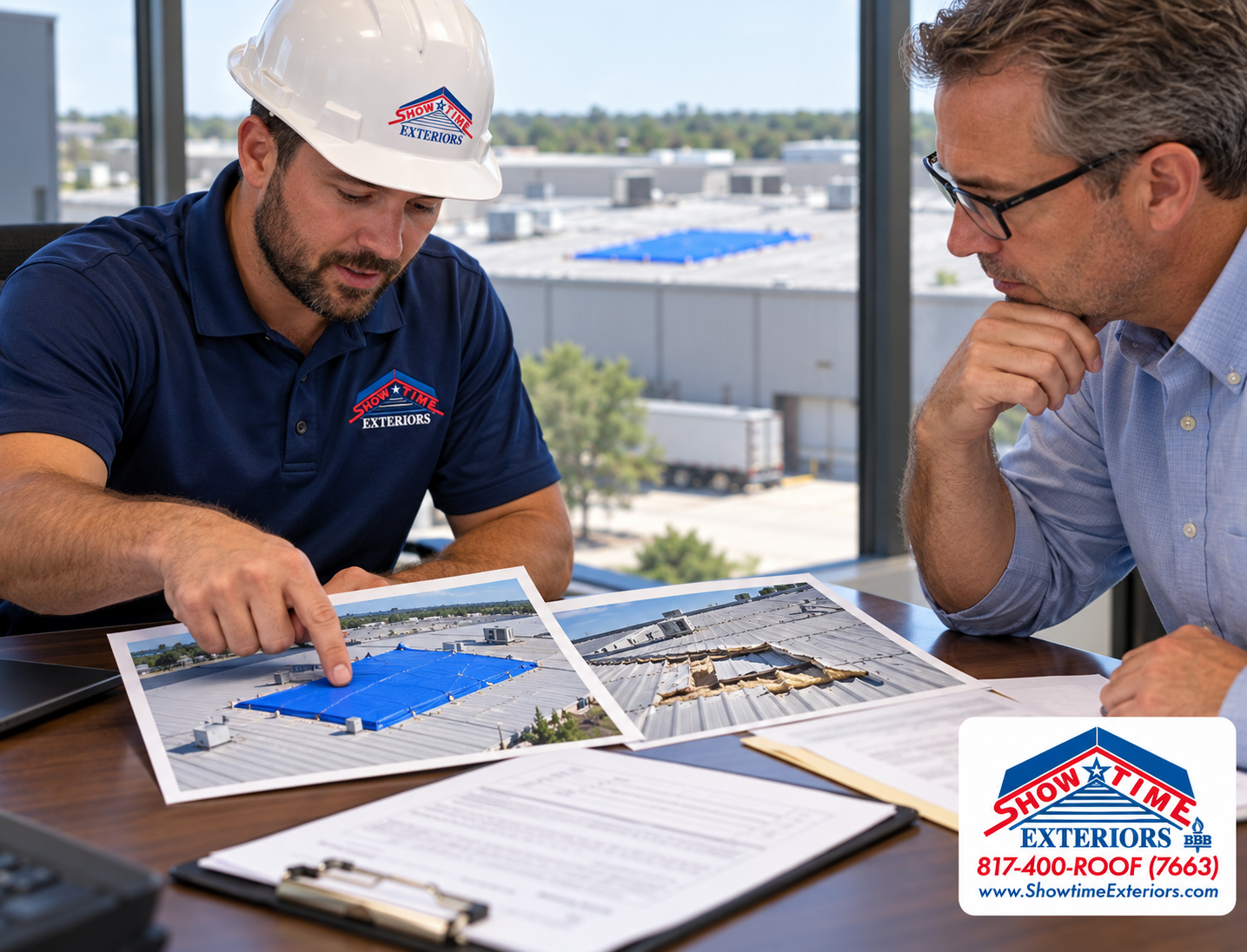
An urgent opening may require protection before everyone agrees on the permanent scope.
Ask the contractor which temporary method is appropriate for the roof and what monitoring is needed.
Document conditions before the area is covered when safe and practical. Obtain photographs of the completed temporary work and an itemized invoice.
Temporary protection should remain distinct from permanent restoration.
GAF’s technical bulletin specifically warns that nails driven through shingles to secure a tarp damage those shingles and that caulking those holes is not a permanent repair. Ask the contractor to account for any affected materials in the later scope. gaf.com
Do not remove temporary protection yourself to obtain better photographs or expose the building while waiting for a decision.
Coordinate any necessary inspection beneath the covering with qualified professionals.
Keep follow-up records if the protection is adjusted, replaced, or removed.
What Documentation Should You Collect?
A clear record supports both the roofing decision and any insurance review.
Start with safe observations and add the contractor’s findings.
Photographs
Collect building overviews, roof-section views, and close-ups that can be linked to a location.
Ask for before, during, and after photographs when work is performed.
Roof diagram
Use a simple diagram to identify slopes, damaged areas, penetrations, and proposed repair boundaries.
It does not need to be elaborate to be useful.
Inspection report
Request observed conditions, recommended work, and inspection limitations.
The report should distinguish facts from assumptions.
Prior records
Preserve installation documents, maintenance reports, earlier photographs, and repair invoices.
These records can provide context for the current findings.
Expense records
Keep emergency scopes, estimates, invoices, and payment records together.
Label separate services clearly.
Communication
Save relevant messages with contractors, the insurer, property management, and tenants.
A timeline helps explain what happened and when.
Keep original image files. Use annotated copies for explanation rather than altering the originals.
How Insurance Fits Into the Roofing Decision
There are two related decisions:
- What physical work does the roof need?
- What will the insurance policy pay for?
Those decisions may overlap, but they are not interchangeable.
The contractor should support the physical scope with findings, photographs, measurements, and an estimate.
The insurer evaluates coverage and payment under the policy.
Ask your agent or insurer about the applicable deductible, valuation provisions, endorsements, and claim requirements. Commercial policies can differ from homeowners policies.
TDI also notes that insurance does not pay for a new roof simply because the existing roof is old or worn out. tdi.texas.gov
If the insurer approves a smaller scope than the contractor recommends, ask both parties to identify the specific disagreement.
Is it about the extent of observed damage? Material suitability? An omitted component? Coverage?
A precise question creates a better opportunity for review than a general demand for replacement.
Do not assume a contractor can guarantee approval or act as your insurance representative. Texas places restrictions on contractors acting as public adjusters on properties where they provide or may provide contracting services. tdi.texas.gov
What Should a Repair Estimate Include?
A repair estimate should describe a completed result.
Ask for enough detail to understand the work and compare proposals.
Relevant items may include:
- Property address and affected roof location.
- Removal and replacement scope.
- Proposed products.
- Associated roof components.
- Underlying work included or excluded.
- Access arrangements.
- Cleanup and disposal.
- Documentation.
- Price and payment terms.
- Warranty information.
Ask how additional concealed conditions will be handled.
For example, if underlying damage is discovered during removal, who will receive photographs, approve additional work, and receive the revised price?
Avoid an estimate that leaves all important details to be decided after the roof is opened.
A smaller project can still have a clear written scope.
What Should a Replacement Estimate Include?
A replacement proposal should make the roof system and project boundaries understandable.
Ask whether the scope includes removal of existing materials, evaluation of the roof deck, associated components, flashing work, disposal, and cleanup.
The contractor should explain what is included and what requires separate authorization.
For commercial buildings, also discuss:
- Tenant access.
- Deliveries.
- Parking and staging.
- Interior protection.
- Work around rooftop equipment.
- Communication during the project.
- Response to unexpected weather.
Review warranty documents before selecting a proposal. Ask which coverage comes from the contractor and which comes from the manufacturer.
Do not assume that a manufacturer warranty covers every workmanship issue or every future storm.
Confirm product and installation requirements for the proposed system rather than relying on a broad statement that the roof is “fully warranted.”
How to Compare Costs Without Focusing Only on Price
Repair generally involves a smaller scope than replacement, but the lowest total is not automatically the best value.
Compare proposals that address the same documented problem.
If one estimate replaces missing shingles and another includes a damaged flashing detail, they are not directly comparable until the difference is understood.
Ask each contractor to explain:
- What the price includes.
- What remains unresolved.
- Which assumptions affect the price.
- What additional work may be needed.
- What warranty applies.
Avoid unsupported national price ranges when budgeting for a specific commercial property. Access, building configuration, scope, and materials can change the project substantially.
Request a property-specific estimate.
If insurance is involved, separate the construction price from the expected insurance payment and the owner’s financial responsibility.
Texas law prohibits contractors from offering to waive, rebate, or absorb a property policyholder’s deductible. tdi.texas.gov
Three Illustrative Decision Scenarios
These examples explain the process. They are not actual Showtime Exteriors projects or insurance outcomes.
Scenario 1: A defined localized problem
A private office building has missing shingles in one roof section.
The inspection documents that area, evaluates surrounding conditions, and identifies suitable replacement materials. The contractor provides a clear localized scope.
The owner can review repair as a practical option while asking what, if anything, remains outside the work.
Scenario 2: A broader concern on one slope
A building has visible missing shingles on one slope, with additional conditions documented nearby.
The contractor recommends replacing that slope and explains why a spot repair would be insufficient.
The owner should review the evidence, transitions, associated components, appearance, and condition of other slopes.
Scenario 3: Findings across the roof
A multi-tenant property has documented concerns on several slopes, prior repair history, and additional underlying questions.
The contractor recommends broader evaluation and replacement planning.
The owner should ask how each finding affects the recommendation, what remains uncertain, and how the project would protect occupied spaces.
The lesson is that similar-looking missing shingles can lead to different scopes once the actual conditions are evaluated.
Questions to Ask Before Approving the Work
Use these questions to make the recommendation concrete:
- What did you observe, and where?
- What photographs support those findings?
- What areas could not be inspected?
- Why is this scope appropriate?
- What would a smaller scope leave unresolved?
- What replacement material is proposed?
- How will adjacent roofing and transitions be handled?
- What temporary protection is needed?
- What could change the price?
- What warranty applies?
- What documentation will I receive?
- What follow-up should I plan?
If two contractors disagree, ask them to explain the difference using the same roof areas and records.
A second opinion is most useful when it addresses a specific unanswered question.
Common Mistakes to Avoid
Waiting for an interior leak
A dry ceiling does not establish the condition of the exposed roof area. Arrange evaluation.
Assuming every missing shingle means full replacement
Ask for evidence that supports the recommended scope.
Accepting a patch without material information
Identify the proposed product and the basis for its suitability.
Confusing appearance with repair feasibility
Document visual concerns and technical concerns separately.
Assuming insurance will fund the preferred option
Review the actual policy and insurer’s written position.
Letting emergency work become undocumented
Keep photographs, scopes, invoices, and completion records.
Approving work based only on a verbal explanation
Obtain a written scope that can be reviewed before and after completion.
Treating temporary protection as permanent repair
Continue inspection, monitoring, and permanent repair planning.
Frequently Asked Questions
Can one missing shingle be replaced?
Sometimes. A qualified contractor should assess the affected area, surrounding roofing, and suitable replacement material before defining the scope.
Can a roof be damaged without leaking?
Yes. An absence of visible interior water does not establish that the roof is undamaged.
Does an older roof automatically need replacement?
No. Age provides context, but the recommendation should address actual conditions and the owner’s objectives.
Does a discontinued shingle guarantee full replacement?
No. Material availability, repair feasibility, appearance, and insurance coverage require separate evaluation.
Can just one slope be replaced?
It may be possible. Ask the contractor to explain the boundaries, transitions, associated work, and condition of adjoining areas.
Should I climb onto the roof to inspect it?
Leave roof access to qualified professionals. Document safe ground-level and interior observations.
Will a repair look different?
It may. Discuss product selection, existing weathering, and appearance expectations before authorization.
What if the insurer and roofer disagree?
Identify the specific disputed issue and request supporting records. Seek qualified insurance or legal advice when the disagreement concerns coverage or rights.
Should I repair the roof before selling the building?
Arrange an assessment first. Review the condition, available options, documentation, and any transaction requirements with the relevant professionals.
What should happen after the work?
Obtain completion photographs, final scope information, invoices, product records, and applicable warranty documents. Add them to the property’s roof file.
Get a Roofing Recommendation You Can Evaluate
Missing shingles require attention, but the correct permanent solution depends on the roof.
A useful assessment explains what was observed, where the damage is located, which materials are suitable, and why repair or replacement is recommended.
For private commercial properties, it should also account for tenants, access, interior risks, and project planning.
Have missing shingles after a Texas storm? Contact Showtime Exteriors to discuss a roof assessment and your repair or replacement options.
Call [817-400-ROOF (7663) (line 8174007663)](tel:8174007663) or visit ShowtimeExteriors.com.