



How Quickly Should You Address Hidden Hail Damage?
A Practical Guide for Texas Commercial Property Owners

Address suspected hidden hail damage promptly by arranging a professional inspection as soon as safe access and scheduling allow. If you have active leaking, an exposed opening, loose materials, or another immediate hazard, prioritize appropriate protective assistance.
You do not need to wait for a ceiling stain before asking about your roof’s condition. You also should not assume that every hailstorm damaged the building or that every questionable mark requires replacement.
The right response begins with an evaluation.
For commercial property owners in Texas, that distinction matters. A warehouse may remain dry after a storm while an exterior concern still needs investigation. A restaurant may have several rooftop systems that require separate evaluation. A church or office building may have roof sections installed at different times.
“Hidden hail damage” describes a concern that is not readily apparent to the owner. It is not a diagnosis that can be made from a weather alert, a neighboring property’s damage, or a photograph alone.
A professional assessment should explain whether damage exists, what evidence supports the conclusion, which areas are affected, and what action is appropriate.
This guide explains how to set the response timeline, recognize reasons for an inspection, document observations, and move from uncertainty to a practical plan.
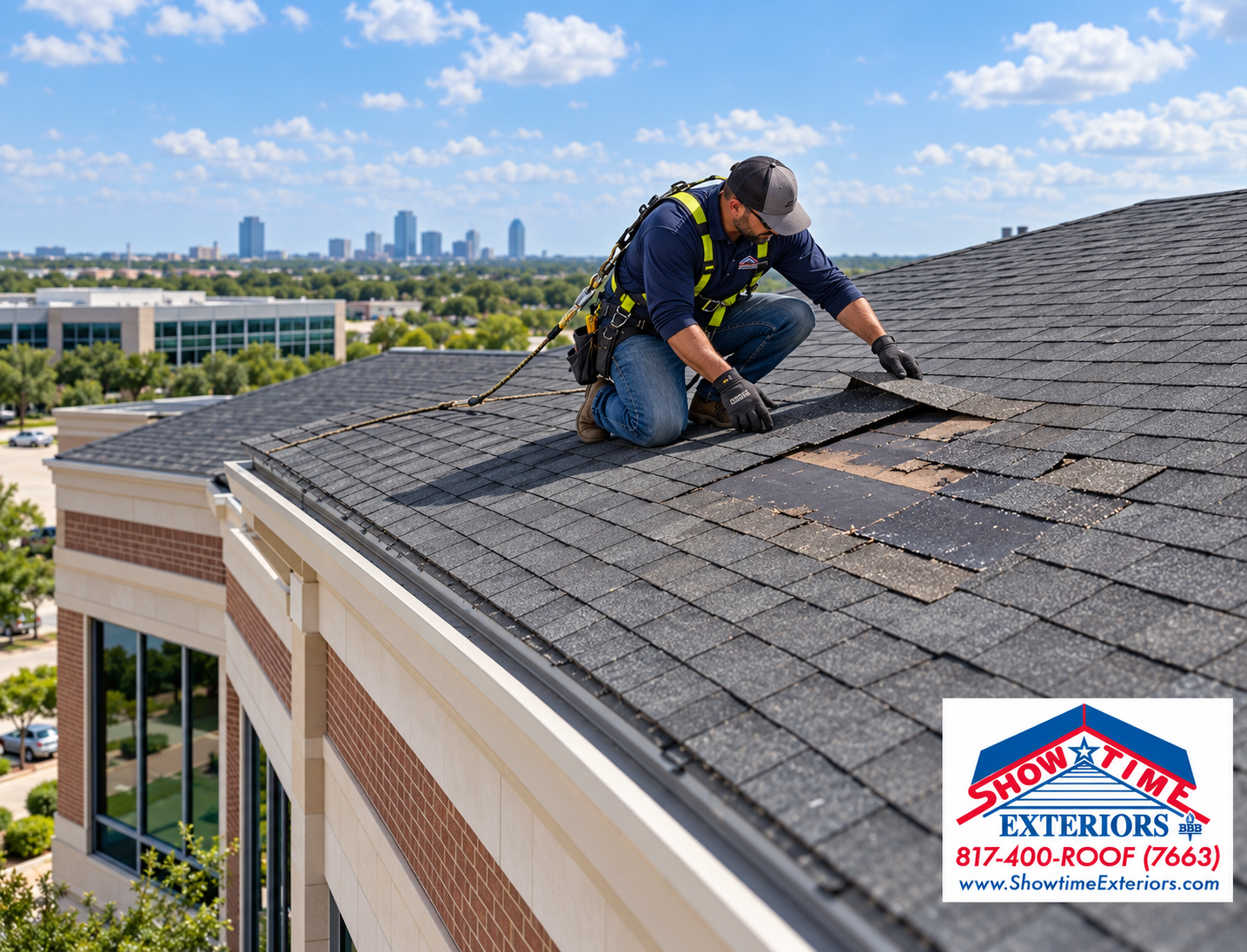
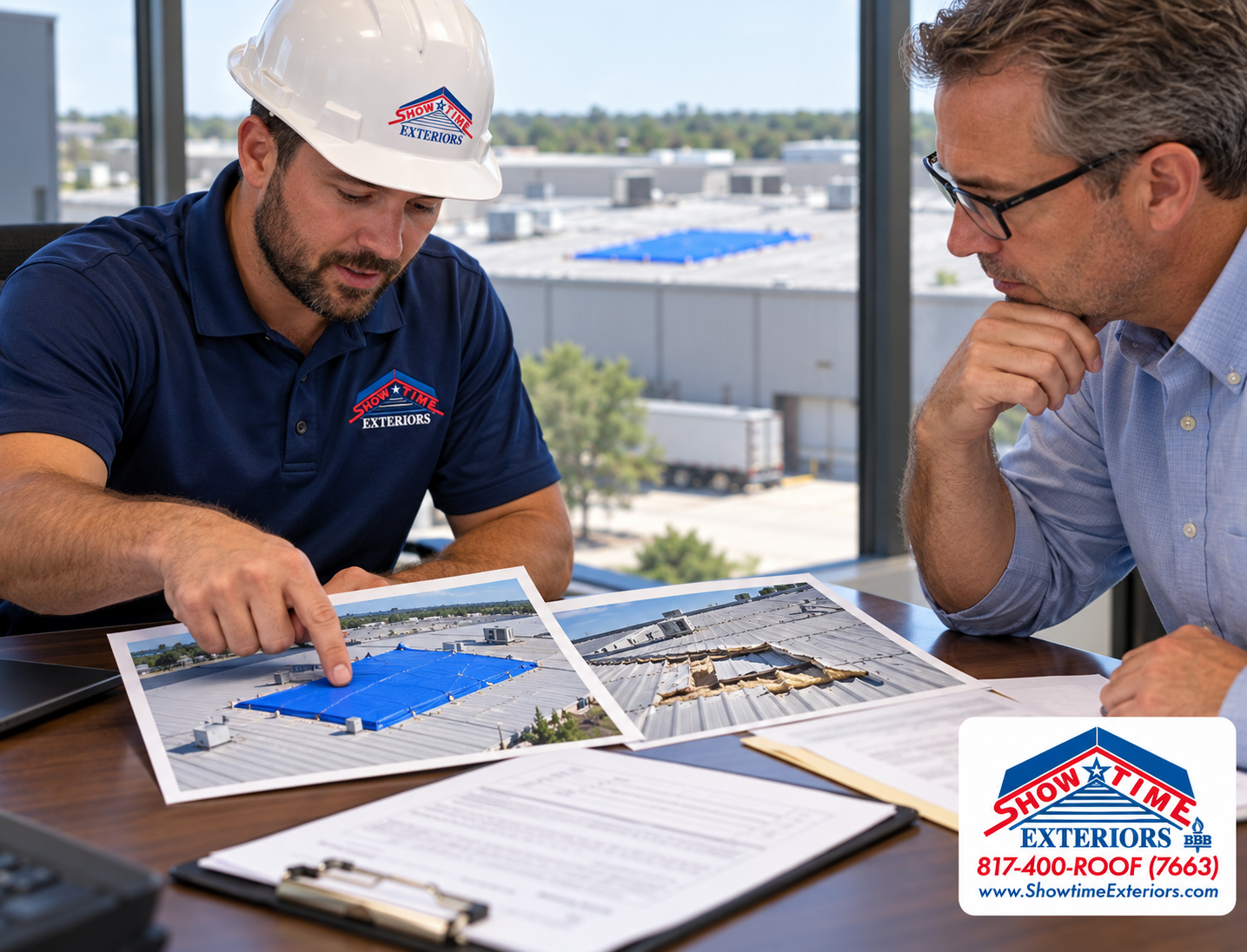
The two Showtime Exteriors images above are illustrative marketing artwork created for this article.
1. Separate Inspection Urgency From Repair Urgency
An inspection and a repair are different decisions.
You may need an inspection promptly because the roof’s condition is uncertain. The inspection may then identify an urgent protective need, a repair that can be scheduled, a question requiring further investigation, or no storm-related damage.
Do not commit to a permanent scope merely because you requested a post-storm visit.
Ask the contractor to explain the sequence:
- Assess immediate concerns.
- Document relevant conditions.
- Identify any necessary protection.
- Recommend further investigation or permanent work.
- Establish the next step.
This sequence helps an owner act without prematurely deciding the project’s size.
For example, a report may identify one location requiring protection while recommending a broader condition assessment elsewhere. Those recommendations should remain distinct.
The important first action is to obtain reliable information. Once the findings are available, the repair timeline should reflect the actual condition and the building’s exposure.
2. There Is No Universal Safe Waiting Period
A generic waiting period cannot establish whether a particular roof is safe or sound.
The response depends on the observed condition, roof system, previous concerns, building use, and whether additional exposure is expected.
The following table provides practical priorities rather than contractual deadlines or guaranteed arrival times.
SituationSuggested responseFalling materials, suspected instability, or water near electrical equipmentRestrict access and seek appropriate emergency assistance.Active leaking or an exposed roof openingContact a roofing professional promptly for assessment and protection when access is safe.Credible post-storm concern without leakingArrange the earliest practical professional inspection.Significant exposure with no obvious concernConsider a post-storm condition check, particularly where the roof has known vulnerabilities.A professional has recommended further investigationAgree on a specific next step and schedule.Temporary protection is installedConfirm its limitations and permanent follow-up plan.
Avoid interpreting “no emergency symptoms” as “no action needed.”
Likewise, do not assume that every storm requires emergency construction. The evaluation should determine the appropriate response.
3. What Does “Hidden” Actually Mean?
A roof concern may be hidden because it cannot be seen from the ground, is difficult to interpret, or involves components beneath the visible surface.
The owner may see an intact-looking roof but lack the information needed to assess its condition.
GAF recommends professional inspection when hail damage is suspected and notes that not all damage is readily visible. gaf.com
This does not mean every apparently sound roof contains concealed damage. It means appearance alone may not answer the question.
Use careful language when contacting a contractor. “We suspect a condition after the storm” is more accurate than “the roof has hidden hail damage” before evaluation.
Ask the inspector what they can establish visually and what remains uncertain.
A useful assessment should describe the observation, location, significance, and supporting evidence. If further investigation is needed, it should explain why.
The objective is to replace uncertainty with documented findings.
4. A Dry Interior Does Not Answer Every Roof Question
The absence of an interior leak is useful information, but it is not a complete roof assessment.
IIBEC explains that a roof’s functional attributes can be diminished without an obvious immediate impact on performance. IIBEC
For an owner, the practical implication is to avoid using a dry ceiling as the sole basis for dismissing a documented exterior concern.
Ask the evaluator what the finding means. Does it affect water protection? Does it involve another aspect of performance? Is it primarily an appearance issue? Is more information required?
Those distinctions matter because different observations support different actions.
An inspector should not use the phrase “hidden damage” as a substitute for an explanation.
Similarly, an owner should not assume that a concern will inevitably become a leak.
The response should follow the condition and its significance, with a clear recommendation about protection, repair, investigation, or monitoring.
5. Look for Reasons to Investigate From Safe Locations
Owners and staff can provide useful observations without accessing the roof.
From safe, accessible areas, note new exterior marks, displaced components, debris, or changes reported by equipment service providers. Inside, document new stains, dripping water, or other changes.
GAF identifies dents and other exterior changes as reasons to investigate roof condition after hail. Rooftop inspection is best left to professionals. gaf.com
Describe the observation rather than assigning a cause.
“Indentation on the east downspout; previous condition unknown” is more precise than “hail destroyed the roof.”
Likewise, identify interior locations by room, suite, aisle, or column line.
Do not climb onto the roof to obtain a more convincing image. Do not lift materials, probe suspected impacts, or attempt an improvised test.
The owner’s role is to report changes and arrange evaluation. Accurate observations can guide the visit without turning staff into roof diagnosticians.
6. Give Greater Attention to Known Roof Concerns
A roof with unresolved issues deserves a specific review after significant weather.
Provide the contractor with previous findings, temporary repair records, recurring leak locations, and deferred maintenance items.
Ask whether the post-storm evaluation should include those areas.
Do not assume that the event caused every condition now observed. Previous records may show that some concerns existed beforehand.
At the same time, do not dismiss a new observation simply because the roof already had maintenance needs.
The assessment should distinguish the history from the current findings.
For budgeting, keep existing maintenance work separate from any newly recommended work where practical. This makes estimates and project decisions easier to understand.
If a previous report recommended follow-up that never occurred, tell the inspector.
A complete history supports a more useful evaluation than presenting the roof as either entirely sound or entirely damaged before anyone has examined it.
7. Contact the Contractor With Useful Information
A productive first call does not require a completed technical file.
Provide the address, building type, known roof system, and a short description of the concern. Explain whether there is active leaking or an immediate access issue.
Mention the reported storm date and the discovery date separately.
Describe affected operations. A contractor needs to know if the concern is above occupied offices, stored products, a production area, or equipment.
Also identify access arrangements and the person authorized to approve work.
A practical message might be:
“We manage a warehouse in Mansfield. After the reported hailstorm, staff noticed new exterior marks and a stain near storage aisle seven. We need an inspection to evaluate the roof and identify any protective work.”
That is an illustrative format, not an actual project report.
Clear information helps the contractor prioritize the request and prepare for the visit without relying on an unsupported diagnosis.
8. Prepare Roof Records Before the Visit
Gather installation documents, warranty paperwork, inspection reports, repair invoices, and dated photographs where available.
For a property with several buildings or additions, identify which records apply to each roof section.
Mark estimated details as estimated. If the roof’s age is uncertain, do not present a remembered date as confirmed.
Prepare a simple list of current concerns with location references.
Arrange interior access as well as roof access. A contractor may need to review the room where a symptom was reported.
GAF describes a commercial inspection approach that considers interior conditions, the building perimeter, and the roof’s vulnerable areas. gaf.com
For management, this means the visit should be supported by information about the building as a whole.
Do not delay urgent protection while searching for old invoices. Collect what is readily available and identify missing records so the evaluator understands the limits.
9. Request a Report That Clarifies the Next Action
Ask what documentation you will receive before the inspection.
A useful report should identify the date, evaluated areas, observations, photographs, limitations, and recommendations.
It should distinguish confirmed findings from suspected conditions.
For each recommendation, ask:
- What condition is being addressed?
- How urgent is the action?
- What happens next?
- Is temporary protection needed?
- What remains uncertain?
A report that simply says “storm damage found” leaves important decisions unresolved.
Similarly, “roof looks fine” should be understood in relation to the inspection’s scope. Was every relevant section evaluated? Were reported symptoms investigated?
A clear report does not need dramatic language. It needs information that helps the owner act.
If the inspector recommends monitoring, ask what should be monitored and what change triggers another call.
If further investigation is recommended, establish its purpose and scheduling rather than leaving the file open indefinitely.
10. Evaluate Cause Carefully
A condition discovered after a hailstorm is not automatically caused by that storm.
Roof history, maintenance, rooftop service, other events, and physical findings may all require consideration.
IIBEC identifies professional knowledge and judgment as important to evaluating damage associated with unusual events and other external factors. IIBEC
Ask the evaluator what supports the causal conclusion.
Do not rely solely on timing, a regional weather report, or damage to a nearby building.
Likewise, do not ask the contractor to label every observed concern as hail-related.
The report should explain the evidence and acknowledge uncertainty where it exists.
For property management, accurate cause assessment helps separate repair needs from insurance questions. A roof may need work regardless of the final conclusion about when or why the condition developed.
The construction recommendation should remain understandable on its own.
11. Understand the Role of Additional Testing
Some questions may require more than visual inspection.
Ask what a proposed test is intended to establish and how the results will affect the decision.
IIBEC identifies evaluation tools including moisture surveys, infrared thermography, electronic leak detection, and exploratory openings. These methods answer different questions and need qualified interpretation. IIBEC
Do not assume that a technical image proves storm causation or automatically supports replacement.
Request the method, locations, results, limitations, and any recommended confirmation.
If the investigation disturbs the roof, clarify how openings will be documented and repaired.
Avoid improvised testing by maintenance staff.
The purpose is to obtain relevant information, not simply accumulate technical-looking material.
A test should help resolve an identified uncertainty about the condition, extent, or appropriate corrective work. Ask the evaluator to explain that connection in plain language.
12. Document Discovery Dates Accurately
A delayed discovery needs an accurate chronology.
Record when the concern was first noticed, who observed it, and what was happening at the time.
Do not change the discovery date to match the storm date.
If an employee noticed a stain two weeks later, preserve that information. If a contractor found a concern during scheduled maintenance, record the visit date.
Keep weather information separate from firsthand observations.
For several potentially relevant events, identify the uncertainty instead of choosing one without a basis.
Photographs should have location references and original files retained.
This record helps later reviewers understand what was known at each stage.
It also protects against accidental contradictions between maintenance notes, inspection reports, and communications.
Accuracy is more valuable than presenting an artificially simple account of damage appearing immediately after a single event.
13. If You Plan to File a Claim, Ask About Requirements Promptly
Contact the insurer or agent promptly if you intend to report damage.
Ask about initial notice, supporting records, inspection arrangements, and requirements under the actual policy.
GAF’s storm guidance recommends reviewing coverage, restrictions, and deductibles and following the insurer’s claim procedure promptly. gaf.com
For commercial properties, do not assume that a residential example or another owner’s experience describes your policy.
Ask qualified advisers about disputed coverage or legal deadlines where necessary.
Do not wait for a polished report if doing so would delay an important initial action.
You can explain that evaluation is pending and provide additional information through the insurer’s process.
Keep the roofing and coverage decisions clear. The contractor evaluates conditions and proposes work. The insurer evaluates the claim under the policy.
An inspection finding does not guarantee payment, and an insurance decision does not eliminate a building’s need for protection.
14. Coordinate Temporary Protection With a Permanent Plan
If the evaluation identifies exposure requiring protection, ask what interim work is appropriate.
The contractor should explain the location, method, purpose, and limitations.
Keep photographs and invoices where available. Identify whether the work is temporary or permanent.
Do not treat an emergency patch as confirmation that every roof concern has been resolved.
Ask when the next visit should occur and what conditions should trigger another call.
If permanent work depends on materials, authorization, or another professional, identify those dependencies.
Give staff a simple process for reporting new leaking or changed conditions.
A temporary measure is most useful when it comes with a defined follow-up plan.
The owner should know what remains outstanding, who is responsible, and when another decision is expected.
This prevents a prompt initial response from becoming a long period of uncertainty.
15. Choose the Permanent Scope From the Findings
Hidden damage does not automatically mean complete replacement.
Ask the contractor to explain whether localized repair, restoration, recover, or replacement is appropriate for the actual roof.
The recommendation should identify what each option accomplishes and which conditions remain.
Avoid selecting solely by price or by the belief that a larger project provides stronger evidence of a claim.
A repair proposal should identify affected locations and suitable materials. A broader proposal should explain why that scope is necessary.
If concealed conditions could change the work, define how discoveries will be photographed, priced, and authorized.
Ask about warranty terms and future maintenance.
The inspection should help the owner make an informed construction decision. It should not replace that decision with a vague assertion that “hail means a new roof.”
Clear findings support a clearer budget and schedule.
16. Plan Around the Building’s Use
Repair timing should account for both exposure and operations.
Explain shift patterns, tenant access, deliveries, kitchen activity, services, or other building uses that may affect the work.
Ask which tasks can occur during normal operation and which may require temporary changes.
Do not assume that every repair can be completed without interruption.
Assign one property contact to communicate with the contractor and affected occupants.
For a warehouse, instructions may concern a loading route or storage aisle. For an office, they may concern a suite or entrance. For a church, they may concern an event or classroom wing.
Use specific directions and dates.
If conditions change, update the operating plan through the agreed process.
The goal is to give the contractor realistic constraints while helping occupants prepare. Urgency should lead to coordination, not unclear instructions or competing approvals.
17. Manage the Time Between Inspection and Completion
After the inspection, maintain an active project record.
Identify the next action, responsible person, and expected communication date.
If no permanent work is recommended, retain the report and any monitoring instructions.
If work remains, record the scope and outstanding dependencies.
Do not let “inspection completed” become the final status of an unresolved concern.
Review additional exposure with the contractor where relevant, especially if a known opening or temporary repair remains.
Ask staff to report changes using exact locations and dated observations rather than technical diagnoses.
When a scheduled visit changes, obtain an updated plan.
This period is often where otherwise organized responses lose momentum. A defined follow-up keeps the building concern visible until it is resolved or assigned an appropriate maintenance action.
18. Confirm Completion and Preserve the Roof History
At completion, request a description of the work, final photographs, warranty information, and maintenance recommendations.
Confirm whether every approved item was addressed.
If another professional evaluated equipment, electrical, structural, or interior concerns, keep those records alongside the roofing documents while preserving their separate responsibilities.
Update occupants when temporary restrictions can end.
Place the completed project in the property’s permanent roof file.
Include the event and discovery chronology, inspection findings, authorizations, temporary work, permanent work, and remaining recommendations.
GAF emphasizes structured inspection and maintenance planning and detailed recordkeeping for commercial roofs. gaf.com
For an owner, the practical benefit is continuity.
A future manager should be able to understand what happened and what was done without reconstructing the history from scattered messages or relying on someone’s memory.
An Illustrative Response Plan
Consider a warehouse manager who hears that hail passed through the area. Staff notice exterior marks, but there is no active leak.
A practical response might be:
- Record the observations and relevant dates.
- Contact a roofing professional for an inspection.
- Gather previous roof records and arrange access.
- Review findings and any recommended investigation.
- Authorize appropriate work with a clear scope.
- Retain completion records and follow-up instructions.
This is a planning example, not an actual Showtime Exteriors project or a guarantee that hail damage will be found.
If the inspection identifies an exposed opening, the response becomes more urgent. If it finds no storm-related damage, the owner gains a documented assessment.
The useful outcome is a decision based on the property rather than assumptions about the event.
Mistakes That Can Delay a Useful Response
Several common decisions create confusion.
Waiting for a leak can leave an identified exterior question unresolved. Assuming damage exists can lead to premature project decisions.
Another problem is relying on photographs without locations or dates. A close-up may show a concern but not explain which roof section it represents.
Owners also lose momentum when they obtain an inspection but never establish the next action.
Avoid allowing several people to issue conflicting instructions. Designate a primary contact and approval process.
Finally, keep temporary and permanent work distinct.
The response works better when each stage has a purpose: observe, evaluate, protect where necessary, decide the scope, complete the work, and preserve the records.
Frequently Asked Questions
How soon should I call after suspected hail exposure?
Contact a roofing professional promptly to discuss inspection availability. If there is active leaking, an opening, loose material, or an immediate hazard, prioritize appropriate protective or emergency assistance.
Must repairs begin within 24 or 48 hours?
There is no universal timetable that applies to every condition. The findings, immediate exposure, safe access, and work requirements should guide the schedule.
What if the building is still dry?
A dry interior does not answer every roof question. If you have a credible concern or significant exposure, ask about a professional condition assessment.
Can damage be discovered weeks later?
A concern may be identified later. Record the discovery date accurately and arrange evaluation without assuming that timing alone proves cause.
Does a dent mean the roof needs replacement?
Not by itself. Ask the professional to explain the observation’s significance and the evidence supporting the proposed scope.
Can my maintenance team test suspected impacts?
Do not use improvised testing. Leave technical assessment and appropriate roof access to qualified professionals following suitable procedures.
Should I contact the insurer before the report is complete?
If you intend to report damage, ask the insurer or agent promptly about the procedure and requirements. Explain which evaluations remain pending.
Does an inspection guarantee claim approval?
No. Technical findings and insurance coverage are separate questions. The policy and claim evaluation determine the insurer’s decision.
What if the first report is unclear?
Ask which areas were evaluated, what the findings mean, and what remains uncertain. An additional qualified evaluation may help answer a defined unresolved question.
What is the most important next step?
Arrange an appropriate evaluation and establish a concrete follow-up. Do not rely solely on the absence of leaking or a general statement that the storm was severe.
Get a Clear Assessment From Showtime Exteriors
Concerned about hidden hail damage at your Texas commercial property? Contact Showtime Exteriors to discuss an inspection and the next steps for your roof.
Share the property address, reported storm information, observed changes, and available roof records. Ask for an explanation of the findings, immediate protection needs, and appropriate repair options.
Prompt evaluation gives you a better basis for protecting the building and planning the work.
Call 817-400-ROOF (7663)
Visit
ShowtimeExteriors.com