



Can You Wait to Repair a Sagging Roof Deck? Risks and Timelines
Learn how to respond to a sagging roof deck, recognize urgent warning signs, arrange structural assessment, and plan stabilization, repairs, and safe reoccupancy.
Do not assume a sagging roof deck can safely wait until the next storm passes or the next replacement cycle arrives. New, unexplained, or worsening sagging needs prompt professional assessment. If movement is sudden, cracking or falling material occurs, or collapse appears possible, leave the affected building and call emergency services from a safe location.
There is no universal number of safe waiting days. A dip might involve localized decking deterioration, movement of supporting members, or another condition that cannot be diagnosed from a street photograph. The appropriate timeline follows the assessed condition and any restrictions imposed by qualified professionals or local authorities.
Showtime Exteriors can discuss roofing observations and repair needs in North Texas. Structural questions may also require a licensed structural engineer and coordination with building officials. This guide explains how to organize that response without treating a roofing appointment as clearance to occupy an unsafe area.
Separate the Roof Deck from the Whole Structure
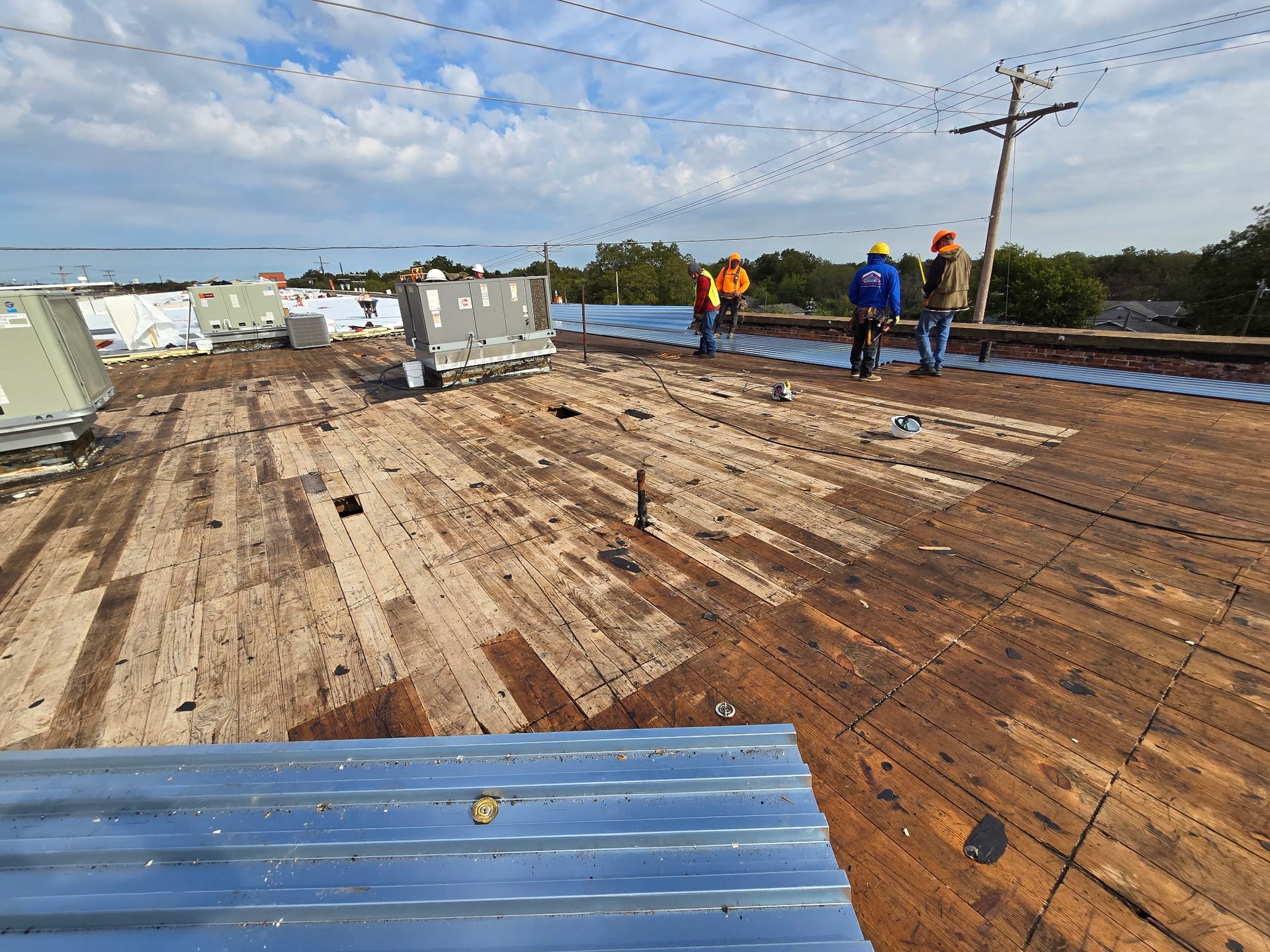
The deck is the supporting surface beneath the roofing assembly. Depending on the building, it may consist of wood sheathing, metal decking, concrete, or another specified construction.
Below it are supporting members and connections that carry loads through the building. Visible sagging can involve the deck, those supporting elements, or both.
A homeowner may also mistake an uneven covering, a distorted ceiling, or a long-standing roof profile for deck movement. That possibility does not establish that a newly noticed condition is harmless.
Ask the assessor to identify what has actually been observed, what remains concealed, and which professional is qualified to evaluate the uncertainty. A surface observation should not be converted into an unsupported structural diagnosis.
Recognize Conditions That Need an Emergency Response
Sudden or increasing deflection, loud cracking, falling ceiling material, visible separation, or signs of imminent failure justify leaving the affected building and seeking emergency assistance. Do not remain inside to collect better photographs.
FEMA's snow-load safety guidance identifies sagging and other distress signs in the specific context of roof loading. It is useful background on warning signs, not a tool for calculating the safety of a Texas roof from appearance alone.
Keep people away from the building and potential falling-material areas. Follow emergency officials' instructions about access, exclusion zones, and reentry.
An absence of dramatic noise does not prove safety. If the condition looks dangerous or changes quickly, prioritize leaving and contacting the appropriate responders rather than waiting for a routine contractor visit.
Do Not Confuse Ceiling Sagging with a Minor Cosmetic Defect
A sagging ceiling may involve water accumulation, damaged finishes, or a structural issue above it. The visible ceiling does not reliably identify the cause or extent.
The American Red Cross's guidance on checking structural elements after a disaster addresses sagging ceilings and cautions about collapse hazards. Avoid standing beneath a bulge or disturbing it to investigate.
Do not enter an attic or climb onto a suspect roof to determine whether it feels firm. Your presence adds load and places you in the area being evaluated.
If an interior condition is accompanied by sudden movement, falling material, or concern about collapse, leave the building and obtain emergency direction. A roof leak appointment is not a substitute for that response.
Use a Condition-Based Timeline
The first deadline is assessment and control of access, not necessarily completion of permanent construction. Stabilization, investigation, design, permitting, and repair may be separate stages.
Observed situationAppropriate next stepWhat it does not establishSudden movement, cracking, falling material, or suspected imminent failureLeave the building and call emergency services from a safe locationNo self-selected waiting period is appropriateNew or worsening sagging without obvious immediate failureSeek urgent professional assessment and avoid the affected areaA routine appointment date does not confirm safe occupancyLong-standing unevenness with unknown historyArrange prompt qualified evaluation and disclose any changesAge of the condition alone does not establish safetyCondition assessed with documented restrictionsFollow the assessor's restrictions and repair planTemporary stabilization is not automatically permanent repairPermanent repair completedObtain required inspections and applicable reentry directionA finished roof covering alone does not prove structural acceptance
This table is a response framework. It cannot determine whether a particular building is safe to enter or occupy.
Why Waiting Can Increase the Problem
If water intrusion is contributing to deterioration, continued exposure can affect more material. If a supporting connection or member is failing, additional loading or movement may change the situation.
The visible dip may also interfere with drainage, create new stress at details, or damage finishes. Which effects are present requires evaluation of the actual assembly.
Do not assume the rate of change will remain steady. A condition that seemed unchanged during dry weather may behave differently during rain, wind, construction activity, or another load event.
Ask the professional to explain the identified risks and what would trigger a revised response. A useful plan establishes restrictions and decision points instead of offering reassurance based solely on how long the roof has looked uneven.
Water Damage Adds a Separate Timeline
Stopping water entry, assessing structural condition, and drying affected materials are related but distinct tasks. None should be assumed to resolve the others automatically.
EPA's moisture and mold guidance recommends drying water-damaged areas and items within 24–48 hours to help prevent mold growth. That drying guidance is not a safe waiting period for a sagging structure.
Access must first be appropriate for the work. Restoration personnel should not enter a restricted area simply to meet a drying target.
Ask who will coordinate the roof repair, moisture assessment, interior restoration, and any structural review. When responsibilities are unclear, one contractor may assume another has addressed a condition that remains unresolved.
What an Initial Assessment Should Clarify
Provide the date you first noticed the sag, whether it appears to have changed, recent weather events, leak history, and any construction or equipment changes. Share photographs taken only from safe locations.
The assessor should explain what can be observed safely and whether further investigation is needed. Concealed framing, insulation, or inaccessible connections may limit the first visit.
Ask whether the condition appears localized or whether supporting members and adjoining areas need evaluation. The answer should distinguish observation from a final conclusion.
For residential roofing concerns, a roofing contractor can assess relevant roof components within its scope. Ask explicitly when a structural engineer or building official needs to become involved.
When Structural Engineering Matters
Movement involving rafters, trusses, joists, beams, purlins, connections, or uncertain load capacity can require structural evaluation. An engineering review may also be appropriate when the cause or significance of the deflection is unclear.
The engineer can determine the scope of the structural investigation and, where needed, develop repair or stabilization requirements. The roofing contractor then coordinates the roof-related work with that direction.
Do not accept improvised reinforcement simply because it appears stronger. Altering a truss or adding supports can change how forces travel through the building.
Ask who is responsible for design, permits, inspections, and any occupancy recommendations. Those responsibilities should be assigned to the appropriate parties rather than implied by a general roof repair contract.
Possible Causes Need Verification
Potential contributors include deterioration from water exposure, damaged or inadequate supporting components, connection problems, changes in loading, and defects in the original construction. Different materials can present different failure mechanisms.
A stain may support further investigation without proving the entire cause. Likewise, a visible sag does not establish that a recent storm created it.
Ask what evidence supports the proposed explanation and whether other plausible causes have been considered. The repair should address the condition established by the investigation.
Avoid a diagnosis based only on the building's age or a photograph. A credible assessment states uncertainty when needed and explains what additional access, records, or testing would resolve it.
Commercial Buildings Require Coordinated Decisions
For a business, a suspected structural problem affects occupants, service personnel, deliveries, and operations. Identify the person with authority to restrict access and coordinate emergency or professional direction.
A commercial roofing assessment should account for the actual roof construction, drainage, equipment, and repair history. Structural questions still require the appropriate expertise.
Do not move stored materials, add temporary equipment, or send maintenance staff onto the roof in an attempt to improve the situation without direction. Actions intended to help can change loading or expose people to risk.
Communicate restrictions clearly to tenants and vendors. An area that is closed for assessment should not remain available to a service contractor who was unaware of the concern.
Why Roof Access Must Be Controlled
A roof that supports normal service conditions cannot be assumed to support people safely when damage is suspected. Access planning is part of the assessment.
OSHA's working-surface and fall-protection requirements require employers to determine that working surfaces have adequate strength and structural integrity for workers. Fall protection alone does not make a weakened surface safe.
Ask how the contractor will perform observations without placing personnel on unverified areas. Appropriate access methods depend on the building and condition.
Owners should not test the roof by walking on it, pushing up from below, or probing damaged material. Leave physical investigation and access decisions to qualified personnel operating under an appropriate plan.
Temporary Protection Is Not Structural Clearance
A tarp or limited leak repair may reduce water entry when it can be installed safely. It does not establish that the deck or supporting structure is sound.
Similarly, temporary shoring requires suitable design and installation. Do not attempt to jack up a roof or place improvised posts beneath it as a do-it-yourself measure.
Ask what each temporary measure is intended to accomplish, who specified it, what restrictions remain, and when it will be reviewed. Document any monitoring or access requirements.
The permanent repair plan should identify how temporary protection will be removed or incorporated. A temporary condition should not quietly become the long-term arrangement because the immediate leak stopped.
What Permanent Repair May Include
The scope may involve removing roofing, replacing damaged decking, repairing supporting elements, correcting connections, restoring insulation, and rebuilding the weather-resistant assembly. The actual work depends on the findings.
Ask whether the proposal includes the source of water entry and any drainage defect. Replacing damaged material without correcting the cause can leave the building vulnerable to recurrence.
A broader Texas roofing systems comparison can help when replacement options are being considered. Material selection should follow verification of the supporting construction.
A new covering should not be described as a cure for unexplained sagging. The finished appearance and the adequacy of the underlying repair are separate questions that the project must address.
Why a Coating or Overlay May Be the Wrong Starting Point
A coating changes the surface condition. An overlay retains existing construction and adds new material. Neither automatically corrects a damaged deck or a structural problem.
Before considering either approach, ask how the support condition has been established and what repairs are required. The added assembly must be appropriate for the building.
A proposal that simply covers the depression may make later observations more difficult without resolving its cause. Ask how drainage, attachment, and the repair geometry will be addressed.
If a contractor recommends restoration before the sagging is explained, request the supporting assessment. A sound plan should connect the condition findings to the proposed work rather than begin with a preferred product.
Plan the Schedule in Separate Stages
Ask for the expected sequence: immediate assessment, access restrictions, investigation, design if needed, permitting, temporary protection, material procurement, repair, and required inspections.
Each stage can have a different lead time. A permanent repair may take longer to organize than an initial visit, particularly when engineering, specialized materials, or concealed conditions are involved.
The schedule should explain what makes the building or affected area acceptable to use during that period. Do not infer permission to remain from the fact that a contractor has scheduled work for a later date.
If conditions change, contact the responsible professional promptly and follow emergency guidance when needed. An earlier assessment may need review after new movement, damage, or loading.
Avoid Insurance-Driven Delays in Safety Decisions
When insurance may be involved, contact the insurer for claim requirements and policy questions. Preserve records from safe locations and retain invoices for authorized work.
TDI's roofing and insurance law guidance explains that a contractor cannot act as a public adjuster while also providing contracting services on the property. Contractors can document construction conditions without promising coverage.
Do not treat an insurer's appointment as structural clearance. Follow emergency officials and qualified professionals concerning access, stabilization, and occupancy.
Clarify the price and authorization for urgent work separately from any assumption about reimbursement. Safety-related decisions and funding questions need coordination, but a pending coverage decision does not establish that waiting is safe.
Ask for a Reviewable Written Scope
The proposal should identify the assessed condition, work areas, removal, repairs, design documents where applicable, materials, exclusions, and approval procedures for concealed findings.
The FTC's home improvement guidance recommends researching contractors and comparing written estimates. Apply that care while still respecting any urgent restrictions or emergency directions.
Ask what is included in deck pricing and what requires separate structural work. A unit price for sheathing replacement should not be assumed to cover damaged framing, engineering, or interior restoration.
Confirm responsibility for permits, inspections, weather protection, and closeout records. If important work is excluded, identify who will provide it and how the schedules will be coordinated.
Keep the Record Useful After Repair
Retain photographs, investigation findings, engineering documents where applicable, permits, approved changes, invoices, and completion records. The file should describe the actual work rather than only the original estimate.
Consistent roof maintenance records help future service providers understand prior conditions and repairs. Include any remaining monitoring or maintenance requirements.
Ask who will provide applicable inspection results and any direction about reoccupancy or removal of restrictions. A verbal statement that the shingles are finished may not answer those questions.
Document the corrected water-entry or drainage condition as well. Repair history is more useful when it explains both the damaged material and the work intended to prevent the same problem from recurring.
A Practical Owner Response
Suppose an owner notices a new roof depression after a period of leaks. The first step is to avoid the affected area and promptly seek appropriate assessment, not to choose a cosmetic repair.
If sudden movement or other signs suggest imminent failure, the owner leaves the building and calls emergency services. Otherwise, the professional response still needs to establish the condition and appropriate restrictions.
Investigation may identify localized deck deterioration or a problem involving supporting elements. The permanent repair scope follows those findings rather than the owner's initial guess about the cause.
This sequence separates urgency from construction duration. A repair may require planning time, but any delay needs to occur under appropriate restrictions and professional direction, not an assumed grace period.
Clarify Responsibility Before Work Starts
Identify the person coordinating the roofer, engineer, restoration provider, and local authority where applicable. Each party should understand which decisions fall within its scope and which information must be shared before the next stage begins.
Request a clear contact process for new findings during removal. If additional damage is exposed, the crew needs an agreed method for documenting it, obtaining direction, and protecting the building while the scope is revised.
Finally, make sure occupants receive practical instructions about restricted areas and authorized access. A repair plan is easier to follow when those instructions are written, current, and communicated to everyone using the property.
Frequently Asked Questions
Can I wait a month if the roof is not leaking?
There is no universal safe waiting period. The absence of a leak does not establish structural adequacy. Arrange prompt assessment and follow any restrictions or emergency directions.
Does every roof dip mean collapse is imminent?
No. Appearance alone cannot establish the cause or urgency. New, unexplained, or worsening sagging requires evaluation; sudden movement or signs of imminent failure require an emergency response.
Will replacing shingles fix a sagging deck?
A new covering does not automatically correct deck deterioration or supporting-member problems. The underlying condition must be assessed and included in the repair plan.
Should I inspect the attic myself?
Do not enter a suspect area to investigate structural distress. Share existing records and safe observations with the professionals assessing the building.
Can a roofer decide whether an engineer is needed?
A roofer can identify roofing findings and recommend further evaluation. Structural capacity, design, and uncertain movement may require a licensed structural engineer and coordination with local authorities.
When can the area be used again?
Follow applicable direction from emergency officials, building authorities, and qualified professionals. Completion of a surface repair alone should not be treated as permission to remove restrictions.
Act on the Condition, Not an Assumed Deadline
A sagging roof deck deserves prompt attention because the visible condition does not reveal every underlying issue. Seek emergency help when failure appears possible, obtain an appropriate assessment, and base the repair timeline on documented findings and restrictions.
For a North Texas roofing assessment or repair discussion, contact Showtime Exteriors or call 817-400-7663. If you suspect an immediate collapse hazard, leave the building and contact emergency services first.