



How Quickly Should You Address a Wind-Damaged Roof?
An actionable guide for Texas commercial property owners from Showtime Exteriors.

Address suspected wind damage as soon as it is safe to do so. Active leaks, exposed roof openings, loose materials, and signs of structural instability require urgent professional attention. Less obvious concerns still warrant prompt inspection rather than waiting for the next storm.
There is no universal 24-hour, 48-hour, or one-week window during which every damaged roof can safely remain unattended. The appropriate response depends on the observed conditions, the roof system, building occupancy, and upcoming weather.
Addressing the damage also does not necessarily mean replacing the roof immediately. The first priorities are protecting people, evaluating the condition, documenting the findings, and arranging suitable temporary protection when needed.
Permanent repairs should follow a clearly supported scope.
For commercial property owners, this sequence matters. A roof problem can affect tenants, employees, inventory, equipment, customer access, and business operations. A coordinated response helps keep the roofing work and the building’s needs moving together.
What Does “Address the Damage Quickly” Actually Mean?
A prompt response involves several actions that can overlap:
- Identify immediate safety concerns.
- Contact a qualified roofing contractor.
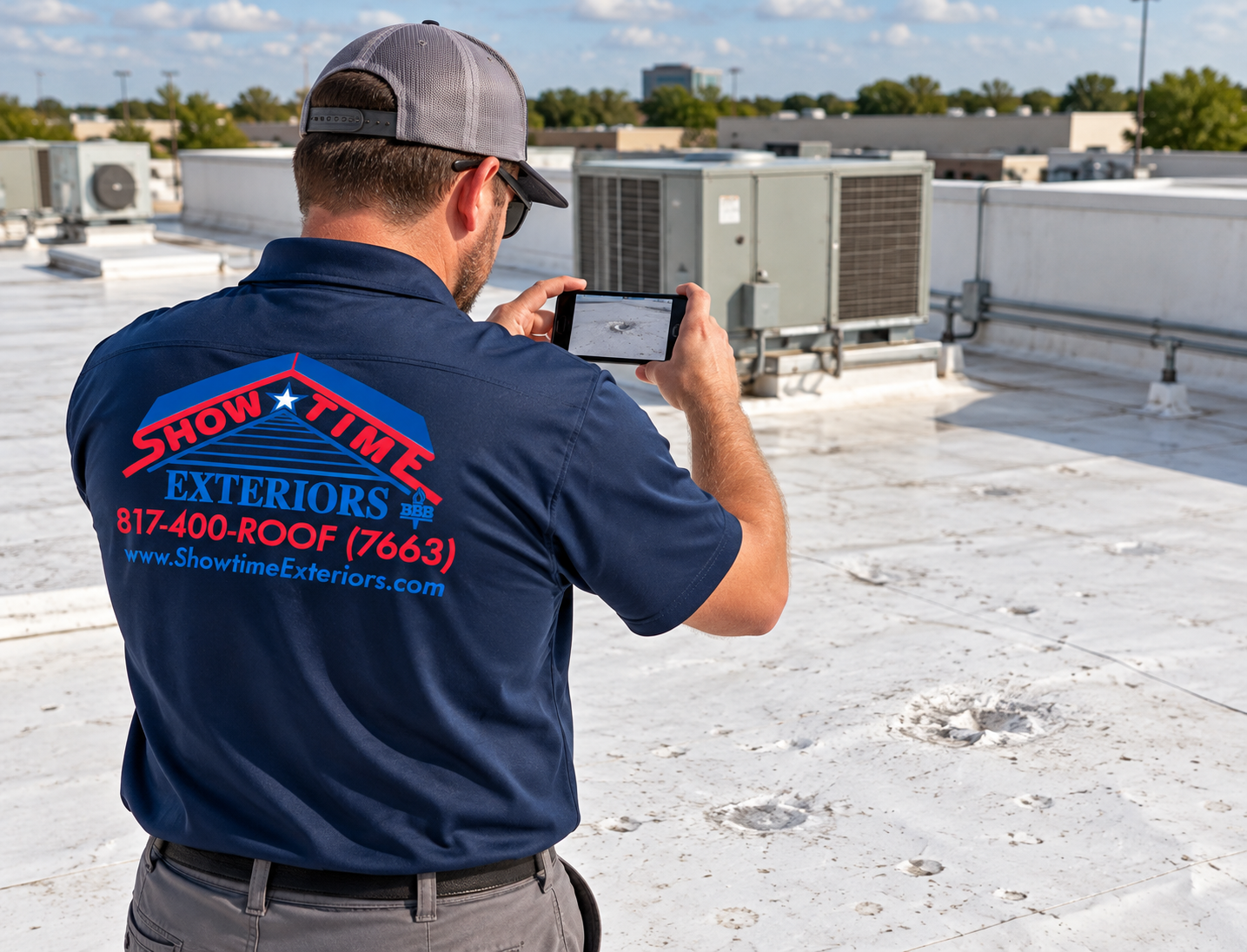
- Record safe observations.
- Notify the insurer when a claim may be involved.
- Arrange appropriate temporary protection.
- Obtain findings and a permanent repair recommendation.
- Monitor conditions until the work is completed.
You do not need every answer before starting these steps.
For example, an owner can report water entry, request a roofing assessment, and photograph the affected room while the contractor determines how to protect the roof.
The Texas Department of Insurance recommends reporting storm damage, taking photographs and video, making temporary repairs to prevent further damage, and retaining repair records and receipts. Coordinate permanent work with the insurer when a claim is involved. Your policy determines the requirements that apply to your property. Texas Department of Insurance
The objective is to prevent avoidable delay while keeping decisions accurate and reviewable.
Which Conditions Require an Urgent Response?
Some observations should move the situation beyond a routine inspection request.
Describe these conditions clearly when contacting the roofer or other appropriate professionals.
Active water entry
Report where water is entering, whether it is ongoing, and what occupied spaces or equipment are nearby.
Do not assume a bucket resolves the roof problem. Interior containment may help manage a symptom while the entry source still requires evaluation.
Visible openings or missing roofing
An exposed area deserves prompt professional assessment, even if no interior leak has appeared.
For shingle roofs, GAF notes that lifted or missing shingles can allow moisture underneath and potentially affect the roof deck. gaf.com
Loose or displaced materials
If roofing, metal trim, or other components appear unstable, keep people away from the area where materials could fall.
Do not send an employee onto the roof to secure them.
Sagging ceilings or suspected structural movement
Restrict access and seek appropriate professional assistance. Do not stand beneath a sagging ceiling to inspect or photograph it.
A roofer may need to coordinate with other qualified professionals when the concern extends beyond the roof covering.
Water near electrical equipment
Keep people away from the affected area. Have qualified personnel evaluate the electrical concern.
The roofing response should proceed alongside the necessary building safety response.
A Practical Urgency Guide
Use this table to communicate observations. It does not replace an on-site assessment or establish a guaranteed service timeframe.
Observed conditionAppropriate next stepActive leak or visible openingRequest urgent assessment and temporary protectionLoose materials above occupied areasRestrict access and seek urgent professional helpSagging ceiling or suspected structural damageKeep people clear and obtain appropriate emergency evaluationMissing shingles without visible interior waterArrange prompt inspection and protection planningUnexplained new staining after a stormDocument it and request evaluationNo visible damage, but concern after severe windsArrange an inspection based on the building’s circumstancesTemporary protection already installedConfirm monitoring, follow-up, and permanent repair plans
When uncertain, describe what you see and ask the professional how the response should be prioritized.
Avoid assigning urgency solely from the size of a stain or the number of materials found on the ground.
What to Do While the Storm Is Still Active
Do not climb onto the roof during dangerous weather.
Concentrate on people and safe interior actions. Follow applicable emergency instructions and keep occupants away from affected spaces.
Where conditions allow, a designated manager can collect reports from tenants or employees. Record the room, time, observation, and person reporting it.
For instance:
“At approximately 3:20 p.m., staff reported dripping above the rear stockroom. Access to the affected area was restricted.”
That is a useful factual record. It does not require anyone to establish the roof’s cause during the storm.
If a contractor cannot safely access the roof yet, ask what actions are appropriate in the meantime. Weather and site conditions may limit inspection or work.
Do not interpret those limitations as a reason to stop coordinating the response. Reporting, communication, and safe documentation can continue.
What to Do Once Conditions Are Safe
Start with a ground-level walkaround if the exterior is safe to access.
Look for changes you can observe without climbing:
- Roofing materials on the ground.
- Displaced exterior components.
- Visible roof openings.
- Fallen branches or debris.
- New interior water symptoms.
- Damage reported by neighboring tenants or occupants.
Photograph the overall location before taking closer images.
Then contact the roofing contractor with a concise description:
“We have a commercial building in Mansfield. Following the wind event, we observed displaced roofing near the west elevation and water entering the rear storage area. We need an assessment and advice on temporary protection.”
This gives the contractor more useful information than “the roof looks bad.”
If insurance may be involved, report the observations promptly through the insurer’s designated process. Additional photographs and reports can follow.
Keep the storm date, discovery date, and inspection date distinct. If any date is uncertain, say so.
Can You Wait If the Building Is Not Leaking?
An absence of visible interior water does not establish that the roof is undamaged.
It also does not prove that every suspected condition requires emergency replacement.
The appropriate next step is evaluation.
For a shingle roof, the contractor may need to investigate missing, raised, or creased materials and associated details. GAF identifies these as potential signs of wind-related concerns and recommends professional inspection. gaf.com
For a commercial membrane or metal roof, ask the contractor to assess the system and the specific conditions observed. Do not apply a shingle checklist to every roofing material.
An owner’s useful question is:
“What needs immediate protection, and what can be scheduled after the inspection?”
That separates the urgent response from the permanent project.
If the contractor recommends monitoring rather than immediate work, ask for a clear explanation of what was observed, what remains uncertain, and what changes should trigger another call.
Why Commercial Properties Need a Coordinated Response
A commercial building often has several people making decisions at once.
The tenant wants the leak stopped. The facilities manager needs safe access. The owner wants a supported scope. The insurer needs records. The contractor needs authorization.
Without coordination, important details can be lost.
Assign one primary contact to maintain the response log and collect documents. Identify who can authorize emergency work and who can approve permanent repairs.
For a multi-tenant property, ask occupants to report:
- Exact location of the observation.
- Time it was first noticed.
- Whether water is currently entering.
- Photographs taken from safe locations.
- Any immediate operational concern.
Give occupants a clear reporting channel.
Do not require tenants to diagnose the roof. “Water entered beside the rear wall” is a useful observation. “The whole roof has failed” is a conclusion that requires evaluation.
A single coordinated record makes the project easier to manage.
How to Protect Operations Without Delaying the Roof Response
Business continuity should be part of the plan from the beginning.
Identify the spaces that need particular attention: inventory rooms, workstations, customer areas, electrical equipment, food preparation spaces, or sensitive operations.
Ask the contractor how access and temporary work will affect those spaces.
Depending on the project, coordination may involve parking, delivery routes, staging areas, rooftop equipment, and communication with occupants.
Make priorities specific.
For example:
“The rear service entrance must remain available for scheduled deliveries. Please identify any work that would restrict that route.”
Do not promise tenants that everything will remain open before the conditions have been evaluated.
If an area needs to close temporarily, document the decision and who authorized it. Keep records of actual operational impacts rather than estimating losses casually.
Coverage for business interruption or related expenses is a separate policy question. Ask the insurer or agent about the requirements that apply to the building’s policy.
What Should the First Roofing Assessment Establish?
The initial assessment should help answer three questions:
- What conditions have been observed?
- What requires immediate action?
- What further evaluation or permanent work is recommended?
Ask for findings that identify locations and limitations.
A useful report might document an affected roof section, describe the observed condition, recommend temporary protection, and identify areas that could not yet be inspected.
A less useful report says only “storm damage—replace roof.”
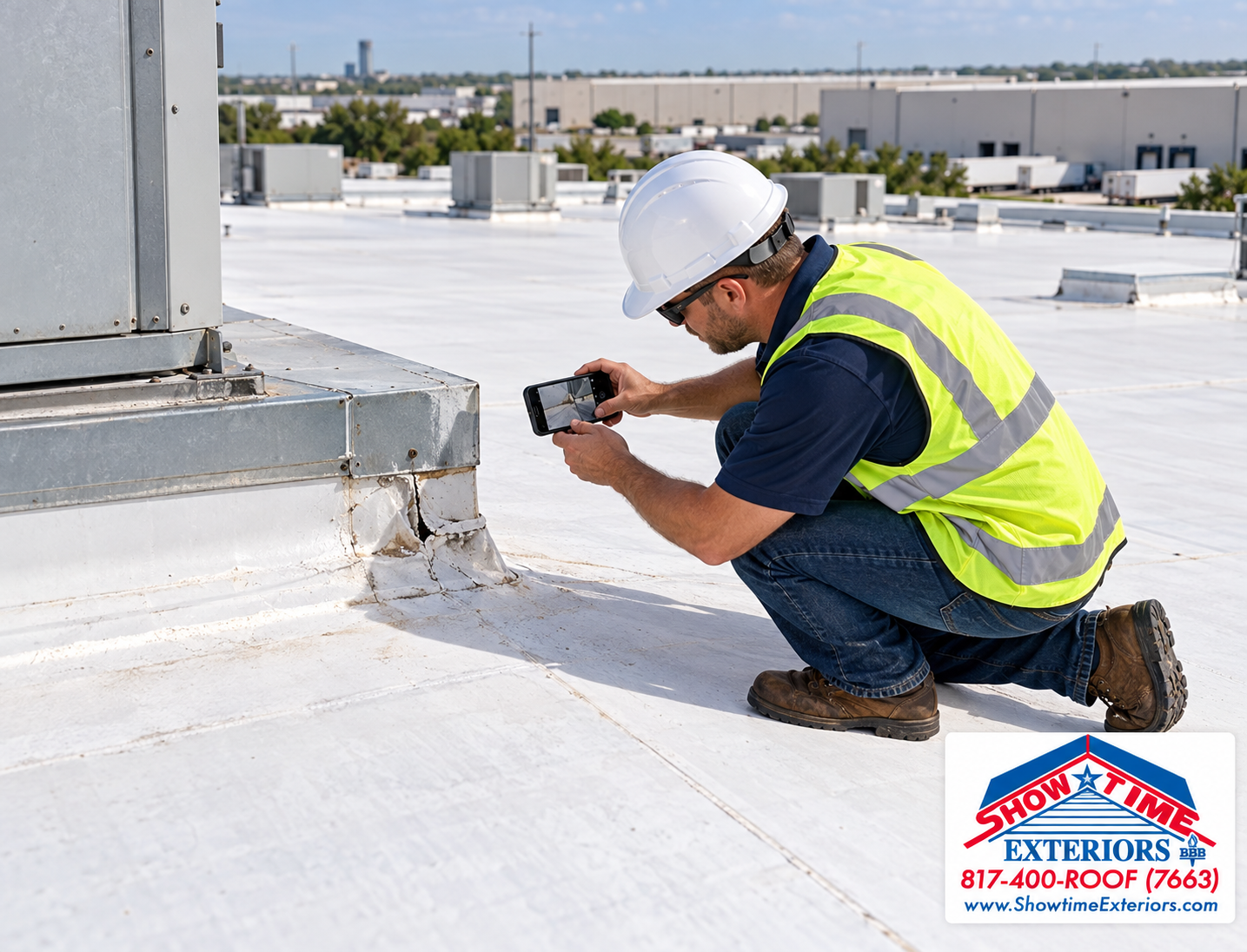
Request photographs that connect details to the overall roof. A close-up needs enough context to show where it was taken.
Also ask whether the assessment is complete or limited to the emergency area. That distinction matters when deciding what to do next.
If concealed conditions require additional investigation, ask what method is proposed, why it is needed, and how the resulting information will affect the scope.
How Should Different Roof Systems Be Evaluated?
The inspection should fit the roof actually installed.
Asphalt shingle roofs
Ask about the affected shingles, surrounding materials, roof details, and the feasibility of a suitable repair.
GAF’s repair guidance recognizes that partial roof repairs may be possible and recommends professional evaluation when choosing between repair and replacement. GAF
Low-slope membrane roofs
Ask the contractor to identify the system and explain the observed conditions at the affected surface, details, and transitions.
The report should distinguish visible findings from concealed areas requiring further evaluation.
Metal roofs
Ask which panels, connections, or associated details are affected and how the proposed work relates to the existing system.
A photograph of a displaced component should lead to a location-specific scope.
Buildings with multiple systems
A property may have a sloped front section and a low-slope rear section. Identify which areas were inspected and which recommendation applies to each.
The same storm does not automatically create the same repair requirement across every roof section.
When Is Temporary Protection Appropriate?
Temporary protection may be needed when the building cannot remain in its observed condition while permanent work is arranged.
Ask the contractor which method is suitable and why.
A tarp is one option for some conditions, but it is not automatically appropriate for every commercial roof. The method should reflect the roof system and site circumstances.
Before work begins, obtain a written emergency scope when practical. It should identify the affected area, proposed work, pricing basis, and authorization process.
Ask the contractor to document conditions before covering them when safe and feasible. Urgent protection should not be delayed solely to create a perfect photo file.
After completion, request photographs and a note describing the work, limitations, and next steps.
Temporary protection needs follow-up. Ask who to contact if water returns or visible conditions change.
Should You Wait for the Insurance Adjuster?
Do not leave an urgent condition unaddressed solely because an inspection has not yet been scheduled.
Notify the insurer, explain the need for protection, and ask for instructions about documentation and inspection.
TDI’s claim guidance recommends photographing damage before repairs where possible, keeping receipts, preserving damaged property for review, and coordinating permanent repairs with the adjuster. tdi.texas.gov
Apply those practices alongside the actual policy requirements for your commercial property.
If immediate permanent work is proposed because temporary protection is insufficient, explain the circumstances to the insurer promptly and seek written guidance. Preserve the best available evidence.
Keep hazardous materials away from occupants. Do not retain unsafe debris in a public area merely to preserve it for an inspection.
The goal is to protect the property while maintaining an accurate record of why the work was necessary.
What Evidence Should You Preserve?
Collect enough information to explain the condition and response.
Useful records include:
- Original photographs and videos.
- A roof location diagram.
- Contractor inspection findings.
- Emergency work authorization.
- Temporary protection photographs.
- Itemized invoices.
- Payment records.
- Prior roof inspections and repairs.
- Relevant communication.
- Follow-up observations.
Keep original files separate from annotated copies.
An arrow or label can clarify a photograph, but it should not replace the unaltered image. Do not use filters that change the appearance of a condition.
If the roof was covered before complete photographs were available, document that limitation honestly. Ask the contractor whether arrival photographs or technician notes exist.
Never recreate damage for the camera or use illustrative marketing images as claim evidence.
Build a Timeline That Explains the Response
A timeline is especially useful when several people participate.
Use a simple format:
EventInformation to recordDiscoveryDate, time, location, observerInitial reportWho was contacted and what was describedContractor arrivalInspection scope and access limitationsEmergency workAuthorization, work performed, completionInsurer communicationClaim reference and instructionsFollow-upNew observations or changesPermanent workApproved scope and completion records
Use approximate times when exact times are unknown.
For example:
“Monday morning: Tenant reported a new ceiling stain. Tuesday afternoon: Roofer inspected the affected roof section.”
Do not change that into a precise storm-causation statement unless the evidence supports it.
A factual timeline helps reviewers distinguish the weather event, discovery, and later work.
It also helps the property manager identify missing follow-up actions.
What If Another Storm Is Forecast?
Upcoming weather should be part of the conversation.
Tell the contractor about the concern and ask whether the current condition or temporary protection needs additional attention.
Do not assume that every project can be completed before the next rainfall. Ask for the practical plan.
That plan should explain what can be protected, what remains exposed or uncertain, and what observations require another call.
If temporary work has already been completed, confirm whether a follow-up inspection is recommended before the weather changes.
Communicate the plan to occupants. Give them clear reporting instructions if water appears.
Avoid promises such as “the building is guaranteed not to leak.” Instead, describe the work completed and the monitoring process.
The response should follow actual conditions and professional judgment, rather than a fixed online countdown.
Does Wind Damage Automatically Mean Replacement?
No.
The permanent scope depends on the findings.
A localized repair may be appropriate for a defined problem. A larger section or full replacement may require consideration when the assessment supports broader work.
Ask the contractor to explain why the recommended scope is necessary and what a smaller scope would leave unresolved.
Separate the roof’s technical needs from the owner’s improvement plans. An owner may choose a broader project for long-term reasons, but that does not automatically make every cost part of a storm claim.
Similarly, insurance approval does not replace a clear construction scope.
The roofing proposal should identify the work. The insurer’s decision should explain coverage and payment under the policy.
If the two differ, identify the specific disputed issue rather than assuming one general explanation resolves everything.
How Quickly Should Permanent Repairs Be Completed?
Permanent work should proceed promptly once the conditions, scope, authorization, materials, and safe work plan are established.
The appropriate schedule is property-specific.
Ask the contractor:
- What must happen before work begins?
- Are materials available?
- Is further inspection needed?
- What access arrangements are required?
- What temporary protection remains in place?
- How will weather affect scheduling?
- Who will communicate changes?
Do not confuse a scheduled future repair with a completed response.
Until permanent work is finished, the building still needs monitoring and a clear contact process.
If the schedule changes, update the protection plan and notify relevant occupants.
A useful schedule identifies dependencies rather than offering an unsupported completion promise.
For an occupied commercial building, careful coordination can help the project proceed without overlooking tenant needs or inspection requirements.
What If the Insurer and Contractor Disagree?
First identify the disagreement.
It may concern the damage extent, the proposed repair method, omitted components, pricing, or insurance coverage.
Ask the contractor for location-specific findings and the insurer for its written explanation.
If the disagreement involves physical work, additional documentation or evaluation may clarify it.
If it involves policy interpretation or legal rights, seek appropriately qualified advice.
Do not ask the roofer to promise a claim outcome. The contractor’s role should remain focused on roofing findings and the construction scope.
Keep communications organized. Record what was submitted and what additional information was requested.
Continue addressing urgent protection needs while the disagreement is reviewed. A dispute about the permanent scope should not leave the emergency response without an owner or follow-up plan.
How to Compare Contractor Proposals
Compare the work, not only the total price.
One proposal may address a visible opening while another includes associated details. Understand those differences before deciding.
Ask each contractor to identify:
- The observed problem.
- The proposed boundary of work.
- Materials and methods.
- Associated components.
- Exclusions.
- Concealed-condition allowances or procedures.
- Access and operational requirements.
- Warranty coverage.
- Documentation.
- Price and payment terms.
A lower price can represent a smaller scope. A higher price can include work that needs explanation.
Avoid pressure to approve a major project before reviewing findings.
For emergency work, authorization may need to happen quickly. Even then, seek a concise scope and a clear process for additional charges.
Keep temporary and permanent expenses understandable in the records.
Three Illustrative Response Scenarios
These examples describe planning approaches, not actual Showtime Exteriors projects or insurance outcomes.
A retail property with active water entry
Staff report dripping above stored inventory.
The manager restricts access where needed, records safe observations, and requests urgent roofing evaluation. The contractor assesses protection needs while the insurer is notified.
Permanent scope decisions follow the findings.
An office building with visible missing shingles
The building has no reported interior water, but a ground-level observation identifies an affected roof area.
The owner arranges prompt inspection rather than waiting for a leak. The contractor documents the area and explains whether protection and repair are needed.
A low-slope roof with displaced exterior metal
A property manager notices a changed roof-edge condition after a wind event.
The manager keeps occupants away from the potential falling-material area and requests professional evaluation. The contractor assesses the affected detail and the appropriate response.
In each case, urgency follows the observed condition. The final repair decision follows the assessment.
Common Mistakes That Delay a Useful Response
Waiting for visible interior damage
Arrange evaluation when roof concerns are observed. A dry room does not establish the roof’s condition.
Sending employees onto the roof
Leave roof access and repairs to qualified professionals.
Assuming a small opening is harmless
Ask what the affected area needs rather than judging only its apparent size.
Treating a tarp as the final solution
Maintain monitoring and permanent repair planning.
Reporting conclusions instead of observations
Describe what was seen, where, and when. Let further evaluation address cause and extent.
Approving replacement without supporting findings
Request photographs and an explanation of the scope.
Losing invoices and original photographs
Maintain one organized property file.
Forgetting tenants during the response
Give occupants clear reporting and access instructions.
Waiting for every document before notifying the insurer
Report promptly and provide additional records as they become available.
Questions to Ask Before Ending the First Contractor Call
The initial call should produce a practical next step.
Ask:
- Based on the reported conditions, how should the request be prioritized?
- What should we do while awaiting assessment?
- What areas should remain restricted?
- What information will help you prepare?
- Who needs to authorize emergency work?
- How will findings be documented?
- What temporary protection may be considered?
- Who should we contact if conditions change?
Do not expect a definitive replacement decision from a phone description alone.
The call should establish the response process and the information needed for the inspection.
For a commercial property, mention occupancy, access restrictions, rooftop equipment, and any sensitive interior spaces.
Those details help the contractor understand the building before arriving.
Frequently Asked Questions
Is every wind-damaged roof an emergency?
No. Active water entry, unstable materials, exposed openings, and safety concerns warrant urgent attention. Other suspected conditions still deserve prompt assessment.
Can I wait until next month if there is no leak?
Have the condition evaluated before deciding to defer work. The absence of visible water is not enough information.
Should I repair the roof myself?
Leave roof access and repair to qualified professionals. Owners can document safe observations and coordinate the response.
Does temporary protection guarantee the building will stay dry?
No. Ask about limitations, monitoring, and follow-up. Report renewed water entry promptly.
Does a roof inspection prove the storm caused every problem?
Not automatically. The report should distinguish observations, conclusions, and limitations.
How long does an inspection take?
It depends on the building, roof, access, and evaluation scope. Ask the contractor what is included and whether further investigation may be required.
Will insurance pay for the damage?
Coverage depends on the policy and claim circumstances. Ask the insurer or agent about the applicable terms.
Should I keep damaged materials?
Ask the insurer about preservation and coordinate safe handling. Do not keep hazardous materials where people may be exposed.
Can permanent work begin before the claim is resolved?
Discuss the proposed work, documentation, and policy requirements with the insurer. Urgent protection and permanent restoration need clear coordination.
What records should I keep after repairs?
Retain completion photographs, invoices, product information, inspection findings, and applicable warranties in the building’s roof file.
Take the Next Step While the Condition Is Still Manageable
A useful response starts with the condition in front of you.
Protect people, report observations, arrange professional evaluation, and document the work. If temporary protection is needed, establish monitoring and a permanent repair plan.
You do not need to know whether the roof requires a small repair or replacement before requesting an assessment.
Concerned about wind damage at your Texas commercial property? Contact Showtime Exteriors to discuss the observed conditions, roof assessment, and appropriate next steps.
Call [817-400-ROOF (7663) (line 8174007663)](tel:8174007663) or visit ShowtimeExteriors.com.