



Best Roof Repair Companies in Rockwall, Texas: How to Choose the Right Roofer

Showtime Exteriors • September 20, 2026

This is a subtitle for your new post

Searching for the best roof repair companies in Rockwall, Texas usually begins with an urgent problem: a leak after a thunderstorm, lifted shingles, hail marks, damaged flashing, ponding water, or an aging commercial roof that is becoming harder to insure. The right contractor should do more than arrive with a tube of sealant and a quick estimate. A dependable roofer should identify how water is entering, determine how far the damage extends, document the roof condition, explain the available repair options, and tell you honestly when another patch would be poor value.

Showtime Exteriors provides residential and commercial roof repair, inspection, restoration, and replacement services for property owners throughout North Texas. From its Mansfield base, the company serves the Dallas-Fort Worth Metroplex, including Rockwall and surrounding communities. Property owners can begin by reviewing Showtime Exteriors' roofing services or calling 817-400-ROOF (7663).

This guide explains how to compare Rockwall roofing companies, what a professional inspection should include, which warning signs require prompt attention, how residential and commercial repairs differ, and why aging gravel-surfaced built-up roofs require special caution. It also explains the difference between roof repair, restoration, and replacement so you can make a decision based on evidence rather than pressure.

What Makes a Roof Repair Company One of the Best in Rockwall?

The best roof repair company is not necessarily the company with the loudest advertisement, the lowest initial price, or the longest list of vague promises. A strong roofing contractor combines accurate diagnosis, appropriate materials, trained installation, safety planning, documentation, communication, and dependable service after the work is finished.

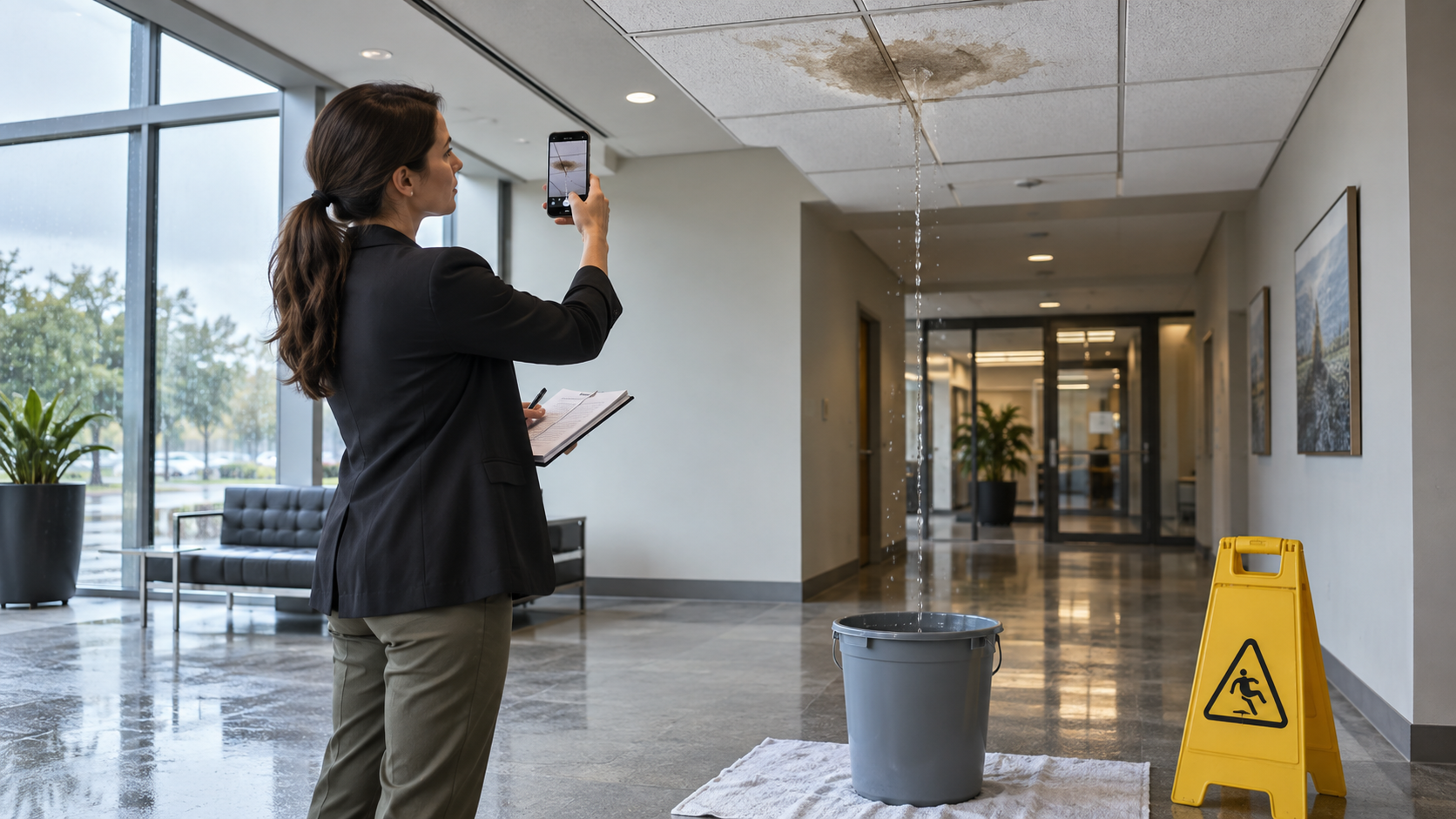
Roof leaks are rarely solved well by guessing. Water may enter at a puncture, open seam, failed flashing, loose fastener, damaged shingle, wall transition, drain, skylight, curb, or rooftop penetration. It can then travel along insulation, decking, structural members, or ceiling components before appearing inside. The wet ceiling tile may be several feet away from the exterior defect. A roofer who repairs only the location directly above the interior stain may miss the actual pathway.

A reputable company should therefore inspect the roof as a complete system. That means looking at the field of the roof, edges, penetrations, flashings, drainage, transitions, repairs, rooftop equipment, and visible interior evidence. The contractor should explain what was observed, distinguish confirmed findings from reasonable suspicions, and recommend the least invasive solution that addresses the actual cause.

Why Rockwall Roofs Need Local Storm Experience

Rockwall sits within the broader North Texas weather environment, where roofs may experience strong thunderstorms, hail, straight-line winds, rapid temperature changes, heavy rain, and intense summer heat. These exposures can affect shingles, membranes, fasteners, edge metal, gutters, flashings, sealants, insulation, and decking in different ways.

The National Weather Service Fort Worth office publishes forecasts, warnings, and severe-weather information for North and Central Texas. Weather data can help establish when a storm occurred, but weather reports alone do not prove that a specific roof was damaged. A roof still needs an on-site evaluation that connects observed conditions to the building, roof type, age, maintenance history, and reported event.

Local experience also matters because North Texas repairs must account for heat and ultraviolet exposure after the storm has passed. A rushed patch may appear watertight initially but fail when materials expand, contract, or lose adhesion. The repair method should be compatible with the existing roof and installed according to applicable manufacturer instructions and accepted roofing practices.

Start With a Complete Roof Inspection

A professional inspection establishes the condition of the roof before anyone recommends repair or replacement. The inspection should be systematic enough that another qualified person can understand what was found and where it was found.

Exterior Roof Surface

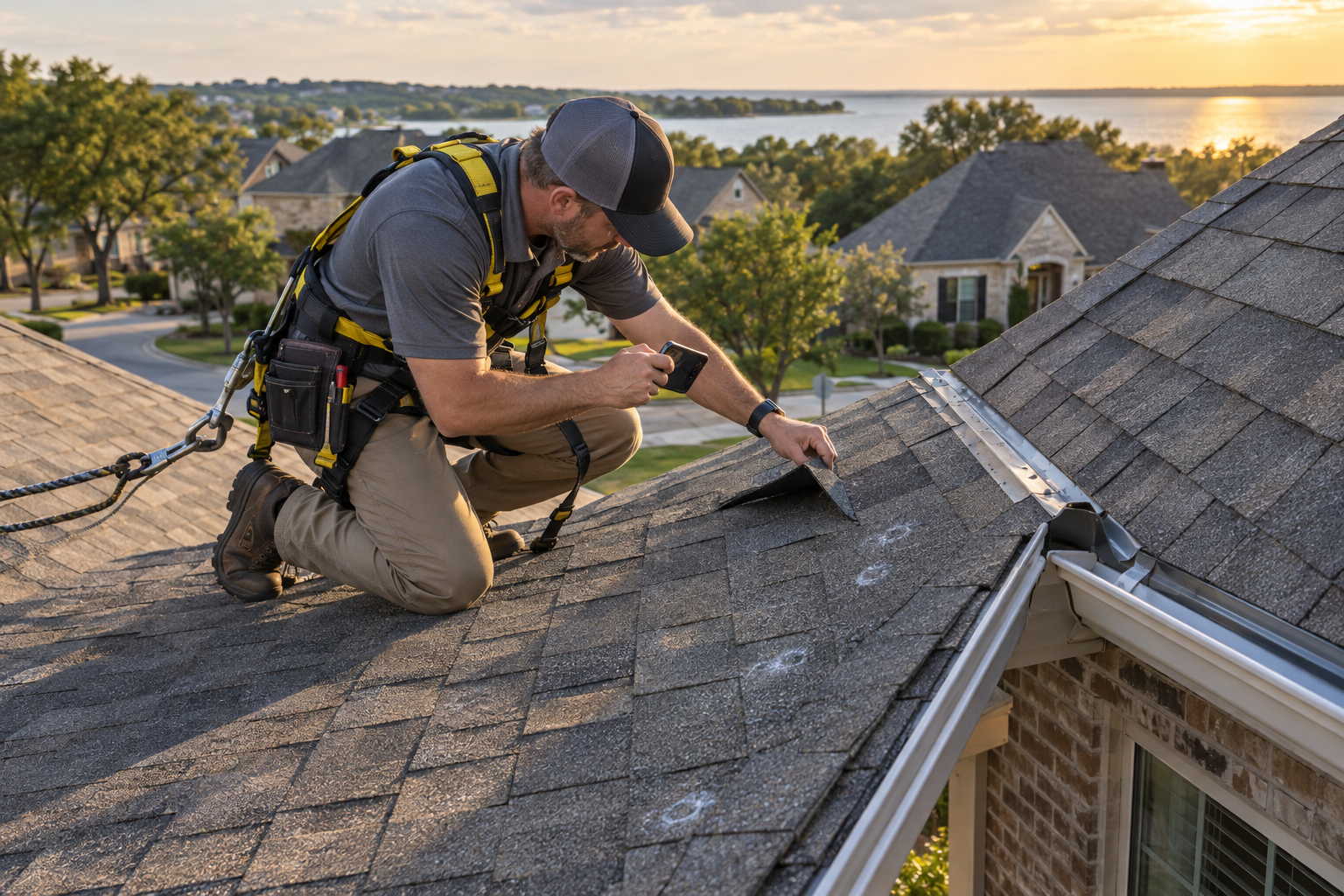
On a shingle roof, the contractor should evaluate missing, lifted, creased, cracked, loose, blistered, and impact-marked shingles. Granule loss should be evaluated in context because normal aging, foot traffic, manufacturing characteristics, and hail can create different patterns. The roofer should also inspect ridge caps, valleys, starter courses, eaves, rakes, vents, pipe boots, skylights, wall intersections, and chimney flashings.

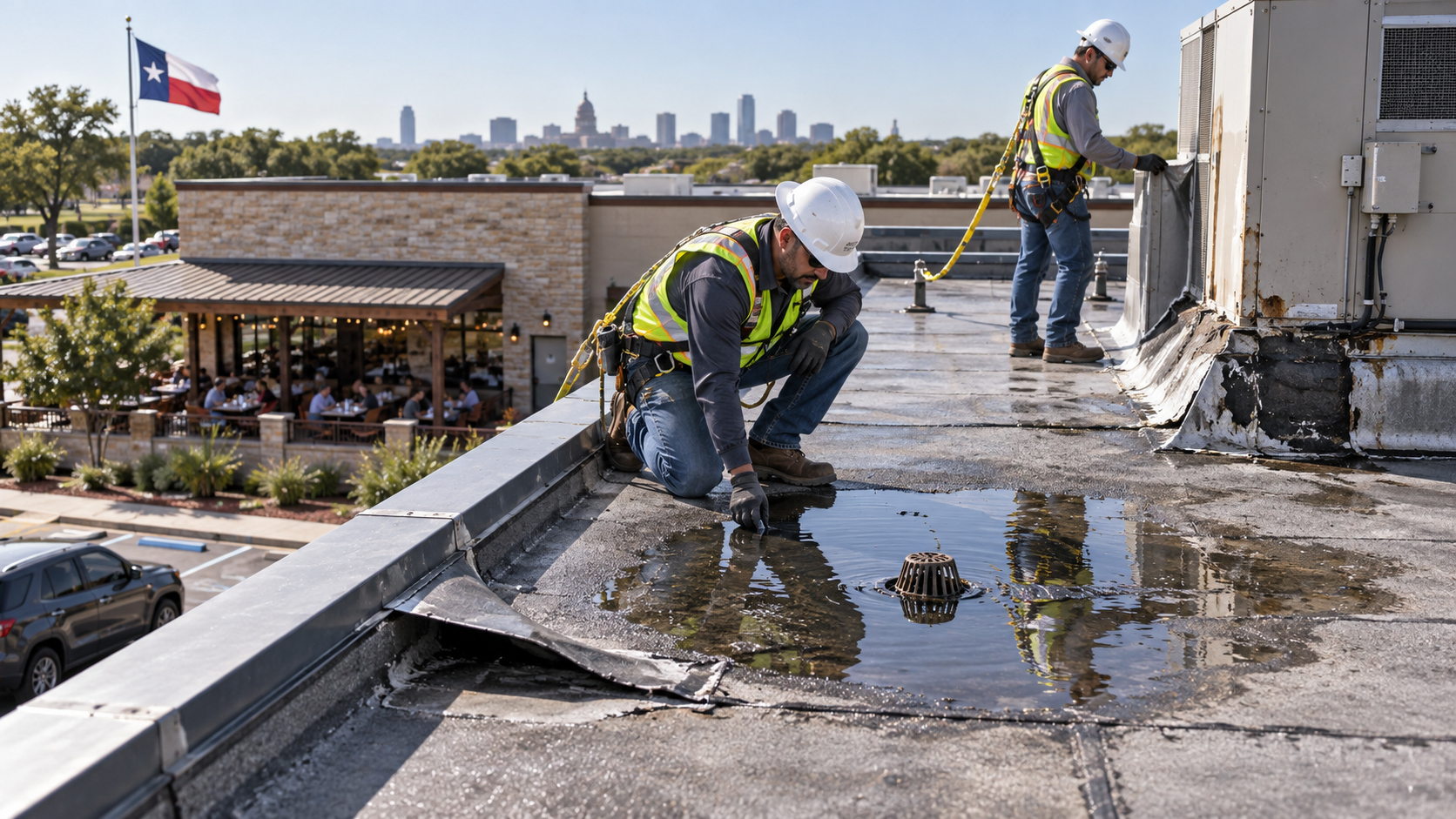
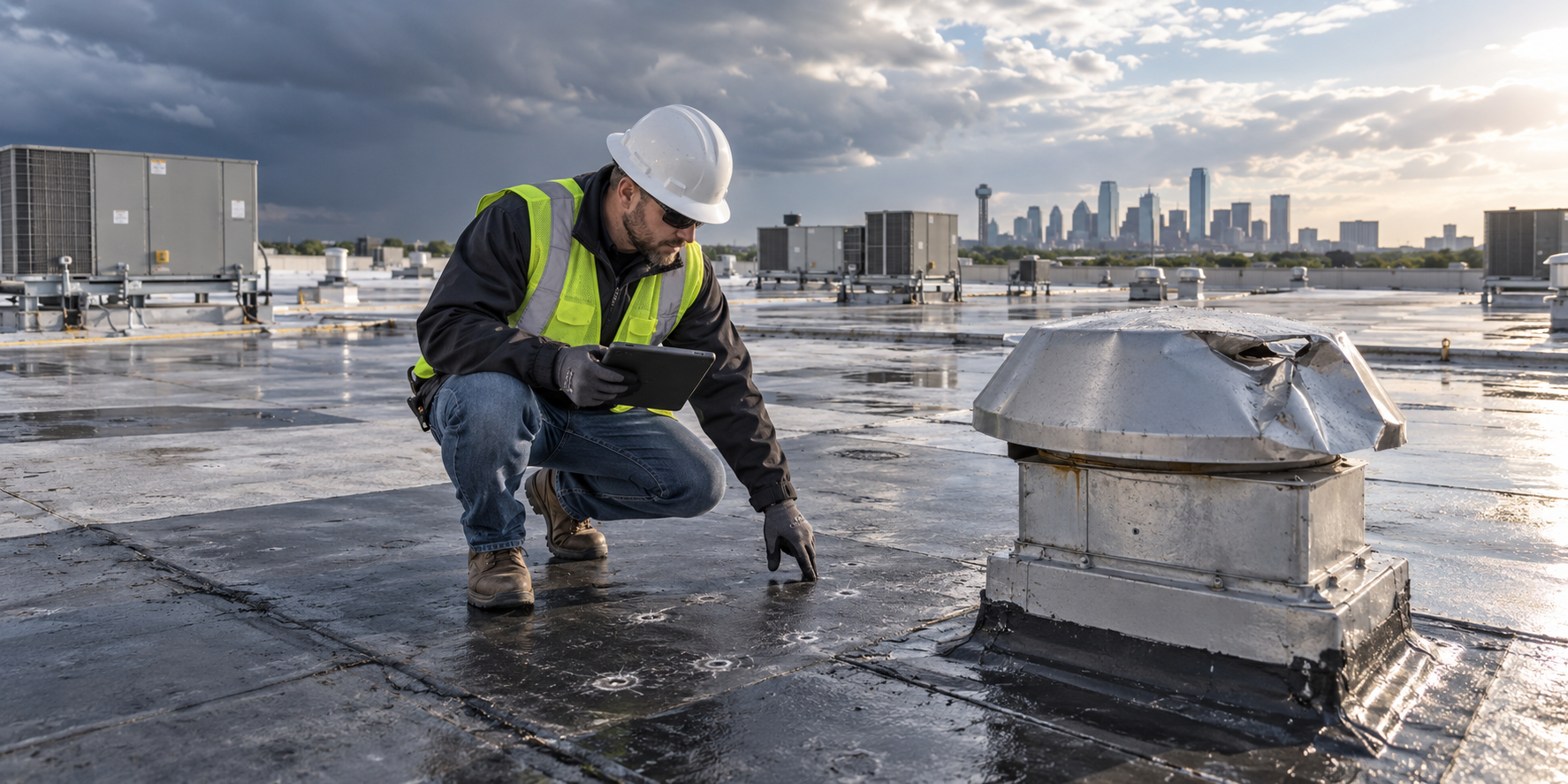
On a commercial or low-slope roof, the evaluation should address seams, laps, punctures, open terminations, flashing transitions, membrane deterioration, fasteners, plates, curbs, drains, scuppers, penetrations, edge metal, previous patches, and evidence of ponding. Showtime Exteriors describes its approach to commercial roofing throughout Texas for owners managing larger facilities.

Interior and Attic Evidence

When access is available and safe, the inspection should include the attic, underside of the deck, ceiling areas, or interior spaces associated with the leak. Darkened wood, rusted fasteners, wet insulation, staining, microbial growth, peeling paint, and damaged ceiling materials can help trace the water pathway. Moisture readings may help define affected areas, but readings should be interpreted alongside physical observations.

Drainage and Water Movement

Even a sound roof can develop problems when water does not leave the surface properly. The roofer should look for clogged gutters, blocked drains, inadequate slope, settled insulation, debris, damaged downspouts, and water marks showing repeated ponding. Repairing a membrane opening without addressing the drainage condition that contributed to it can lead to another failure.

Documentation

A useful inspection record includes an overview of the roof, close-up photographs, roof-area references, descriptions of observed damage, moisture findings when applicable, repair recommendations, and limitations of the inspection. Property owners should retain this information with invoices, warranty documents, maintenance records, and storm correspondence.

Signs Your Rockwall Roof Needs Immediate Repair


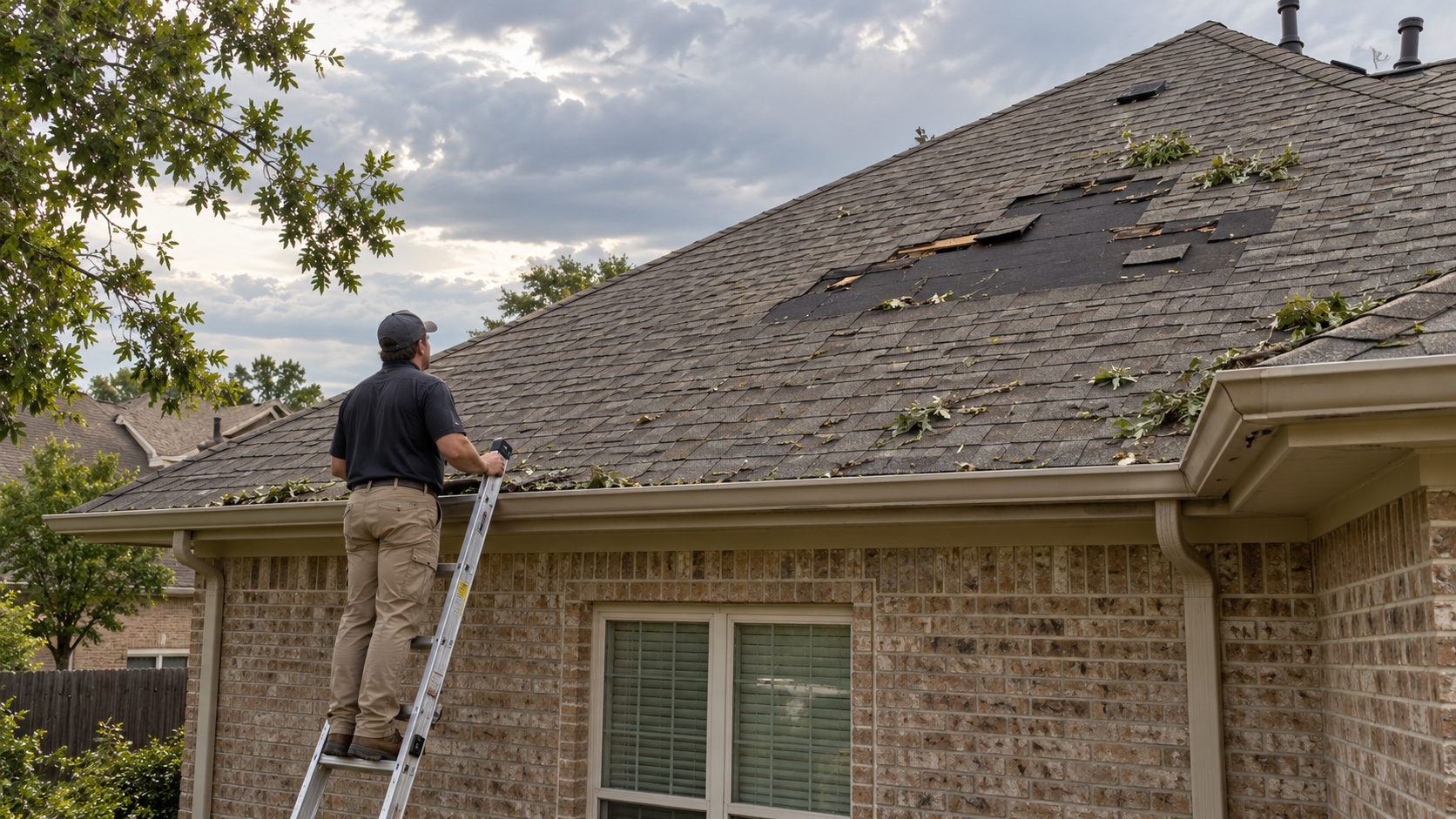
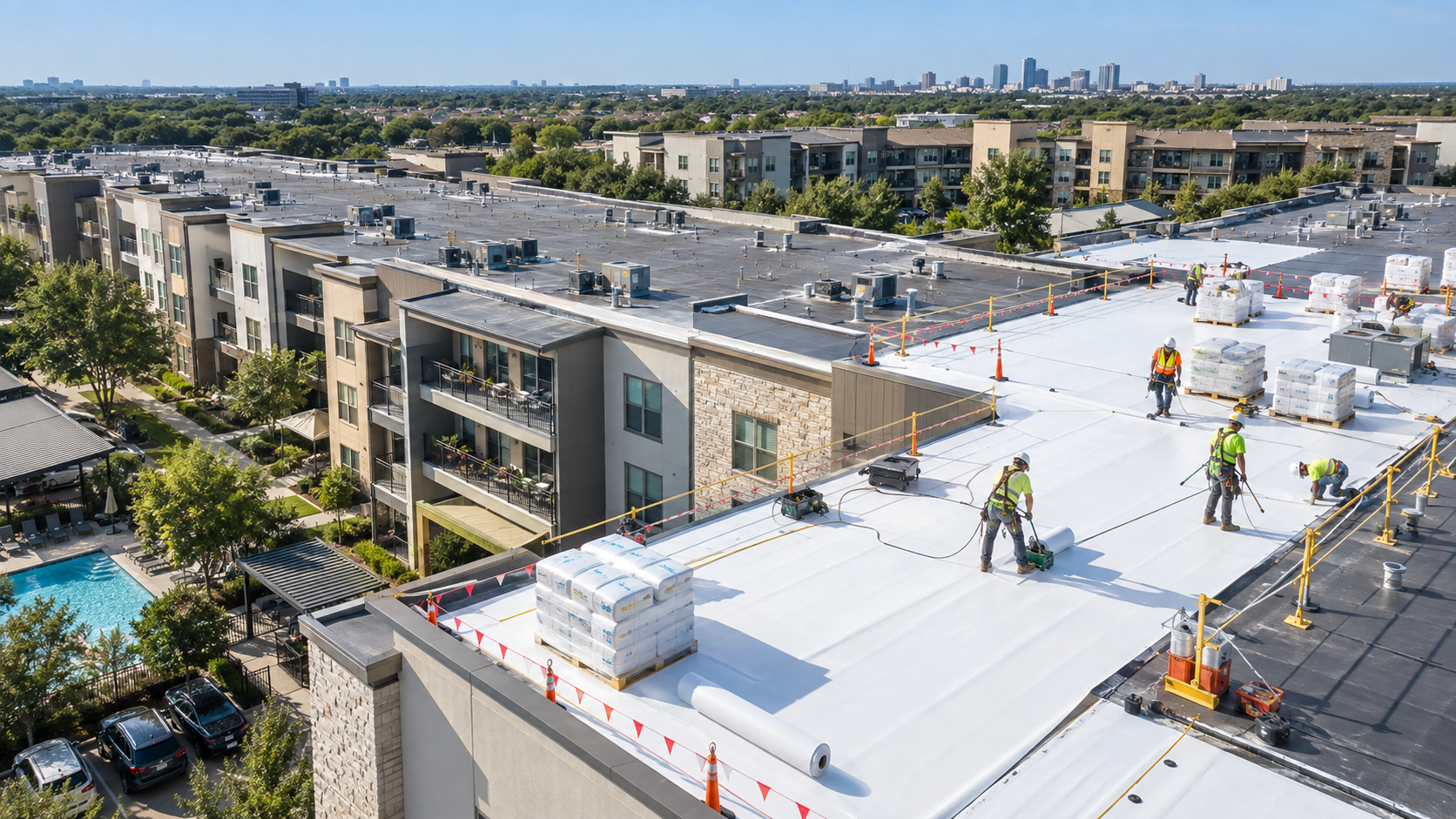
Storm documentation should show specific roof conditions without creating additional damage or compromising safety.

Some roofing conditions can be scheduled and monitored. Others need prompt attention because delay increases the chance of interior damage, structural deterioration, mold, operational disruption, or a larger repair area.

Active Water Entry

An active leak during rain should be treated as an urgent condition. Protect people, electronics, inventory, furniture, and flooring when it is safe to do so. Do not climb onto a wet roof or enter an unsafe ceiling area. A roofing contractor may install temporary protection before weather permits a permanent repair.

Missing or Lifted Shingles

Missing shingles expose the underlying assembly to weather. Lifted or creased shingles may no longer seal properly and can be vulnerable to additional wind. Prompt replacement can sometimes prevent a localized issue from becoming widespread decking or interior damage.

Open Seams or Punctured Membrane

On commercial roofs, open seams, punctures, failed terminations, and damaged flashings can allow water into insulation even before water appears inside. Wet insulation can reduce thermal performance, increase the repair scope, and make it difficult to install a durable patch unless the affected material is removed.

Sagging, Soft, or Unstable Areas

Visible sagging, soft decking, or unstable roof areas may indicate trapped moisture or structural deterioration. Keep occupants away from the affected area and request professional evaluation. A roofing contractor may need to coordinate with other specialists when structural conditions are suspected.

Damaged Edge Metal or Flashing

Perimeter edges and flashings experience significant wind pressure and movement. Loose metal, displaced coping, failed counterflashing, or open wall transitions can admit large volumes of water. These details should be secured and rebuilt using compatible components rather than simply covered with sealant.

Roof Repair, Restoration, or Replacement?

The right scope depends on the extent of damage, roof age, substrate condition, moisture content, repair history, system compatibility, warranty status, and the owner's plans for the property.

When Repair Is Appropriate

Repair is often appropriate when the damage is localized, the surrounding system remains serviceable, wet insulation can be removed completely, compatible materials are available, and the corrected detail is likely to provide meaningful service life. Examples include replacing several wind-damaged shingles, rebuilding an isolated flashing, repairing a limited membrane puncture, correcting a small open seam, or replacing a deteriorated pipe boot.

A good repair should include preparation of the surrounding surface, removal of failed material where required, installation of compatible components, proper fastening or adhesion, and documentation of the finished work. Smearing generic sealant over a wet or dirty surface is not the same as a designed roof repair.

When Restoration May Work

Restoration may be considered when the existing roof is fundamentally sound, moisture is limited and removable, the substrate is suitable, drainage is acceptable, and the selected restoration system is approved for the existing assembly. Restoration can include targeted repairs followed by a coating or reinforced system, but the coating should not be used to conceal unresolved moisture, unstable decking, failed insulation, or widespread deterioration.

When Replacement Is the Better Investment

Replacement may be more practical when damage is widespread, the roof is near the end of its useful service life, repairs have become frequent, insulation is extensively wet, decking is deteriorated, the system is incompatible with a durable repair, or the owner needs a long-term solution for insurance, sale, refinancing, or occupancy.

The choice should not be based on age alone. A relatively young roof can require replacement after severe damage or defective installation, while an older roof may remain repairable when the assembly is dry and defects are limited. The contractor should show the evidence supporting the recommendation.

Special Warning About Aging Gravel-Surfaced BUR

Rockwall commercial buildings with aging built-up roofing, or BUR, covered by gravel require careful evaluation. Gravel can conceal cracks, blisters, open laps, deteriorated felts, old patchwork, membrane erosion, and moisture pathways. It also makes consistent visual inspection and leak tracing more difficult because the waterproofing surface is not fully visible.

This uncertainty can become an insurance concern. Some carriers may request additional documentation, impose coverage restrictions, charge higher premiums, or decline renewal for properties with aging gravel-surfaced BUR. Underwriting decisions vary by insurer and policy, so no roofer can promise that repair or replacement will secure coverage. Property owners should communicate directly with their insurer or qualified insurance professional.

A responsible roofer should not present gravel as a reason to avoid investigating the roof. The evaluation may require moving gravel in selected areas, examining flashings and drainage, using moisture-detection methods, taking core samples when appropriate, and assessing insulation and deck conditions. If deterioration is widespread or the roof is difficult to document for underwriting, replacement with a more inspectable and maintainable system may be a stronger long-term plan.

Showtime Exteriors' approach is to document the condition and develop an evidence-based repair, restoration, or replacement scope. Gravel BUR should never receive a cosmetic coating merely to hide age or unresolved defects.

Residential Roof Repair Services in Rockwall

Residential roofing repairs often involve asphalt shingles, metal roofing, tile or specialty systems, underlayment, ventilation, flashing, gutters, and storm-related damage. The contractor should match replacement materials as closely as practical while explaining that exact color and weathering matches may not always be possible.

Shingle Repairs

Shingle repairs can address missing tabs, wind creases, localized impact damage, damaged ridge caps, exposed fasteners, or improper previous repairs. The roofer should avoid damaging surrounding shingles during removal and confirm that the replacement integrates with the existing courses.

Flashing and Penetration Repairs

Many residential leaks originate around pipe boots, chimneys, skylights, sidewalls, headwalls, valleys, vents, and roof-to-wall transitions. These areas often require removal of surrounding materials so the waterproofing detail can be rebuilt properly. Surface caulk may be part of a detail, but it should not substitute for correctly layered flashing.

Emergency Tarping

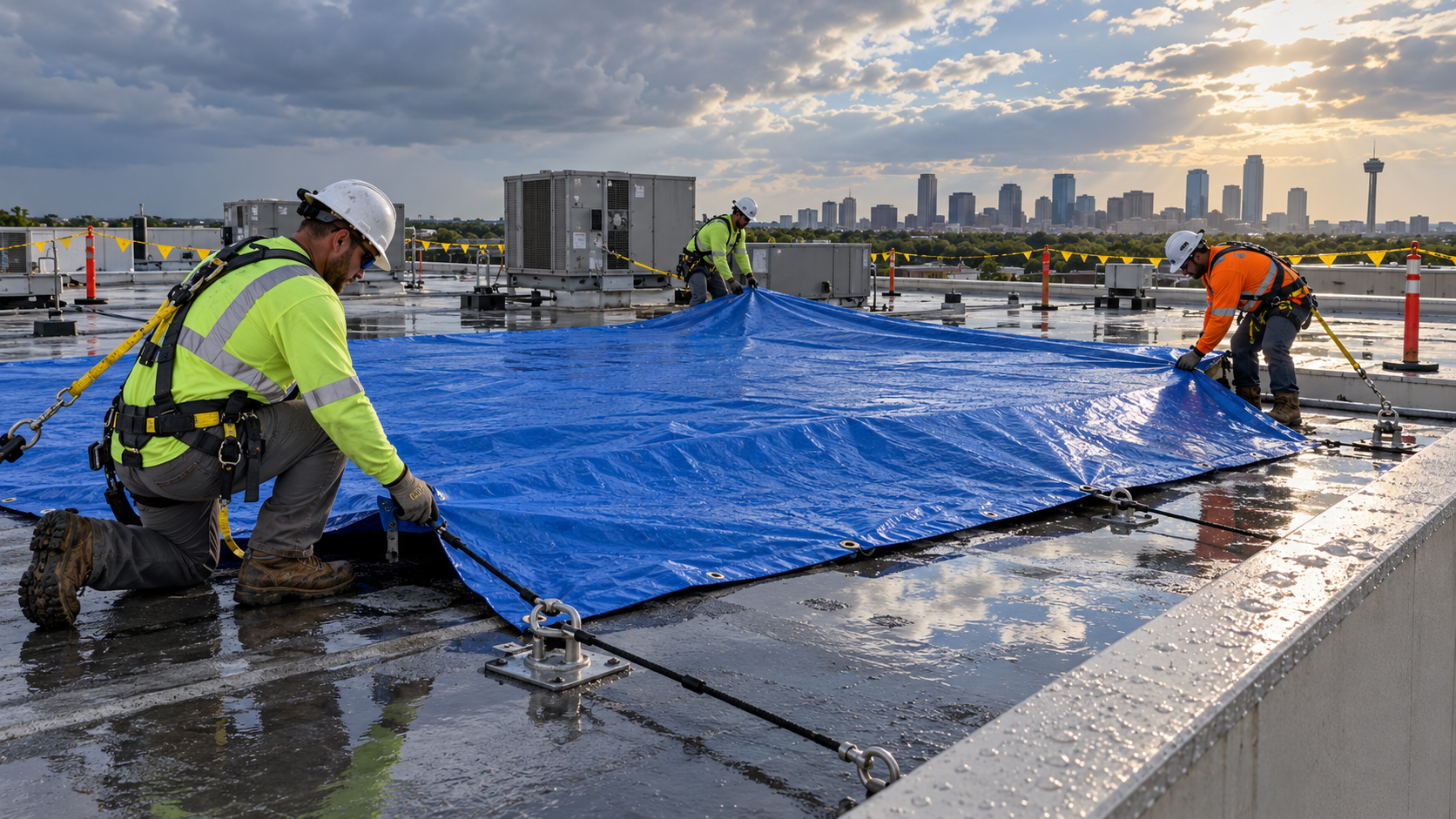
Emergency tarping can reduce immediate water entry after a storm, fallen branch, or sudden opening. It is temporary protection, not a permanent repair. The contractor should document the damaged area before covering it when conditions permit and return for a permanent solution as soon as the roof is safe and dry enough to work on.

Commercial Roof Repair Services in Rockwall

Commercial repairs require familiarity with TPO, PVC, EPDM, modified bitumen, metal, coatings, and built-up systems. Each material has different preparation, welding, adhesion, fastening, flashing, and compatibility requirements. A contractor should identify the existing system before choosing repair materials.

Single-Ply Membrane Repairs

TPO and PVC repairs commonly involve heat-welded compatible membrane after cleaning and preparing the surface. EPDM repairs typically rely on manufacturer-approved primers, tapes, uncured flashing, or membrane components. The roofer should test or verify seams as appropriate and avoid mixing incompatible chemistries.

Modified Bitumen Repairs

Modified bitumen repairs may address splits, blisters, open laps, deteriorated flashings, punctures, or failed transitions. The correct method depends on whether the membrane is APP, SBS, self-adhered, cold-applied, or installed by another method. Fire and safety controls are essential whenever heat or open-flame procedures are considered.

Metal Roof Repairs

Metal roof leaks may develop at fasteners, seams, laps, closures, penetrations, transitions, gutters, or edge details. The repair should account for metal movement. Overusing incompatible sealant can trap water or fail as panels expand and contract. The roofer should evaluate corrosion, panel condition, attachment, and the surrounding detail.

Coating Repairs

A coated roof may need cleaning, adhesion testing, reinforcement at seams and penetrations, repair of substrate defects, and compatible recoating. Applying new coating over dirt, moisture, loose material, or an incompatible product can create peeling, blistering, or trapped water.

How to Compare Rockwall Roofing Companies

Comparing contractors requires more than collecting three prices. Ask each company to inspect the same areas and define assumptions so the proposals address comparable scopes.

Confirm Company Identity and Insurance

Verify the legal business name, contact information, physical service presence, and appropriate insurance. Ask who will supervise the work and whether employees or subcontractors will perform it. Request documentation rather than relying on a verbal assurance.

Review Relevant Experience

A contractor who excels at residential shingles may not have the equipment or training for commercial membrane welding, and a commercial contractor may not specialize in every residential specialty material. Ask for experience with the exact roof type and repair condition. Showtime Exteriors provides project references that owners can review while evaluating experience.

Demand a Written Scope

The proposal should identify the repair location, removal work, materials, substrate assumptions, dimensions or quantities, installation method, disposal, protection, cleanup, exclusions, price, payment terms, and warranty. Vague language such as “fix leak” does not establish what will actually be done.

Compare Warranties Carefully

Ask whether the repair warranty covers workmanship, materials, or both; how long it lasts; what is excluded; who responds; and whether maintenance is required. The Federal Trade Commission provides general consumer warranty guidance, but the signed roofing proposal and written warranty control the actual project.

Evaluate Communication

The company should return calls, explain findings in plain language, schedule realistically, and notify you when conditions change. Good communication is especially important when the roof protects tenants, medical operations, retail inventory, manufacturing, restaurants, or occupied homes.

Questions to Ask Before Signing a Roof Repair Contract

Ask these questions before authorizing work:

What Caused the Problem?

The roofer should distinguish the visible symptom from the likely failure pathway. If the cause is uncertain, the contractor should explain what diagnostic work is needed instead of pretending certainty.

How Far Does the Damage Extend?

Ask whether insulation, decking, underlayment, framing, ceiling materials, or adjacent roof components may be affected. The proposal should state how concealed damage will be handled if discovered.

Are the Repair Materials Compatible?

Compatibility matters for membranes, coatings, sealants, metals, adhesives, primers, and shingles. Ask how the contractor identified the existing system and whether the proposed products are approved for the application.

Is a Permit Required?

Requirements can vary by scope and jurisdiction. Property owners should verify current requirements with the City of Rockwall construction and permit resources and ensure that required approvals are addressed before work begins.

How Will the Property Be Protected?

Discuss landscaping, vehicles, sidewalks, entrances, inventory, HVAC equipment, interior finishes, and occupants. The contractor should explain debris control, weather protection, material staging, access, and cleanup.

What Happens if It Rains During the Work?

The roofer should monitor weather, limit daily tear-off to an area that can be made watertight, protect open sections, and maintain emergency materials. Ask who is responsible for responding if unexpected water entry occurs.

What Documentation Will I Receive?

Request before-and-after photographs, an invoice describing the completed scope, warranty information, maintenance guidance, and records of any concealed conditions or approved changes.

Storm Damage and Insurance Claims

After a storm, prioritize safety and mitigation. Photograph visible damage from the ground when possible, note the date and time, protect the interior, retain receipts, and contact the insurer according to the policy. The Texas Department of Insurance publishes storm recovery guidance for consumers.

A roofing contractor can inspect the roof, document observed conditions, provide an estimate, perform emergency protection, and complete authorized repairs. The contractor should not promise claim approval, interpret coverage as an insurance adjuster or attorney, waive deductibles improperly, or guarantee how the carrier will classify the loss. Coverage, depreciation, deductibles, exclusions, deadlines, and payment are governed by the policy and insurer.

Property owners should also avoid signing rushed agreements with unknown storm chasers. Verify identity, read cancellation and payment terms, and do not allow anyone to create artificial damage. FEMA's consumer resources on avoiding disaster-related fraud and scams offer additional precautions after severe events.

Safety Is Part of Professional Roof Repair

Roof repair involves fall exposure, ladders, electrical hazards, weather, hot materials, tools, sharp metal, fragile surfaces, and occupied-property risks. A professional contractor should plan access, fall protection, material handling, pedestrian control, housekeeping, and emergency procedures.

Owners should not climb onto a wet, steep, damaged, or structurally questionable roof to collect photographs. OSHA maintains general roofing safety resources for employers and workers. The contractor is responsible for following applicable safety requirements; the customer should expect visible organization and safe conduct at the property.

What a High-Quality Roof Repair Should Include

A durable repair begins with a clean, stable, and correctly prepared substrate. Failed materials should be removed when the repair design requires removal. Wet insulation should not be sealed inside merely to reduce the price. The replacement should integrate with the surrounding roof and restore continuity at seams, flashings, edges, and penetrations.

Quality control should occur before the crew leaves. Depending on the system, this may include seam probing, adhesion checks, fastener verification, water-path review, cleanup, magnetic sweeps, drain clearing, and photographs. The owner should receive an explanation of what was repaired and what conditions still require monitoring.

Temporary materials should be labeled and tracked as temporary. A tarp, emergency patch, or short-term seal can protect the building until permanent work is possible, but it should not disappear into the maintenance history. Set a follow-up date and keep documentation.

Preventive Maintenance After the Repair

Even a well-executed repair needs reasonable maintenance. Inspect the roof after major storms and at intervals appropriate for the building and warranty. Keep gutters, drains, and scuppers clear. Limit unauthorized rooftop traffic. Require HVAC, solar, plumbing, and electrical contractors to protect the roof and coordinate penetrations.

Keep a roof file containing inspection reports, photographs, proposals, invoices, warranty documents, maintenance logs, leak reports, and records of work by other trades. Documentation makes it easier to identify recurring problems, plan budgets, support property transactions, and respond to insurer questions.

Showtime Exteriors publishes additional commercial roofing resources for Texas property owners who want to understand systems, maintenance, insurance documentation, and replacement planning.

Why Rockwall Property Owners Choose Showtime Exteriors

Showtime Exteriors is a Texas-based, full-service roofing company serving residential and commercial property owners across North Texas. The company evaluates shingle, metal, TPO, PVC, EPDM, modified bitumen, coating, and built-up roofing conditions and develops practical repair or replacement options based on the building.

The goal is not to sell a universal answer. A localized defect on a serviceable roof may justify repair. Widespread deterioration, extensive moisture, repeated failures, or an aging gravel-surfaced BUR system may justify a larger replacement plan. The decision should be supported by inspection evidence, photographs, roof-system knowledge, and the owner's priorities.

Property owners can review common roofing questions and answers before scheduling service. For a Rockwall roof inspection or repair consultation, use the Showtime Exteriors contact page or call 817-400-ROOF (7663).

What to Expect During a Showtime Exteriors Repair Visit

The visit should begin with a discussion of the symptoms, when they started, whether they change with wind direction or rainfall intensity, and what previous work has been performed. The inspector then evaluates accessible exterior and interior areas, documents relevant conditions, and identifies any limitations that prevent a complete conclusion.

When the defect is clear and localized, the recommended scope should identify the exact repair area and materials. When moisture may extend beyond the visible defect, additional investigation may be recommended before a final price is established. That step protects the owner from approving a surface repair that leaves wet insulation or deteriorated decking in place.

After the work, the repair area should be reviewed and photographed. The owner should receive the final scope, invoice, warranty information when applicable, and any remaining maintenance recommendations. If the roof has other aging conditions that were not included in the authorized repair, those conditions should be reported separately rather than quietly added to the invoice.

This process is particularly valuable for property managers responsible for multiple buildings. Consistent records allow repair histories to be compared across roof areas, help identify recurring failures, and support capital planning. They also provide a clearer basis for deciding when continuing repairs no longer produces reasonable value.

Frequently Asked Questions

How Much Does Roof Repair Cost in Rockwall, Texas?

Cost depends on roof type, access, height, damage extent, materials, wet insulation, decking, flashing complexity, permits, safety requirements, and whether the work is temporary or permanent. A site inspection is the most reliable way to define the scope. Very low estimates may exclude removal, substrate repair, compatible materials, or warranty coverage.

How Quickly Should a Storm-Damaged Roof Be Inspected?

Arrange an inspection promptly after it is safe to do so, especially when there is active water entry, missing material, displaced flashing, punctures, or visible structural concern. Prompt inspection does not mean automatically filing a claim or replacing the roof. It creates a record and helps prevent avoidable additional damage.

Can a Roof Leak Always Be Repaired?

Many leaks can be repaired, but not every roof is a good repair candidate. Widespread moisture, unstable decking, incompatible materials, chronic failures, or advanced deterioration may make replacement more responsible. The roofer should explain why the surrounding system can or cannot support a durable repair.

Should I Get More Than One Roofing Estimate?

Multiple proposals can be helpful, particularly for a large or complex scope. Make sure each contractor is pricing comparable work. One estimate may include wet-insulation removal, flashing reconstruction, and a warranty while another includes only surface sealant.

Will Roof Repair Guarantee Insurance Renewal?

No. A contractor can document the roof and complete repairs, restoration, or replacement, but the insurer decides eligibility, coverage, premiums, deductibles, and renewal. This is particularly important for aging gravel-surfaced BUR, which some carriers may view as difficult to inspect or maintain.

Is Showtime Exteriors Only a Commercial Roofer?

No. Showtime Exteriors provides both residential and commercial roofing services across North Texas, including inspection, repair, storm response, and replacement planning.

Final Checklist for Choosing the Best Rockwall Roof Repair Company

Before hiring, confirm the contractor's identity, insurance, roof-system experience, inspection findings, written scope, compatible materials, safety approach, schedule, payment terms, warranty, documentation, and service process. Ask whether the proposed work corrects the source of the problem or only covers the symptom.

For commercial buildings with aging gravel BUR, require an assessment that addresses concealed moisture, insulation, decking, drainage, flashings, patch history, and potential insurance concerns. Do not accept a cosmetic surface treatment as a substitute for investigation.

For residential roofs, require careful evaluation of shingles, underlayment, flashings, penetrations, ventilation, edges, and storm patterns. A trustworthy roofer will explain whether repair is sufficient and will not pressure you into unnecessary replacement.

To schedule a roof inspection in Rockwall, Texas, contact Showtime Exteriors at 817-400-ROOF (7663).

By Showtime Exteriors September 20, 2026
Texas commercial roofing warranty guide
By Showtime Exteriors September 20, 2026
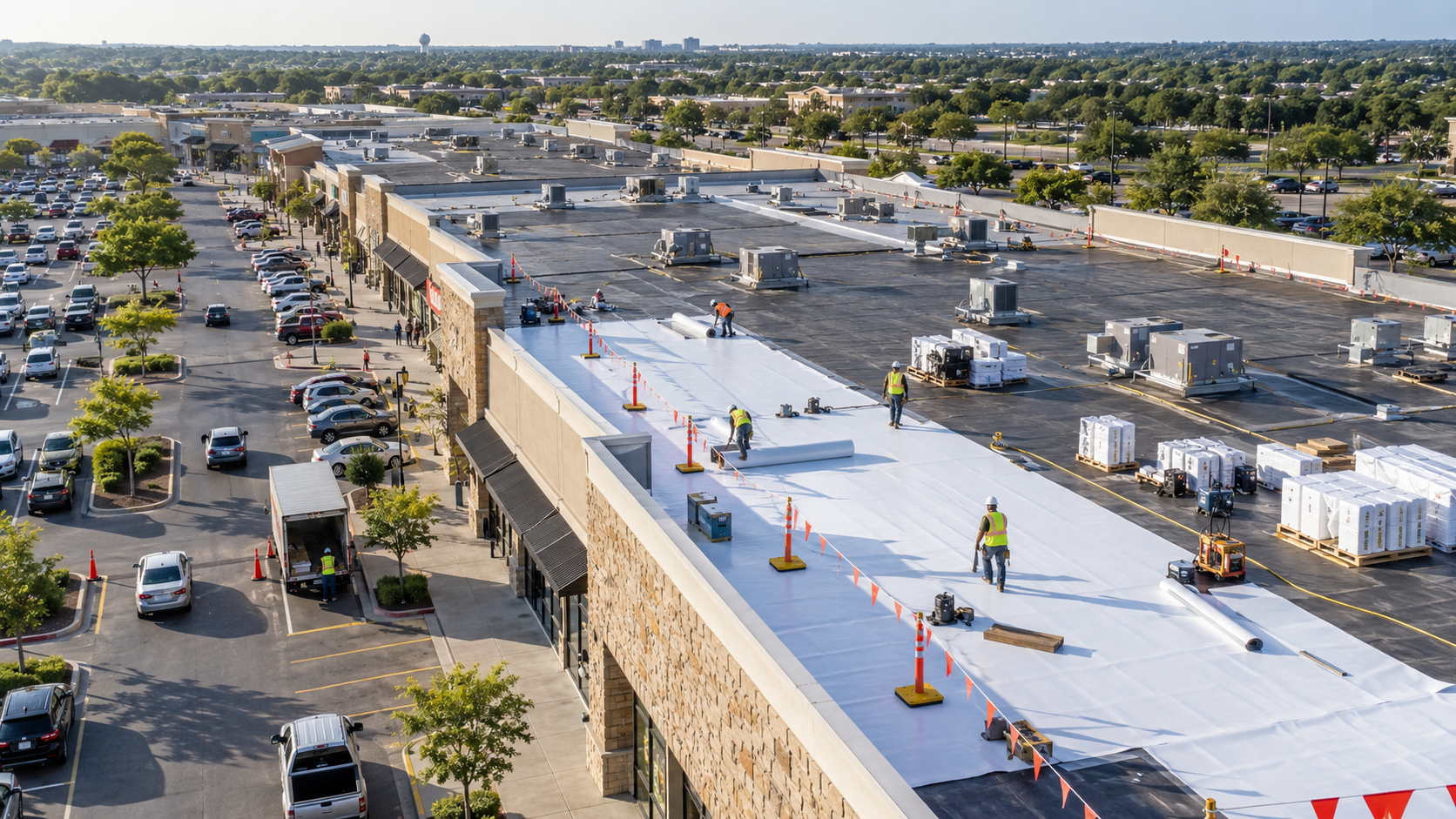
Replacing a shopping center roof is an occupied-property project with direct consequences for tenants, customers, employees, deliveries, signage, utilities, parking, and rental income. A successful replacement must improve the building envelope without creating unnecessary interruption below. That requires more than choosing a membrane and scheduling a crew. It requires a building-by-building assessment, an accurate scope, tenant coordination, safe staging, weather planning, insurance documentation, and daily quality control. Texas shopping centers face intense ultraviolet exposure, high surface temperatures, hail, straight-line wind, thunderstorms, heavy rain, and rapid weather changes. Large low-slope roofs can collect enormous amounts of water. Numerous HVAC units, curbs, pipes, conduits, drains, parapets, signs, and tenant improvements create hundreds of details that must remain watertight. Showtime Exteriors provides commercial roofing services throughout Texas , including inspection, repair, restoration, retrofit, and replacement planning. This guide explains how shopping center owners can evaluate roof condition, understand cost variables, coordinate tenants, select a replacement system, document insurance concerns, and address aging gravel-surfaced built-up roofing as the liability David Washington wants emphasized. Why Shopping Center Roof Replacement Is Different A retail property rarely operates as one uniform building. A single center may include restaurants, medical tenants, offices, salons, grocery spaces, warehouses, and small storefronts. Each tenant may have different hours, equipment, air intakes, odors, security needs, delivery windows, and sensitivity to noise or dust. Roof work over a restaurant kitchen cannot always be managed the same way as work over a vacant suite. Tenant improvements also change the roof over time. Mechanical contractors add or replace rooftop units. Sign companies install supports and electrical lines. Satellite, solar, plumbing, and refrigeration work can create penetrations that do not appear on original plans. A replacement scope must document what exists today rather than rely entirely on old drawings. Broad roofs create logistical demands. Materials may require cranes or lifts. Tear-off debris needs a controlled route. Fire lanes, accessible spaces, storefront entrances, loading zones, and customer traffic must remain protected. Showtime Exteriors’ shopping center roofing resource provides more retail-property context. Signs a Shopping Center Roof May Need Replacement One leak does not automatically require replacement. A localized puncture, open seam, damaged flashing, or isolated storm defect may be repairable when surrounding materials remain serviceable. Replacement becomes more defensible when deterioration is widespread, insulation is wet, the deck is compromised, drainage is chronically poor, or repair spending no longer produces dependable performance. Warning signs include recurring leaks in several suites, repeated failures around HVAC curbs, widespread seam deterioration, membrane shrinkage, exposed reinforcement, loose edge metal, extensive blistering, saturated insulation, corrosion, soft roof areas, ponding, and many layers of old patches. A trend across repair invoices often reveals more than one visual inspection. Owners should compare the annual cost of emergency calls, interior repairs, tenant disruption, lost inventory, and recurring patches with the cost and expected performance of a planned capital project. Waiting for an emergency reduces choices. Planned replacement gives ownership more control over system selection, timing, financing, tenant notices, staging, and warranties. Why Aging Gravel Surfaced BUR Is a Retail Property Liability Aging gravel-surfaced BUR can conceal moisture, failed repairs, membrane deterioration, and drainage defects. An aging gravel-surfaced built-up roof is difficult to evaluate because loose aggregate conceals the waterproofing surface. Beneath the gravel may be cracks, blisters, deteriorated felts, failed patches, irregular asphalt, punctures, trapped moisture, and drainage defects. A surface walk alone may not reveal the true condition. Gravel can migrate into drains and low areas. It complicates moisture investigation, repair preparation, adhesion testing, and some restoration approaches. Applying a coating over loose or unstable aggregate is not a responsible shortcut. Controlled gravel removal, test areas, core samples, moisture surveys, or authorized cuts may be needed before a defensible scope can be developed. Insurance underwriting can increase the urgency. Some carriers may request roof age, photographs, repair history, moisture findings, or a replacement plan when reviewing an older gravel BUR property. Others may impose limitations, higher premiums, or non-renewal based on their own guidelines and the building’s condition. Requirements vary. Showtime Exteriors can document observable roofing conditions, but no contractor can guarantee coverage, claim payment, premium reductions, or renewal. Start With a Complete Roof Inventory Create a roof plan showing every section, elevation, tenant below, access point, drain, scupper, gutter, downspout, overflow, parapet, expansion joint, penetration, rooftop unit, and transition. Identify the existing system on each section and note approximate age, previous recover layers, and visible repairs. The inspection should cover the field membrane, seams, fasteners, flashings, curbs, pipes, pitch pockets, equipment supports, traffic areas, edges, coping, walls, drainage, prior patches, and accessible interiors. Map reported leaks by suite and room. Water can travel through insulation, deck flutes, framing, conduits, and walls, so the ceiling stain may be far from the entry point. Moisture evaluation may use visual observations, infrared scanning, capacitance testing, probing, core samples, or test cuts when appropriate. Each method has limitations related to roof construction, weather, surface condition, calibration, and interpretation. Suspected wet areas may require confirmation before removal quantities are finalized. Build an Accurate Roof History Collect original plans, specifications, warranties, inspection reports, repair invoices, leak logs, storm dates, moisture surveys, photographs, tenant reports, and records of rooftop equipment changes. Interview maintenance staff, but distinguish reported history from confirmed physical findings. Create a timeline showing when each section was installed, repaired, coated, or recovered. Note which areas fail repeatedly and whether water entry follows a particular wind direction or rainfall pattern. Review whether third-party contractors have cut or fastened through the roof without documented flashing. A reliable history supports budgeting and proposal comparison. It also helps the contractor avoid repeating a detail that has already failed. When records are missing, the scope should acknowledge the uncertainty and define how hidden conditions will be handled. What Determines Shopping Center Roof Replacement Cost Square footage matters, but it is only one part of the price. Cost depends on the existing assembly, number of layers, tear-off method, gravel removal, disposal, deck repairs, insulation, cover board, membrane or panel selection, attachment, perimeter design, drainage corrections, penetrations, rooftop equipment, access, staging, safety, tenant protection, permits, and number of mobilizations. A large open roof may install efficiently, but a center with many walls, curbs, signs, drains, and elevation changes contains more labor-intensive detail work. Restaurants and grocery tenants may have grease exhaust, refrigeration lines, and equipment requiring special coordination. Medical or office tenants may have sensitive operations below. Concealed conditions are another variable. Tear-off may expose wet insulation, corroded steel deck, deteriorated wood, abandoned openings, unsafe wiring, or construction that does not match drawings. A responsible proposal should define allowances, unit prices, or authorization procedures rather than pretend concealed work will never occur. Major Cost Categories Tear Off Gravel Removal and Disposal Removing one dry single-ply layer differs from removing several asphaltic layers covered with gravel. Aggregate removal, loading, transportation, and disposal add labor and equipment. Multiple layers increase weight and time. Test cuts help establish the assembly before bids are finalized. Insulation and Cover Board Insulation affects energy performance, condensation control, attachment, code compliance, and drainage. Tapered insulation can direct water toward drains or scuppers. Cover board can improve the substrate and resistance to service traffic. Required thickness and configuration depend on the building, deck, code, selected system, and design. Deck Repair Steel deck may have corrosion, damaged welds, or loose fasteners. Wood may be rotted or delaminated. Concrete may have cracks, spalls, or unsuitable surfaces. Structural conditions outside the roofing contractor’s responsibility should be evaluated by a qualified professional. Flashings Perimeters and Penetrations Walls, curbs, pipes, drains, edges, and transitions often require more labor than the open field. A low bid that excludes tenant equipment, counterflashing, edge metal, or drain work may not represent the complete project. Access Safety and Customer Protection Fall protection, pedestrian controls, covered walkways, debris handling, secure staging, traffic control, and daily cleanup are real costs. OSHA maintains general roofing safety resources that reinforce the need to design safety into the project rather than treat it as an optional line item. Repair Restore Recover or Replace Repair is appropriate when defects are limited and the adjacent assembly remains serviceable. Restoration may be considered when the roof is dry, stable, compatible, and accepted by the selected manufacturer. A recover may install a new system over an eligible existing roof after moisture, load, attachment, code, fire, and warranty requirements are addressed. Replacement removes the existing system to an approved substrate and rebuilds the assembly. For aging gravel BUR, replacement or a carefully evaluated recover becomes more defensible when recurring leaks, widespread moisture, failing flashings, unstable surfacing, poor drainage, extensive patching, deck concerns, or insurance restrictions exist. Continued patches can spend operating funds while leaving concealed deterioration and underwriting uncertainty unresolved. The recommendation should compare total ownership cost, not only initial price. Consider expected service, maintenance, disruption, energy goals, warranty, and the risk that an incomplete approach preserves wet materials or failed details. Choosing the Replacement System TPO Roofing TPO is commonly considered for broad low-slope retail roofs. It uses heat-welded seams and is available in reflective colors. Performance depends on membrane thickness, attachment or adhesion, substrate preparation, welding, flashing, perimeter securement, drainage, installation conditions, and maintenance. Color alone does not determine performance. PVC Roofing PVC also uses heat-welded seams but is not interchangeable with TPO. It may be evaluated near restaurants or other exposures where grease or chemicals affect material selection, subject to project-specific review. Formulation, thickness, attachment, flashing, and compatibility matter. EPDM Roofing EPDM is a rubber membrane installed with system-specific adhesives, tapes, primers, seams, terminations, and flashings. Design must account for wind, traffic, drainage, substrate, temperature, and compatibility. The existing membrane should be correctly identified before repair or transition work. Modified Bitumen Modified bitumen may use hot asphalt, torch, cold adhesive, self-adhered components, or other approved methods. Fire safety, odors, tenant air intakes, substrate, weather, and manufacturer instructions affect whether an application method fits an occupied shopping center. Metal Roofing and Retrofits Metal evaluation should address panels, seams, clips, fasteners, washers, closures, corrosion, movement, edges, penetrations, gutters, and substrate. Coating every screw with sealant does not correct loose panels, elongated holes, failed clips, corroded metal, or uncontrolled movement. Roof Coatings A coating is appropriate only when the existing roof is a qualified candidate. Confirm roof chemistry, moisture, adhesion, cleanliness, repairs, reinforcement, slope, ponding, coverage rate, thickness, cure conditions, and manufacturer acceptance. Coating wet or unstable materials can hide a problem instead of solving it. Drainage and Texas Rain A broad retail roof can collect thousands of gallons during a downpour. Drains, scuppers, gutters, downspouts, overflows, crickets, sumps, tapered insulation, and structural slope must work together. Debris and displaced gravel can restrict outlets. Chronic ponding may require design or construction changes, not another patch. Replacement is an opportunity to correct low areas and damaged drains instead of copying the previous configuration. Confirm where discharged water travels at grade so a roof correction does not create a storefront, sidewalk, foundation, or parking-lot problem. Drainage components should remain accessible after the project. Maintenance teams need safe routes and clear records identifying primary and overflow outlets. Final inspection should verify that strainers, clamping rings, seals, flashings, and adjacent membrane are complete. Energy and Heat Considerations Texas sun places heavy thermal demand on retail roofs. A reflective membrane may support energy goals when compatible with the property, but the roof is one part of performance. Insulation, air leakage, HVAC condition, ducts, tenant loads, windows, occupancy, and controls also affect consumption. The Department of Energy provides general information about cool roofs . Do not reduce system selection to surface color. Wind design, drainage, attachment, deck condition, flashing, workmanship, rooftop traffic, and maintenance remain essential. A reflective membrane installed over wet insulation or a damaged deck is not a high-performance assembly. Coordinate roofing with planned HVAC replacement. Installing new roofing around equipment scheduled for removal can create avoidable patches later. When equipment remains, curbs, condensate, gas, electrical, ducts, vibration, and service access should be addressed in the scope. Tenant Coordination Before Construction Create a tenant matrix listing business name, suite, hours, delivery windows, sensitive operations, rooftop equipment, air intakes, emergency contacts, and planned events. Identify restaurants, clinics, childcare, grocery, fitness, salons, and other tenants that may need additional planning. Tenant notices should explain anticipated dates, hours, noise, vibration, odors, parking changes, delivery restrictions, and whom to contact. Avoid promises that weather may make impossible. Explain how schedule changes will be communicated. The lease may define roof access, maintenance responsibilities, utility ownership, insurance, notice, and restoration obligations. Ownership should review lease requirements with appropriate professionals rather than ask the roofer to interpret legal duties. Phasing Work Around Customers and Operations Phasing divides the roof into sections that can be opened, completed, inspected, and made watertight in a controlled sequence. Daily limits should reflect crew capacity, roof complexity, weather, and the time required to secure the building before work stops. Plan staging so customer entrances, fire lanes, accessible routes, loading areas, and emergency access remain clear. Use barriers and spotters where equipment crosses active traffic. Coordinate crane or lift operations during lower-traffic periods when practical. Restaurants may require different sequencing because of exhaust and kitchen operations. Offices may be sensitive to noise during meetings. Dedicated restaurant roofing guidance and office building roofing guidance can help owners compare those operational differences. Protecting Inventory Interiors and Building Systems Before tear-off, identify sensitive areas below. Electronics, food, pharmacy products, medical equipment, ceilings, fire-alarm systems, electrical rooms, server closets, and tenant improvements may need additional protection. Dust and debris can enter through deck openings, while vibration can affect suspended components. Assign responsibility for inspecting interior protection during each active phase. Establish an immediate process for reporting water, dust, odors, or debris. Record the suite, room, time, active roof section, weather, photograph, and response. When moisture or suspected mold exists, roofing repairs address the exterior source but may not complete the interior remediation. The EPA provides general mold and moisture guidance . Qualified parties should define testing, drying, removal, cleaning, reconstruction, and clearance when needed. Coordinating Signs Fire Protection and Rooftop Utilities Shopping centers often contain sign structures, lighting circuits, fire-sprinkler components, gas lines, refrigeration piping, communications equipment, exhaust systems, and tenant-installed conduits near or through the roof. These systems may cross proposed tear-off areas or be supported by improvised blocks that damage the membrane. The preconstruction survey should identify ownership, function, condition, and responsibility for every visible rooftop component. Sign bands and parapets deserve special attention because water can enter above the roof membrane and travel behind walls before appearing inside a suite. Counterflashing, coping, joints, fasteners, sealants, masonry, wall panels, and sign penetrations should be reviewed as a connected water-control system. Replacing only the horizontal membrane will not correct leakage entering through a deteriorated wall or coping joint. Fire-protection and life-safety systems must remain functional unless an authorized shutdown has been planned and communicated. Roof drains, smoke vents, access hatches, fire lanes, hydrants, and emergency exits cannot be obstructed casually by materials or equipment. Property management should coordinate required notices, impairment procedures, and inspections with the responsible professionals and authorities. Rooftop utilities should be supported without trapping water or concentrating loads. Abandoned pipes and conduits should be traced before removal. Active lines should not be moved, disconnected, or buried beneath new roofing without approval. Where supports remain, the scope should address compatible bases, walk pads, clearance for flashing, and a route for future service technicians. New roof work should also anticipate scheduled tenant improvements. If a major HVAC unit, sign, refrigeration system, or solar installation is planned within the next year, coordinate the sequence now. Completing the roof and then allowing another trade to cut it open weeks later creates unnecessary risk, patches, and warranty questions. A written rooftop-work policy can require advance notice, approved details, contractor coordination, and post-work inspection for every future penetration. Weather and Heat Planning Texas conditions can change rapidly. Monitor forecasts and actual site conditions throughout the day. Secure materials against wind. Install adhesives and coatings only within approved temperature, humidity, and substrate conditions. Open no more roof than the crew can complete and protect before weather changes. Temporary tie-ins should be inspected before crews leave. Materials and debris should not be allowed to block drains. The project team needs clear authority to pause work when wind, rain, lightning, or heat creates unsafe or unsuitable conditions. Extreme heat affects workers and productivity. OSHA’s heat exposure guidance emphasizes water, rest, shade, acclimatization, planning, and recognition of illness. A schedule that ignores Texas heat can create safety problems and pressure crews to rush details. Business Continuity and Emergency Planning The project plan should address more than the normal schedule. Define what happens if a storm develops, a tenant reports active water, a delivery blocks access, an alarm activates, or concealed deck damage expands the work area. Maintain contact lists for ownership, management, contractor supervision, tenants, security, utilities, and emergency services. Identify who can authorize extra work and who communicates schedule changes. Ready.gov offers general business continuity guidance that can support property-level planning. Emergency protection should be treated as temporary. Tarps, temporary membranes, and sealants may reduce immediate water entry, but they require follow-up inspection and permanent correction. Document emergency work with dates, photographs, locations, materials, and invoices. Insurance Documentation Without Guarantees Roof replacement may be driven by age, deterioration, storm damage, underwriting requirements, or capital planning. Keep those issues distinct. Inspection notes should separate observable facts, reported history, test results, and professional opinion. After a storm, preserve photographs, videos, weather information, repair invoices, damaged materials when practical, correspondence, and estimates. The Texas Department of Insurance provides general storm and claim guidance , but commercial policies and facts vary. Showtime Exteriors can document physical conditions and prepare a roofing estimate. The carrier determines coverage, causation, depreciation, deductibles, scope approval, payment, renewal, and premiums. No article, inspection, or contractor statement guarantees an insurance outcome. Comparing Commercial Roofing Proposals Compare proposals line by line. Confirm roof areas, tear-off assumptions, disposal, deck repair procedures, insulation, cover board, membrane thickness, attachment, flashing, edge metal, drainage, walk pads, equipment coordination, safety, tenant protection, permits, inspections, warranties, exclusions, and payment terms. Ask who supervises the work and how changes are documented. Clarify manufacturer inspection requirements and conditions that could limit warranty issuance. Verify the exact system instead of accepting vague wording such as white membrane or premium coating. The cheapest proposal may omit critical scope. A complete bid should explain assumptions, allowances, unit prices, and responsibilities. Showtime Exteriors also provides broader retail roofing guidance for owners comparing shopping-center work. Define Owner Contractor and Tenant Responsibilities Before signing, create a responsibility matrix. It should state who moves tenant property, disconnects equipment, provides interior protection, controls keys and roof access, communicates with tenants, authorizes concealed-condition work, coordinates utilities, restores ceilings, and responds after hours. Unassigned tasks often become schedule delays or disputes once the roof is open. The contractor should identify roofing inclusions and exclusions clearly. Property management should manage tenant communications and access unless the agreement assigns another process. Tenants should know that unauthorized rooftop work can damage the new assembly and affect warranty rights. Specialty trades should coordinate their work through ownership and use approved details. The matrix should also identify the decision maker who can approve urgent changes. If deteriorated deck or hidden wet insulation is discovered, the crew may not be able to leave the area exposed while several parties debate responsibility. A documented approval path, supported by photographs and agreed unit prices, helps the project move without sacrificing control. Quality Control During Installation Verify approved materials, storage, substrate conditions, layout, attachment patterns, and details before installation. During work, document deck repairs, insulation, fastening, adhesive, seam welding, flashing, perimeter securement, drains, and daily tie-ins. Inspect details before they are concealed. Completed seams may require probing or other system-specific checks. Photographs should be labeled by building, roof area, and location so they remain useful after personnel changes. Manufacturer representatives or independent consultants may participate when project size, warranty, financing, or ownership requirements justify it. Their involvement does not replace contractor workmanship responsibility or the owner’s need for complete records. Closeout and Maintenance Closeout should include final inspections, approved change orders, photographs, product data, warranty documents, maintenance requirements, repair procedures, and contact information. Update roof plans to identify the installed system, drains, access points, equipment, and replacement areas. Train maintenance personnel on safe access, drainage cleaning, leak reporting, and restrictions on third-party work. HVAC, sign, electrical, satellite, and solar contractors should not cut or fasten through the roof without coordination and compatible flashing. Inspect after major storms and at appropriate maintenance intervals. Maintenance cannot prevent every leak, but it can identify loose metal, blocked drainage, punctures, damaged flashing, and unauthorized work before the affected area expands. The Showtime Exteriors commercial roofing blog provides additional educational resources. Practical Project Timeline Assessment and Budgeting Map roof sections and tenants, collect records, inspect conditions, evaluate moisture, identify urgent repairs, and establish preliminary replacement priorities. Begin before the roof reaches emergency condition. Scope and Procurement Select the replacement approach, define materials and details, coordinate engineering when needed, obtain comparable proposals, review insurance and financing needs, and establish a realistic schedule. Preconstruction Finalize tenant notices, staging, access, traffic control, phasing, submittals, permits, safety, interior protection, weather protocols, and communication responsibilities. Construction Work in controlled sections, document concealed conditions, maintain daily water protection, inspect details, communicate changes, and keep customer and emergency routes open. Closeout Resolve punch-list items, collect warranties and photographs, update roof records, train staff, and establish inspection and maintenance dates. Frequently Asked Questions Can stores remain open during roof replacement Often they can, but the answer depends on the building, system, removal method, tenant operations, odors, noise, structural work, interior protection, and safety plan. Phased work and clear communication are essential. Can the project be completed one section at a time Yes. Phasing can reduce disruption and support budgeting, but delaying later sections may expose ownership to continued leaks, price changes, or material differences. Priorities should be based on condition and risk. Is coating cheaper than replacement A coating may cost less initially, but it is not a substitute when the roof is wet, unstable, incompatible, poorly drained, or extensively deteriorated. Candidate testing and manufacturer requirements should control the decision. Should aging gravel BUR be coated Loose gravel is generally not a dependable coating substrate. The assembly requires careful investigation, and substantial preparation or removal may be necessary. When concealed moisture, failed felts, recurring leaks, drainage defects, or insurance restrictions exist, replacement may be the more defensible route. Will replacement guarantee insurance renewal No. A new roof may address a physical condition that concerns an insurer, but the carrier determines eligibility, terms, limits, premiums, renewal, and coverage. Ask the insurer what documentation it requires. How can owners reduce tenant disruption Plan early, phase the work, limit daily openings, coordinate deliveries and parking, protect interiors, communicate changes, monitor weather, and assign clear points of contact. Schedule a Shopping Center Roof Assessment Shopping center roof replacement requires technical knowledge, logistics, tenant coordination, and disciplined documentation. Showtime Exteriors helps Texas owners compare repair, restoration, recover, retrofit, and replacement based on actual conditions. For aging gravel-surfaced BUR, the goal is to reveal and document the true condition, not present gravel as an advantage. Concealed moisture, deteriorated materials, failed repairs, blocked drainage, and underwriting uncertainty should drive a professional assessment and practical scope. Call 817-400-ROOF (7663) or visit https://www.showtimeexteriors.com/commercial-roofing to schedule a commercial roof inspection.
By Showtime Exteriors September 20, 2026
Texas apartment roofing planning guide
By Showtime Exteriors September 19, 2026
Signs Your Restaurant Roof Needs Immediate Repair
By Showtime Exteriors September 19, 2026
A Texas property owner’s guide to phased roofing, patient safety, infection-control coordination, and uninterrupted clinical service
By Showtime Exteriors September 18, 2026
A Decision Guide for Texas Commercial Property Owners
By Showtime Exteriors September 18, 2026
Storm Damage Evidence and Roofing Response Guide
By Showtime Exteriors September 18, 2026
Texas Commercial Property Documentation Guide
By Showtime Exteriors September 18, 2026
Texas Storm Response and Roof Repair Guide
By Showtime Exteriors September 18, 2026
Texas Commercial Roof Decision Guide